

Vitamins are organic substances the body needs in small amounts for normal cell function, growth and development. For licensed practitioners, the useful question is not what each vitamin does in isolation. It is when a vitamin product is clinically justified, how deficiency is confirmed, and how to source and document what you use. This guide is written for qualified healthcare professionals and aesthetic practitioners working in the UK, and it is educational rather than advice for individual patients.
TL;DR
- There are 13 essential vitamins, and a varied, balanced diet should cover most of them for most people. Vitamin D is the usual exception.
- The BNF position is that vitamins are for preventing or treating recognised deficiency, or where diet is inadequate. General “pick-me-up” use is unproven, and mega-dose therapy can be harmful.
- Test for deficiency when there are clinical grounds. Routine vitamin D testing is discouraged in the general population, and B12 results can be distorted by supplements already taken.
- Food supplements and medicines are different regulatory categories, and supplements must not be presented as treating disease.
- If your clinic uses injectable vitamins, supplier verification, documentation and a written protocol matter as much as the product itself.
Table of Contents
- What vitamins are and what they do
- Food first: what a balanced diet provides
- When supplementation is justified
- Assessing deficiency: vitamin D and B12
- Vitamin D and the UK seasonal advice
- Supplements and medicines are not the same thing
- Injectable vitamins in clinical practice
- Our perspective
- What to check when sourcing vitamin products
- Our vitamin range for practitioners
- Common mistakes we see in vitamin services
- FAQ
- Sources
What vitamins are and what they do
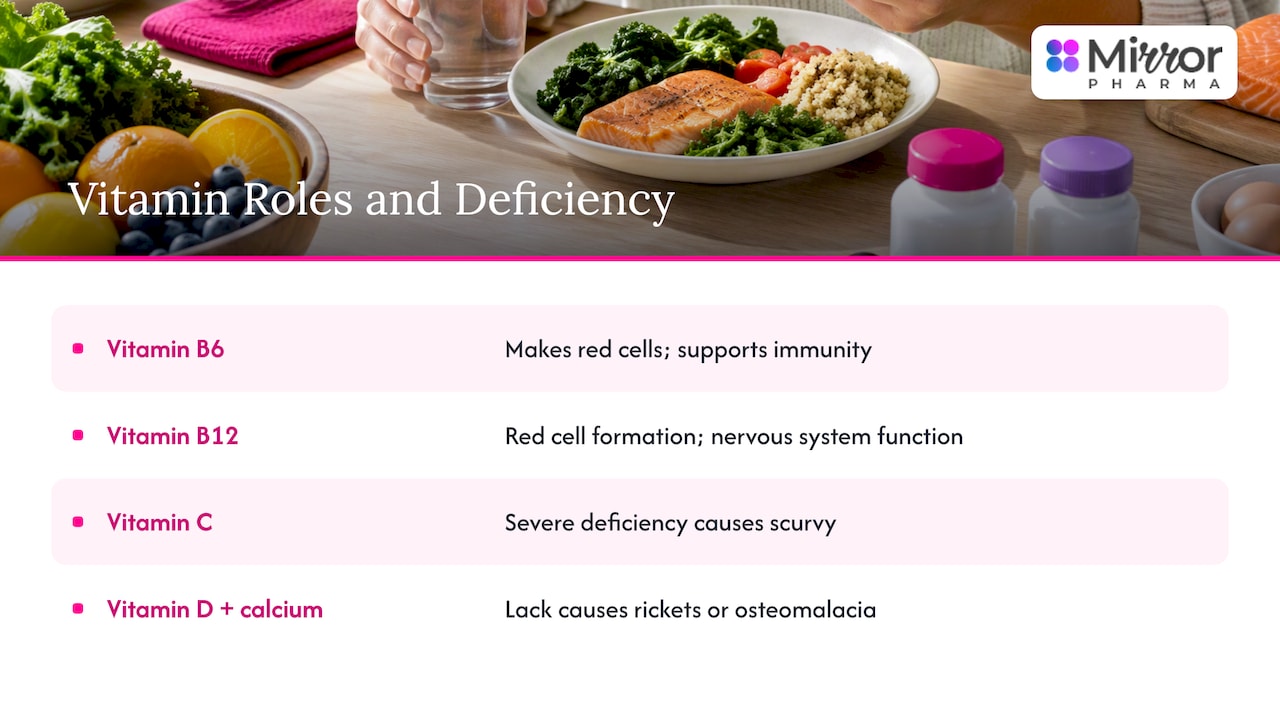
Vitamins are substances that the body needs for normal cell function, growth and development. MedlinePlus describes 13 essential vitamins that the body requires to function properly, each with its own role. Because the body cannot make most of them in adequate amounts, they must come from food, from sunlight in the case of vitamin D, or from supplementation.
Two examples show how specific the roles are. The British Nutrition Foundation notes that vitamin B6 helps the body make red blood cells and supports the immune system, while vitamin B12 is crucial for red blood cell formation and for nervous system function. A shortfall therefore shows up in different systems depending on which vitamin is low, which is why a vague complaint such as tiredness rarely points to one vitamin on its own.
Severe shortfalls still occur. The same source describes scurvy as a consequence of severe vitamin C deficiency, and rickets in children or osteomalacia in adults as consequences of a lack of vitamin D and calcium. These are uncommon in the UK, but they are a reminder that the conditions are real and that the vitamins in question have measurable clinical effects.
Food first: what a balanced diet provides
The British Nutrition Foundation states that a varied, balanced diet with the right proportions of foods from the main food groups should provide enough vitamins for most people, with the exception of vitamin D. That single sentence frames most of the clinical reasoning that follows.
In practice, this means the starting point for any patient presenting with a suspected vitamin problem is a dietary history, not a product. Useful questions for a licensed practitioner include:
- Does the patient follow a restricted diet (vegan, vegetarian, or highly selective eating)?
- Is there a history of malabsorption, bariatric surgery or long-term gut disease?
- Are there long-term medicines that could lower vitamin levels?
- How much time does the patient spend outdoors, and do they cover most of their skin when they do?
- Are they pregnant, planning a pregnancy or breastfeeding?
NICE makes a related point for B12: deficiency may be medicine-induced or diet-related, and the cause shapes the management. NICE’s adult malnutrition guidance is a useful reference for the assessment step.
When supplementation is justified
The BNF treatment summary on vitamins sets out the principle clearly. Vitamins are used to prevent or treat specific deficiency states, or where the diet is inadequate. It describes the use of vitamins as general pick-me-ups as unproven, and it warns that mega-vitamin therapy can be harmful.
This matters for anyone who offers wellness services. It means your consultation should document why a vitamin is being given: which deficiency, which risk factor, which diet gap. A treatment that cannot be explained in those terms is difficult to defend to a regulator, an insurer or the patient.
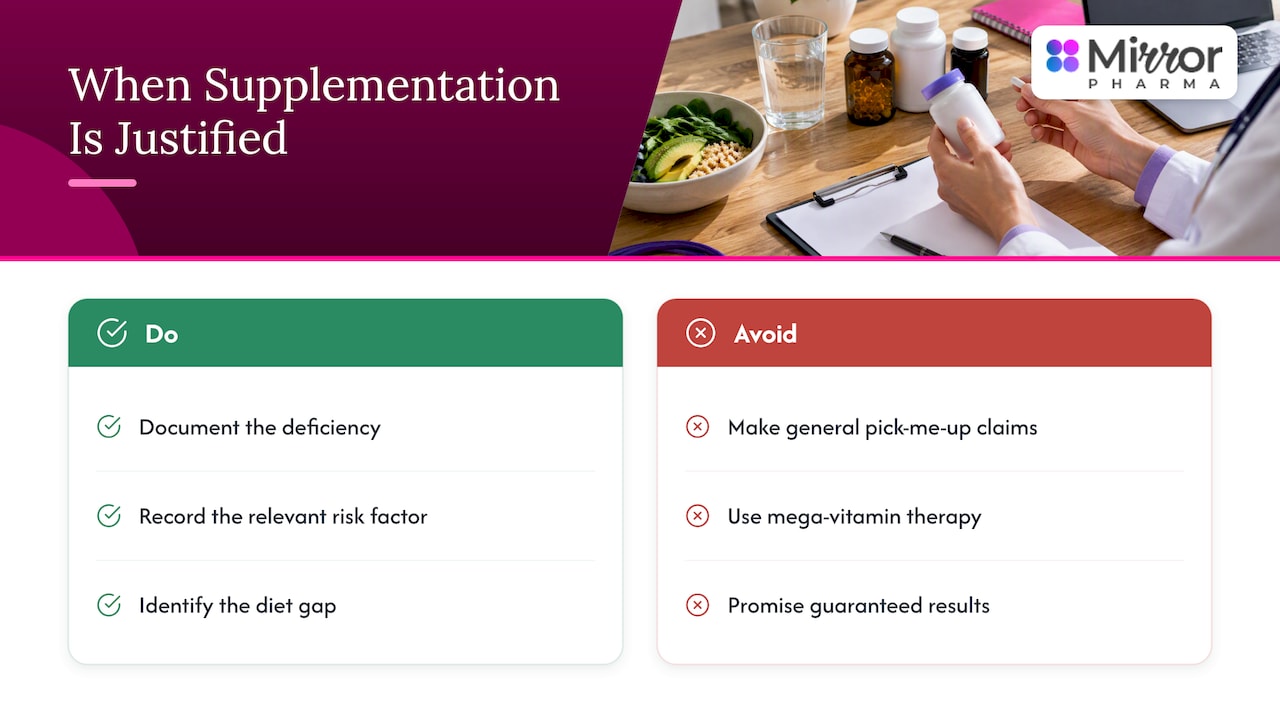
It also means that wellness language needs care. Phrases that imply a vitamin will boost energy, restore youth or guarantee a result go beyond what the evidence supports. We avoid them, and we suggest you do too, in consent forms, social media and clinic websites.
Assessing deficiency: vitamin D and B12
Two vitamins dominate UK practice for assessment: vitamin D and B12. Both have official guidance that is worth reading in full.
Vitamin D
Clinical vitamin D deficiency in adults can lead to bone discomfort, muscle weakness and osteomalacia. Guidance from Mersey Care and NHS partners discourages routine testing and advises testing only when specific symptoms are present. The Scottish guideline on vitamin D prevention and treatment of deficiency agrees that routine measurement is not required for the general population. It lists situations where testing is indicated, such as suspected osteomalacia, malabsorption or severe kidney disease.
The practical consequence: a patient who asks for a vitamin D blood test “just to check” does not automatically need one. A patient with bone pain, muscle weakness or a malabsorption history may.
Vitamin B12
NICE’s guideline on B12 deficiency in over 16s advises initial testing using total B12 or active B12. It cautions that supplements may affect test results, and it advises asking about over-the-counter B12 preparations, because these can raise B12 concentrations without fully treating a deficiency. In other words, take a supplement history before you interpret the number.
Where diet is the suspected cause, the same NICE guidance advises discussing dietary intake and choosing a supplement containing cyanocobalamin, methylcobalamin or adenosylcobalamin.
Vitamin D and the UK seasonal advice
Vitamin D is the one vitamin where population-level advice goes beyond “eat a balanced diet”. The NHS advises that everyone should consider taking 10 micrograms (400 IU) daily in autumn and winter, from October to early March, when sunlight is not strong enough for the body to make it. Certain higher-risk groups are advised to take or consider it all year round, and the NHS page lists them.
There is also a public scheme worth knowing about when you advise eligible patients. GOV.UK migrant health guidance notes that eligible pregnant women, women with a child under 1, and children up to 4 can get free Healthy Start vitamins, and that the women’s tablets contain vitamin D and folic acid.
This is a recurring seasonal pattern, so it is a natural moment in the year to review how your clinic talks about vitamin D, and to check that your patient information matches the current NHS page.
Supplements and medicines are not the same thing
If you recommend or stock anything described as a food supplement, the regulatory line matters. The GOV.UK food supplements guidance says supplements are not a substitute for a balanced diet and should not be marketed with claims of treating or preventing medical conditions, because that is the function of medicines. The Food Standards Agency distinction is consistent: supplements are food, medicines are medicines.
The same guidance gives safety points that are worth repeating to patients:
- follow the label and do not exceed the recommended dose, since high intakes can cause side effects such as nausea or headaches;
- speak to a GP or healthcare professional before use if pregnant, breastfeeding, unwell or taking prescribed medication;
- tell your doctor about any supplements you take.
For a practitioner, the third point works in reverse as well. Ask every patient what they already take, including over-the-counter products, before adding anything.
Injectable vitamins in clinical practice
Some vitamins are given by intramuscular or intravenous routes by suitably qualified prescribers, usually where oral routes are inappropriate, such as in some malabsorption states, or where a prescriber has decided a parenteral product is indicated. These products are prescription medicines, so the standards that apply are those of medicines, not wellness retail.
That has several practical implications for a clinic:
- A prescriber must be involved. Prescription-only products need a valid prescription from a prescriber who has assessed the patient.
- The indication must be documented. The BNF position on deficiency and inadequate diet is the benchmark.
- Preparation must follow a written protocol. Mixing and infusion errors are avoidable with a structured process. Our MHRA-aligned protocol for mixing IV vitamins sets out the steps, and our guide to infusion line types explains how line choice affects rate accuracy.
- Safety conditions should be checked before each session. Our clinician checklist for safe IV vitamin therapy and the wider IV vitamin therapy safety toolkit cover this in detail.
None of this is a promise of outcome. The aim is a documented, defensible, safe process for patients who have a clinical reason to receive the treatment.
Our perspective
We supply healthcare professionals, so we see the same pattern repeatedly. Clinics that do vitamin work well tend to have three things in common: a clear clinical reason for each treatment, a written protocol that every team member follows, and a supplier whose paperwork they can verify.
We would argue the third is underrated. A product can be excellent and still be a problem if you cannot show where it came from. That is why we require practitioner and prescriber verification before an account can order, and why our orders are fulfilled by a team of healthcare professionals who understand what the products are. We also run extended order cut-off times, because we know a clinic that has booked a patient needs stock when it expects it.
On the clinical side, we agree with the BNF line and we think the industry should say so more often. Vitamins have a real place in treating deficiency and in cases where diet is inadequate. They are not a shortcut, and we would rather help you build a defensible service than a fashionable one.
— Rizwan
What to check when sourcing vitamin products
Whether you buy oral, intramuscular or intravenous products, the same checklist applies. These are the questions we would ask any supplier, including ourselves.
| Check | Why it matters |
|---|---|
| Is the product a licensed medicine, an unlicensed special or a food supplement? | Each category has different rules on supply, prescribing and claims. |
| Does the supplier verify that you are a registered practitioner or prescriber? | Prescription-only medicines should only reach people entitled to use them. |
| Can the supplier produce its authorisations and batch documentation? | You need an audit trail if there is ever a patient safety query. |
| Are storage and delivery conditions clear? | Temperature and handling affect product integrity. |
| Is there a named contact with clinical knowledge? | Questions about presentation and compatibility need an informed answer. |
We have set out the paperwork in more detail in our guide to the documents UK clinics should obtain from a medicine supplier.
Our vitamin range for practitioners
If you are a registered practitioner or prescriber and you are building or restocking a vitamin service, our IM/IV vitamins category brings together the injectable vitamin products we supply, and our vitamins category covers the wider range. Our IM/IV consumables section lists the supporting items you need to administer them. Access requires practitioner or prescriber verification, and all products are for use by trained, qualified professionals.
Common mistakes we see in vitamin services
A few patterns recur and are easy to correct.
- Treating without testing where testing is indicated. If a patient has symptoms that fit a vitamin D or B12 problem, guidance supports testing. Treating blind can mask the picture.
- Testing when it is not indicated. For vitamin D, routine measurement in the general population is discouraged, so a request alone is not a reason.
- Ignoring the supplement history. NICE specifically warns that over-the-counter B12 can raise levels without fully treating deficiency.
- Marketing language that overreaches. Claims that a vitamin treats or prevents disease belong to medicines, not to supplements, and any claim should be one you can support.
- No protocol for preparation. Mixing and rate errors are process failures, and a written protocol is the fix.
FAQ
Are vitamins healthy or unhealthy?
Vitamins are essential, and a balanced diet should provide enough of most of them. The BNF position is that supplements are for preventing or treating recognised deficiency or where diet is inadequate, and that mega-dose use can be harmful. The answer depends on dose, indication and the individual patient, so it is a matter for a qualified clinician.
Does everyone in the UK need vitamin D?
The NHS advises that everyone should consider 10 micrograms daily from October to early March, when sunlight is insufficient. Some higher-risk groups are advised to take it all year. Individual advice, particularly for pregnancy, children or patients on other medicines, should come from a GP or other healthcare professional.
Should patients be tested routinely for vitamin deficiency?
Not as a rule. Guidance on vitamin D discourages routine testing in the general population and supports it where there are specific clinical reasons, such as suspected osteomalacia or malabsorption. For B12, NICE advises testing with total or active B12 and interpreting results with care if the patient has taken supplements.
Can vitamin supplements be marketed as treating a condition?
No. UK guidance states that food supplements should not be presented as treating or preventing medical conditions, because that is the function of medicines. Practitioners should keep clinic marketing within that boundary.
Who can order injectable vitamins from Mirror Pharma?
We supply registered healthcare professionals, prescribers and aesthetic clinics, and we verify practitioner access before orders are accepted. We do not supply members of the public.
Sources
- Vitamins: MedlinePlus Medical Encyclopedia
- Vitamins and Minerals: British Nutrition Foundation
- Adult malnutrition assessment: NICE CKS
- Vitamins: BNF treatment summary
- Treatment of vitamin D deficiency in adults
- Vitamin D: prevention and treatment of deficiency (NHS Scotland)
- Vitamin B12 deficiency in over 16s: NICE guideline NG239
- Vitamin D: NHS
- Vitamin D deficiency: migrant health guide, GOV.UK
- Food supplements guidance: GOV.UK