

The three categories answer different questions. Skin boosters work on skin quality: hydration, texture and elasticity. Dermal fillers work on structure: volume, support and contour. Biostimulators work on the tissue itself, prompting the patient’s own collagen production over weeks. This guide is for licensed practitioners and qualified aesthetic professionals who need a clear framework for choosing between them, explaining the choice at consultation and combining them safely.
TL;DR
- Skin boosters deliver hydration across a wide area to improve skin quality. They are not designed to add volume or reshape the face.
- Dermal fillers (mostly cross-linked hyaluronic acid) restore volume and shape specific areas, and the effect is visible quickly.
- Biostimulators such as PLLA and CaHA products prompt the skin to build its own collagen, so change is gradual and suits laxity and reduced support.
- The three can be phased in one treatment plan. The order depends on the patient’s anatomy, and more treatments are not automatically better.
- Every injectable carries risk, so assessment, consent, anatomical knowledge and a complication plan matter more than the product category. Supply is for verified prescribers and practitioners only.
Table of Contents
- The short version: three different jobs
- Skin boosters: improving the quality of the skin
- Dermal fillers: restoring volume and shape
- Biostimulators: prompting the skin to rebuild
- Choosing between them: a consultation framework
- Combining and phasing treatments
- Risks and responsibilities for each category
- Our perspective
- Sourcing for your clinic
- FAQ
- Sources
The short version: three different jobs
Much confusion comes from the fact that all three categories are injected and all three can leave skin looking fresher. The mechanism is what separates them.
| Skin boosters | Dermal fillers | Biostimulators | |
|---|---|---|---|
| Main aim | Hydration, elasticity, skin quality | Volume, support, contour | Stimulating new collagen |
| Typical concerns | Dull, dehydrated, crepey skin, fine lines, texture | Lost volume, defined lips, folds, shape | Laxity, deeper volume loss, reduced dermal support |
| Placement | Spread over larger areas, superficially | Specific, targeted areas | Planned for the tissue layer and the product |
| Speed of change | Gradual, over weeks | Usually visible quickly | Gradual, over weeks to months |
| Typical technique | Multiple small deposits or microdroplets | Bolus, linear threading or deep placement, by product | Per the manufacturer’s instructions and training |
A useful summary is that fillers fill specific areas and shape contours, skin boosters are spread over larger areas to improve hydration and elasticity, and biostimulators activate the skin’s own collagen production. The rest of this guide expands on each, then on how to choose and combine them.
Skin boosters: improving the quality of the skin
Skin boosters are injectable products, most often non-cross-linked or lightly cross-linked hyaluronic acid, placed in the skin rather than beneath it. The aim is to hydrate and improve elasticity across a whole area such as the cheeks, neck, décolletage or hands. They do not provide lift, projection or structural support.
Patients usually describe the goal in terms of skin: dullness, fine lines, roughness, enlarged pores or crepey texture. Those descriptions map well to skin boosters. If the same patient describes hollowing or a changed facial shape, the concern is structural and a booster alone will not address it.
What the clinical literature supports
The Journal of Aesthetic Nursing advises that skin boosters should be chosen for a rational clinical indication, with the product and injection method matched to it. The same article reports improved hydration after treatment and notes that practitioners may use boosters early, between corrective treatments or for maintenance, depending on the patient’s needs.
The practical consequence is that “skin booster” is not one product. Rheology, concentration and technique vary, and the right choice depends on the site and the concern. Training on the specific product matters as much as the category.
Polynucleotides: a related skin-quality option
Polynucleotides sit close to skin boosters in practice. They are used for biostimulation and hydration with minimal volume. The Aesthetic Journal’s 2026 evidence review concluded that the evidence most consistently supports gains in hydration, elasticity and periorbital skin quality, not major correction of deep wrinkles or significant laxity. That matters when you set patient expectations. Under the eyes, for example, polynucleotides suit crepey, dehydrated skin rather than structural hollowing.
Licensed practitioners can view the skin booster range and the polynucleotides range after verification. For a head-to-head view of boosters and fillers, see our clinical guide to skin boosters and fillers.
Dermal fillers: restoring volume and shape
Dermal fillers are designed to add volume, support tissue and define contours. Most in current use are based on stabilised, cross-linked hyaluronic acid, which is why they can be shaped, are visible soon after treatment and, in many cases, can be dissolved if needed. Typical indications include lips, folds, cheeks, chin and jawline.
How long do fillers last?
Duration depends on the product, the site, the volume used and the individual. Government review material describes temporary biodegradable fillers made from collagen or hyaluronic acid as lasting roughly 3 to 9 months, while manufacturer information describes wider ranges for modern cross-linked products. Treat any single figure as a range, and never promise a patient a fixed duration. Imaging work suggests hyaluronic acid can persist in tissue longer than many patients assume; our article on MRI findings on HA persistence covers what that means for clinicians.
Why the safety framework matters most here
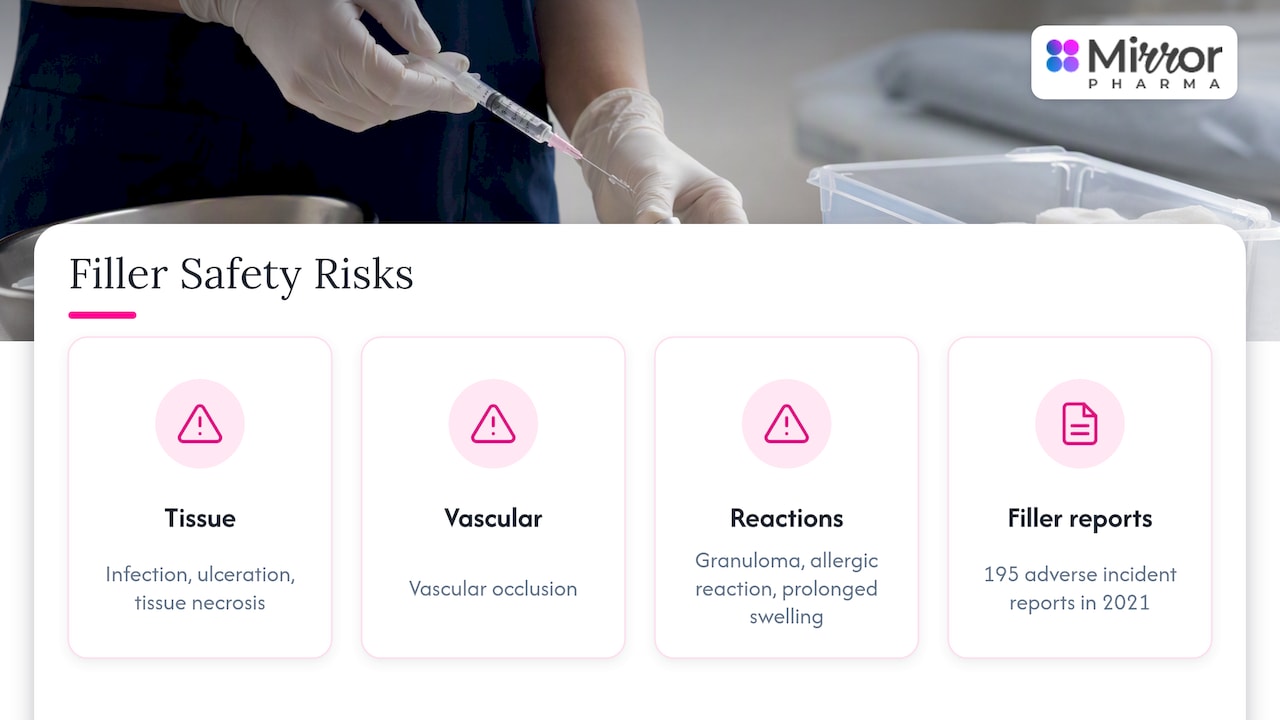
Fillers are structural injections, and the complications are the most serious of the three categories. The government’s review of cosmetic interventions records infection, granuloma, ulceration, vascular occlusion, tissue necrosis, allergic reaction, prolonged swelling and, rarely, blindness, with risk highest around the eyes. The MHRA reported 195 adverse incident reports involving dermal fillers in 2021, including infection, allergic reactions, embolism and vascular problems.
Delayed problems also happen. Moorfields Private notes that chronic swelling, immune reactions and granulomas can appear weeks or months after treatment. Our guide to spotting dermal filler complications and our hyaluronic acid filler safety guide set out what to look for and what to have in place before you inject.
Biostimulators: prompting the skin to rebuild
Biostimulators are not space-fillers in the ordinary sense. Substances such as poly-L-lactic acid (PLLA) and calcium hydroxylapatite (CaHA) act by stimulating the patient’s own tissue to produce collagen, aiming at longer-term rejuvenation rather than simple filling. Some CaHA products give a degree of immediate definition, followed by collagen and elastin stimulation. PLLA products tend to work more gradually, over a course of treatments.
When they are the better fit
Save Face, the UK register of accredited practitioners, explains that collagen-stimulating products are used when the concern is deeper volume loss, reduced support or laxity. A patient whose main complaint is lax skin over the cheeks or jawline is a more natural candidate than one whose main complaint is a single deep fold.
Do biostimulators really work?
A 2025 systematic review in Aesthetic Surgery Journal found that biostimulants show clinical promise and favourable tolerability, with studies outside the meta-analysis reporting improvements in dermal, volume, anatomic and satisfaction outcomes. That is encouraging but not a guarantee for any individual patient. Response varies, results develop over weeks, and the product, dilution, depth and technique all affect the outcome. Present them as a considered, gradual option, not a quick correction.
Practitioners can browse our PLLA products and collagen production range once verified.
Choosing between them: a consultation framework
Start from the anatomical layer and the patient’s own words, not the product.
- Skin is the complaint (dehydrated, dull, fine lines, texture): consider a skin booster or polynucleotide.
- Volume or shape is the complaint (hollowing, definition, projection): consider a hyaluronic acid dermal filler placed to the planned anatomy.
- Laxity or thinning support is the complaint: consider a biostimulator, with clear counselling that change is gradual.
- More than one layer is involved: plan in stages rather than all at once.
The Journal of Aesthetic Nursing’s 2026 review of treatment stacking makes the case for this. It argues that ageing affects skin, fat, muscle and bone, so one modality may not address every concern. It recommends patient-led consultation, evidence-based planning and staged treatment rather than assuming more is better.
Questions to ask at every consultation
- What exactly does the patient want to change, and in which layer is it happening?
- Is the expectation realistic for a gradual or a temporary effect?
- Is there any history of allergy, autoimmune disease, infection or previous filler reactions?
- Have you explained that effects vary and that duration cannot be promised?
- Is the patient’s consent informed and documented? The government’s call for evidence is clear that valid consent must be obtained and patients need appropriate information.
Combining and phasing treatments
Combination plans are common, and the logic is simple: each category does a different job. A typical staged approach might correct structure with a hyaluronic acid filler, then improve skin quality with a booster once swelling has settled, or use a biostimulator first to improve tissue support before refining detail. The Journal of Aesthetic Nursing notes boosters can be used early, between corrective treatments or as maintenance.
There is no single correct order. Sequencing depends on the patient’s anatomy, the products’ properties and the manufacturers’ guidance, and you should not stack products in the same plane without a clear reason. Leave enough time between sessions to assess the result and any delayed reaction before adding more.
Risks and responsibilities for each category
No category is risk-free. Common risks of non-surgical injectables in the UK include pain, bruising and infection, with rare but serious complications such as vascular occlusion, blindness and tissue necrosis. The same Health Education England publication cites a survey of 309 British Association of Dermatologists members in which 60% had reviewed at least one patient with complications after a non-surgical cosmetic procedure.
Local-authority guidance for aesthetic premises advises risk assessment, trained clinical delivery, infection-prevention measures and plans for complications. Translated into practice for licensed practitioners:
- Complete an assessment and document consent before every treatment.
- Know the vascular anatomy of the site, and have a complication protocol and the relevant emergency products to hand where the treatment requires them.
- Use products sourced from a verified supply chain with traceable batches.
- Give patients clear aftercare and a route to contact you.
- Review at follow-up, and remember that delayed reactions can appear weeks or months later.
Supplier choice is part of patient safety. Our checklist on what to look for in an aesthetics injectable supplier covers four compliance checks for UK clinicians.
Our perspective
We supply the products, not the treatment decision, and we think that division is worth respecting. In our experience the most useful question for a practitioner is not which category is best. It is which layer of the problem you are treating, and whether the category you pick matches it.

We see skin boosters, fillers and biostimulators as complementary tools. Treating a skin-quality complaint with a volume product, or a structural complaint with a hydrating one, tends to disappoint everyone, however good the technique. Equally, we would encourage restraint: a staged plan with a review between steps is usually kinder to the patient and to your reputation than a single large session.
That is also why we verify every practitioner and prescriber before supplying prescription aesthetic products, and why our orders are handled by a team of healthcare professionals. These products are for trained, qualified professionals, and the supply chain should reflect that.
— Rizwan
Sourcing for your clinic
If you are a verified practitioner or prescriber building a treatment menu, you can order from our ranges online. Browse dermal fillers, skin boosters and polynucleotides, with extended order cut-off times to help you keep client appointments on schedule. Access to prescription products requires verification, and all products are for use by trained practitioners only.
FAQ
What is the difference between biostimulators and skin boosters?
Skin boosters hydrate and improve skin quality, usually with hyaluronic acid spread across an area. Biostimulators, such as PLLA or CaHA products, prompt the skin to produce its own collagen, which suits laxity and reduced support. Boosters tend to be chosen for texture and hydration, biostimulators for firmness and structure.
Are biostimulators better than fillers?
Neither is better in general; they solve different problems. Fillers give shaped, relatively quick volume, while biostimulators work gradually on tissue quality and support. A practitioner should choose on the patient’s anatomy and goals, and sometimes the plan uses both in stages.
Are skin boosters better than fillers?
Only for the right concern. Boosters improve hydration and skin texture but do not add meaningful volume or contour. If the patient’s complaint is hollowing or loss of shape, a filler is the more appropriate category.
Do biostimulators really work?
A 2025 systematic review found clinical promise and favourable tolerability for biostimulants. Results still vary between patients and depend on product, technique and realistic planning, so no outcome can be guaranteed. Counsel patients that change develops over weeks to months.
Sources
- Biostimulants in Aesthetic Medicine: A Systematic Review (Aesthetic Surgery Journal, 2025)
- Fillers, skinboosters and collagen biostimulators: what’s the difference
- Journal of Aesthetic Nursing: a holistic approach to injectable skinboosters
- Journal of Aesthetic Nursing: treatment stacking in aesthetics
- The Aesthetic Journal: polynucleotides and the evidence
- Save Face: which regenerative injectable is right for you
- Review of the Regulation of Cosmetic Interventions, call for evidence (GOV.UK, 2012)
- Review of the Regulation of Cosmetic Interventions (GOV.UK, 2013)
- MHRA Freedom of Information response FOI 22/839
- Health Education England: cosmetic interventions, part two
- Moorfields Private: the 5 key risks of under-eye filler injections
- Telford & Wrekin Council: aesthetic procedures