

Most sequencing mistakes in aesthetics are made before the needle is picked up. They happen when a patient’s history is not fully taken, when a second treatment is booked before the first has been assessed, or when the medicines journey, from ordering to monitoring, has no fixed order. This guide is for licensed practitioners and qualified aesthetic professionals. It sets out the errors that recur, why they matter, and how to build a sequence you can defend in your notes.
It is educational and written for prescribers and clinic teams. It is not guidance for patients, and it names no prescription-only products.
TL;DR
- Screen first. Recent illness and a full history of past treatments, including any legacy filler, come before any plan.
- Do not layer new product over non-degradable or minimally degradable filler without knowing exactly what is there.
- Leave a buffer after filler. Review for at least 72 hours is the standard in the 10-point plan for filler safety, so do not stack a peel or energy-based device on top of it.
- Sequence for the anatomical layer that needs treating, not for a pre-packaged menu or for revenue.
- Safe sequencing starts at procurement and storage. Standardise how you order, label and store before the patient arrives.
Table of Contents
- What a sequencing mistake actually is
- Clinical sequencing errors
- Planning errors: stacking, menus and over-treatment
- A staged sequence you can adapt
- Operational errors that start before the patient arrives
- Our perspective
- Supplying your sequence reliably
- Building the habit into your clinic
- FAQ
- Sources
What a sequencing mistake actually is
Sequencing means the order, timing and spacing of everything you do for a patient: consultation, consent, ordering and preparing medicines, the treatment itself, review, and any next step. A sequencing mistake is a correct treatment done at the wrong moment, in the wrong order, or without the checks that should have come before it.
This matters because errors are not confined to the injection. The NHS Specialist Pharmacy Service describes how medication errors can occur at any stage of the medicine journey: ordering, prescribing, dispensing, administration and monitoring. Aesthetic practice has the same stages, often with fewer people to catch a slip. If one person orders, prepares, injects and reviews, the sequence is the safety net.
The mistakes below fall into three groups: clinical (patient and procedure), planning (how treatments are combined and spaced) and operational (how medicines and consent are handled).
Clinical sequencing errors
Treating without screening for recent illness
The 10-point plan describes sequencing problems as often coming from failing to account for causative factors in the patient, the product and the procedure. One of the clearest examples is proceeding when the patient has had a recent medical issue, such as a cold, flu or COVID-19 infection, which the authors flag as a reason to pause.
Make the screen part of every appointment, not only the first one. Ask on the day, record the answer, and be prepared to rebook. A rescheduled appointment is an inconvenience. A complication in a patient whose immune system was already stretched is a much larger problem.
Layering over legacy filler
Practitioners often underestimate what is already in the tissue. The 10-point plan notes that new treatment placed over non-degradable or minimally degradable filler can provoke the earlier product into a reactive state, with delayed-onset nodules or granulomas that are harder to manage than a primary complication.
The fix is a sequence rule, not a technique: no treatment plan until you have a documented history of previous aesthetic procedures, including product type and location where the patient knows them. If the history is unclear, say so in the notes and consider whether imaging or a conservative plan is more appropriate. Our own notes on how long hyaluronic acid filler can persist on MRI are a reminder that “it was done years ago” does not mean it has gone.

Moving to a second modality before assessing the first
The third recurring error in the same paper is proceeding to secondary treatments, such as energy-based devices, before assessing how the patient responded to primary injectables. You cannot judge what the next step should be if the baseline is still changing.
A workable rule: the first treatment is assessed at review, the result and any adverse signs are documented, and only then is the next step planned. If a patient wants everything in one visit, the answer for a licensed practitioner is a staged plan with dates, not a compromise on safety.
Ignoring the 72-hour window
Vascular occlusion risk is why the 10-point plan asks clinicians to be available for review for at least 72 hours after a filler procedure. Published reviews of complications make a related planning point: a chemical peel or energy-based device placed straight after a filler session can obscure early warning signs of vascular compromise or put a still-healing injection site at risk.
Build buffer periods into the plan. Tell the patient in advance why the next step is not on the same day. It is much easier to explain when it is in the consent conversation rather than after something has gone wrong.
Planning errors: stacking, menus and over-treatment
Treating combination as a goal in itself
Combination treatment has real value, but the Journal of Aesthetic Nursing is direct about it: more is not always better. Its discussion of treatment stacking argues for patient-led consultation, evidence-based planning and staged interventions rather than pre-packaged menus, and for choosing the anatomical layer that needs attention, whether bone, fat, muscle or skin.
A useful test when you plan a sequence: for each step, can you write one sentence saying which layer it addresses and why it comes at this point? If the honest answer is that it completes a package, remove it.
Sequencing by revenue
The same article is clear that sequencing should serve patient outcomes, not strategy or revenue. In practice this shows up as appointment templates that book three treatments into one slot, or review gaps that are skipped because the diary is full. Audit your own diary. If your standard pathway has no gap between a filler and the next procedure, you have built a sequencing error into the system.
Planning from a textbook, not from the patient
Reviews of toxin and filler complications stress that textbook or recommended injection points do not apply to every individual, and that a comprehensive examination should shape each plan. A sequence copied from a training slide may be right for the average face and wrong for the person in your chair.
Choosing product and technique after the plan, not before
Product, depth and delivery method should follow from the planned layer and area. The order matters because it avoids the opposite error: deciding on a product you have in stock and then fitting the patient to it. For practitioners comparing options, our article on matching fillers to treatment areas and the occlusion data on cannulas covers the choice in more detail.
A staged sequence you can adapt
This is a framework, not a protocol, and it does not replace your own training, indemnity requirements or the clinical judgement of the prescriber.
- Consultation and history. Full medical history, recent illness, previous aesthetic treatments including legacy filler, medicines and expectations. No treatment is performed at the first contact if you are not satisfied with the history.
- Consent and cooling off. The JCCP and CPSA code of practice requires that you give the patient time and information to reach a voluntary, informed decision. Consent is written and covers rare serious outcomes, including necrosis and visual impairment, and the plan for reversal agents.
- Plan by layer. Write the sequence with intervals, naming what each step addresses and what you will assess before moving on.
- Procurement and preparation check. Confirm the right product, strength, batch and expiry, and that your complication kit is complete before the appointment.
- Treatment. Standard operating procedures from the JCCP stress written consent, standardised photographs, appropriate needle or cannula selection, slow injection with continuous assessment, and documented sites and volumes.
- Aftercare and review. Make sure the patient knows how to reach you and that a face-to-face review is available inside the monitoring window.
- Reassess before the next step. Only then release the next stage. If anything has changed, revise the plan, not just the date.
Operational errors that start before the patient arrives
Treating medicines safety as an administration-time issue
A common belief is that safety lives at the bedside. The medicine journey guidance from the NHS Specialist Pharmacy Service shows otherwise, and the “10 Rs” literature extends from procurement and storage to final monitoring. Look-alike, sound-alike products are a classic hazard: two vials with similar names or packaging, stored next to each other.
Practical sequencing steps for a clinic:
- Store similar-looking products apart and label shelves clearly.
- Check name, strength, batch and expiry at ordering, at receipt and at preparation, not only once.
- Standardise reconstitution and dilution steps so they are done the same way by everyone.
- Keep a record linking product batch to patient.
Relying on one safeguard
The Healthcare Safety Investigation Branch report on electronic prescribing reviews evidence that such systems are associated with a reduction in medication errors of more than 50% when they are integrated with clinical workflows. The same report is a reminder that medicines reconciliation, comparing an accurate list of a person’s current medicines with what is in use, still needs a defined process. Software supports the sequence. It does not replace it.
If you prescribe unlicensed or off-label medicines, build the regulatory check into the sequence as well, ideally before ordering. Our guide to two MHRA checks for prescribers using unlicensed medicines sets out where this belongs.
Having no complication protocol before you start
The authors of the 10-point plan treat complication management as a proactive duty: an emergency kit in line with ACE guidance, fast-track referral routes to local experts, and a written, audited protocol for each adverse event. The sequencing consequence is simple. The protocol comes before the first patient of the day, not after the first problem.
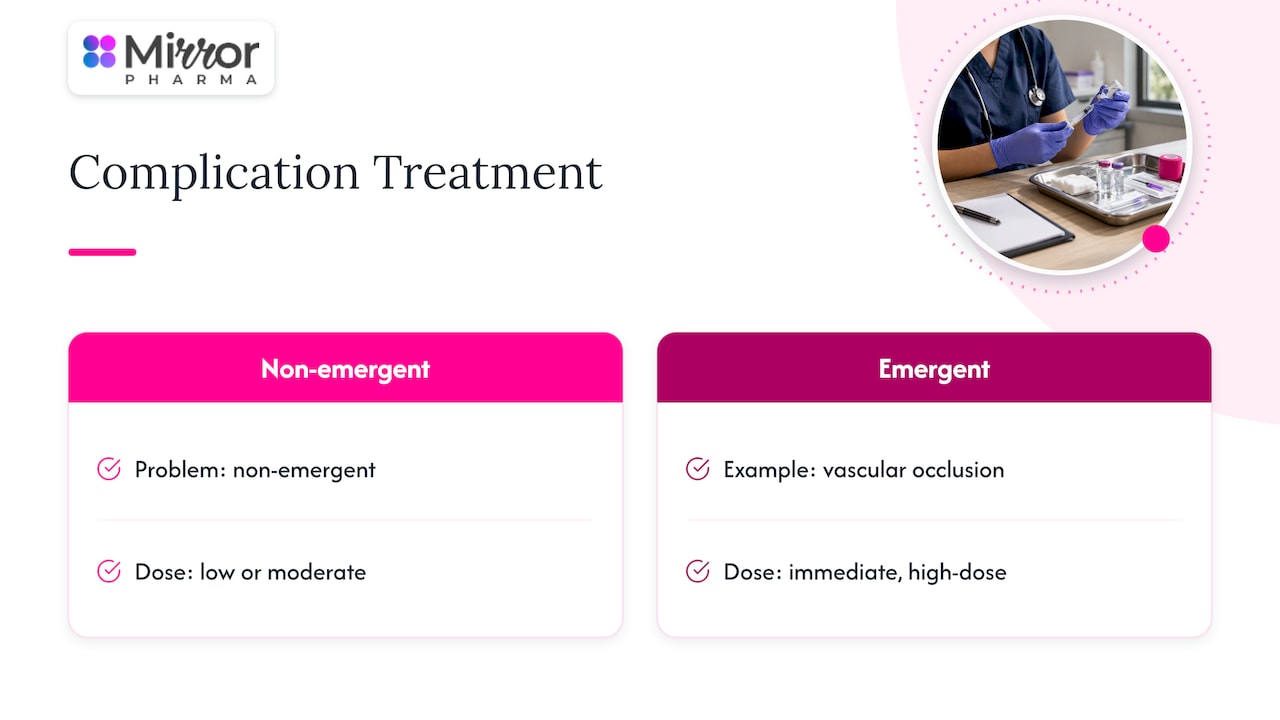
For hyaluronic acid filler, that means having hyaluronidase available and knowing the dosing approach. A 2024 review in JMIR Dermatology distinguishes between non-emergent problems, which can be treated with low or moderate doses, and emergent ones such as vascular occlusion, which need immediate, high-dose treatment. Read it with your own training and local protocols.
Diagnosing by phone or photograph
The Journal of Aesthetic Nursing’s practice standard for managing filler complications says that a suspected adverse reaction such as vascular occlusion needs a face-to-face review, and that you should not rely on self-reported assessments by telephone or selfie. Delays in time-sensitive events such as tissue necrosis can be catastrophic. If you are away, the sequence must include a named colleague the patient can be referred to.
Assuming the patient understood the risks
Consent is also a sequencing issue: it must come before the plan is fixed, not as a form signed on arrival. The JCCP and CPSA code expects practitioners to communicate all risks clearly, including rare serious outcomes, and to document consent in writing. Use simple, consistent and balanced language, and never assume understanding. If a patient hesitates, the right sequence is to pause.
Our perspective
We supply prescription aesthetic medicines, consumables and related products to verified practitioners and prescribers, and our fulfilment is carried out by a team of healthcare professionals. From that vantage point, the pattern is consistent: the clinics that run into trouble are rarely short of skill. They are short of a fixed order of operations.
We would put three things at the top of a clinic’s list. First, treat ordering as the first step of the clinical sequence. Know what you need, check what arrives, and store it so that similar products cannot be confused. Second, plan the schedule around review, not around the diary. Third, write the “what if” before the “what next”. If you cannot describe your response to an occlusion or infection in a few lines, the plan is not ready.
This is also why we run verification for practitioner and prescriber access, and why we publish clinical guidance such as our safety guide to hyaluronic acid fillers and our overview of dermal filler complications clinics should spot. None of it replaces your training or your clinical judgement, and we would not want it to.
— Rizwan
Supplying your sequence reliably
A sequence only works if the right product is on the shelf on the day. For licensed practitioners and verified clinics, we offer dermal fillers, toxins, skin boosters, polynucleotides and the needles and consumables that go with them, through a straightforward online ordering process with extended order cut-off times. Access is for qualified prescribers and practitioners, and verification is required.
Building the habit into your clinic
Good sequencing is easier to maintain as a team habit than as individual vigilance. A few small changes make the difference:
- Put the sequence on paper. A one-page treatment-plan template with a column for layer, interval and review date makes stacking visible.
- Audit a sample each quarter. Pull ten records and check that history, consent, batch and review are all present, in order.
- Rehearse the complication. Run a short drill for occlusion and infection: who does what, where the kit is, who is the referral contact.
- Make “no” easy. Agree as a clinic that rescheduling for recent illness or an unclear history is normal and supported.
If your clinic also offers infusion therapies, the same logic applies to preparation. Our 8-step protocol for mixing IV vitamins and IV vitamin therapy safety checklist apply sequence thinking to a different part of the practice.
FAQ
How long should I wait between a filler and an energy-based device?
There is no single interval that fits every patient, product and device, so follow your training, the manufacturer’s instructions and your own protocol. What the literature does support is leaving enough time to complete monitoring after the filler, at least the 72-hour review window for vascular occlusion, and not obscuring early signs with another procedure. Document your reasoning in the plan.
Is it wrong to offer combination treatments?
No. Combination treatment can offer real benefits for the right patient. The problem is stacking without a reason tied to the anatomical layer being treated, or doing so to fit a package or a diary. Staged, patient-led plans with a review between steps are the safer approach.
What should I do if I cannot establish a patient’s filler history?
Record that the history is incomplete, avoid assuming the area is untreated, and consider a conservative plan or further assessment before layering anything new. Previous non-degradable or minimally degradable product is a known risk for delayed reactions, so uncertainty is a reason to slow down.
Can I assess a suspected complication by video call or photograph?
Not as a substitute for examination. Professional guidance says a suspected adverse reaction such as vascular occlusion needs a face-to-face review, because delays can be serious. Have a written protocol, access to hyaluronidase and a named colleague for referral if you are unavailable.
Where does ordering and storage fit into sequencing?
At the start. Medicines errors can occur at ordering, prescribing, dispensing, administration and monitoring, so checks on product, strength, batch and storage belong before the patient arrives. Separating look-alike, sound-alike products is a simple, practical step.
Sources
- The 10-Point Plan 2021: Updated Concepts for Improved Procedural Safety During Facial Filler Treatments
- Complications of toxins and fillers in facial aesthetics
- Treatment stacking in aesthetics: improved patient outcomes or practice strategy?
- Practice standard for the management of dermal filler complications
- Preventing errors on the medicine journey, NHS Specialist Pharmacy Service
- Electronic prescribing and medicines administration systems and safe discharge, HSSIB
- JCCP and CPSA Guidance for Practitioners Who Provide Cosmetic Interventions
- Hyaluronidase for Dermal Filler Complications, JMIR Dermatology