
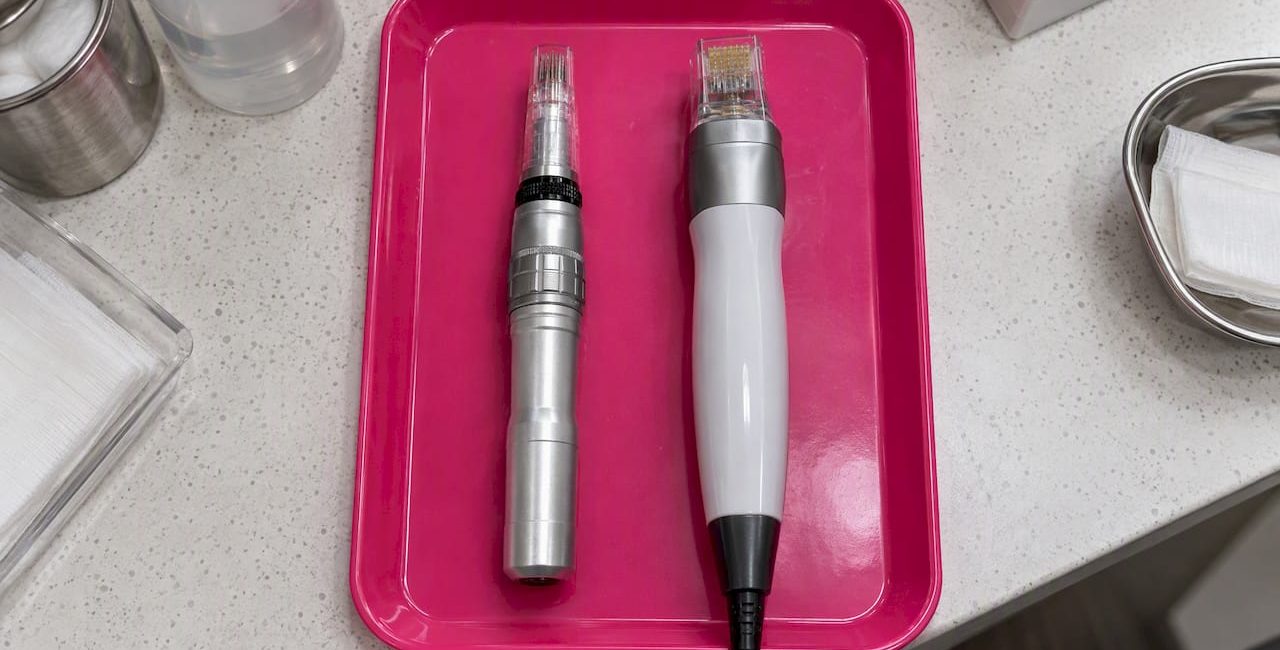
For licensed practitioners, the difference is simple to state and harder to apply. Traditional microneedling creates controlled mechanical micro-injuries. RF microneedling adds radiofrequency energy delivered through the needles, so heat is applied at a chosen dermal depth. The published evidence does not show that RF is better across the board. The better choice depends on the indication, the scar type, the skin phototype, the device settings and your regulatory position in the UK nation where you practise.
This guide is written for qualified aesthetic professionals, prescribers and clinic managers. It covers the mechanism, the evidence for scars, acne and laxity, safety and downtime, UK governance and a decision framework you can use in consultation. It is educational and is not clinical advice for individual patients.
TL;DR
- Traditional microneedling is the simpler mechanical option for texture and superficial scar remodelling. RF microneedling is the more complex option, suited to cases where controlled dermal heating is clinically justified, such as laxity, wrinkles or selected scars.
- A 2022 meta-analysis of randomised studies found a significant pooled scar improvement for conventional microneedling but not for fractional RF microneedling, so RF should not be presented as universally superior.
- RF devices and protocols vary widely, and reviews flag inconsistent reporting of settings. Results do not transfer between devices without checking parameters.
- UK requirements differ by nation and are evolving. RF and combined RF-plus-needling were proposed as higher-risk than microneedling alone, so verify your local position before you treat.
- No outcome is guaranteed or permanent. Document the indication, settings, consent and follow-up for every patient.
Table of Contents
- How the two modalities work
- What the evidence says
- Safety, downtime and contraindications
- Questions practitioners often field
- UK governance: the choice is also a regulatory one
- Choosing between them: a decision framework
- Our perspective
- Building a protocol around either approach
- Supplying your clinic
- FAQ
- Sources
How the two modalities work
Traditional microneedling
A device with fine, sterile needles punctures the skin repeatedly to a selected depth. The aim is a controlled wound-healing response that remodels dermal tissue. The NHS-commissioned review of non-surgical cosmetic interventions describes it as repeated puncturing with tiny sterile needles, with devices that may carry up to 200 super fine needles.
The best-supported shared mechanism is wound-healing-driven remodelling, not instant collagen replacement. In one objective acne-scar study of 10 patients, six sessions at two-week intervals over three months produced statistically significant increases in collagen types I, III and VII. Treat that as a plan for a course, not a single definitive session.
RF microneedling
RF microneedling adds a thermal injury at the needle tip depth. A comprehensive review of RF microneedling describes progressive neocollagenesis that may keep improving for up to six months after treatment. That has a practical consequence: early post-treatment photographs can understate the result, and judging a protocol at two weeks is premature.
The British College of Aesthetic Medicine describes RF microneedling as a series of treatments that aims to improve skin appearance by stimulating collagen and promoting skin tightening, with applications including fine lines, large pores, scars and uneven texture.
Side by side
| Factor | Traditional microneedling | RF microneedling |
|---|---|---|
| Injury type | Mechanical micro-channels | Mechanical plus controlled thermal injury |
| Typical clinical use | Texture, superficial scar remodelling, delivery-assisted protocols | Laxity, wrinkles, selected scars, texture where heat is justified |
| Settings to document | Needle depth, passes, endpoint | Needle depth, RF energy, pulse width, temperature and cooling where available, endpoint |
| Course | Planned series | Planned series, with remodelling continuing for months |
| Equipment complexity | Lower | Higher, device-specific training advised |
| UK governance (proposed) | Lower-risk category in England’s consultation | Medium-risk category in England’s consultation |
What the evidence says
Acne scars: do not assume RF wins
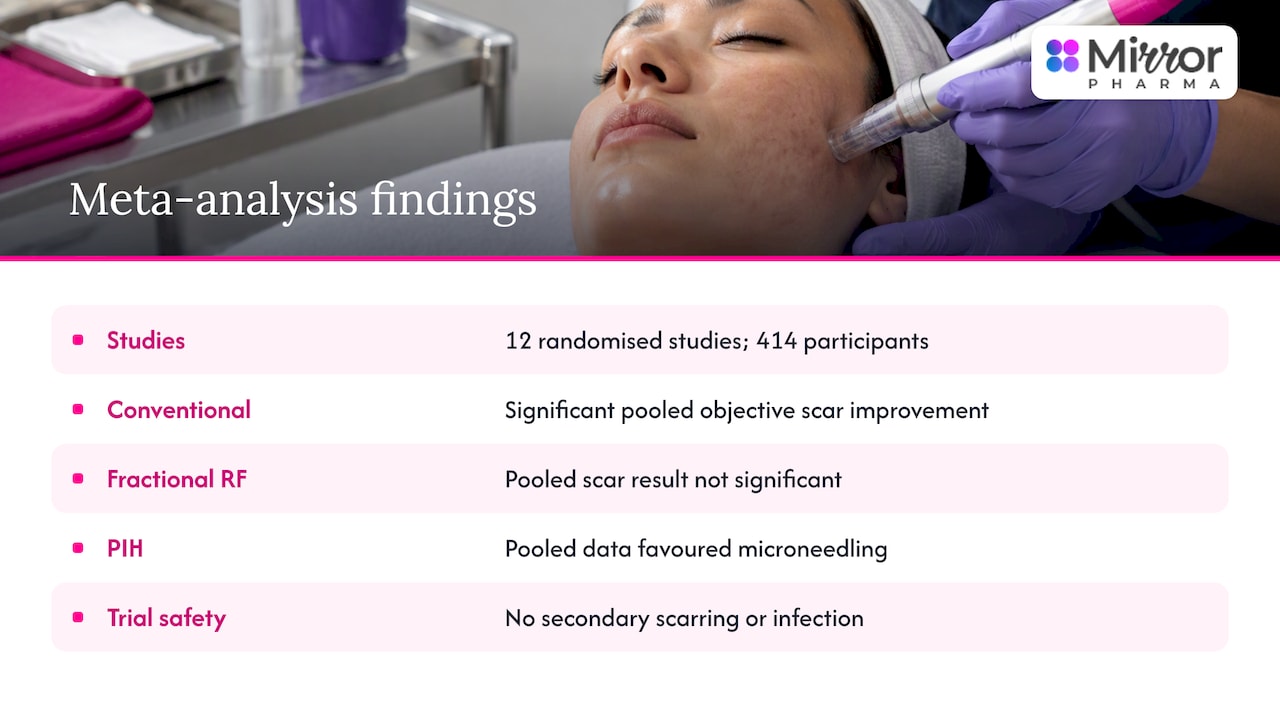
Many of the top-ranking pages for this topic state that RF delivers quicker and more pronounced results. The controlled evidence is more cautious. In the 2022 meta-analysis of 12 randomised studies with 414 participants, conventional microneedling showed a statistically significant pooled objective scar improvement, while fractional RF microneedling did not reach significance in the corresponding analysis. Post-inflammatory hyperpigmentation favoured microneedling in the pooled data, and the included trials reported no secondary scarring or infection.
That does not prove RF is ineffective. It means the claim of superiority is not established for acne scars. Broader reviews, including the clinician update on microneedling for scars, find that both conventional and RF approaches most consistently improve rolling and boxcar scars, while ice-pick scars are more resistant.
Acne and scar figures: read them as study-specific
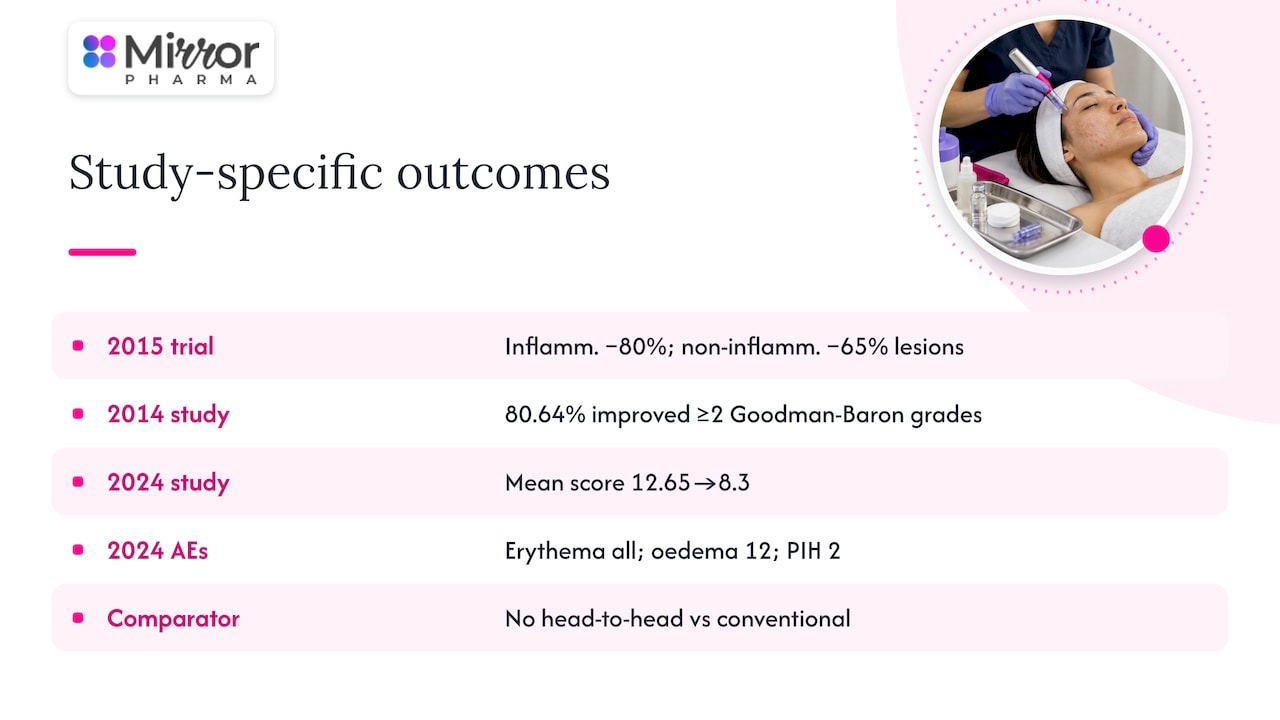
Published RF figures can look striking. A 2015 randomised split-face trial of 20 participants used two treatments four weeks apart and reported an 80% reduction in inflammatory lesions and 65% in non-inflammatory lesions on the RF-treated side at 12 weeks. A 2014 study of 31 patients receiving four sessions six weeks apart reported that 80.64% improved by two Goodman-Baron grades. A 2024 prospective study of 44 patients aged 18 to 55 gave four sessions three weeks apart and recorded a mean Goodman-Baron score change from 12.65 to 8.3, with erythema in all patients, oedema in 12 and post-inflammatory hyperpigmentation in 2.
None of these is a head-to-head comparison with conventional microneedling. Studies differ in comparator, sample size, treatment interval, grading system and follow-up. Present them to colleagues, and to patients in consultation, as study-specific outcomes and never as a prediction for the person in front of you.
Laxity and rejuvenation
This is where RF has its clearest rationale, because heat is the point. The 2021 review covered 14 skin-rejuvenation studies and concluded that RF microneedling can be used repeatedly and safely when appropriately performed, including in darker skin phototypes. A 2026 systematic review of 41 studies reached a similar conclusion about credible evidence across rejuvenation, acne scars, acne and striae, but flagged heterogeneity and inconsistent reporting of temperature, pulse width and cooling.
So when a patient asks whether RF skin tightening actually works, an honest answer is that the evidence supports improvement in laxity and dermal remodelling for selected patients, over a course and over months. It does not support a promise of tightening, and it does not support permanence.
Why the label is a poor predictor
The expert takeaway from the reviews is that the modality name tells you little. Two RF devices can deliver very different energy at different depths with different cooling. A defensible consultation documents:
- The indication and scar morphology.
- Skin phototype.
- Needle depth and number of passes.
- RF delivery parameters, where the device reports them.
- The clinical endpoint for each pass.
- Follow-up interval and how you will judge response.
Safety, downtime and contraindications
“Minimal downtime” is not the same as no recovery. Clinical reviews report pain or bleeding during treatment and short-lived burning, erythema or swelling afterwards. BCAM guidance states that RF treatment commonly causes temporary redness, swelling and discomfort for a few days, and recommends treatment by trained aesthetic practitioners.
Points to build into your consent process:
- Expected and transient: erythema, oedema, discomfort. Persistent redness, signs of infection or prolonged swelling need prompt review.
- Possible: post-inflammatory hyperpigmentation, which is why phototype and conservative settings matter.
- Technique risk: aggressive passes can produce track-like scarring and raise avoidable risk without a proven comparative benefit.
- Unsuitability and caution: BCAM lists active infection and autoimmune or skin disorders as reasons for unsuitability, and advises caution with a history of keloid or hypertrophic scarring. Refer for specialist assessment where that history exists.
Sterility and consumables
Microneedling breaches the skin and can transmit bacterial, fungal or viral infection, and greater needle depth increases tissue injury. The MHRA has issued a device alert on certain microneedling pen cartridges because of the risk of injury or infection. The lesson applies to every clinic: verify device status, keep cartridge lot traceability and dispose of single-use items correctly. Do not treat consumables as generic supplies.
Questions practitioners often field
Age and suitability
Age 40 alone is not identified in the cited clinical review as a contraindication. Suitability rests on the indication, skin examination, active infection or inflammatory disease, scarring history, medications, healing capacity and informed consent. BCAM describes RF microneedling as an option for mild-to-moderate signs of ageing, uneven tone and poor texture, subject to professional consultation.
Spider veins
Routine facial or body microneedling is not supported as a treatment for visible spider veins. The UK government consultation places injection microsclerotherapy and microneedling in separate proposed categories, because they are different procedures. A patient with spider veins needs a vascular assessment and an appropriate vascular pathway, not a standard microneedling device passed over the vessels.
UK governance: the choice is also a regulatory one
For a UK clinic, “regular or RF” has a compliance dimension. England’s 2023 consultation proposed microneedling among the lowest-risk procedures, but placed radiofrequency, and combined RF plus microneedling, in the medium-risk group that needs oversight by a regulated healthcare professional. Scotland took a different route: its 2025 consultation response proposed microneedling to 1.5 mm and radiofrequency as licensable activities.
These are consultation and proposed-framework documents, not a UK-wide rule, and they may have moved since publication. Before you add or change a modality:
- Check the current requirements of your nation and your local authority.
- Confirm that the practitioner has documented, device-specific training, not just a generic microneedling certificate.
- Keep consultation, consent and device records.
- Confirm your insurer covers the specific device and procedure.
Choosing between them: a decision framework
This framework is for qualified aesthetic professionals and sits alongside your own assessment.
Traditional microneedling is often the first consideration when:
- The target is surface texture, superficial scarring or rolling and boxcar scars.
- You want the simpler mechanical option with fewer variables to document.
- Hyperpigmentation risk is a particular concern for the patient’s phototype.
- You plan to pair needling with topical or mesotherapy-type protocols as part of a wider plan.
RF microneedling is worth weighing when:
- Skin laxity or wrinkles are the main concern and controlled dermal heating is clinically justified.
- You have a device whose parameters are transparent and a practitioner trained on it.
- The patient accepts a course of treatments and a remodelling period of months.
- Your governance, insurance and local licensing position cover RF.
Neither is appropriate when there is active infection, an unsuitable skin or autoimmune condition, or a keloid history without specialist input. Ice-pick scars need frank counselling, because they are more resistant with either approach.
A common counselling error
The most frequent mistake is promising that RF is automatically superior for every scar. Evidence is heterogeneous by device, settings, skin type and indication. Patient selection and conservative, documented settings matter more than the RF label. Avoid before-and-after language that implies a guaranteed result, and avoid describing any outcome as permanent or risk-free.
Our perspective
We supply licensed practitioners and clinics, and we see the same pattern in how they choose protocols. The question is rarely “which machine is best”. It is “which approach fits this indication, this patient and the governance we operate under”.
Our view is that traditional microneedling remains the workhorse for many texture and scar plans, precisely because it is simpler to standardise and document. RF earns its place when the clinical reasoning for dermal heating is clear and the team is trained on the specific device. In both cases, the supporting detail matters: sterile, traceable single-use consumables, clear records and realistic expectations over a planned course.
We also think clinics should be wary of marketing that reads like a league table. The reviews do not support a simple winner, and your patients are better served by a practitioner who can explain why they chose a modality than by one who recommends the newest device.
— Rizwan
Building a protocol around either approach
Microneedling is often combined with other treatments as part of a staged plan. If you are considering sequencing needling with injectables, our clinical guide on combining microneedling with skin boosters sets out the practical considerations for qualified practitioners. You can also browse our microneedling product archive and the mesotherapy for scars range.
Sequencing matters. A plan that stacks heat, mechanical injury and injectables in one visit raises the risk of avoidable adverse events, so space treatments to allow healing and record what was done at each stage.
Supplying your clinic
Mirror Pharma supplies prescription aesthetic medicines and consumables to verified healthcare professionals, clinics and aesthetic practitioners across the UK. If your protocols include skin boosters or polynucleotides, or you need needles and consumables, you can order online. Access is subject to practitioner and prescriber verification, and our fulfilment team of healthcare professionals handles orders with extended cut-off times to help you keep treatment days on schedule. Start from our online pharmacy.
FAQ
Is regular or RF microneedling better?
Neither is better in every case. A 2022 meta-analysis found a significant pooled scar improvement for conventional microneedling but not for fractional RF, while RF has a stronger rationale where dermal heating is wanted for laxity. The right choice depends on indication, skin type, device settings and practitioner training.
Does RF skin tightening actually work?
The evidence supports improvement in laxity and dermal remodelling in selected patients, with remodelling that may continue for up to six months. It does not support guaranteed tightening or permanent results. Suitability should be decided at consultation with a qualified practitioner.
Can I microneedle spider veins?
Standard microneedling is not an evidence-supported treatment for visible spider veins. UK consultation documents treat microsclerotherapy and microneedling as separate procedure categories. Patients should be assessed for an appropriate vascular treatment pathway.
Is 40 too old for microneedling?
Age alone is not a contraindication in the clinical review cited here. Practitioners assess the indication, skin condition, infection or inflammatory disease, scarring history, medications and healing capacity. BCAM advises caution with keloid or hypertrophic scar history.
Sources
- Effectiveness of Radiofrequency Microneedling in the Treatment of Dermatological Conditions: A Systematic Review (2026)
- Microneedling Monotherapy for Acne Scar: Systematic Review and Meta-Analysis
- Objective acne-scar collagen study (PMC)
- Radiofrequency Microneedling: A Comprehensive and Critical Review
- British College of Aesthetic Medicine: Microneedling Radiofrequency
- Efficacy and safety of microneedling radiofrequency in acne scars (PMC)
- Microneedling for the Treatment of Scars: An Update for Clinicians
- Non-surgical cosmetic interventions: Report on Phase 1
- MHRA device alert MDA/2019/028 on microneedling pen cartridges
- The licensing of non-surgical cosmetic procedures in England: consultation document
- Regulation and licensing of non-surgical cosmetic procedures: consultation analysis and response (Scotland)