
For licensed practitioners, a regenerative stack means three tools with three different jobs, used in a planned order. Skin boosters hydrate the dermis, polynucleotides support the skin’s own repair, and microneedling creates controlled micro-injury and a delivery route. Combined well, they improve skin quality over a course of sessions. Combined carelessly, they become a ‘beauty menu’ that stacks inflammation on top of inflammation. This guide is written for qualified aesthetic professionals who prescribe, inject or supervise these treatments in the UK.
TL;DR
- Skin boosters (hyaluronic acid based) mainly address hydration and glow. Polynucleotides aim at repair, elasticity and resilience. Microneedling adds controlled stimulation and a channel for topical or adjunct products.
- Published studies support the combination, but they are small and some used radiofrequency microneedling in Asian patients, so apply the findings with judgement.
- Stage the treatments, typically 2 to 4 weeks apart, rather than doing everything in one visit, and screen every patient face to face for contraindications.
- None of these treatments is guaranteed, permanent or risk-free. Consult accordingly and document realistic expectations.
- For licensed practitioners only: product access requires verification of your prescriber or practitioner status.
Table of Contents
- What each layer of the stack actually does
- What the evidence says about combining them
- Building the sequence: staging and intervals
- Screening, contraindications and consent
- UK regulation: what applies to you now
- Our perspective
- Sourcing for your clinic
- Common questions
- Sources
What each layer of the stack actually does
The common mistake is to treat these three modalities as interchangeable ‘skin quality’ options. They are not, and the consultation should say why each one is in the plan.
Skin boosters. These are injectable hyaluronic acid products placed in the dermis to improve hydration, glow, fine lines and texture. If you want the full technique and session-count discussion, our clinical guide to skin booster injections covers it, and our comparison of skin booster versus filler explains where hydration ends and volume begins.
Polynucleotides. These are chains of nucleotides, usually of purified biological origin, injected intradermally. A 2024 review in the International Journal of Molecular Sciences describes their potential to regulate gene expression and promote tissue regeneration. Practitioners often describe them as a scaffold-like matrix supporting tissue remodelling. Expert commentary in Clinical, Cosmetic and Investigational Dermatology stresses that this is bio-stimulation of skin quality over weeks, not the immediate volumetric correction you get from a filler.
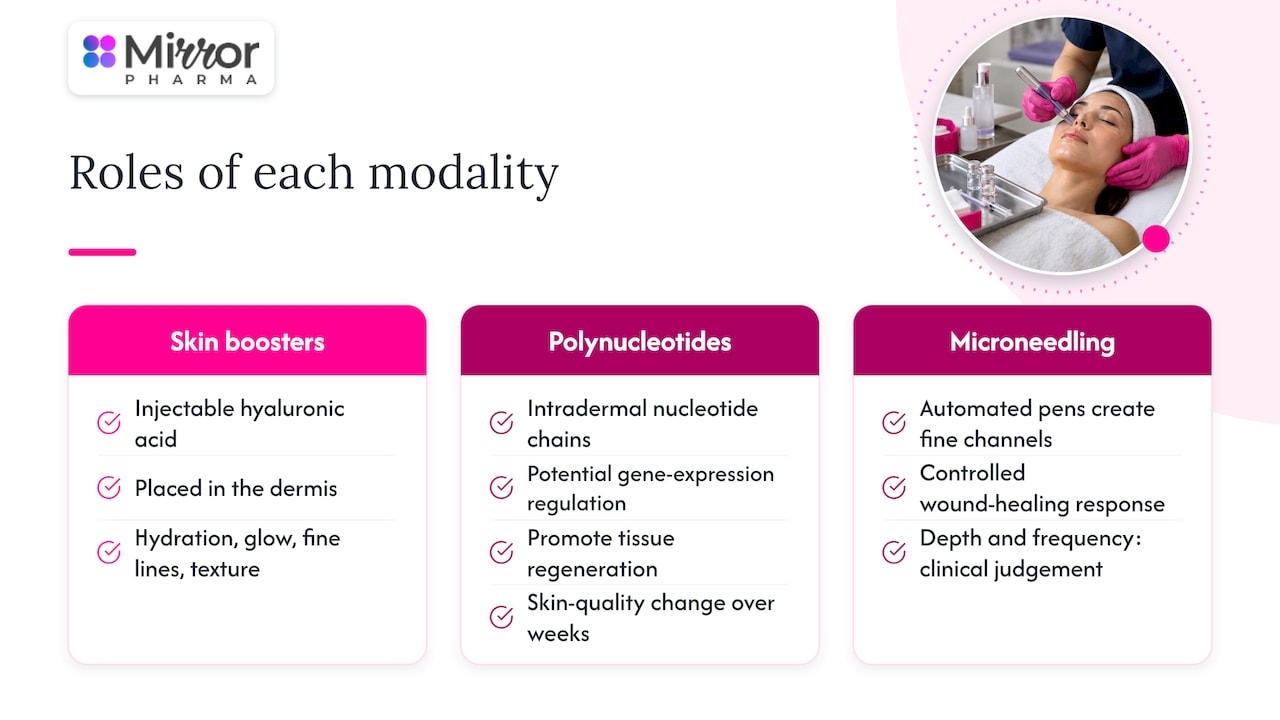
Microneedling. Automated pens create fine channels and a controlled wound-healing response. The same commentary notes that the shift from manual rollers to automated devices has improved procedural consistency, but depth and frequency still depend on clinical judgement for each patient.
How the three differ at a glance
| Skin booster | Polynucleotide | Microneedling | |
|---|---|---|---|
| Main aim | Hydration, glow, plumpness | Repair, elasticity, resilience | Controlled stimulation, texture |
| Delivery | Intradermal injection | Intradermal injection | Device, with or without topical adjunct |
| Typical expectation | Smoother, more hydrated skin | Gradual change in skin quality | Gradual change in texture and scarring |
| Not a substitute for | Volume replacement | Volume replacement | Injectable treatment |
The comparison of the first two columns follows a regional clinic guide that sets hydration against repair. Both categories are widely discussed, but protocols differ by product, so always follow the manufacturer’s instructions for use for the specific product you prescribe.
What the evidence says about combining them
The honest summary is that the evidence is encouraging but thin.
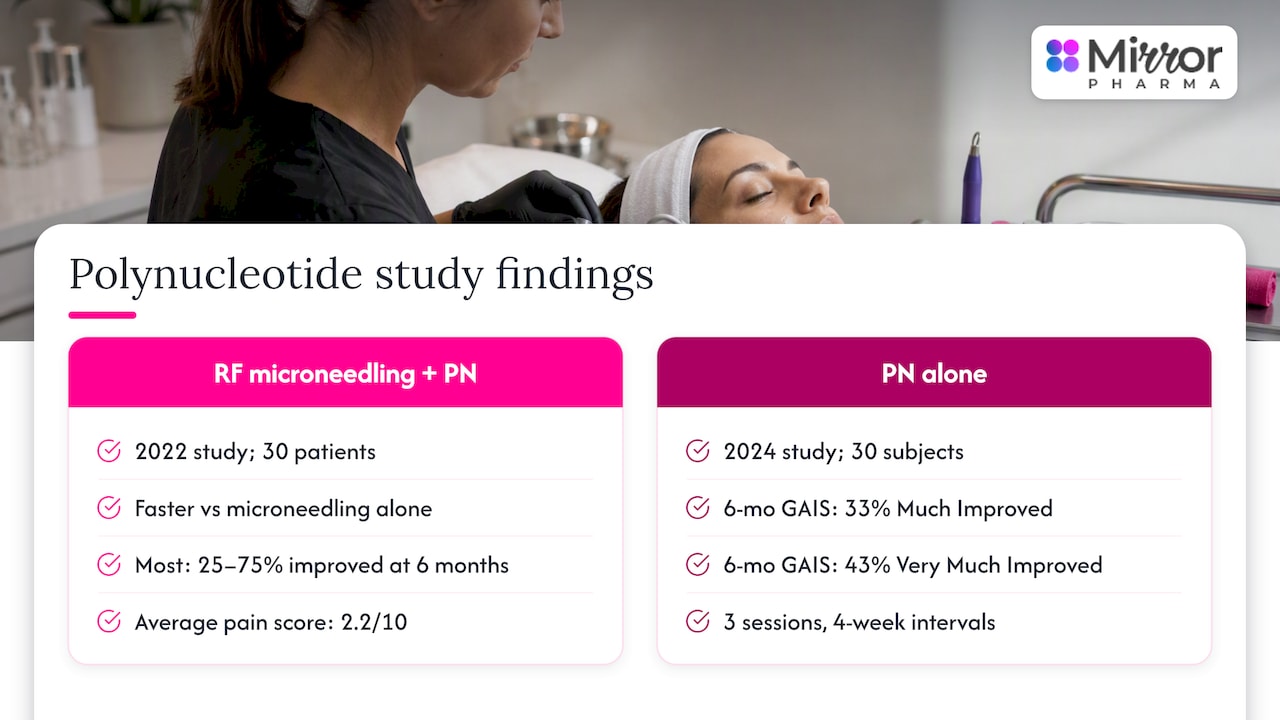
In a 2022 study of 30 patients, non-insulated radiofrequency microneedling combined with polynucleotides produced faster improvement of periorbital wrinkles than microneedling alone. At the six-month follow-up, most subjects showed 25 to 75% improvement. Participants reported average pain scores of 2.2 out of 10, and the authors observed no serious adverse events such as scarring or persistent erythema. Note the limits: a small sample, a periorbital focus and a radiofrequency device, which is not the same as a standard needle pen.
On polynucleotides alone, a 2024 study of 30 subjects reported statistically significant gains in firmness, tone and radiance after three intradermal sessions at four-week intervals, with benefits persisting to six months. On the Global Aesthetic Improvement Scale at six months, 33% reported ‘Much Improved’ and 43% ‘Very Much Improved’. These are self-reported outcomes in a small cohort, and results vary between individuals.
A consensus report on PN-HPT reached majority agreement for the face, periocular area, décolleté and neck, hands, scalp and stretch marks. It is a useful reference when you are deciding which areas to treat.
What this does not give you is a validated, universal ‘stack protocol’. Any sequence you offer is a clinical judgement, and your consent form should say so in plain terms.
Building the sequence: staging and intervals
There are two broad ways to combine microneedling with an injectable. Neither is proven superior in head-to-head trials, so choose on patient factors.
- Same-visit pairing. Microneedling is performed and an adjunct is applied during or immediately after. This suits patients with limited availability but increases the inflammatory load of a single session.
- Staged alternation. Injectable and microneedling sessions are separated. Practitioner commentary on combination treatment suggests intervals of roughly 2 to 4 weeks to balance comfort against stimulation without provoking excessive inflammation.
A worked example of a staged plan for a patient with dull, thin-feeling skin and no contraindications might look like this:
- Week 0: consultation, photographs under standard lighting, skin assessment, consent and patch discussion.
- Week 0 or 1: first polynucleotide session, following the product’s instructions.
- Weeks 3 to 4: second polynucleotide session, or a microneedling session if you want to alternate.
- Weeks 6 to 8: further session in the course, then review.
- Review: reassess skin quality against baseline photographs and decide whether to maintain, adjust or stop.
This is an illustration of the planning logic, not a prescribed protocol. The 2024 study above used three sessions at four-week intervals, and course length in practice depends on the product, the area and the patient.
Where skin boosters fit
Hydration-focused boosters and repair-focused polynucleotides are sometimes layered across a course rather than within one visit. If you are pairing microneedling with a booster specifically, our clinical guide to combining microneedling with skin boosters goes through the practicalities.
Under-eye skin: a good test of your reasoning
The under-eye area shows why the distinction matters. Hollowing from volume loss, crepey thin skin and texture irregularity are three different problems. Fillers, polynucleotides and microneedling each address a different one, as experienced practitioners note. If your assessment cannot say which problem you are treating, the plan is not ready.
Screening, contraindications and consent
The practitioner-focused review of regenerative microneedling warns against the ‘beauty menu’ approach. Contraindications such as active acne, a history of keloids or immunosuppression must be screened during a face-to-face consultation. Build that into your process:
- Take a full medical history, including medicines, allergies, autoimmune conditions, pregnancy or breastfeeding, and any history of poor healing.
- Check the treatment area for active infection, active acne, open lesions or inflammatory flares.
- Explain what is injected, how many sessions are usually needed, what result is realistic and what downtime to expect. This mirrors the plain-terms approach in guidance on questions patients should ask before injectables.
- Record the lot numbers and batch details of every product used.
- Have written protocols for adverse events, including anaphylaxis, whatever the treatment’s perceived risk level. Clinic-led governance of that kind is what ClinicSpark’s analysis of the regulatory gap says professional excellence requires.
Talk through the realistic range of results. Expect temporary redness, swelling and tenderness, and stress that outcomes vary and are not guaranteed or permanent. Avoid any language that implies a promised transformation.
Adjuncts and acne scarring
Patients often ask about topical copper peptides alongside microneedling. A 2026 randomised controlled trial of 76 patients found microneedling with a 0.5% copper peptide serum was as effective as 1% phenytoin cream for atrophic acne scars. Most improved by 25 to 50%, some by more than 75%, over five sessions at three-week intervals, with mild, transient erythema and oedema. That is a scar-specific finding, not evidence for general rejuvenation. Our guide to microneedling for acne scars covers that indication separately.
UK regulation: what applies to you now
The regulatory picture is easy to misstate, so check it for your own nation and premises.
- In England, CQC registration does not cover standard facial dermal fillers, skin boosters, bio-remodellers or cosmetic microneedling. Many clinics wrongly assume they are all registered.
- A UK regulation tracker states that powers for a licensing scheme exist in law, but no regulations have been made and the scheme is proposed, not in force. One rule has already changed: since 1 June 2025, remote prescribing of cosmetic injectable medicines has been restricted.
- Microneedling, skin boosters and polynucleotides are generally described as lower-to-medium risk in that proposed tiering, so prepare for local-authority licensing rather than assuming exemption.
- Wales and Scotland have taken different routes from England, so do not apply an English summary to a clinic elsewhere in the UK.
If you prescribe any medicine in your clinic, read our summaries on what to check when sourcing aesthetics injectables, unlicensed medicines and MHRA checks and the evidence practitioners need while licensing is pending. Your insurer, professional body and local authority are the right authorities for your specific obligations.
Our perspective
We supply regenerative products to verified healthcare professionals, so we see how clinics actually build these protocols, and where they go wrong.
The pattern we notice is that practices which do well with polynucleotides frame them as a course, not an event. They book the follow-up before the patient leaves, photograph consistently and describe the result as a gradual change in skin quality. Practices that struggle usually sold a ‘stack’ on day one, then faced a patient who expected a filler-like change.
Our view is simple. Choose the modality for the problem. Sequence it so that the skin can recover. Source every product from a supplier that verifies who is buying, because traceability is part of your patient safety, not an administrative extra. And keep your consultation honest: it is better to say ‘this may improve your skin quality gradually’ than to promise a visible transformation.
We verify practitioner and prescriber status before supplying prescription products, and our fulfilment is handled by a team of healthcare professionals. Extended order cut-off times exist so that a clinic with a patient booked later in the week is not left waiting on stock.
— Rizwan
Sourcing for your clinic
If you are planning a regenerative course, you can browse our polynucleotides range and skin booster range from one verified account, and find needles and consumables through our online pharmacy. Access is for licensed practitioners and prescribers, and we check eligibility before dispatch.
Common questions
Can you microneedle polynucleotides?
Studies have combined polynucleotides with microneedling, including a 2022 trial using radiofrequency microneedling. Whether and how a particular product may be used with a needling device depends on its instructions for use and your own clinical risk assessment. Do not assume that every injectable is suitable for topical application or channel delivery.
What is better, skin boosters or polynucleotides?
Neither is better in general, because they target different things. Boosters mainly address hydration and glow, while polynucleotides are aimed at repair and elasticity. Choose according to the patient’s skin concern and document your reasoning.
Can copper peptides be used with microneedling?
There is trial evidence for a copper peptide serum with microneedling in atrophic acne scars, as above, but it is specific to that indication. Use only products intended for use on needled skin and screen for sensitivity and infection risk. Seek the product manufacturer’s guidance when in doubt.
How far apart should sessions be?
Practitioner sources describe intervals of around 2 to 4 weeks between stimulating treatments, and a published polynucleotide study used four-week intervals across three sessions. Adjust for how each patient heals, and delay if the skin is still inflamed.
Sources
- Efficacy and Safety of Noninsulated Microneedle Radiofrequency Alone versus with Polynucleotides (2022)
- Polynucleotides HPT for Asian Skin Regeneration and Rejuvenation (2024)
- Consensus report on the use of PN-HPT in aesthetic medicine
- Polynucleotides in Aesthetic Medicine: A Review of Current Practices
- Expert commentary on polynucleotides, Clinical, Cosmetic and Investigational Dermatology
- Regenerative microneedling practitioner review
- Copper peptide microneedling trial for atrophic acne scars
- New Aesthetics Regulations UK 2026
- Ultimate Guide to Aesthetic Treatments in Worthing
- Injectables in the UK: 15 Questions