
Compliance means five things done every time: point-of-use containers, correct segregation by lid colour under HTM 07-01, a licensed waste carrier, signed waste transfer or consignment notes on file, and staff trained under the Sharps Regulations 2013. Miss any one of these and a routine CQC visit becomes a formal finding. Compliant containers and consumables are available from suppliers for licensed practitioners, but the paperwork trail matters just as much as the equipment.
TL;DR:
- Proper sharps waste segregation by lid color is critical, with purple for cytotoxic, yellow for medicinally contaminated, and orange for non-medicinal infectious sharps.
- Consignment notes must be retained for at least three years and must match specific details like waste type, quantity, and carrier information to ensure lawful disposal.
- Staff training on segregation, disposal procedures, and incident response remains the most common compliance gap that inspectors check during audits.
- Waste collection must be scheduled before containers overfill, with secure mounting, exact fill line adherence, and appropriate portable containers for community and home settings.
- Using the correct EWC codes, verified suppliers, and maintaining detailed procurement records are essential for legal compliance and smooth audit processes.
Table of Contents
- Quick compliance checklist for busy clinics
- What the law requires: Sharps Regulations 2013, duty of care and HTM 07-01
- Segregation, colour-coding and EWC classification
- Practical point-of-use controls: containers, placement, fill lines and secure mounting
- Storage, transport and documentation (waste transfer and consignment notes)
- Training, incident response and audit readiness
- Sharps disposal requirements for home healthcare settings and community healthcare workers
- Guidance on disposal of sharps for non-healthcare businesses (e.g., tattooists, veterinary clinics)
- Penalties and enforcement actions for non-compliance with sharps disposal regulations
- Procurement and supplier integration affect compliance
- Where to buy compliant sharps bins and consumables
- Sources
- FAQ
Quick compliance checklist for busy clinics
Most sharps disposal failures aren’t equipment problems. They’re process gaps that surface the moment an inspector asks to see the paper trail behind a bin.
Work through this before your next audit or inspection window:
- Placement: keep a sharps container at the point of use. Never carry an exposed, used sharp across a room to reach a bin.
- Segregation: use purple lids for cytotoxic and cytostatic waste, yellow lids for medicinally contaminated sharps, and orange where non-medicinal infectious sharps apply.
- Collection: book licensed carrier collections on a schedule, not when a container is already overflowing past its fill line.
- Documentation: match every consignment or waste transfer note to a specific container or collection date, not a vague monthly total.
- Training: brief staff on segregation rules immediately after any change to your container setup, and log who attended.
None of this is complicated. It’s the consistency that inspectors actually check.
What the law requires: Sharps Regulations 2013, duty of care and HTM 07-01
The Health and Safety (Sharp Instruments in Healthcare) Regulations 2013 set out a clear hierarchy for employers: avoid unnecessary sharps use where possible, substitute safer sharps devices where practicable, place secure containers close to the point of use, and give staff written instructions and training. HSE’s HSIS7 guidance is explicit that this isn’t a one-off policy exercise. Employers must review procedures regularly and be able to show why a particular sharps device or disposal method was chosen over a safer alternative.
Separately, environmental law imposes a duty of care on anyone who produces clinical waste. Under the Environmental Protection Act 1990, clinics must store, transport, and dispose of sharps waste through a licensed carrier, and they must keep documentation proving it happened. This duty doesn’t end when the bin leaves the premises. It follows the waste to final treatment, which is why consignment notes matter as much as the container itself.
HTM 07-01 bridges the two. It sets the colour-coding and segregation standard that HSE and environmental regulators both expect to see, and it defines what a “permitted facility” must demonstrate when it accepts your waste for treatment. A clinic that gets HTM 07-01 segregation wrong upstream creates a downstream problem for its waste contractor, and that problem traces straight back to the practice that filled the bin.
Segregation, colour-coding and EWC classification
Lid colour isn’t decoration. It’s the first filter that determines which treatment route your waste can legally take, and getting it wrong at source causes rejected loads and contractor disputes later.
Cytotoxic and cytostatic sharps, anything contaminated with medicines that carry mutagenic or carcinogenic properties, go in containers with a purple lid. Medicinally contaminated sharps that don’t carry that hazard, the bulk of routine clinical sharps waste, go in yellow-lidded containers. Non-medicinal infectious sharps use orange where a facility separates that stream, though many smaller clinics simplify to yellow-only streams by agreement with their carrier.
The European Waste Catalogue codes you write on your consignment note follow from that colour choice, and getting them right determines whether your contractor can legally accept the load.
| Waste stream | Typical lid colour | EWC code | Treatment route |
|---|---|---|---|
| Cytotoxic/cytostatic sharps | Purple | 18 01 03* | High-temperature incineration |
| Medicinally contaminated sharps | Yellow | 18 01 03* | Incineration or alternative treatment (contractor-dependent) |
| Non-medicinal, non-hazardous sharps | Yellow/orange | 18 01 09 | Alternative treatment permitted |
Before you standardise on a container type, confirm what your contractor’s permit actually allows. Some facilities only accept incineration-bound waste; others run alternative treatment lines that can’t process cytotoxic streams at all. Verifying this once at contract stage avoids a rejected collection months later.
Practical point-of-use controls: containers, placement, fill lines and secure mounting
Point-of-use disposal exists for one reason: it removes the walk between generating a sharp and disposing of it, and that walk is where most needle-stick injuries happen. A trolley-mounted container beside a treatment chair, or a wall-mounted bin fixed near the procedure area, closes that gap.
A few non-negotiables on handling:
- Follow the manufacturer’s fill line exactly. Overfilled containers are the single most common cause of sharps injuries during handling.
- Seal and label the container the moment it reaches the fill line, not at the end of the shift.
- Mount or position containers so they can’t be knocked over, particularly in busy treatment rooms or where children or pets might be present in community settings.
- For portable or community use, choose containers with a temporary closure mechanism that seals securely between visits, not just at final disposal.
Pro Tip: Match container size to how often a room is used, not to how long you’d like between changeovers. A 1 litre container in a low-traffic treatment room outlasts a 5 litre bin that sits half-empty for weeks, and smaller containers are easier to mount securely near a single procedure chair.
Mirror Pharma stocks Sharpsguard sharps bins across several sizes, which makes it easier to match container to room without over-ordering.
Storage, transport and documentation (waste transfer and consignment notes)
Hazardous or “special” waste, which covers most clinical sharps streams, requires a consignment note under environmental law. Non-hazardous clinical waste can move on a simpler waste transfer note, but the distinction matters because using the wrong document is itself a compliance gap.
Keep these points straight:
- Consignment notes need the waste producer’s details, the EWC code, quantity, and the carrier’s licence number. Retain them for a minimum of three years for hazardous waste records.
- Before booking any carrier, check their waste carrier licence and ask for evidence of final disposal, not just collection confirmation.
- If your facility is a permitted site running its own pre-treatment or tracking system, quarantine rules apply to non-conforming packages, and the maximum quarantine period is set by your permit’s pre-acceptance conditions.
A missing consignment note is one of the easiest findings for an inspector to raise, because it’s binary. Either the document exists with the right fields filled in, or it doesn’t.
Training, incident response and audit readiness
Inadequate training, not a shortage of containers, is what drives most non-compliance findings, according to HSE guidance on infection control in healthcare premises. Fix the training gap and most other issues fall away.
- Cover safe sharps use, correct disposal, and the immediate steps after a sharps injury, including reporting lines and where health surveillance applies.
- Keep a documented policy with a set refresher cycle, and log attendance against named staff, not just a headcount.
- Before an inspection, check for the failings auditors flag most often: missing consignment notes, overfilled containers still in use, and no record of why a particular sharps device was chosen over a safer alternative.
Sharps disposal requirements for home healthcare settings and community healthcare workers
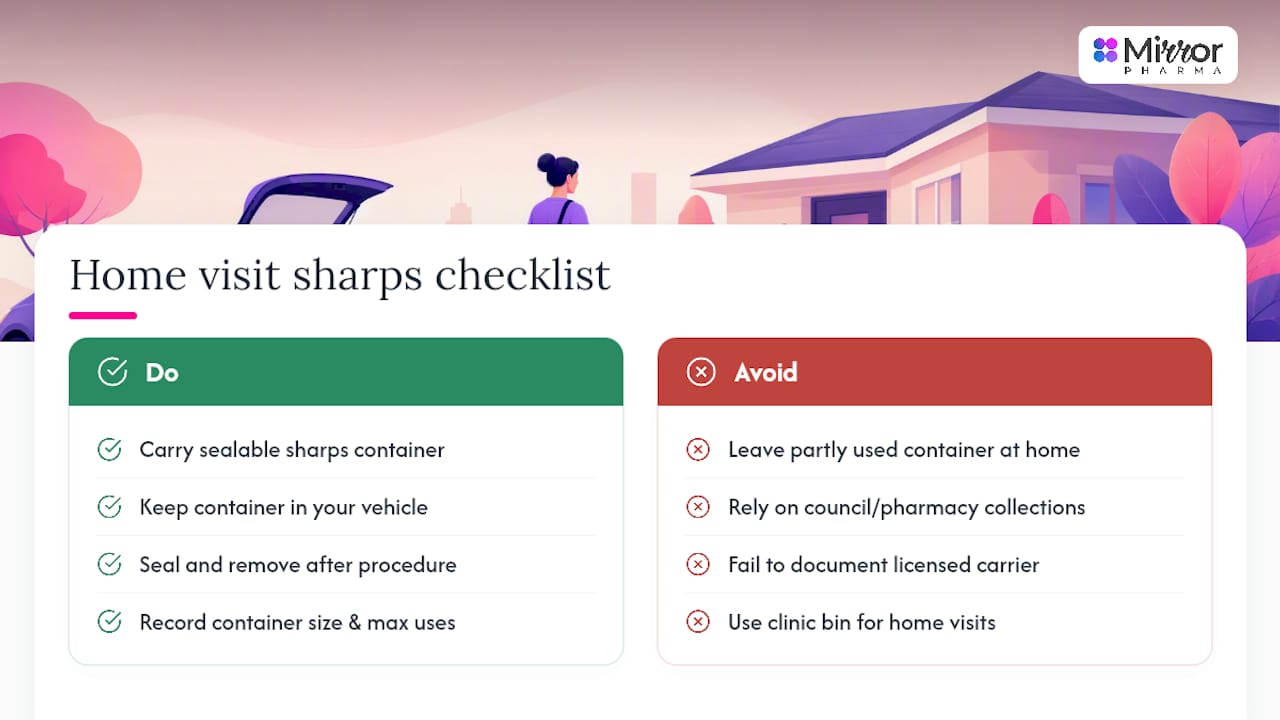
Community nursing, domiciliary phlebotomy, and home-based aesthetic treatments carry the same legal duties as a clinic, just without a fixed disposal point. The Sharps Regulations 2013 still apply, and the practitioner, not the patient’s household, remains responsible for correct segregation and eventual disposal through a licensed route.
The practical answer is a portable, sealable sharps container carried to every visit. It travels in the vehicle, comes into the home for the procedure, and travels back out sealed rather than being left on-site. Leaving a partially used container in a patient’s home creates a gap in the chain of custody that’s difficult to defend at audit, and it exposes household members, including children, to risk the practitioner is meant to control.
Some local authorities and participating pharmacies run collection services for household sharps, but these schemes are designed for patient-generated waste such as diabetic sharps, not practitioner-generated clinical waste from a visiting professional. A community nurse or mobile aesthetic practitioner cannot rely on a council collection to discharge their own duty of care. The waste generated during a professional visit must go back through the practitioner’s own licensed carrier arrangement, documented the same way a clinic-based collection would be.
Risk assessments for home visits should specify the container size carried, the maximum number of procedures per container before it’s sealed and replaced, and the arrangement for emergency replacement if a container reaches its fill line mid-round. This is the point where portable, smaller containers, such as 1 litre options, earn their place: they’re easier to seal and carry securely than a bulkier clinic-format bin.
Guidance on disposal of sharps for non-healthcare businesses (e.g., tattooists, veterinary clinics)
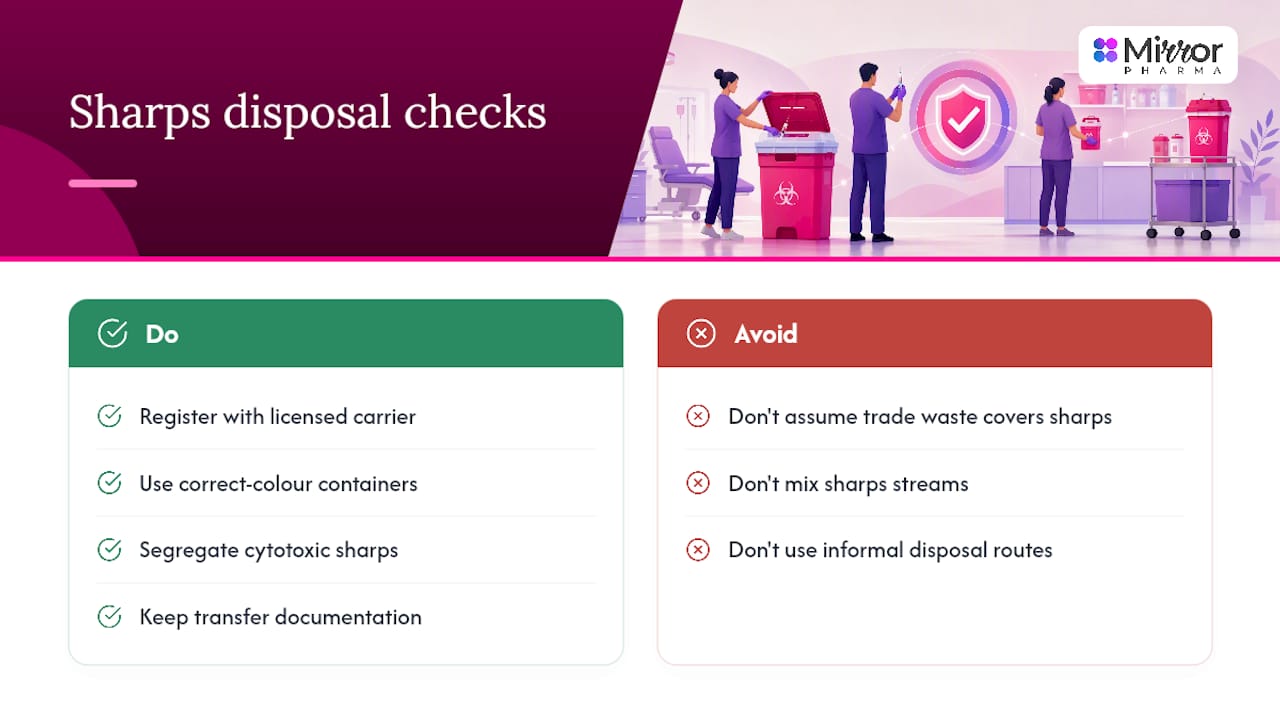
Tattoo studios, veterinary practices, and body piercing businesses generate sharps waste and sit under the same regulatory framework as medical clinics, even though they aren’t NHS or CQC-registered providers. The Sharps Regulations 2013 apply to any workplace where employees are exposed to medical sharps risk, and the duty of care under environmental law applies to anyone producing hazardous waste, regardless of sector.
Veterinary practices typically generate both cytotoxic sharps, where chemotherapy or certain sedation drugs are used, and standard medicinally contaminated sharps from routine procedures, so segregation by lid colour matters just as much as in a human clinic. A vet practice that mixes these streams into one yellow bin because “it’s all going to the same contractor anyway” is creating exactly the kind of EWC misclassification that gets a load rejected or, worse, incinerated via the wrong route.
Tattoo and piercing studios generate large volumes of non-medicinal but still contaminated sharps: needles, cartridges, and blades that have contacted blood. These typically classify as offensive or clinical waste depending on local authority guidance, and studios need a registered waste carrier agreement in place, not an informal arrangement with a local pharmacy or GP surgery. Environment Agency and local council NetRegs guidance is the reference point for classifying these borderline streams correctly.
The practical takeaway for any non-healthcare business handling sharps: don’t assume general trade waste or informal disposal covers you. Register with a licensed clinical waste carrier, use correctly coloured containers, and keep transfer documentation exactly as a clinic would.
Penalties and enforcement actions for non-compliance with sharps disposal regulations
Non-compliance with sharps disposal rules exposes a practice to enforcement from several directions at once, because the same failure can breach health and safety law, environmental law, and professional regulatory standards simultaneously.
HSE can issue improvement or prohibition notices where sharps handling creates an ongoing risk of injury, and failure to comply with a notice is a criminal offence that can lead to prosecution. Environmental regulators can prosecute under the Environmental Protection Act for illegal disposal of hazardous waste, unlicensed carriage, or failure to keep required consignment documentation, with penalties that scale with the severity and duration of the breach.
For CQC-registered providers, sharps and clinical waste failings typically surface as a “requires improvement” or “inadequate” rating under the safe key question, which affects public inspection reports and can trigger follow-up inspections. Non-registered businesses, such as tattoo studios or aesthetic practices operating outside CQC scope, still face council-level environmental health enforcement, which can include fixed penalty notices or prosecution for waste offences.
The pattern across enforcement cases is consistent: it’s rarely the container itself that triggers action. It’s the absence of documentation proving correct disposal, or evidence that staff weren’t trained on the procedures the practice claims to follow. A clinic with the right bins but no consignment notes on file is in a weaker position at audit than one with slightly untidy segregation but a complete paper trail. Both need fixing, but the paperwork gap is what turns a minor observation into a formal finding.
Procurement and supplier integration affect compliance
Maintaining consistent relationships with suppliers simplifies record-keeping and audit trails. Consistent replenishment also helps avoid stock shortages that can lead to overfilling containers. This content is written for licensed practitioners managing their own procurement and compliance obligations.
Where to buy compliant sharps bins and consumables
Mirror Pharma stocks Sharpsguard yellow sharps bins across multiple sizes, from compact 1 litre containers suited to community visits up to larger clinic-format bins, alongside BD Micro-Fine Plus needles for routine procedures. Every order comes with an invoice and product documentation that slots straight into your procurement records, giving your practice a dated, itemised paper trail to show an inspector alongside your consignment notes.
For clinics juggling multiple product lines, from dermal fillers and toxins through to IM/IV vitamins, keeping consumables procurement with one verified supplier simplifies both reordering and audit prep. If you need bulk supply for a multi-site clinic group or have an urgent stock gap ahead of an inspection, get in touch with Mirror Pharma’s procurement team through the needles and consumables page to discuss availability and account setup.
This article is general information, not a substitute for advice from a qualified doctor. Consult a qualified healthcare professional about your own circumstances before acting on anything here.
Sources
- Gov
- Health and Safety (Sharp Instruments in Healthcare) Regulations 2013: A guide for employers and employees (HSIS7) – HSE
FAQ
What colour bin is used for sharps disposal in the UK?
Medicinally contaminated sharps go in yellow-lidded containers, cytotoxic and cytostatic sharps use purple lids, and non-medicinal infectious sharps use orange where a facility separates that stream, following HTM 07-01 colour-coding.
How long must consignment notes be kept?
Hazardous waste consignment note records must be retained for a minimum of three years, in line with duty of care requirements under the Environmental Protection Act 1990.
Do home healthcare workers need their own sharps disposal arrangement?
Yes. A visiting practitioner remains responsible for correctly disposing of sharps generated during a home visit and cannot rely on a council household collection scheme, which is designed for patient-generated waste rather than professional clinical waste.
What EWC code applies to routine clinical sharps?
Most medicinally contaminated sharps use EWC code 18 01 03*, while non-hazardous sharps streams can use 18 01 09, and the correct code depends on your waste contractor’s classification guidance.
Can a clinic be prosecuted for incorrect sharps disposal?
Yes. HSE can issue improvement or prohibition notices under the Sharps Regulations 2013, and environmental regulators can prosecute for illegal disposal or missing consignment documentation, separately from any CQC inspection findings.
Where can I buy compliant sharps bins for a UK clinic?
Mirror Pharma supplies Sharpsguard yellow sharps bins in multiple sizes and BD Micro-Fine Plus needles for licensed practitioners; current pricing is listed on the site.