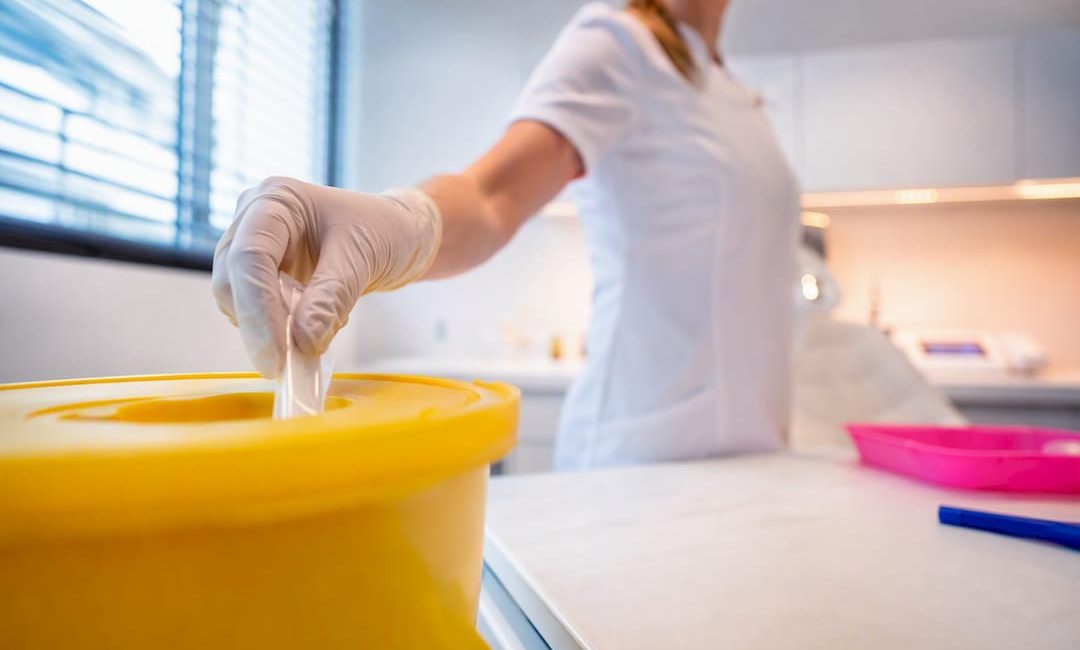
Clinics and healthcare employers must provide BS EN ISO 23907-compliant sharps containers at the point of use, train every member of staff who handles sharps, and arrange collection through a licensed waste carrier. This is a legal duty under the Sharps Regulations, not a matter of best practice. If your clinic cannot answer, right now, which container standard it uses and who collects the waste, that is the gap to close first.
TL;DR:
- All sharps containers in clinics must meet BS EN ISO 23907 standards for puncture resistance and leakproof construction, with proper colour coding for waste streams.
- Staff must be trained in safe sharps handling, disposal, and incident reporting, with documentation kept up-to-date and easily accessible during audits.
- Filled bins should be securely stored away from public areas, and disposal must only be carried out by licensed waste carriers using proper documentation and waste codes.
- Positioning containers within arm’s reach and labeling them with assembly details are critical steps to prevent needlestick injuries and ensure compliance.
- Regular, short audit checklists should verify procurement conformity, staff training, proper bin filling, incident response, and disposal records.
Table of Contents
- What are the sharps bin requirements in the UK?
- Which sharps bin should you use for each waste stream?
- How should sharps bins be placed, labelled and filled?
- How do you store and dispose of sharps bins legally?
- What does an audit-ready sharps compliance checklist look like?
- Publisher perspective: how Mirror Pharma supports compliance for licensed practitioners
- Where to buy compliant sharps bins and consumables
- Sources
- FAQ
What are the sharps bin requirements in the UK?
The Health and Safety (Sharp Instruments in Healthcare) Regulations 2013 place clear duties on healthcare employers and contractors, not just NHS trusts. Private clinics, aesthetic practices and community services fall within scope wherever staff use, handle or dispose of medical sharps.
The regulations require employers to:
- Avoid the unnecessary use of sharps wherever a safer alternative exists.
- Use safer sharps devices where practicable, and document why one was rejected if not.
- Provide clearly marked, secure containers located close to the point of use.
- Give staff written instructions and training in safe disposal before they handle sharps unsupervised.
- Record, investigate and follow up every sharps injury, including near misses.
HSE’s information sheet HSIS7 reinforces the same hierarchy: eliminate, substitute, contain, train. Embedding this into policy means building it into induction packs, annual audits and incident reporting forms, not leaving it as a line in a folder nobody reopens. A clinic manager who can produce a signed training record and an incident log on request is in a far stronger position than one relying on memory.
Which sharps bin should you use for each waste stream?
Every sharps container used in a UK clinical setting must meet the BS EN ISO 23907 series: BS EN ISO 23907-1 for single-use containers, BS EN ISO 23907-2 for reusable ones. Both standards test for puncture resistance, leakproof construction and secure closure, so a container that does not carry this marking should not be in your treatment room.
Colour coding then tells staff which stream a bin belongs to:
- Orange lid: non-medicinal sharps, such as items with no pharmaceutical contamination.
- Yellow lid: medicinal sharps that are non-cytotoxic and non-cytostatic, the stream most aesthetic and general clinics will use daily.
- Purple lid: cytotoxic or cytostatic contaminated sharps, requiring separate segregation under SPS guidance.
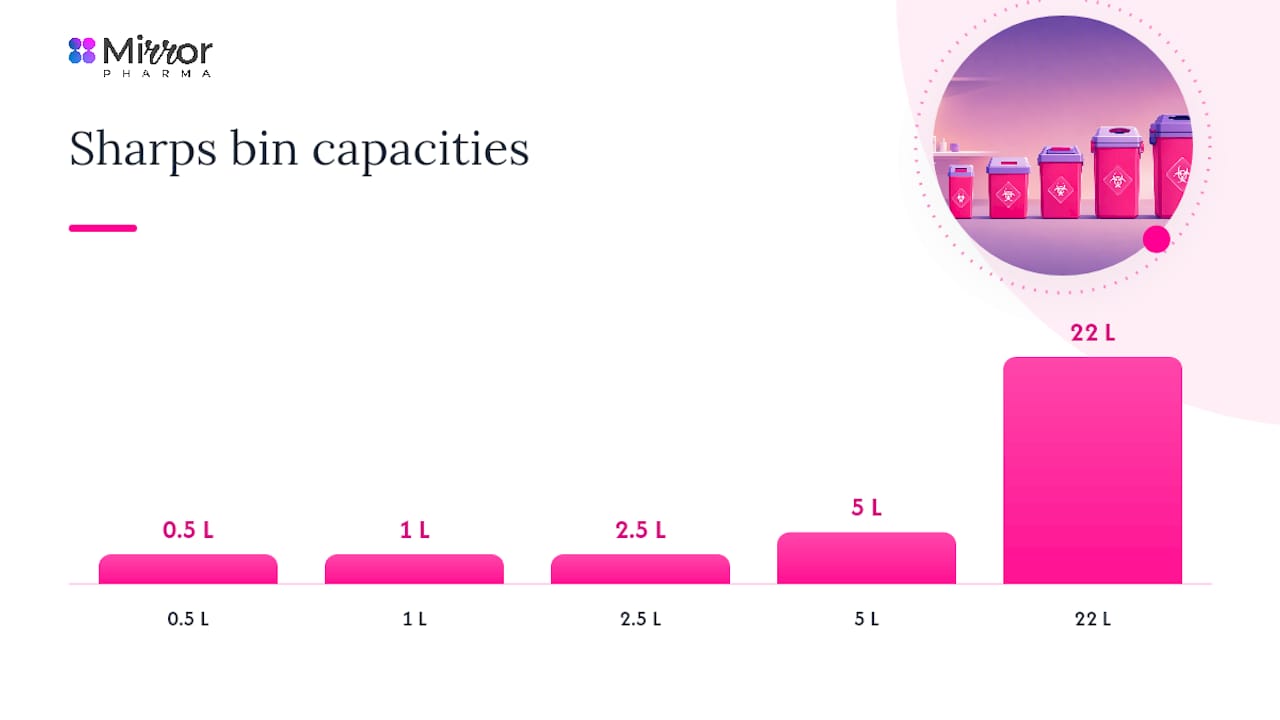
Sizes typically run from 0.5L up to 22L, with suppliers commonly stocking 0.5L, 1L, 2.5L, 5L, 11.5L and 22L options depending on throughput. A busy treatment room might get through a 5L bin in a week, while a single home visit rarely needs more than 1L. One point clinics miss: sharps bins are not designed for bulk liquids, so any treatment that generates significant liquid waste alongside sharps needs its own risk assessment.
How should sharps bins be placed, labelled and filled?
Set-up follows a simple sequence, and skipping steps is where most compliance gaps start.
- Position the bin within arm’s reach of the procedure, ideally wall mounted or on a trolley at working height rather than on the floor.
- Label the box before first use with the department, the name of the person who assembled it, and the assembly date, keeping the manufacturer’s instructions to hand.
- Never fill above the marked fill line. Time-based replacement schedules are no substitute for checking the line itself.
- Close the temporary lid whenever the bin is not actively in use, even between patients.
- For community visits, carry the bin by its handle, keep it secure in transit, and never leave it unattended in a public area.
Pro Tip: Documenting the assembler’s name and date on every box sounds like a small thing, but it’s the single detail auditors check first, and it’s the one clinics most often skip.
Placing containers within arm’s reach is the single most effective control against needlestick injuries, because it removes the temptation to walk a used sharp across a room.
How do you store and dispose of sharps bins legally?
Filled bins must be stored securely, away from public areas, while they wait for collection. That means a locked clinical waste store or cupboard, never a corridor or reception space where a visitor could reach it.
Disposal itself must go through a licensed waste carrier, and clinics carry legal responsibility for confirming that carrier’s registration before signing a contract.
- Consign only the waste your organisation actually produced. Mixing in waste from elsewhere breaches consignment rules.
- Check the carrier’s licence and ask which disposal route they use, whether incineration or an approved alternative treatment.
- Confirm European Waste Catalogue (EWC) codes for your waste streams; pharmaceutical hazardous and non-hazardous sharps carry different codes, and SPS guidance sets these out clearly.
- Request manifests and certificates of disposal for every collection, and keep them on file.
Local authority collection is one option worth checking, since Gov varies in availability and cost depending on where your clinic sits.
What does an audit-ready sharps compliance checklist look like?
A short, repeatable checklist beats a long policy document nobody rereads. Run through this on a fixed schedule, not just before an inspection.
- Procurement: hold supplier declarations of conformity to BS EN ISO 23907 for every container type in stock, filed alongside purchase records.
- Training: cover safe handling, safer sharps devices, and disposal at induction, with refreshers at intervals your policy defines and signed records kept for each member of staff.
- Daily checks: verify point-of-use placement, inspect fill lines, and confirm every assembled box carries its label and date.
- Incident response: report sharps injuries immediately, investigate the cause, and offer medical follow-up without delay.
- Audit trail: keep training records, assembly logs, consignment notes and disposal certificates together so any single item can be produced on request.
Pro Tip: Run a five-minute spot check on fill lines at the end of each clinic day. It catches the one bin that got missed before it becomes a Monday morning problem.
Publisher perspective: how Mirror Pharma supports compliance for licensed practitioners
Compliance stops being theoretical the moment a bin actually turns up wrong: unmarked, undersized, or missing a declaration of conformity. Sharps containers and needles supplied as standard stock lines for licensed practitioners typically carry the documentation an auditor asks for.
Choosing a supplier that lists container standards plainly on the product page removes a step most clinics do not realise they are skipping until an inspection asks for it. For stock planning, most treatment rooms get more mileage from holding a mix of a small container for occasional use and a larger one for higher throughput, rather than standardising on a single size and running short mid-week.
— Rizwan
Where to buy compliant sharps bins and consumables
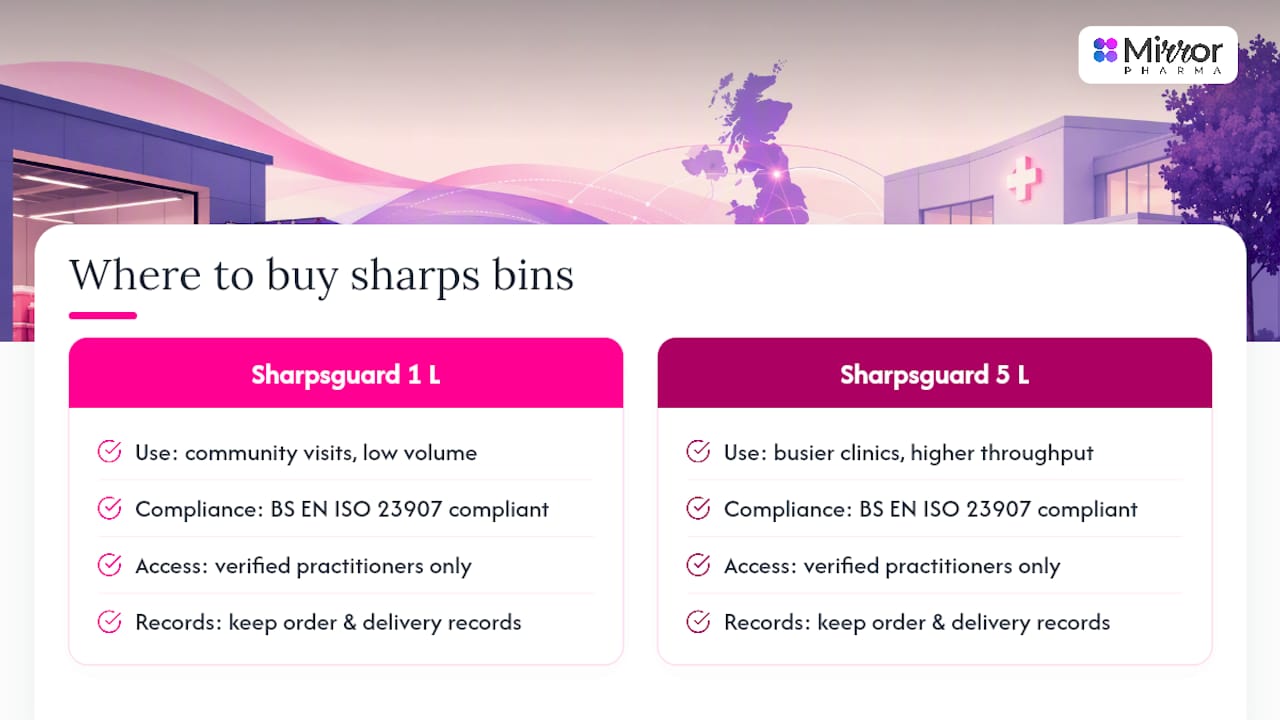
Mirror Pharma stocks the yellow-lidded Sharpsguard 1 Ltr sharps bin for community visits and lower-volume treatment rooms, alongside the Sharpsguard 5 Ltr sharps bin for busier clinics running through consumables faster. Both are BS EN ISO 23907 compliant, so the declaration of conformity your audit trail needs comes with the order.
Access to these products, along with needles such as the BD Micro-Fine+ range, is restricted to verified practitioners, in line with Mirror Pharma’s commitment to supplying only trained healthcare professionals. Order confirmation and delivery records should sit in the same file as your training logs and consignment notes, ready for the next audit rather than assembled the week before it. Browse the full needles and consumables range to match stock levels to your clinic’s throughput before you run short.
This article is general information, not a substitute for advice from a qualified doctor. Consult a qualified healthcare professional about your own circumstances before acting on anything here.
Sources
- The Health and Safety (Sharp Instruments in Healthcare) Regulations 2013
- Sharps: Health and Safety (Sharp Instruments in Healthcare) Regulations 2013 – HSE information sheet HSIS7
- Managing sharps contaminated with pharmaceutical waste – Specialist Pharmacy Service (SPS)
- Gov
FAQ
What are the current rules for sharps bins in the UK?
Employers must supply BS EN ISO 23907-compliant containers at the point of use, train staff in safe disposal, and arrange collection through a licensed waste carrier, under the Sharps Regulations 2013.
What colour sharps bin should a clinic use?
Yellow-lidded bins are for non-cytotoxic medicinal sharps and cover most clinic work; purple is for cytotoxic or cytostatic waste, and orange is for non-medicinal sharps, per SPS guidance.
Can patients get a sharps bin for free in the UK?
Some local authorities collect clinical waste from home patients, but availability and charges vary; check the gov.uk clinical waste collection page for your area, or ask your clinic to supply one alongside a home-use treatment.
What should you do if a sharps bin is overfilled?
Stop using it immediately once contents reach the manufacturer’s marked fill line, seal it with the temporary or permanent closure, and replace it with a new container rather than continuing past the line.
Where can clinics buy compliant sharps bins?
Mirror Pharma supplies BS EN ISO 23907 compliant sharps bins, including the 1 Ltr and 5 Ltr Sharpsguard sizes, to verified licensed practitioners in the UK.