

Both major cosmetic and therapeutic injectables on the market are botulinum toxin type A. The practical distinction that matters for licensed practitioners is formulation: one contains accessory complexing proteins around the active molecule, the other is supplied without them. Choosing between the two comes down to a patient’s prior response history, whether they are on high-dose therapeutic regimens, and the injector’s own clinical experience with each product.
TL;DR:
- The choice between formulations mainly depends on patient history, particularly for those receiving high-dose long-term therapy, due to differences in antigenic protein load.
- Both botulinum toxin formulations generally last three to four months, with onset within three to five days and results primarily driven by injection technique rather than product differences.
- Antibody formation risks are low at cosmetic doses but are higher in therapeutic settings, making the purified formulation preferable for patients on high cumulative doses.
- Common side effects are similar across formulations, including bruising and mild swelling, with systemic effects being rare and requiring careful dosing and injection site management.
- Practitioners should document accurate product, dose, and lot information for each patient to track response changes and consider switching formulations if secondary non-response occurs.
Table of Contents
- Botox vs Xeomin: what botulinum toxin type A actually does
- Formulation and immunogenicity: accessory proteins versus a purified molecule
- Onset, duration, and dose equivalence between the two toxins
- Matching the formulation to the patient in front of you
- Side effects, safety signals and what recent warnings say
- Building a consultation checklist for choosing between formulations
- Mirror Pharma: supporting practitioners who prescribe and inject
- When formulation theory actually changes clinical decisions
- Ordering toxins and consumables through Mirror Pharma
- Sources
- FAQ
Botox vs Xeomin: what botulinum toxin type A actually does
Every product in this class works the same way at the neuromuscular junction: it blocks the release of acetylcholine, temporarily preventing the targeted muscle from contracting. That is why a frown line softens or a hyperactive bladder muscle calms down, depending on the indication. Understanding this shared mechanism is the starting point for any sensible botox vs xeomin discussion, because the differences that follow are refinements on the same basic biology, not competing modes of action.
Both formulations carry licensed uses across cosmetic and therapeutic categories, though exact approved indications vary by product and region, so practitioners should always check current labelling rather than assume parity. What actually drives the outcome, more than the formulation itself, is technique.
- Blocks acetylcholine release at the neuromuscular junction, producing temporary muscle relaxation
- Shared indications span cosmetic lines and therapeutic conditions such as movement disorders, though licensing differs by product and market
- Injector skill, dilution practice and dosing accuracy typically influence results more than the choice between formulations, according to Mayo Clinic’s clinical overview
Formulation and immunogenicity: accessory proteins versus a purified molecule
The complexing (or accessory) proteins are a cluster of non-toxic proteins that naturally surround the botulinum toxin molecule in some formulations, originally thought to stabilise it. One formulation retains these; another is manufactured to strip them away, leaving what is often called a “purified” or “naked” 150 kDa molecule.
Why does this matter? More protein bulk in a product theoretically means more antigenic material for the immune system to react to, which can lead to neutralising antibodies over repeated exposure. Reviews summarised in PMC11508269 note that the purified formulation carries a theoretically lower risk of antibody formation, but absolute antibody incidence at standard cosmetic doses is low across the class. The practical relevance shows up mainly in patients receiving frequent, high cumulative doses over years, such as those treated for cervical dystonia or spasticity, where secondary non-response from antibody build-up is a recognised clinical problem.
- Accessory proteins add antigenic bulk without contributing to clinical effect
- Purified formulations reduce antigen load, a factor that matters most in high-dose, long-term therapeutic use
- Standard cosmetic dosing carries low absolute antibody risk regardless of formulation
Pro Tip: If a patient reports a previous formulation stopped working despite consistent technique and dose, antibody resistance is worth discussing before assuming poor injector performance.
Onset, duration, and dose equivalence between the two toxins
Clinical comparisons, including head-to-head work reviewed by the Cleveland Clinic, show non-inferiority between the purified and complexed formulations for glabellar lines at comparable unit dosing. Onset differs only modestly: most patients notice softening within three to five days, with peak effect around the two-week mark for either product.
Duration is where patients ask the most questions, and the honest answer is that both formulations tend to last a similar length of time in real-world practice, commonly three to four months, though muscle mass, injection depth and metabolism all shift that window.
- Onset typically begins within three to five days, with peak effect near two weeks for both formulations
- Median duration runs roughly three to four months, varying with dose, site and patient metabolism
- A practical 1:1 unit conversion is widely used as a starting point, but clinicians should document the exact product, batch and unit count at every visit rather than assuming interchangeability long-term
Matching the formulation to the patient in front of you
Not every patient needs the same product, and the decision usually sorts itself once you separate cosmetic cases from therapeutic ones.
- First-time cosmetic patients. Either formulation performs comparably for glabellar lines, crow’s feet and forehead lines; product choice here often comes down to practitioner familiarity and stock on hand.
- Maintenance cosmetic patients with a stable response. If a patient has been reliably responding to one formulation, there is little clinical reason to switch purely on theoretical grounds.
- High-dose therapeutic patients (spasticity, dystonia, chronic migraine at higher cumulative units). This is where the purified formulation’s lower antigenic load becomes clinically meaningful, particularly for patients on long-term repeat treatment cycles.
- Suspected secondary non-response. Where a patient who previously responded well now shows diminishing effect despite correct technique, antibody testing or a trial switch to a purified product is reasonable to discuss.
- Contraindications common to both. Active infection at the injection site, known hypersensitivity to any formulation component, and certain neuromuscular conditions warrant caution regardless of which product is chosen.
Side effects, safety signals and what recent warnings say
Common local effects are near-identical across the class: bruising, mild swelling, headache and transient asymmetry, usually resolving within days. The American Society of Plastic Surgeons lists these alongside rarer but serious systemic events, including breathing or swallowing difficulty, that can occur if the toxin spreads beyond the intended muscle group.
Regulators have not been quiet on this. Gov flagging rare cases of systemic, botulism-like effects across botulinum toxin products generally, and advising practitioners to remain vigilant about dosing and injection site selection rather than assuming any single product is exempt from this risk.
Rare systemic events remain uncommon, but regulatory guidance is consistent: technique and dosing discipline reduce risk far more reliably than product choice alone.
- Common effects: bruising, mild swelling, headache, transient asymmetry
- Rare but serious: difficulty breathing or swallowing, requiring urgent medical review
- Aftercare basics that reduce migration risk: avoid vigorous exercise, facial massage and lying flat for several hours post-treatment
Building a consultation checklist for choosing between formulations
A structured consultation avoids most of the guesswork clinicians worry about when a patient asks which product they should have.
- Take a full treatment history. Ask which formulation was used previously, at what dose, and how the patient responded, including how long the effect lasted.
- Screen for secondary non-response. If effect duration has been shrinking despite consistent technique, flag possible antibody involvement and consider the purified option.
- Check for contraindications. Active skin infection at the site, known allergy to any formulation component, and neuromuscular disease history all need documenting before proceeding.
- Confirm cumulative dosing for therapeutic patients. High total annual units across chronic conditions is the strongest single indicator that formulation choice genuinely matters.
- Set a follow-up window. Review at two to four weeks for cosmetic cases to assess peak effect, and at the patient’s normal retreatment interval for therapeutic cases to monitor for waning response.
Pro Tip: Keep a simple product and lot-number log for every patient. It turns “it stopped working” into a data point instead of a guess.
Mirror Pharma: supporting practitioners who prescribe and inject
The company supplies licensed practitioners and verified clinics with toxins, dermal fillers, skin boosters and related consumables. Account registration requires practitioner verification before ordering to restrict access to qualified professionals and training academies.
- Practitioner-only ordering with verification checks before account approval
- Order cut-off times are extended to accommodate clinic scheduling needs
- Order fulfilment is handled by a dedicated team experienced with aesthetic stock management
- Product ranges spanning toxins, dermal fillers, and needles and consumables for day-to-day clinic use
When formulation theory actually changes clinical decisions
For most cosmetic patients, the formulation debate is mostly academic. Efficacy, onset and duration sit close enough together that injector skill and honest patient history do more to explain outcomes than the product label. Where it stops being academic is high-dose, long-term therapeutic work, where the purified formulation’s lower antigenic load has a real, if modest, evidence base behind it.
The sensible position is a shared-decision one: switch on evidence, not assumption, and let qualified clinicians weigh prior response against theoretical antibody risk rather than treating either product as automatically superior.
— Rizwan
Ordering toxins and consumables through Mirror Pharma
Mirror Pharma exists for the clinics and practitioners who read articles like this one and then need to actually stock their treatment room. Rather than juggling multiple suppliers with inconsistent lead times, qualified clinics get a single verified account, extended order cut-off times built around clinic hours, and a dedicated fulfilment team that understands aesthetic scheduling pressure. That matters more than it sounds: a missed delivery window on a Friday can mean a cancelled clinic list on Monday.
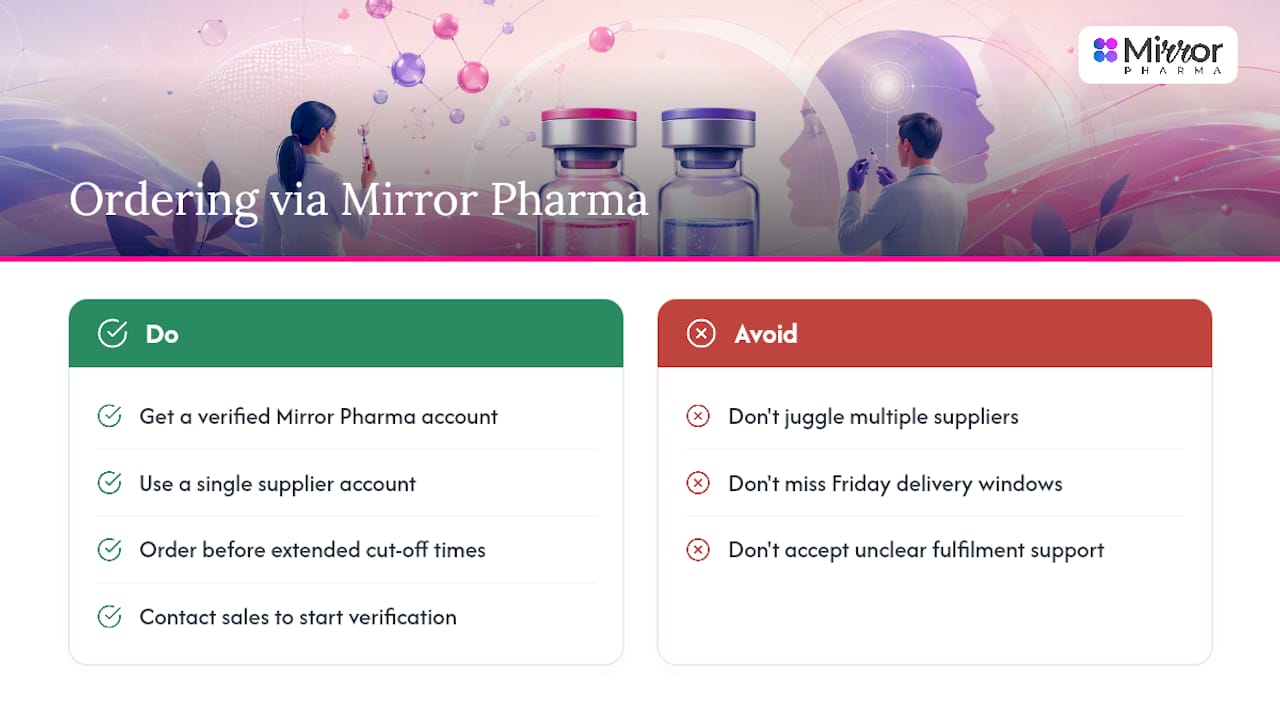
Qualified practitioners can view the toxins category to see current product ranges, or get in touch with the sales team to start account verification and set up ordering.
Sources
This article is general information, not a substitute for advice from a qualified doctor. Consult a qualified healthcare professional about your own circumstances before acting on anything here.
FAQ
Is one formulation better than the other?
Neither is universally better; both are botulinum toxin type A with comparable efficacy for standard cosmetic use, confirmed by head-to-head non-inferiority data. The purified, accessory-protein-free formulation has a theoretical edge for patients on long-term, high-dose therapeutic regimens where antibody resistance is a concern.
Which formulation lasts longer?
Duration is broadly similar between the two, commonly three to four months in real-world cosmetic practice. Individual factors like muscle mass, dose and metabolism affect longevity more than the formulation itself.
Is 20 units of one formulation the same as 20 units of the other?
Clinicians generally use a 1:1 practical dosing convention between these two type A formulations for common cosmetic sites. Units are not directly interchangeable with type B products or across all brands, so documenting the exact product and unit count at every visit remains essential.
What do practitioners use instead of these standard formulations?
Alongside the two purified and complexed type A options discussed here, clinics also stock other botulinum toxin type A products and complementary treatments such as dermal fillers and skin boosters for a fuller facial rejuvenation approach. Product choice ultimately depends on patient history, licensing in the practitioner’s region, and clinical judgement rather than a single default alternative.
Are the side effects different between the two formulations?
Common local side effects, such as bruising, mild swelling and transient asymmetry, are essentially the same across the class. Rare systemic risks from toxin spread are also shared, which is why regulatory safety warnings apply to botulinum toxin products generally rather than singling out one formulation.