
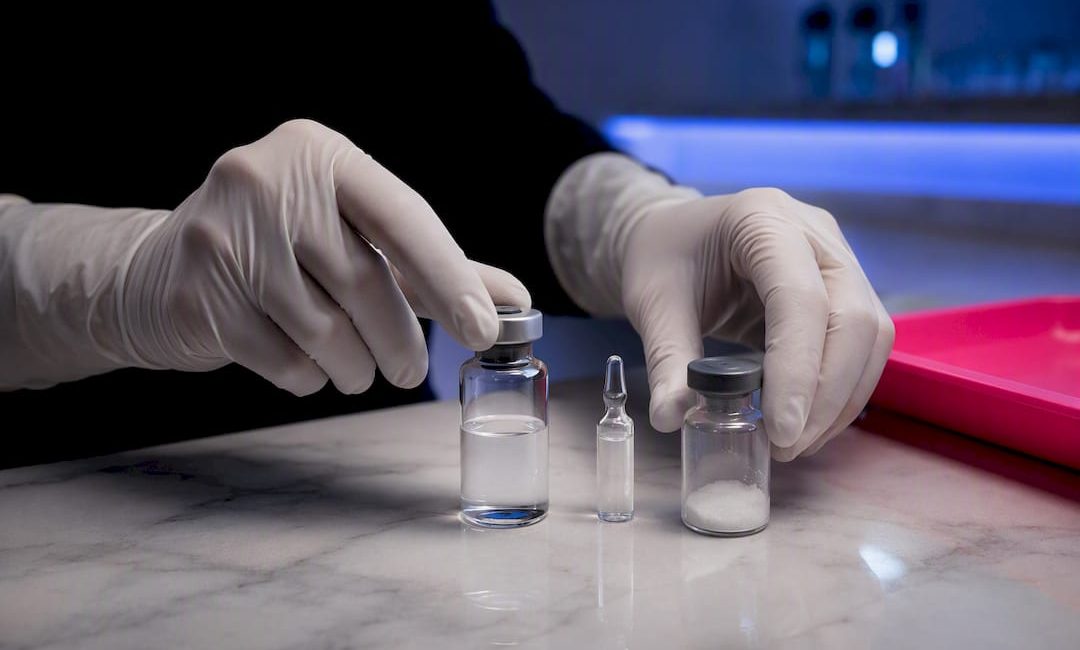
For licensed practitioners, ready-to-use liquid botulinum toxin simplifies preparation and reduces reconstitution error risk, while powder formulations retain established stability data and a longer clinical track record. Neither format is interchangeable with the other by unit, so dosing must follow product-specific labelling. Author-reviewed evidence, including SNAP-25 based potency assays and findings referenced by Pharmacological differences and clinical implications of various botulinum toxin preparations, and stock supplied through verified channels should anchor the final choice.
TL;DR:
- Ready-to-use liquid botulinum toxin eliminates reconstitution errors and reduces preparation time by approximately one minute per session compared to powder formulations.
- Liquid formulations require tighter cold-chain control and are supplied at a fixed concentration, whereas powders tolerate wider storage ranges and need manual reconstitution.
- Units are product-specific, and differences in protein load and enzyme activity are laboratory findings that do not guarantee clinical superiority without head-to-head trials.
- Proper reconstitution and storage practices, including verifying diluents and rotating stock, are critical to prevent errors and ensure product stability.
- Procurement should involve verifying supplier credentials, matching storage requirements, and trialing new formulations with detailed documentation before full switching.
Table of Contents
- Liquid botulinum toxin vs powder: the formulation science
- What the clinical evidence shows on onset, duration and immunogenicity
- Preparation time, error prevention and consumables in daily practice
- Storage, stability and where to check the regulatory picture
- Procurement checklist for switching or stocking a new formulation
- Balancing workflow gains against the evidence
- How Mirror Pharma supports verified practitioners
- Sources
- FAQ
Liquid botulinum toxin vs powder: the formulation science
The physical difference between the two formats starts at manufacture, not at the point of injection. Powder formulations are lyophilised or vacuum-dried, meaning the practitioner reconstitutes them with a diluent (typically preserved or unpreserved saline) immediately before use. Liquid formulations arrive pre-mixed at a manufacturer-set concentration, removing that reconstitution step entirely.
That distinction affects more than convenience. A ready-to-use liquid neuromodulator manufactured with PEARL technology is supplied at a predetermined concentration, which improves dosing consistency across a clinic compared with manual reconstitution, where dilution volume, mixing technique, and even needle gauge introduce variability from one practitioner to the next.
Protein load is the other variable worth tracking. Complexing proteins, the non-toxin proteins that accompany the active neurotoxin in some formulations, have long been discussed in relation to immunogenicity, though the clinical significance varies by product and is still debated among researchers. In vitro assays measuring specific enzyme activity, the kind of cell-based potency testing referenced in PEARL technology research, give a window into these differences at the molecular level, even where clinical head-to-head data remains thin.
What this means for prescribing decisions:
- Ready-to-use liquids remove the dilution step, so concentration is fixed by the manufacturer rather than set at the point of care.
- Powder formulations require the practitioner to select diluent volume, which directly determines the final unit concentration per millilitre.
- Units are product-specific. A unit of one toxin brand does not equal a unit of another, regardless of format, according to the critical appraisal of botulinum toxin preparations.
- Protein load and the presence of complexing proteins differ by product and manufacturing process, not simply by liquid versus powder status.
None of this changes the clinical fundamentals. Injection technique, anatomical knowledge, and dose selection still determine outcomes far more than the format sitting in the vial.
What the clinical evidence shows on onset, duration and immunogenicity
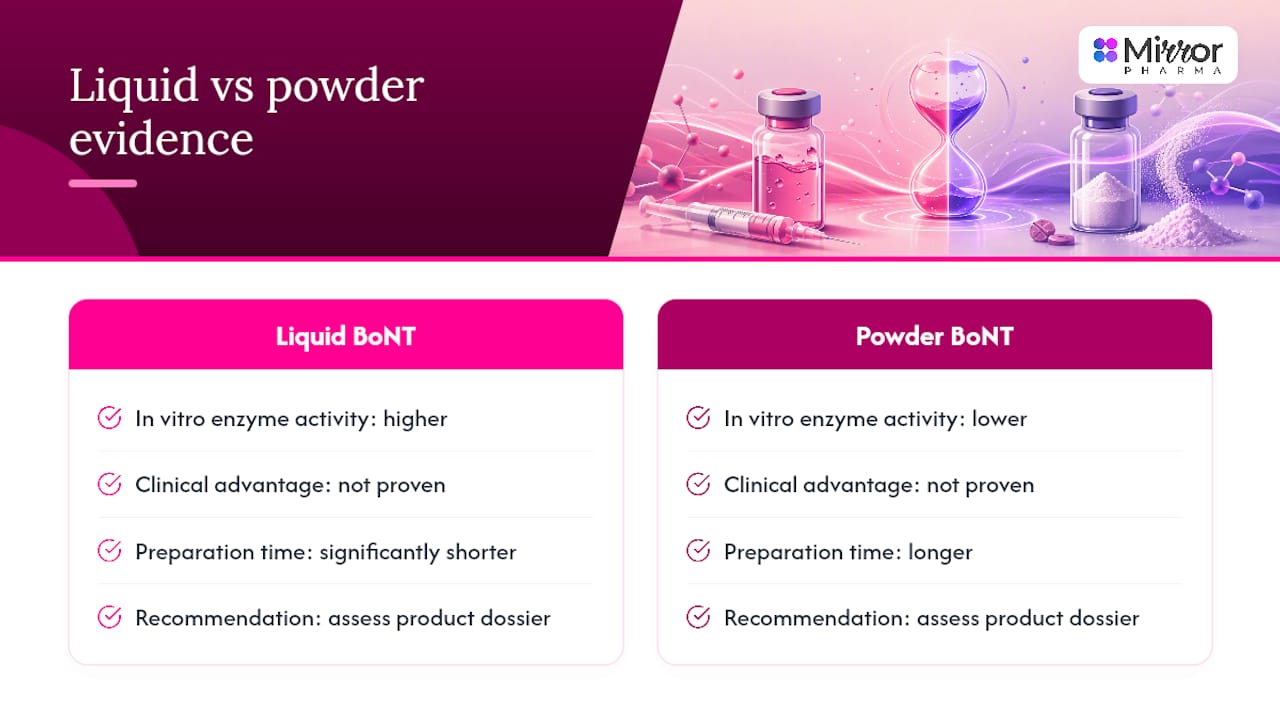
In vitro comparisons have found that at least one ready-to-use liquid product shows higher BoNT-A1 enzyme activity per on-label dose than a comparator powder product, based on cell-based assay work cited in PEARL technology research. That is a laboratory finding, not a clinical guarantee. Specific activity per dose measured in a cell-based assay tells you about biochemical potency under controlled conditions. It does not, on its own, prove faster onset or longer duration in a treated patient, because clinical outcome depends on diffusion, dosing technique, injection depth, and individual patient physiology as well as raw potency.
In vitro versus in vivo: a liquid formulation demonstrating stronger enzyme activity in a lab assay is a mechanistic signal worth noting, but it needs confirmation through head-to-head randomised trials before it can be called a proven clinical advantage.
Usability data tells a more concrete story about the preparation side of the equation. A trial comparing a ready-to-use liquid formulation against powder reported a significantly shorter mean preparation time for the liquid formulation compared to powder, according to the usability trial published on PubMed. That gap reflects preparation workflow, not clinical potency, but it is a real and measurable difference clinicians can plan around.
The honest position, supported by the pharmacological appraisal of botulinum toxin preparations, is that formulation-level differences in protein load, potency assay results, and preparation format do not substitute for product-specific clinical evidence. Treat each toxin on its own dossier.
Preparation time, error prevention and consumables in daily practice
Shaving a minute off reconstitution sounds trivial until you multiply it across a full injectables list. The 61 second average gap recorded between liquid and powder preparation in the abobotulinumtoxinA usability trial adds up over a day of back-to-back appointments, and it also removes several points where things commonly go wrong.
Reconstitution errors tend to cluster around a small number of predictable mistakes. Use this checklist to catch them before they reach the patient:
- Confirm the correct diluent (type and volume) against the specific product’s summary of product characteristics before drawing up.
- Double-check the calculated concentration against the intended dose, rather than relying on memory from a different product.
- Inspect the vial for correct reconstitution (no visible particulate, appropriate clarity) before drawing into the syringe.
- Label the prepared syringe or vial immediately with concentration and time, especially where more than one product is reconstituted in the same session.
- Discard and document any suspected contamination rather than proceeding on the assumption that aseptic technique held.
Small volume losses during transfer between vial, syringe, and needle are a known factor in reconstitution accuracy. Using low-dead-space needles and appropriately sized syringes reduces that loss and improves dosing precision, a point borne out in research on reconstitution technique and device selection. Liquid formulations also cut consumable use, since there is no saline vial or mixing syringe required for reconstitution, which trims both waste and material cost per session, according to PEARL technology research.
Pro Tip: Delegate reconstitution to a single named team member per clinic session wherever possible, and log the diluent volume, lot number, and preparation time on the patient record. A single point of accountability catches far more errors than a rotating roster ever will.
Storage, stability and where to check the regulatory picture
Powder formulations generally tolerate a wider storage temperature range before reconstitution and have a longer track record of stability data, which suits clinics with lower throughput or less predictable stock turnover. Liquid formulations typically demand tighter cold-chain control from the point of manufacture through to the treatment room, which rewards clinics with reliable refrigeration and steady, predictable demand.
Points worth building into your stock management routine:
- Rotate stock on a first-expiry, first-out basis regardless of format, and check the manufacturer’s stated shelf life rather than assuming parity across products.
- Preparation-related errors, including incorrect dilution and contamination during reconstitution, are recorded in pharmacovigilance systems such as the FDA’s FAERS database, a point highlighted in the review of liquid botulinum toxin innovation.
- Always confirm current licensing status and approved indications on your national regulator’s own product pages rather than relying on marketing material, since indications and storage guidance can be updated.
Procurement checklist for switching or stocking a new formulation
Choosing between formats is ultimately an operational decision as much as a clinical one, and it deserves the same rigour you would apply to any change in your treatment protocols. Before switching stock lines or adding a new formulation to your fridge, work through a short procurement checklist.
- Verify supplier credentials and prescriber verification processes before ordering, since prescription aesthetic medicines require full compliance checks at the point of sale.
- Confirm the supplier’s cold-chain and storage capability matches the formulation’s requirements, particularly for liquid products with tighter temperature tolerances.
- Check order cut-off times against your clinic’s booking schedule, so stock arrives before the appointments that depend on it.
- Pair toxin orders with the correct consumables, including needles and reconstitution supplies, rather than treating them as a separate purchasing decision.
- Trial a small batch of any new formulation before a full switch, and log onset, patient-reported comfort, and any adverse events against your existing product’s baseline.
A supplier dispatch model with extended order cut-off times and verification handled by a dedicated team of healthcare professionals supports predictable, low-friction procurement for clinics juggling multiple product lines.
Balancing workflow gains against the evidence
My reading of the data is straightforward: liquid formulations genuinely improve clinic workflow, and the preparation-time figures make that case well. But faster preparation is not the same claim as superior clinical outcome, and treating it that way overstates what the current evidence supports. Review the product literature for whatever you stock, pilot changes in small batches, document what you see, and keep an eye on head-to-head trials as they emerge rather than assuming today’s in vitro data settles the question.
— Rizwan
How Mirror Pharma supports verified practitioners
Mirror Pharma supplies prescription aesthetic medicines, including toxin formulations, dermal fillers, and the consumables that go with them, to verified healthcare professionals across the UK. Every order runs through strict practitioner verification, so stock only reaches trained hands. What sets the ordering experience apart is practical: extended order cut-off times mean a late-booked list does not have to mean a stock out, and a dedicated team of healthcare professionals handles fulfilment rather than a generic logistics desk. Whether you are comparing toxin formulations for the first time or restocking a proven line, browse the current catalogue and place your verified order ahead of your next clinic day. This content is educational and intended for licensed practitioners and qualified aesthetic professionals only.
This article is general information, not a substitute for advice from a qualified doctor. Consult a qualified healthcare professional about your own circumstances before acting on anything here.
Sources
- The botulinum toxin innovation: from powder to liquid
- Ready-to-use abobotulinumtoxinA solution versus powder …
- Pharmacological differences and clinical implications of various botulinum toxin preparations: a critical appraisal
FAQ
Does liquid botulinum toxin really work?
Yes. Ready-to-use liquid formulations deliver the same active neurotoxin as powder formulations, simply pre-mixed at a manufacturer-set concentration. Clinical effect depends on the specific product, dose, and injection technique rather than on format alone, as the pharmacological appraisal of toxin preparations makes clear.
What is the cleanest formulation of botulinum toxin?
There is no single agreed “cleanest” formulation. Some ready-to-use liquid products have shown lower protein load and higher specific enzyme activity per dose in vitro, according to PEARL technology research, but head-to-head clinical comparisons across all licensed products remain limited.
Is botulinum toxin a powder or a liquid?
It is supplied in both formats depending on the product. Traditional formulations are lyophilised powder that require reconstitution before injection, while newer ready-to-use liquid formulations arrive pre-mixed at a fixed concentration.
How does formulation choice affect preparation time?
Preparation time differs significantly between formats. A usability trial recorded a mean preparation time of 33 seconds for a ready-to-use liquid versus 1 minute 34 seconds for powder (p < 0.0001), based on findings from the abobotulinumtoxinA usability trial.
Where can practitioners source verified toxin stock?
Verified practitioners can source toxin formulations through Mirror Pharma, which requires prescriber verification before dispatch and supports orders with extended cut-off times. Current pricing for specific products is listed on the site.