

Semaglutide is a prescription-only GLP-1 receptor agonist, and in the UK the route to prescribing it depends on the indication. Type 2 diabetes follows the NICE diabetes pathway. Weight management follows separate NICE guidance, and in England NHS supply runs through specialist weight management services. This guide is for licensed prescribers and qualified aesthetic and wellness professionals who need to understand the criteria, the assessment and the review points before they prescribe or supply.
It is written for registered healthcare professionals. It is not advice for members of the public, and semaglutide can only be started after an individual assessment by a prescriber.
TL;DR
- Semaglutide is licensed in the UK as separate products for type 2 diabetes (injection and tablet) and for weight management. The diabetes products are not licensed for weight management (GOV.UK).
- NICE recommends the weight management product for adults with a BMI of at least 35.0 kg/m² plus a weight-related comorbidity, or 30.0 to 34.9 kg/m² if referral criteria for specialist services are met (NICE TA875).
- In England, NHS prescribing for weight management sits with specialist weight management services, for up to 2 years (NHS England).
- Whatever the route, remote or in person, you need an adequate assessment, a dialogue with the patient and documented consent (GMC guidance summarised by MDDUS).
- Plan monitoring, safety-netting and a stopping rule before the first dose.
Table of Contents
- What semaglutide is prescribed for in the UK
- Prescribing for weight management: NICE criteria
- How the UK nations differ
- Can a GP or other professional prescribe semaglutide?
- NHS and private prescribing: what differs
- Prescribing for type 2 diabetes
- Starting, escalating and reviewing treatment
- Safety checks and what to tell patients
- Perspective
- Sourcing semaglutide for your practice
- FAQ
- Sources
What semaglutide is prescribed for in the UK
Semaglutide is a once-weekly injectable or once-daily oral GLP-1 receptor agonist. UK regulators treat it as three licensed products with different indications, and the GOV.UK guidance on GLP-1 medicines is the clearest statement of the split. Two products are licensed for type 2 diabetes alongside a reduced-calorie diet and exercise: a subcutaneous pen and an oral tablet. Neither is licensed for weight management. The third product is licensed for weight management (GOV.UK).
This matters in practice for three reasons:
- The indication drives the product. A prescription written for weight management should use the product licensed for it. Using a diabetes product for weight loss is off-label, and the prescriber carries responsibility for that decision.
- The funding pathway differs. Diabetes prescribing sits in primary and secondary diabetes care. Weight management prescribing, on the NHS, sits in specialist services.
- Biological medicines are prescribed by brand. The BNF notes that biological medicines must be prescribed and dispensed by brand name, so your prescription and your record must identify the exact product, not just the molecule (BNF).
For a side-by-side look at the oral and injectable formulations, including absorption differences, see our oral vs injectable semaglutide comparison. If you are weighing semaglutide against another incretin-based option, our tirzepatide vs semaglutide clinical comparison and our note on semaglutide vs liraglutide cover the prescribing differences.
Prescribing for weight management: NICE criteria
NICE technology appraisal TA875 sets the eligibility criteria for the weight management product. It recommends use in adults with at least one weight-related comorbidity and a BMI of at least 35.0 kg/m², or a BMI of 30.0 to 34.9 kg/m² if they meet NICE criteria for referral to specialist overweight and obesity services (NICE TA875).
Two further points from the same guidance shape every prescribing decision:
- Ethnicity-adjusted thresholds. BMI thresholds are usually reduced by 2.5 kg/m² for people from South Asian, Chinese, other Asian, Middle Eastern, Black African or African-Caribbean family backgrounds (NICE TA875). Record the family background you used when applying a threshold.
- Time-limited use within a service. NICE specifies a maximum of 2 years, within a multidisciplinary specialist weight management service. Treatment may be stopped if less than 5% of initial weight is lost after 6 months (NICE TA875).
A quick eligibility check
| Question | What to confirm | Source |
|---|---|---|
| Is the patient an adult? | Aged 18 or over | NICE TA875 |
| What is the BMI? | At least 35.0, or 30.0 to 34.9 if specialist referral criteria are met | NICE TA875 |
| Is there a weight-related comorbidity? | Required for the higher-threshold route | NICE TA875 |
| Does an ethnicity adjustment apply? | Thresholds usually lowered by 2.5 kg/m² | NICE TA875 |
| Is it part of a wider programme? | Behavioural support alongside medication | NICE TA875, Welsh pathway |
This table is a screening aid, not a replacement for reading the guidance and the current summary of product characteristics.
How the UK nations differ
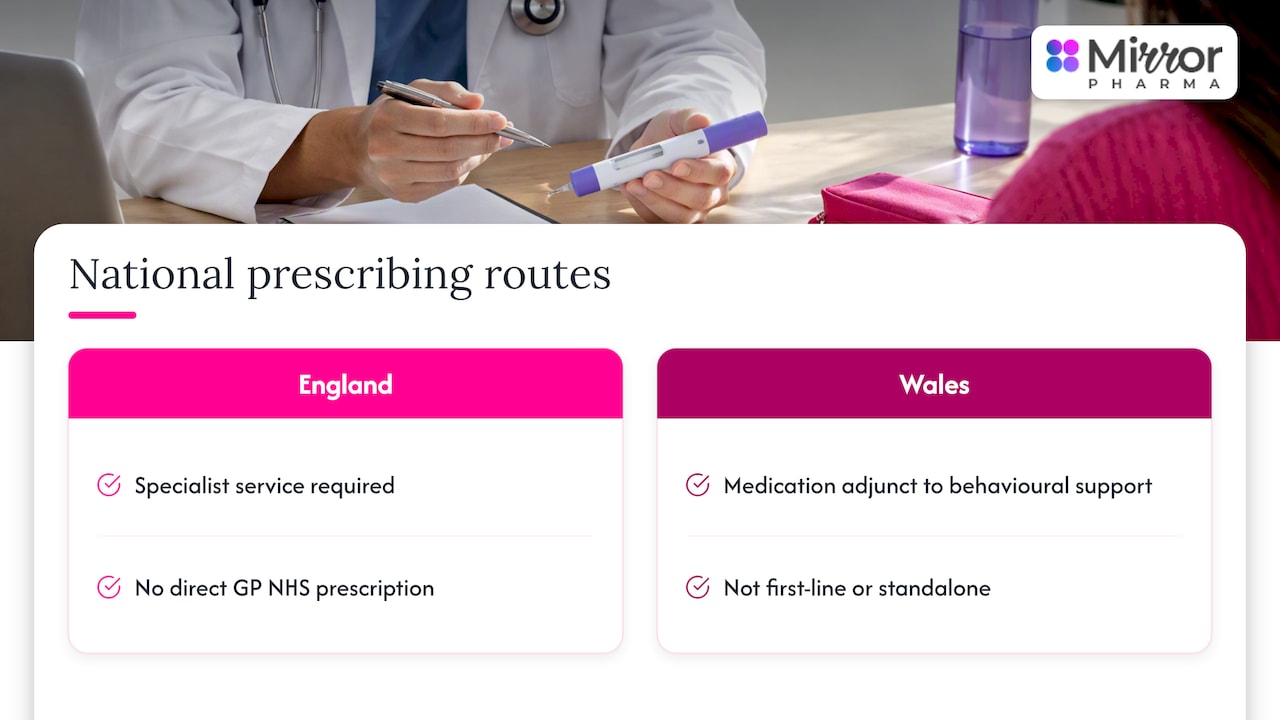
In England, NHS Wegovy-type prescribing for weight management can only happen through a specialist weight management service. NHS England sets out this arrangement on its weight management injections page (NHS England). A patient does not simply present to a GP and receive an NHS prescription for the weight management product.
Wales takes a clear stance on sequencing. Its weight management medication pathway addendum says medication should be an adjunct to behavioural interventions, not a first-line or standalone treatment (Welsh Government). If you work across borders, check the pathway for the nation where the patient is registered, because local commissioning and referral routes can differ even where the NICE criteria are shared.
Can a GP or other professional prescribe semaglutide?
The legal answer is that any appropriately qualified, registered independent prescriber working within their competence can prescribe a prescription-only medicine. The practical answer is narrower, because competence, commissioning and the licence all apply.
What the regulator-level guidance asks of you is consistent:
- Make an adequate assessment. GMC guidance on good practice in prescribing says that before prescribing remotely you must assess the patient adequately, establish a dialogue and obtain consent. Where you doubt you can assess safely, a face-to-face consultation is needed (MDDUS summary of GMC guidance).
- Prescribe only when you have enough information. The same summary stresses issuing a prescription only when you have sufficient information to justify that the medicine is needed and safe.
- Work within your competence. If weight management or diabetes prescribing is outside your scope or experience, refer on rather than prescribe.
Pharmacist and nurse independent prescribers follow the same principle through their own regulators. For online services, the GPhC publishes guidance for registered pharmacies providing services at a distance, covering how prescription-only medicines are supplied remotely (GPhC).
What a sound assessment records
- Indication and licence status of the chosen product.
- Measured height, weight and BMI, not self-reported figures alone.
- Comorbidities, current medicines and relevant history, including pancreatitis, gallbladder disease, eating disorders and pregnancy plans.
- Previous weight management attempts and the behavioural support in place.
- Consent, including the patient’s understanding of side effects and what to do if they arise.
- Follow-up dates and the criteria for stopping.
NHS and private prescribing: what differs
The clinical standard is the same on both routes. The differences are in access and structure.
| Area | NHS route | Private route |
|---|---|---|
| Who prescribes | Specialist weight management service in England for weight management | A registered prescriber working within their competence |
| Eligibility | NICE criteria apply | Prescriber judgement against the licence and guidance |
| Duration | Up to 2 years in a specialist service | Set by the prescriber and review plan |
| Wider support | Multidisciplinary programme | Must be arranged and documented by the prescriber or service |
| Supply | NHS pharmacy dispensing | Dispensing by a registered pharmacy against a valid prescription |
A private prescriber is not bound by NICE funding criteria, but NICE guidance remains the benchmark a regulator or indemnifier would expect you to be able to justify any departure from. Document your reasoning when a patient falls outside the criteria.
Prescribing for type 2 diabetes
Diabetes prescribing is a different conversation from weight management. NICE guideline NG28, updated in February 2026, recommends subcutaneous semaglutide at doses up to 1 mg once weekly for adults with type 2 diabetes and atherosclerotic cardiovascular disease, to provide cardiovascular, renal and glycaemic benefits (NICE NG28).
The differences from weight management prescribing are worth stating plainly:
- The goal is glycaemic and cardiovascular risk management, not a BMI target.
- The product is licensed alongside diet and exercise for this indication.
- Care sits within the diabetes pathway, with its own monitoring, such as HbA1c review.
For professionals sourcing products for licensed diabetes use, our catalogue includes the once-weekly pens, for example the 0.5 mg pre-filled pen and the 1 mg pre-filled pen, as well as oral options such as the 3 mg tablets and 14 mg tablets. These are supplied only to verified practitioners and prescribers.
Starting, escalating and reviewing treatment
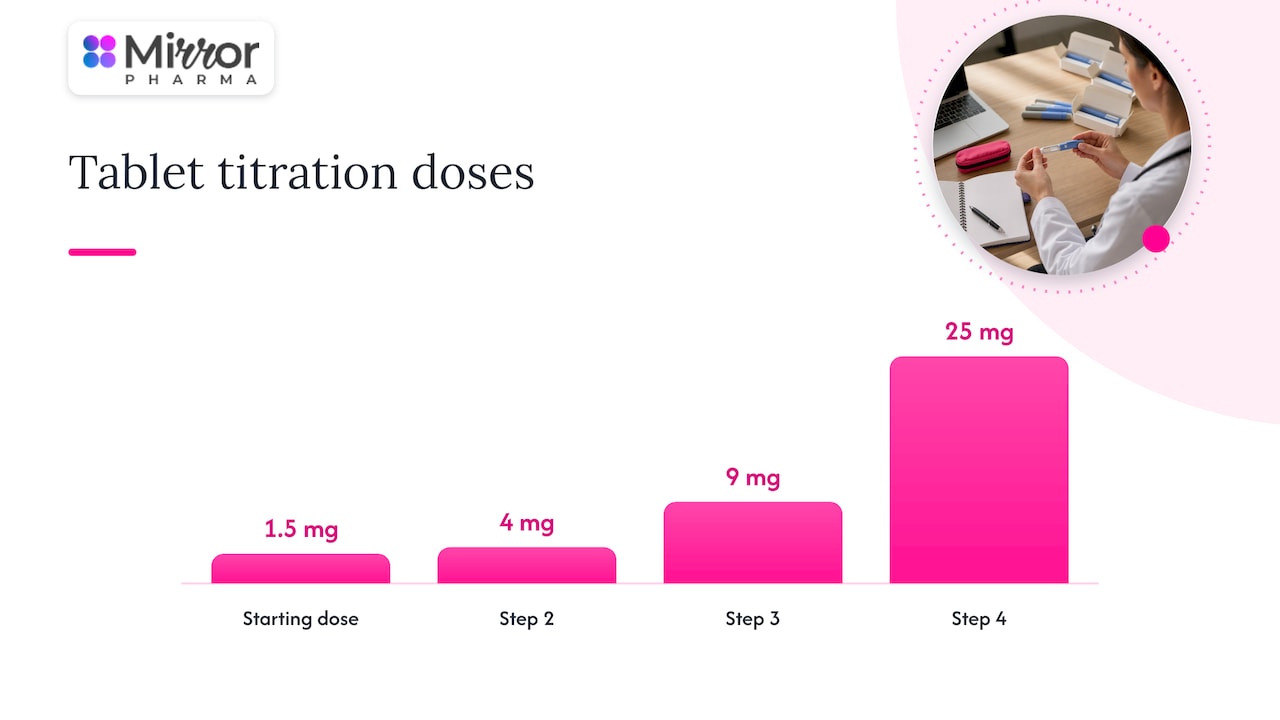
Dose titration is gradual by design. The summary of product characteristics for the specific product is the authority on the schedule, and the figures differ between the injection and the tablet. As an example from the recent approval news, the weight management tablet is reported to start at 1.5 mg once daily, rising through 4 mg, 9 mg and 25 mg with a minimum of one month at each step (MHRA announcement). Always check the current SmPC before you write the titration plan.
A workable review structure:
- Baseline. Weight, BMI, blood pressure, relevant bloods, medicines review.
- Each escalation step. Tolerability, gastrointestinal symptoms, hydration, adherence.
- Six months. Apply the NICE stopping consideration: where less than 5% of initial weight has been lost, discuss stopping (NICE TA875).
- End of the planned course. For NHS weight management, a maximum of 2 years within the specialist service applies, so agree the exit plan early.
Patients should know that medication sits alongside diet, activity and behavioural support. Promise no particular outcome: response varies between individuals.
Safety checks and what to tell patients
This is where prescribers add the most value. The official safety messages are specific.
- Acute pancreatitis. Rare but serious. It presents as severe, persistent abdominal pain that may radiate to the back. Patients should stop the medicine and seek urgent medical help if this occurs (GOV.UK).
- Vision changes. Semaglutide has, in very rare cases, been associated with non-arteritic anterior ischaemic optic neuropathy (NAION). Advise urgent medical attention for sudden vision changes (GOV.UK).
- Hypoglycaemia in people without diabetes. The MHRA’s Drug Safety Update of October 2024 asks healthcare professionals to be aware that hypoglycaemia can occur in non-diabetic patients using some GLP-1 receptor agonists for weight management. Tell patients the signs and symptoms and when to seek urgent advice (MHRA Drug Safety Update).
Build these into the consultation and the written information you give. Check the current SmPC for contraindications, interactions (including oral contraception considerations and other glucose-lowering medicines) and advice for pregnancy and breastfeeding, and report suspected adverse reactions through the Yellow Card scheme.
Perspective
From where we sit, supplying verified prescribers every day, the clinics that prescribe semaglutide well are the ones that treat the prescription as the middle of a pathway, not the start or end of it. They match the licensed product to the indication, record the assessment properly and decide the stopping rule before the first dose.
Supply matters too. A titration plan only works if the right strength arrives when the patient needs the next step. That is why we built our ordering around strict practitioner and prescriber verification, a smooth online checkout and extended order cut-off times, with orders fulfilled by a dedicated team of healthcare professionals. Our aim is simple: help licensed practitioners keep their patients on the plan they designed.
We would rather a prescriber read the guidance twice and order once.
Rizwan
Sourcing semaglutide for your practice
If you are a licensed prescriber or run a clinic, our weight loss category lists the GLP-1 and related products we supply to verified professionals, including the once-weekly weight management pen. Access requires practitioner or prescriber verification. For wider reading, our overview of weight management medications is written for qualified aesthetic and healthcare professionals.
FAQ
What are the NHS criteria for prescribing semaglutide for weight management?
NICE recommends it for adults with a weight-related comorbidity and a BMI of at least 35.0 kg/m², or 30.0 to 34.9 kg/m² if specialist referral criteria are met. Thresholds are usually lowered by 2.5 kg/m² for certain ethnic backgrounds. In England it is provided through a specialist weight management service (NICE TA875).
Can a GP prescribe semaglutide?
A GP is a registered prescriber and can prescribe it for licensed type 2 diabetes use under the NICE pathway. For NHS weight management in England, prescribing sits with specialist services (NHS England). Any prescriber must assess adequately and work within their competence.
How long can semaglutide be prescribed for weight management on the NHS?
NICE specifies a maximum of 2 years within a multidisciplinary specialist service. Treatment may stop earlier if less than 5% of initial weight is lost after 6 months (NICE TA875).
Is a face-to-face consultation always required?
Not always, but remote prescribing needs an adequate assessment, a dialogue with the patient and consent. If you cannot assess safely remotely, GMC guidance points to seeing the patient in person (MDDUS summary).
Which safety warnings should be given to patients?
Advise on acute pancreatitis symptoms, sudden vision changes and, for weight management use, hypoglycaemia signs, and say when to seek urgent help (GOV.UK).
Sources
- GLP-1 medicines for weight loss and diabetes: what you need to know, GOV.UK
- NICE TA875: Semaglutide for managing overweight and obesity
- NHS England: Weight management injections
- Welsh Government: Weight management medication pathway addendum
- NICE NG28: Type 2 diabetes in adults, initial medicines
- MHRA Drug Safety Update, October 2024
- MDDUS: Remote prescribing
- GPhC: Guidance for registered pharmacies providing pharmacy services at a distance
- BNF: Semaglutide
- MHRA: First GLP-1 tablet for weight loss approved in the UK