

Deoxycholic acid injected into submental fat has a favourable safety profile when it is used in the licensed area, at the right depth, by a trained prescriber. Most side effects are local and temporary. The serious ones, such as marginal mandibular nerve injury, dysphagia and skin necrosis, are uncommon and largely linked to technique. This guide is for licensed practitioners and qualified aesthetic professionals who prescribe or administer these treatments, and it covers the risks, the precautions and the first response when something goes wrong. It is educational material, not advice for members of the public.
TL;DR
- Deoxycholic acid is indicated for moderate to severe convexity or fullness of submental fat in adults, where it has an important psychological impact on the patient.
- Common effects are swelling, bruising, pain, redness and numbness at the injection site. They are usually transient.
- Serious events include marginal mandibular nerve paresis (4% of subjects in one pooled dataset), dysphagia, ulceration or necrosis, alopecia and infection. Most are procedure related and avoidable.
- Use outside the submental area is not recommended, and the FDA has added a labelling warning about it.
- Check bleeding disorders and anticoagulant use, landmark carefully, keep the injection out of the dermis and work aseptically.
Table of Contents
- What deoxycholic acid is used for
- Common side effects and how long they last
- Serious complications to recognise
- Who should not be treated, and what to check first
- Technique that lowers risk
- Treating outside the chin
- Storage and handling
- Our perspective
- Sourcing for qualified practitioners
- FAQ
- Sources
What deoxycholic acid is used for
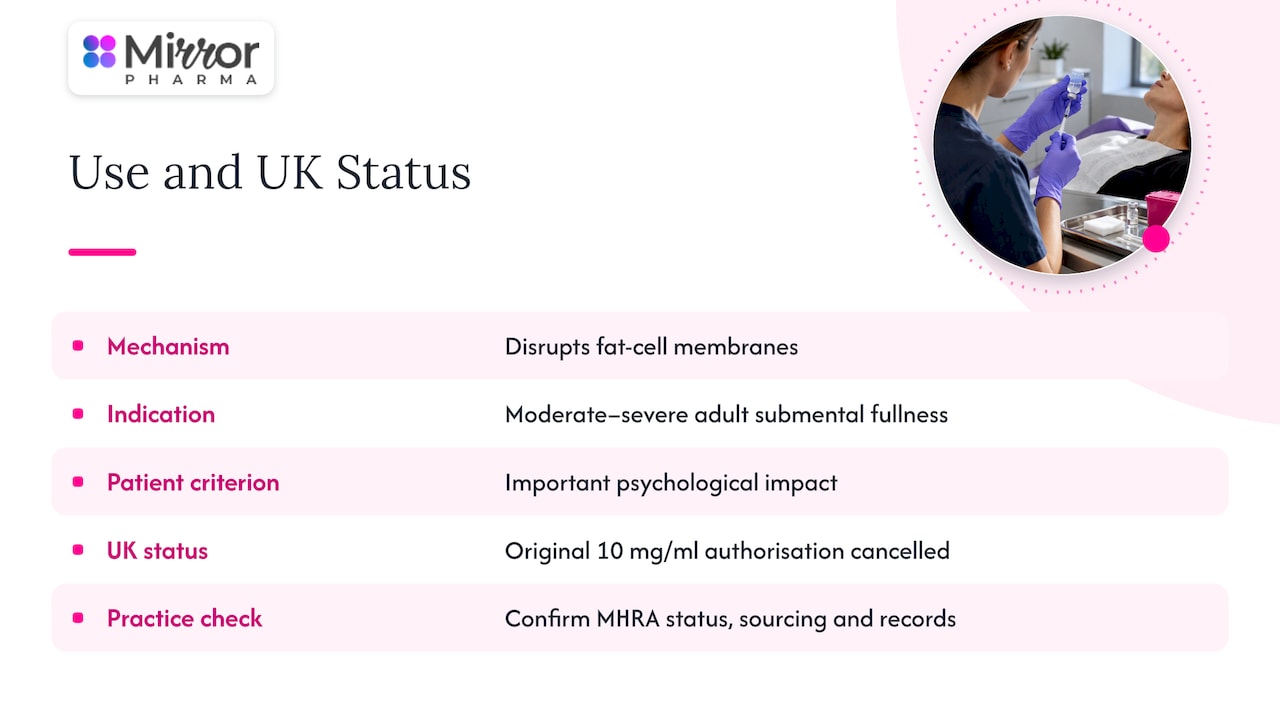
Deoxycholic acid is a bile acid that disrupts cell membranes in fat tissue. The injectable form is indicated for moderate to severe convexity or fullness associated with submental fat in adults when its presence has an important psychological impact for the patient. That wording matters clinically. It describes a defined indication and a defined patient, not a general body-contouring tool.
The regulatory position in the UK is worth checking before you stock or prescribe anything. The marketing authorisation for the original branded 10 mg/ml product is listed as cancelled. Practitioners should therefore confirm the status, sourcing and documentation of any injectable fat-reduction product with the MHRA and their own indemnity provider, and keep the product’s batch and supply records. Our own overview of deoxycholic acid injections for practitioners covers the practical treatment timeline.
Common side effects and how long they last
Expect local reactions in most patients. Reported effects include swelling, redness, bruising, pain and numbness at the injection site. Swelling is typically the most noticeable, and it can make the area look larger for several days before it settles. Numbness can persist for weeks. Hardness or nodularity in the treated tissue is also described.
A 2025 tolerability study reported that adverse effects were mild to moderate, with tenderness, pain, swelling and numbness at the injection site, plus a globus sensation in some patients. Timelines vary between patients and between treatment sessions, so give ranges rather than promises at consent.
What to tell the patient before treatment:
- Swelling and bruising are expected and can be marked.
- Numbness is common and usually temporary, but its duration is not predictable.
- Several sessions are usually needed, and results cannot be guaranteed.
- Who to call, and how quickly, if they notice a weak or asymmetric smile, trouble swallowing, skin blanching or severe pain.
Our fat dissolving aftercare guide for UK clinics sets out the written aftercare points you can adapt to your own protocols.
Serious complications to recognise
The most useful practitioner-facing evidence is a 2024 systematic review of serious adverse events. It describes marginal mandibular nerve injury, dysphagia, skin ulceration or necrosis, alopecia and infection, and concludes that most are procedure related and avoidable.
Marginal mandibular nerve injury
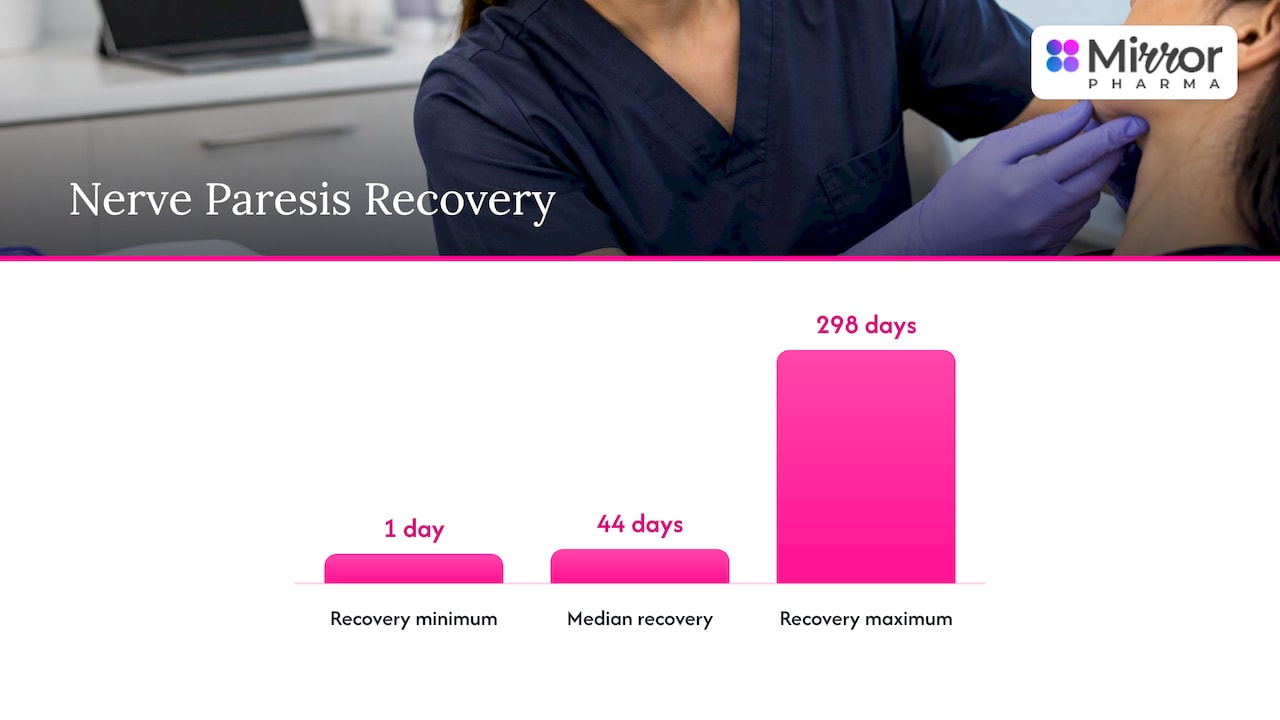
This is the complication practitioners worry about most. In the pooled data, marginal mandibular nerve paresis occurred in 4% of subjects (20/513) and resolved in 1 to 298 days, with a median of 44 days. It can present as an asymmetric smile or weakness of the lower facial muscles. Reviewers attribute nerve injury to demyelination or inflammation caused by the deoxycholate, and note that it is often dose dependent.
If you suspect nerve involvement, document it, reassure the patient honestly that recovery is reported in the literature but not guaranteed, and arrange review. Some experts suggest that botulinum toxin to the non-paralysed depressor anguli oris can reduce visible asymmetry while the nerve recovers. That is a clinical judgement for an appropriately trained prescriber, not a routine step.
Skin ulceration and necrosis
Injection that is too superficial puts the product into or near the dermis. The review notes that dermal injections increase the risk of skin ulceration and necrosis. Warning signs are blanching, a dusky or violaceous patch, severe or disproportionate pain, and blistering. Stop injecting, assess, and escalate early. Severe necrosis or infection may need surgical or specialist medical care.
Dysphagia
Difficulty swallowing is rare but reported, and it needs prompt assessment. Any patient who reports it after treatment should be seen the same day by a qualified clinician rather than managed by phone alone.
Infection and alopecia
Poor sterile technique can lead to cellulitis or abscess formation. Alopecia is also listed among the serious events in the 2024 review, which is relevant in patients with beard growth in the treated area. Include both in consent discussions.
Who should not be treated, and what to check first
The patient selection starts with the indication: an adult with moderate to severe submental fullness that is not mainly skin laxity or a platysmal band problem, and where the fullness matters to them. Beyond that, consider the following.
| Check | Why it matters |
|---|---|
| Bleeding disorder or anticoagulant therapy | Excessive bruising or haematoma risk is the labelled concern, so caution is advised |
| Age under 18 | The manufacturer states that safety and efficacy have not been established in people younger than 18 |
| Active infection or inflammation in the area | Raises the risk of spread and delayed healing |
| Previous surgery, filler or neck treatment | Altered anatomy can change where vessels and nerves sit |
| Unrealistic expectations | Safety and satisfaction both suffer when the patient expects a surgical result |
A full medical history, a record of current medicines and a documented consent conversation are the baseline. Use the product’s own prescribing information and your professional body’s guidance for the complete list of contraindications and warnings.
Technique that lowers risk
The 2024 review’s management recommendations reduce to three habits. Practitioners should landmark the anatomy to avoid vulnerable structures, avoid superficial intradermal injection and keep strict aseptic technique.
- Map the treatment area. Mark the submental region and keep clear of the marginal mandibular nerve zone along the jawline. Stay within the safe zone of your training.
- Respect dose and spacing. Because nerve injury is often dose dependent, follow the product information on volumes, injection spacing and session intervals rather than treating more in one visit.
- Inject into the subcutaneous fat, not the dermis. Choose needle length and angle with this in mind.
- Work aseptically. Clean the skin, use single-use sterile needles and syringes, and dispose of sharps properly.
- Plan for the first 48 hours. Give written instructions and an out-of-hours contact.
- Keep the treatment record complete. Note product, batch, volume, sites and any early reactions.
If a complication does occur, management may involve anti-inflammatory medication, and in severe necrosis or infection, surgical or professional medical intervention. Do not wait for a patient to “see how it settles” when the signs point to vascular or neurological involvement.
Treating outside the chin
Search interest in treating other areas is high, so this question reaches your consulting room. The FDA’s position is clear: the product is not approved for use outside the submental region, such use is not recommended and serious adverse events may occur. The agency specifically warns that neuromuscular and other serious events can result.
A registered trial on the upper inner thigh even states in its own description that the treatment may not be a safe and effective option for that site, which shows how unsettled the evidence is. For a practitioner, that means off-site treatment is outside the evidence base, outside the labelling and a point of real medicolegal exposure. If a patient asks, explain why you will not do it.
Storage and handling
Storage conditions differ by product, pack and supplier, and we have not found a UK-specific instruction we can safely generalise. Follow the storage temperature, light protection and in-use limits in the summary of product characteristics and patient leaflet that come with your specific product. On receipt, check the packaging is intact, the expiry date is clear and the product is stored as labelled. Quarantine anything that arrives out of condition and report it to your supplier. A discoloured or particulate-containing solution should not be used.
Our perspective
We supply practitioners, so we see the same pattern in the questions that reach us: safety problems are rarely about the molecule alone. They come from patient selection, depth, volume and follow-up.
Our view is simple. Treat the licensed indication, not the patient’s wish list. Keep documentation tight, and make sure every patient leaves knowing the early warning signs. We verify that buyers are qualified practitioners or prescribers, because a product in the wrong hands is itself a safety risk. If you are building a fat-reduction pathway, build the complication plan first and the treatment menu second.
— Rizwan
Sourcing for qualified practitioners
If you are a licensed prescriber building a localised fat treatment service, you can browse our fat dissolving range and the needles and consumables you need for aseptic technique. Access is for verified practitioners and prescribers only, with orders placed online and extended order cut-off times to help you meet your clinic schedule. For a wider view of the category, see our localised fat treatment archive.
FAQ
Is deoxycholic acid safe?
In the licensed submental indication, trials describe a favourable safety profile, with mostly transient local effects. Serious events are uncommon but real, and most are linked to technique. No injectable treatment is risk-free, so consent should reflect that.
What are the most serious risks for practitioners to know?
Marginal mandibular nerve injury, dysphagia, skin ulceration or necrosis, alopecia and infection. In pooled data, nerve paresis occurred in 4% of subjects and resolved in a median of 44 days. Early recognition and escalation are the priority.
Can deoxycholic acid be used outside the chin area?
The FDA says it is not approved outside the submental region and that such use is not recommended, because serious adverse events may occur. Licensed practitioners should treat off-site use as outside the evidence and the labelling.
Who should be treated with caution?
Patients with bleeding abnormalities or on anticoagulants, because of bruising and haematoma risk. Adults only, since safety in under-18s has not been established. Use the full prescribing information for the complete list.
Sources
- Deoxycholic acid 10 mg/ml solution for injection: new product summary (NHS Specialist Pharmacy Service)
- Freedom of information response on marketing authorisation status (GOV.UK)
- Management of serious adverse events following deoxycholic acid injection (PMC, 2024)
- Lipolytic agents for submental fat reduction: review (PMC, 2024)
- FDA prescribing information for deoxycholic acid injection
- FDA drug safety communication on use outside the submental region
- Side effects of deoxycholic acid (Synapse)
- ClinicalTrials.gov