

GLP-1 dosing schedules follow a stepwise titration model: injectable agents increase in fixed increments roughly every 4 weeks, while oral semaglutide follows 30-day steps with strict fasting rules. The exact starting dose, increment size, and maintenance target vary by drug and by indication (diabetes versus weight management), so the sections below break down each schedule and the missed-dose rules that go with it. This guide is written for licensed practitioners and for individuals already prescribed one of these medicines who want the precise label-based steps.
TL;DR:
- Tirzepatide’s titration schedule is longer than semaglutide’s weight management protocol due to its additional dose tiers, requiring more time to reach the maximum dose.
- Oral semaglutide reaches maintenance faster in calendar time compared to injectable schedules but demands strict fasting and timing rules for optimal absorption.
- Missed weekly doses should generally be taken within five days, but skipping and resuming the regular schedule is advised if more than five days pass; daily oral doses are simply skipped if missed.
- Safety concerns such as persistent vomiting, severe pain, or signs of allergic reactions require immediate medical attention and prescriber consultation.
- Proper site rotation, timing, and hydration are key to minimizing injection site reactions and GI side effects, with specific adjustments recommended for tolerance or response issues.
Table of Contents
- GLP-1 dosing schedule by drug: semaglutide, tirzepatide and liraglutide
- Comparing time to maintenance across GLP-1 agents
- What to do about a missed GLP-1 dose
- Injection sites, timing and food: what actually matters
- Adjusting the schedule when tolerance or response isn’t right
- How prescribers set and adjust the dose
- Safety signs that mean it’s time to call your prescriber
- Counselling notes for clinics running GLP-1 titration
- Mirror Pharma: supporting practitioners through GLP-1 treatment protocols
- Sources
- FAQ
GLP-1 dosing schedule by drug: semaglutide, tirzepatide and liraglutide
Every GLP-1 receptor agonist starts low and climbs gradually. The point of the climb isn’t caution for its own sake, it’s giving the gut time to adapt before the dose that actually does the metabolic work. Here’s how each agent’s schedule plays out, using international non-proprietary names (INN) rather than brand terms.
Semaglutide, injectable, diabetes indication. The standard schedule starts at 0.25 mg once weekly for four weeks, purely as a tolerability-priming dose with minimal glycaemic effect. It then steps up to 0.5 mg weekly as the initial maintenance dose. If glycaemic targets aren’t met, prescribers can escalate further to 1 mg and then 2 mg weekly, with at least four weeks at each prior dose before the next increase, according to the OZEMPIC prescribing information.
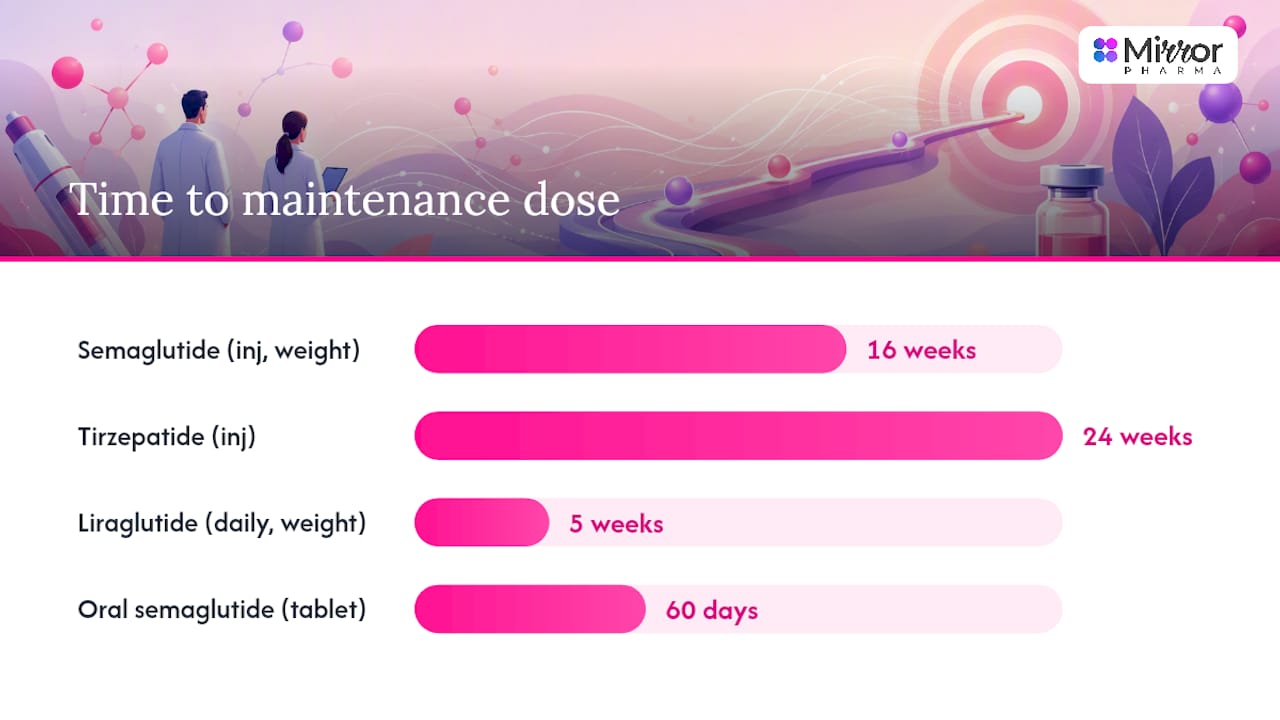
Semaglutide, injectable, weight management indication. This pathway runs longer: five dose steps over 16 weeks, reaching a higher ceiling than the diabetes protocol. The sequence is 0.25 mg, then 0.5 mg, then 1.0 mg, then 1.7 mg, each held for four weeks, before reaching the 2.4 mg weekly maintenance dose, as detailed in the dosing tables on NCBI Bookshelf. That extra step (1.7 mg) doesn’t exist in most diabetes titration schedules, which is why the two indications shouldn’t be confused when reading a patient’s history.
Tirzepatide. This dual GIP/GLP-1 agonist starts at 2.5 mg once weekly for four weeks, a dose chosen for tolerability rather than efficacy. From there, it increases by 2.5 mg every four weeks: 5 mg, then 7.5 mg, then 10 mg, then 12.5 mg, then 15 mg as the maximum weekly dose, per the GLP-1 titration reference. Reaching the top dose takes considerably longer than semaglutide’s weight-management schedule, purely because there are more rungs on the ladder.
Liraglutide. Dosed daily rather than weekly, which changes the rhythm entirely. For diabetes, it starts at 0.6 mg daily, increases weekly to 1.2 mg, with an optional further step to 1.8 mg for patients needing additional glycaemic control. For weight management, the increments are larger: 0.6 mg increases each week climbing to a 3.0 mg daily maintenance dose. Because dosing is daily, missed-dose logic differs from the weekly agents, so liraglutide patients should follow their specific product label rather than assuming weekly rules apply.
Oral semaglutide. The only tablet formulation in this group, and its schedule is built around 30-day blocks rather than four-week ones: 3 mg once daily for 30 days, then 7 mg once daily for another 30 days, then 14 mg once daily as the maintenance dose, according to the EMA product information for oral semaglutide. It must be taken on an empty stomach, with no more than 120 mL of plain water, and food must wait at least 30 minutes. Miss that window and absorption drops sharply, which is a different failure mode entirely from the injectables.
A few points apply across all of these:
- Every agent uses generic (INN) naming in clinical and patient literature, not brand shorthand.
- No schedule allows skipping steps to “catch up” faster: each increment needs its full interval before the next.
- Escalation beyond the initial maintenance dose is almost always optional and driven by response, not automatic.
Comparing time to maintenance across GLP-1 agents
Reaching the labelled maintenance dose takes a different number of weeks depending on which drug you’re on and which indication it’s prescribed for. The table below draws only on figures confirmed in product labelling and clinical dosing tables.
| Agent (indication) | Starting dose | Increment | Time to maintenance | Step extension permitted |
|---|---|---|---|---|
| Semaglutide (diabetes) | 0.25 mg weekly | +0.25 to +1 mg per step | a few weeks to initial maintenance (0.5 mg); optional further steps | Yes, for intolerance |
| Semaglutide (weight management) | 0.25 mg weekly | Five steps to 2.4 mg | several weeks | Yes, for intolerance |
| Tirzepatide | 2.5 mg weekly | +2.5 mg every 4 weeks | a longer period to 15 mg maximum | Yes, per label |
| Oral semaglutide | 3 mg daily | 3 mg → 7 mg → 14 mg | about two months to maintenance | Prescriber-directed |
The practical takeaway is that tirzepatide’s full titration runs longer than semaglutide’s weight-management schedule, simply because it has more dose tiers between the starting point and the ceiling. Oral semaglutide, despite being a tablet, reaches maintenance faster in calendar time than either injectable weight-management schedule, though its fasting requirement makes daily administration less forgiving than a once-weekly jab. None of this means one drug is titrated “too slowly.” The 4-week interval itself is deliberate, giving the gut time to adapt and cutting the risk of nausea and vomiting that drives most early discontinuations.
What to do about a missed GLP-1 dose
Missing a dose isn’t a crisis, but the rules differ depending on how late you are and which agent you’re taking.
- Check how many days have passed since the missed dose. For weekly semaglutide, if it’s within 5 days of the scheduled time, take it as soon as you remember, according to NHS guidance on semaglutide.
- If more than 5 days have passed, skip the missed dose entirely and resume your normal weekly schedule on the next scheduled day. Do not take two doses close together to “make up” for it.
- If you want to permanently shift your weekly injection day, make sure at least 48 hours separate the old dose and the new one.
- If you’ve missed two or more consecutive weekly doses, contact your prescriber before resuming. Restarting at the previous dose, rather than jumping straight back to where you left off, is sometimes necessary to avoid a rebound in GI side effects.
Oral semaglutide follows different logic entirely, since it’s a daily tablet. A missed daily dose is generally just skipped, with the next dose taken at the normal time the following day. Never double up.
Injection sites, timing and food: what actually matters
Approved subcutaneous injection sites for the weekly agents are the abdomen, the thigh, and the upper arm. Rotating between them, and avoiding any area that’s bruised, inflamed, or lumpy from previous injections, reduces local skin reactions and helps absorption stay consistent.

For the injectable agents, food timing barely matters. You can inject before or after a meal without meaningfully affecting how the drug is absorbed, largely because semaglutide’s elimination half-life runs around 165 hours, with steady-state blood levels reached after roughly 4 to 5 weekly doses. That long half-life is exactly why the day of the week matters far less than people assume.
Oral semaglutide is the exception. It has to be taken fasting, with no more than 120 mL of plain water, and a 30-minute gap before eating, drinking anything else, or taking other oral medicines.
A few practical scheduling habits worth adopting:
- Pick a day and time you can realistically stick to for months, not just the first few weeks.
- During early escalation weeks, some clinics suggest dosing in the evening, since early GI symptoms often peak in the first 24 to 48 hours and sleeping through the worst of it can make the week feel more manageable.
- Set a recurring reminder rather than relying on memory. A missed dose is rarely dangerous, but it disrupts the steady state the schedule is built to maintain.
Pro Tip: If nausea tends to hit hardest the day after your injection, try shifting your dose to a Friday evening. Weathering the peak effect over a weekend, rather than a workday, makes the early escalation weeks far easier to tolerate.
Adjusting the schedule when tolerance or response isn’t right
Not every patient sails through the standard timeline, and the label itself builds in flexibility for exactly that.
- If gastrointestinal side effects appear before a scheduled step-up, extending the current dose for an additional four weeks before escalating further is a standard, label-permitted approach rather than a deviation from protocol.
- Some product labels allow temporary down-titration: stepping back to the last tolerated dose for a defined period before attempting escalation again, rather than abandoning the medicine altogether.
- Efficacy shouldn’t be judged too early. Once a patient has spent adequate time at a maintenance dose appropriate to their indication, that’s the point to review HbA1c (for diabetes), weight trend, and overall tolerability before deciding whether to hold, escalate, or switch approach.
None of these adjustments should happen without prescriber input. Self-adjusting a titration schedule, in either direction, removes the safety margin the stepwise design is built to provide.
How prescribers set and adjust the dose
Indication changes everything about the target dose. A diabetes prescription is titrated toward a glycaemic goal, often stopping well below the ceiling used in weight management, where the endpoint is typically the highest tolerated maintenance dose. Renal or hepatic impairment, a history of GI intolerance, pregnancy, and other medicines a patient takes all factor into how fast (or whether) a prescriber pushes toward the next step. Elderly patients, in particular, are often titrated more conservatively, with longer holds at each dose. Follow-up during titration weeks typically includes a check-in around each planned dose change, with HbA1c reviewed at the intervals appropriate to the diabetes indication and symptom checks for anyone reporting persistent GI complaints.
Safety signs that mean it’s time to call your prescriber
Mild nausea, occasional loose stools, or reduced appetite are common during escalation and usually settle within a week or two of each step. Persistent vomiting or diarrhoea is a different matter: it risks dehydration and needs attention rather than waiting it out.
Certain symptoms warrant an urgent call, not a “wait and see”: severe, unrelenting abdominal pain (a possible sign of pancreatitis), vomiting that won’t stop, or any sign of an allergic reaction such as swelling or breathing difficulty. None of these titration schedules are designed to be self-managed outside clinical oversight. If you’re considering pausing, restarting, or changing your dose for any reason, that decision belongs to your prescriber, not to a forum post or a label you’re reading alone. The UK government’s guidance on GLP-1 medicines is worth checking periodically, since formulation changes and safety updates continue to be issued.
Counselling notes for clinics running GLP-1 titration
For licensed practitioners managing patients through titration, the operational details matter as much as the clinical ones. A short counselling checklist at each dose-step review works well: confirm injection site rotation, ask specifically about GI symptoms rather than waiting for spontaneous reports, and document tolerability before authorising the next increase.
Timing follow-up contacts to land just before a scheduled step change, rather than a fixed calendar date, catches problems while they’re still adjustable. Advising on hydration and, where appropriate, discussing antiemetic options for patients struggling through early weeks reduces the number of people who abandon treatment during the first month. Consistency in how a clinic documents each step also makes handovers between prescribers considerably smoother.
— Rizwan
Mirror Pharma: supporting practitioners through GLP-1 treatment protocols
Running a titration schedule properly means having the right consumables on hand when a patient’s next step is due, not scrambling to reorder mid-week. Mirror Pharma supplies clinic consumables and supporting products to licensed practitioners, with verification and prescription compliance checks built into every account. For clinics already managing weight-management or diabetes protocols, having a reliable line for injectable clinic supplies, needles, and related stock removes one more variable from an already carefully sequenced schedule. Practitioners running broader treatment programmes may also find it useful to read Mirror Pharma’s overview on weight management medications for background on clinic-level protocols. Qualified practitioners can set up an account with Mirror Pharma to review supply options and place an order ahead of their next dosing cycle.
This article is general information, not a substitute for advice from a qualified doctor. Consult a qualified healthcare professional about your own circumstances before acting on anything here.
Sources
- Semaglutide | NHS
- OZEMPIC prescribing information — DailyMed (label excerpt)
- Table 7 Dosing for GLP‑1 RAs — NCBI Bookshelf
- Rybelsus (oral semaglutide) product information — EMA
FAQ
What is the standard dosing schedule for GLP-1 medicines?
Most weekly injectables start at a low priming dose held for four weeks, then step up in fixed increments every four weeks until reaching a labelled maintenance dose; oral semaglutide instead uses two 30-day steps before maintenance.
How much GLP-1 medication can I take per week?
The maximum weekly dose depends entirely on the agent and indication. Semaglutide for weight management tops out at 2.4 mg weekly, while tirzepatide’s maximum is 15 mg weekly, both reached only through gradual titration.
What counts as a microdose of GLP-1?
There’s no official clinical definition of a “microdose” in product labelling. The lowest labelled starting doses (such as semaglutide’s 0.25 mg weekly step) are sometimes referred to informally this way, but they’re prescribed as the first titration step, not as a separate dosing strategy.
How do you take oral semaglutide, and how many times a day?
Oral semaglutide is taken once daily on an empty stomach, with no more than 120 mL of plain water, followed by a 30-minute wait before eating, drinking, or taking other oral medicines.
What happens if I miss a weekly GLP-1 injection?
If it’s within 5 days of the scheduled dose, take it as soon as you remember; beyond 5 days, skip it and resume your usual weekly schedule rather than doubling up.