

Forehead lines are one of the most common reasons patients book an anti-wrinkle consultation, and one of the easiest to get wrong. For licensed practitioners, the result depends on three things: choosing patients whose lines are dynamic, treating the forehead in balance with the glabella, and setting honest expectations on onset and duration. This guide covers each, and where a reliable supply of botulinum toxin and consumables fits into a clinic’s routine. It is written for qualified aesthetic professionals and prescribers, not for patients.
TL;DR
- Forehead lines come from frontalis contraction. Dynamic lines respond best to botulinum toxin, while deep static lines often need a different approach.
- Treat the forehead together with the glabella to keep the elevator and depressor muscles balanced and reduce the risk of brow ptosis.
- Onset usually starts within days, with full effect by around 2 weeks. A review at 2 weeks lets you correct asymmetry.
- In the UK, botulinum toxin is a prescription-only medicine, so supply and administration sit with appropriate prescribers and practitioners.
- Mirror Pharma supplies verified practitioners and clinics with toxins and consumables through our toxins category.
Table of Contents
- What causes forehead lines
- How botulinum toxin works on the frontalis
- Patient selection: who is a good candidate
- Treating the forehead and glabella together
- What to tell patients about onset and duration
- Side effects, contraindications and consent
- UK prescribing and regulatory context
- Supplying your clinic
- FAQ
- Sources
What causes forehead lines
Forehead lines form when the frontalis muscle contracts to raise the eyebrows. According to DermNet, these dynamic lines can eventually become static, staying visible at rest. That progression is why patients often ask whether early treatment helps, and why the dynamic or static distinction is the first thing to establish at consultation.
Patients also ask whether stress causes forehead lines. Stress can increase habitual brow raising and frowning, and repeated frontalis use is the mechanism behind the lines. You can explain this plainly: it is the movement, repeated over years, that etches the skin.
How botulinum toxin works on the frontalis
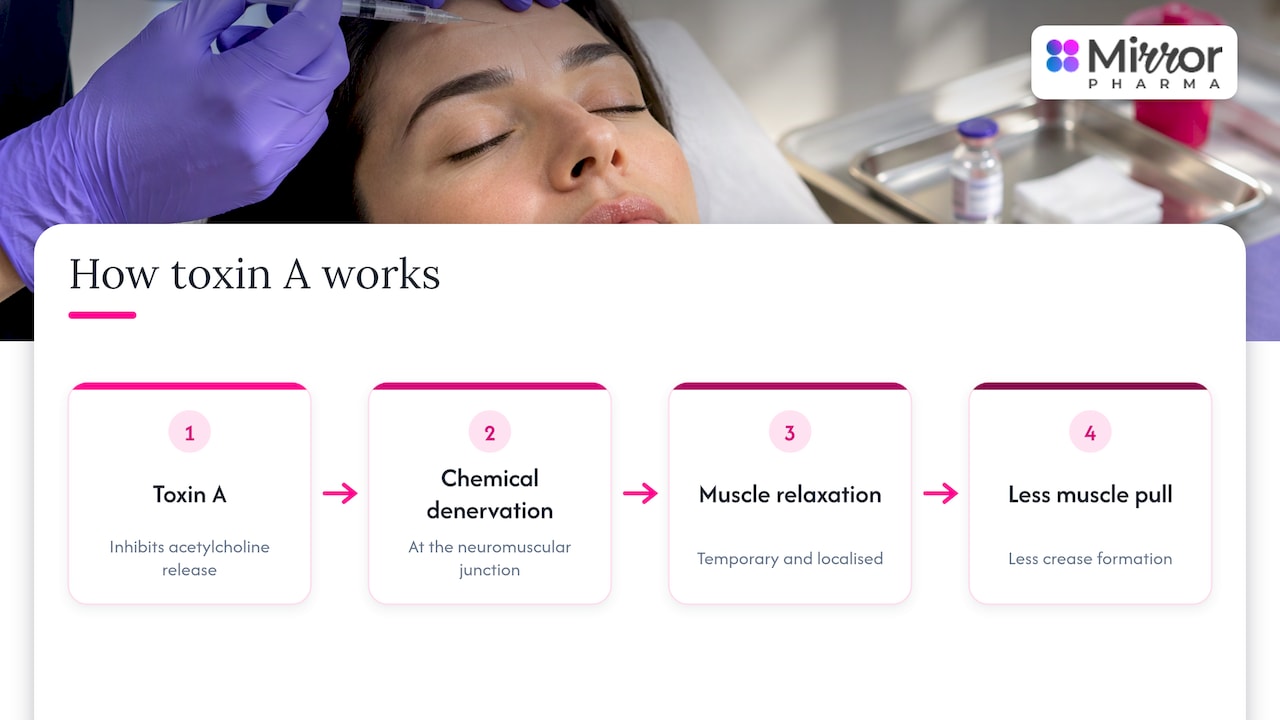
Botulinum toxin type A inhibits acetylcholine release at the neuromuscular junction, producing temporary chemical denervation and localised muscle relaxation, as set out in a 2023 review of crow’s feet and forehead line treatment. Less muscle pull means less crease formation.
A common patient question is whether “toxin” and the best-known brand name are the same thing. They are not: botulinum toxin is the drug class, and several products exist within it. A 2020 review of the mechanisms of botulinum neurotoxin states that all type A products act identically at the molecular level. It also notes that many apparent differences in onset, duration or diffusion can be attributed to dosing. For practitioners, product choice is therefore about licence status, formulation, handling and your own technique. For a product-level comparison, see our guide to incobotulinumtoxinA versus onabotulinumtoxinA.
Patient selection: who is a good candidate
The 2023 SAMCEP consensus on upper facial treatment describes patients with dynamic rhytids as the ideal candidates and the ones who show the most marked improvement. It also states that deep static lines caused by loss of skin elasticity, sun damage and ageing are not responsive to toxin alone.
The British Association of Aesthetic Plastic Surgeons makes the same point: toxin has no effect on fine lines from sun damage or sagging skin, and very heavy lines may need repeated treatments.
Before you inject, the consensus advises assessing:
- facial asymmetry
- any pre-existing brow ptosis
- the frontalis motion pattern
- brow shape at rest and in animation
For patients with a low-set or heavy brow, a lighter forehead dose and careful placement matter most. Document your assessment in the notes, with photographs taken in animation and at rest.
When lines are both dynamic and static
A review of upper face rejuvenation suggests toxin alone suits patients with only dynamic lines. Where dynamic and static lines coexist, treat the dynamic component first, reassess at 2 weeks, then consider hyaluronic acid filler for the remaining static lines. The same review notes that filler typically lasts at least 10 to 12 months, while forehead toxin effects last 3 to 6 months.

This sequencing is also good consultation practice: the patient sees what movement control achieves before committing to a second treatment. Our dermal filler range and our overview of skin boosters, fillers and biostimulators cover the options for the static component, for licensed practitioners.
Treating the forehead and glabella together
The forehead is the area where over-treatment shows. The frontalis is the only elevator of the brow, so weakening it too much, or without addressing the depressors, lowers the brow.
The 2023 review explains that treating glabellar and forehead lines together keeps the elevator and depressor muscles of the glabellar complex in balance. It recommends a pattern of five frontalis and five glabellar injections. It reports that concurrent treatment brought eyebrow ptosis incidence to under 2%, compared with 8 to 25% reported previously with forehead treatment alone.
Practical points from this:
- Plan the whole upper face. Do not agree a forehead-only treatment without assessing the glabella.
- Keep placement above the central brow zone. Stay within the planned pattern and adjust for the patient’s frontalis motion.
- Individualise dose. Under-treat first and refine at review rather than correcting an over-weakened frontalis.
What to tell patients about onset and duration
The JCCP information sheet on botulinum toxins says the toxin takes several days to begin working and up to 2 weeks to be fully effective. Results typically last 3 to 4 months, and a 2-week review may be used to assess and modify the result. The 2020 review above puts onset within 48 hours in some cases, and duration commonly at 3 to 5 months depending on dose, technique, area and patient factors.
The SAMCEP experts recommend telling patients that benefits may appear in 3 to 5 days, full effect can take up to 14 days, and asymmetry can be corrected at a 2-week follow-up. They note that managing expectations in this way is known to increase satisfaction and retention.
Avoid any language implying a guaranteed or permanent outcome. Frame it as a temporary reduction in movement that needs maintenance.
Aftercare advice
The SAMCEP consensus recommends:
- no massage or pressure on the treated area for the first 24 hours, especially towards the orbit
- avoiding rigorous exercise and excessive sun or heat for 24 hours
- resuming normal life after 24 to 48 hours
Give this in writing and book the review before the patient leaves.
Side effects, contraindications and consent
The JCCP sheet lists bruising, redness, localised swelling, mild discomfort, headache and, if toxin affects nearby muscles, eyebrow or eyelid drooping, all resolving within weeks or months. In the first six months of the trial data in the 2023 review, eyebrow ptosis occurred in 2% and eyelid ptosis in 2.4% of treated subjects. Injection-site bruising, haematoma and headache were common.
BAAPS lists these contraindications:
- neuromuscular disorders such as myasthenia gravis
- certain muscle relaxants and aminoglycoside antibiotics
- pregnancy or breastfeeding
- infection or inflammation at the injection site
- bleeding disorders
BAAPS also warns that too frequent or excessive dosing may lead to resistance through antibody formation, which is a reason to keep intervals sensible and doses individualised.
The JCCP advises that risks should not be presented as a bare list. Explain what you and the patient can each do to minimise them, and treat the decision as a shared agreement that weighs risks against benefits.
UK prescribing and regulatory context
The House of Commons Library briefing on non-surgical cosmetic procedures states that botulinum toxin is a prescription-only medicine under the Human Medicines Regulations 2012. It can be supplied only on prescription, and administration must be by an appropriate practitioner or under their direction. Cosmetic use is off-label, and prescribers must explain this to patients.
The same briefing reports that there are no specific controls on who can offer non-surgical cosmetic procedures, and that the government has proposed red, amber and green categories, local-authority licensing and restrictions for under-18s. Check the current position before you update your consent documents, as this area is moving.
For the prescribing sequence in clinic, our guides to the 12 week rule for botulinum toxin set out the safety and legal steps for UK clinics.
Supplying your clinic
A forehead treatment day depends on having the right product, needles and consumables when the diary says so. Mirror Pharma is an online pharmacy supplying toxins, dermal fillers, skin boosters and consumables to healthcare professionals and aesthetic clinics. Access is for trained practitioners and prescribers, with verification required. Our order cut-off times are extended to support timely delivery, and orders are fulfilled by a dedicated team of healthcare professionals.
Browse the toxins category once your practitioner account is verified. If you are weighing powder against ready-to-use presentations, our note on liquid botulinum toxin versus powder covers preparation time.
Perspective
We supply practitioners, and what we hear most from them is that forehead work is won in the consultation, not at the syringe. Choose dynamic lines for toxin, plan the glabella with the forehead, and tell patients plainly that onset takes days and the effect is temporary.
Because the type A products share a mechanism, we encourage clinics to choose by licence status, presentation and handling that suit their workflow, and to keep supply simple so that nothing delays a booked list. That is why we built our service around verified access, extended order cut-off times and a team of healthcare professionals fulfilling orders.
For patients whose static lines need more than movement control, we see filler and skin boosters as the natural second step, always for licensed practitioners and always sequenced after a 2-week review.
Rizwan
FAQ
Is toxin the same as the best-known brand name?
No. Botulinum toxin is the drug class, and several type A products exist. A 2020 review states they act identically at the molecular level, and that many observed differences relate to dosing. Qualified practitioners choose on licence, presentation and technique.
Which is better for forehead lines, toxin or filler?
It depends on the line. Toxin suits dynamic lines caused by movement. Where static lines remain, a reassessment at 2 weeks lets a qualified practitioner decide whether hyaluronic acid filler is appropriate for them.
How long do forehead toxin results last?
The JCCP gives a typical range of 3 to 4 months, and the wider literature reports 3 to 5 months depending on dose, technique and patient factors. Duration varies between patients, so no outcome should be promised.
What are the main risks of forehead treatment?
Bruising, redness, swelling, headache and, if nearby muscles are affected, eyebrow or eyelid drooping. These resolve within weeks or months. Treating the glabella together with the forehead is associated with a lower rate of brow ptosis.
Sources
- Facial lines and wrinkles, DermNet
- Treatment of crow’s feet lines and forehead lines, 2023 review
- The mechanisms of action and use of botulinum neurotoxin, 2020
- SAMCEP Society consensus on upper facial treatment, 2023
- BAAPS: botulinum toxin injections
- JCCP Information Sheet 2: Botulinum Toxins
- Upper face rejuvenation using botulinum toxin and hyaluronic acid fillers
- The regulation of non-surgical cosmetic procedures, House of Commons Library CBP-10331