
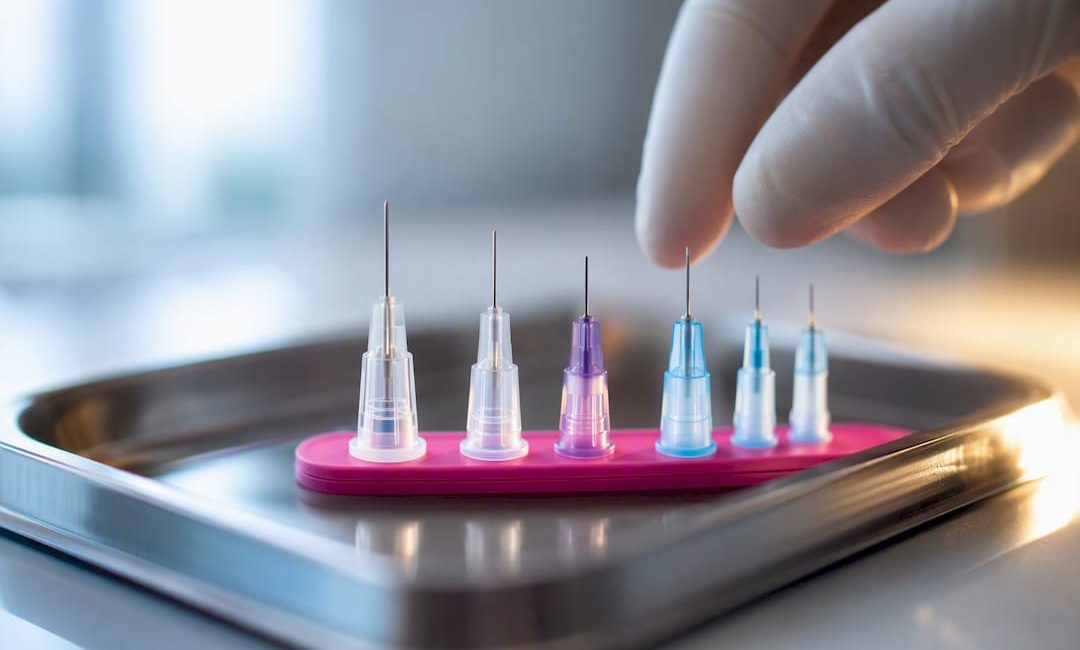
For licensed practitioners, the working range for facial botulinum toxin injections sits between 30G and 34G. Reach for 33G or 34G in delicate, low-volume upper-face work where comfort and bruising matter most, and drop to 30G or 31G when product viscosity, deeper muscle targets, or higher injection volume demand better flow. The trade-off is straightforward: finer gauges cut pain and haematoma risk but clog more easily and slow you down; wider gauges move product faster but hurt more and bruise more.
TL;DR:
- Choosing the correct needle gauge depends on facial region, with 33G or 34G best for upper face and periorbital areas due to lower pain and bruising.
- Wider gauges like 30G or 31G are more suitable for thicker tissues such as the masseter or lower face to ensure consistent flow and reduce injection difficulty.
- Recent clinical evidence highlights a tenfold reduction in bruising and a significant drop in pain when switching from 30G to 33G or 34G needles, especially for delicate regions.
- Proper needle handling, including changing needles after drawing and before injection, is crucial to maintaining sharpness, dosage accuracy, and minimizing patient discomfort.
- Stocking a range of fine-gauge needles and syringes tailored to different facial regions ensures consistent technique, reduces variability, and supports safe, effective treatments.
Table of Contents
- Which needle gauge suits each facial region?
- What does the clinical evidence actually say about pain and bruising?
- What technical factors actually drive needle selection?
- How should you handle syringes and needles during a treatment session?
- How does the 2cm rule and injection technique interact with needle length?
- How can you reduce bruising, haematoma and dosing errors?
- What should clinics stock for consistent needle technique?
- The evidence is clearer than the industry admits
- Sourcing the right needles and syringes for your clinic
- Sources
- FAQ
Which needle gauge suits each facial region?
Needle choice isn’t one-size-fits-all across the face, and treating it that way is where a lot of injectors leave comfort on the table. The upper face, where skin is thin and muscles sit close to the surface, tolerates the finest gauges well. Deeper or bulkier muscle groups need a wider lumen to get product where it needs to go without excessive plunger pressure.
Forehead, glabella and temple. These sites respond best to 33G or 34G needles. A 2024 prospective crossover study comparing 30G, 33G and 34G across exactly these regions found visual analogue scale pain scores dropped from 3.9–4.3 with 30G to as low as 1.6–1.8 with 34G. That’s a meaningful difference for a treatment patients often repeat every three to four months.
Crow’s feet and periorbital area. Skin here is thinner still, and bruising is more visible and harder for patients to conceal. Stick with 33G or 34G, use a gentle, unhurried technique, and keep injection density as low as the treatment plan allows. This is one region where the ultra-fine needle genuinely earns its higher price per unit.
Lower face and masseter. Masseter and other lower-face muscles have more bulk and often need a larger total volume delivered per site. A 30G or 31G needle keeps flow consistent and reduces the risk of you fighting the plunger to push product through a narrow lumen into denser tissue. Trying to run a full masseter treatment through a 34G needle is a common way to end up with inconsistent placement and a sore thumb.
Lips and perioral region. Most injectors settle on 32G here. Lip tissue is mobile and comparatively thin, which makes needle control as important as gauge, and the perioral area’s constant movement from talking and expression means technique matters more than the millimetre of wire you’re using.
Syringe pairing follows the same logic:
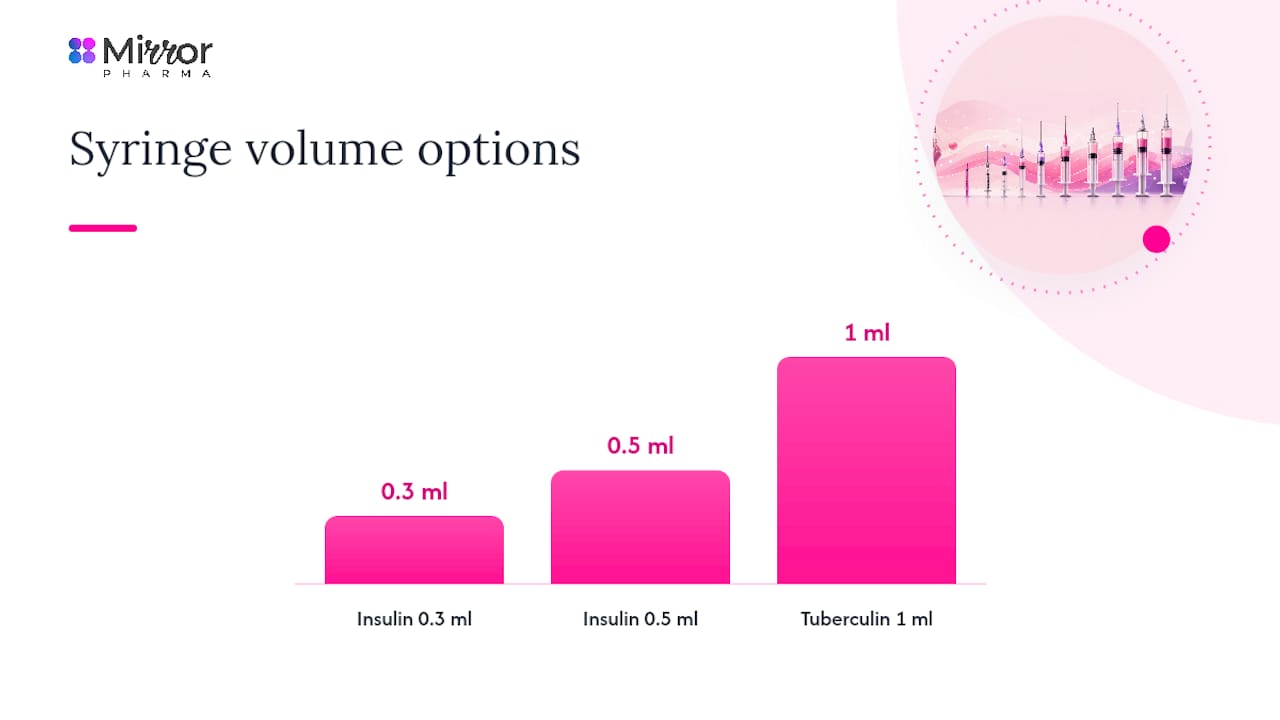
- Upper face, crow’s feet: a 0.3ml insulin-style syringe, such as the BD Micro-Fine+ 30G, gives fine graduation for small unit doses.
- Lower face, masseter: a 0.5ml or 1ml syringe suits higher per-site volumes without repeated refilling.
- Multi-site full-face protocols: many clinics standardise on a 1ml tuberculin syringe for consistency across a session, switching needles as the site demands.
Details on pen needle sizes and gauges are worth reviewing if your clinic is building out a stock list across multiple treatment types.
What does the clinical evidence actually say about pain and bruising?
The strongest recent evidence comes from the 2024 prospective crossover trial referenced above, and it’s worth sitting with the numbers rather than skimming past them.
Pain and haematoma by gauge, from the same trial:
- VAS pain scores: 30G scored 3.9–4.3, 33G scored 2.2–2.7, 34G scored 1.6–1.8.
- Haematoma incidence: 13 cases recorded with 30G, versus just 1 with 33G and 2 with 34G.
That’s roughly a tenfold drop in visible bruising simply from swapping needle gauge, with no change to technique or product.
Older literature is messier. A 2015 randomised trial comparing 30G and 32G found a lower incidence of clinically significant pain with 32G compared to 30G, although results vary across studies. But a separate 2009 comparison of 30G and 32G found no meaningful overall difference in pain between the two. Small sample sizes, differing pain measurement tools, and varied injection sites explain much of that inconsistency.
The practical read: ultra-fine gauges have the best recent evidence behind them for comfort and bruising, but that evidence doesn’t override context. Product viscosity, how many injection points you’re delivering, and your own technique all interact with gauge. An injector with heavy hands and a fine needle can still cause discomfort a lighter touch with a 30G would avoid.
What technical factors actually drive needle selection?
Gauge numbers work backwards from what most people expect: the higher the number, the narrower the needle. A 34G needle has a smaller outer diameter and lumen than a 30G, which means less tissue trauma per puncture but slower, more resistance-prone flow, particularly with anything more viscous than reconstituted toxin.
Length matters as much as gauge, arguably more. Cadaveric and ultrasonographic research supports 2mm, 34G needles for reliable intradermal placement in skin-booster technique, where the target plane is razor thin. Deeper intramuscular toxin work typically calls for longer needles, often in the 8 to 13mm range, to guarantee the tip actually reaches muscle rather than sitting in subcutaneous fat.
A few mechanical points worth building into training:
- Flow and pressure: narrower lumens need more plunger pressure to move the same volume, which increases the risk of sudden, uncontrolled release if resistance suddenly gives way.
- Dead space: low-dead-space hubs matter more than most injectors realise, since standard hubs can trap enough reconstituted product to throw off unit accuracy across a full treatment session.
- Sharpness decay: every puncture, including through a vial stopper, blunts the tip slightly. Clinical observation links repeated use of the same needle to increased injection force and higher reported discomfort.
Pro Tip: Keep a mental “two-puncture rule”: one needle to draw through the stopper, a fresh one for the patient. It costs you a needle per syringe and saves you a noticeably duller injection.
How should you handle syringes and needles during a treatment session?
A consistent handling workflow protects both dosing accuracy and needle sharpness, and it takes barely any extra time once it’s a habit.
- Remove the vial’s rubber stopper cover with a bottle-top remover rather than piercing it repeatedly with an injection needle.
- Draw the reconstituted product into a sterile syringe using a drawing needle, ideally one you won’t inject with.
- Swap to a fresh injection needle before touching the patient, discarding the drawing needle immediately.
- Label each syringe with product, dilution and draw time before moving to the next patient or site.
- Store any unused reconstituted product according to the manufacturer’s refrigeration guidance.
The rationale for step three is simple: passing the same needle through a rubber stopper and then through skin multiple times dulls the tip faster than skin punctures alone, and a blunter needle needs more force to advance, which patients feel.
On syringe choice, insulin-style syringes at 0.3ml or 0.5ml give finer graduation for small unit doses and suit single-site, low-volume work well. A tuberculin 1ml syringe suits multi-injection sessions where you’re moving across several sites without refilling, though the trade-off is slightly coarser graduation at the very low end of the scale.
Pro Tip: If a 33G or 34G needle starts clogging mid-session, don’t force the plunger. Swap to a fresh needle of the same gauge first. Forcing it almost always ends in an uneven, higher-pressure bolus that spreads further than intended.
How does the 2cm rule and injection technique interact with needle length?
The 2cm rule is one of the simplest safety heuristics in aesthetic injecting: staying at least 2cm above the orbital rim when treating the frontalis or glabella complex reduces the risk of the toxin migrating into muscles controlling eyelid position. It’s a spacing rule rather than a needle-size rule, but the two work together. A short needle used at the correct angle and distance from the orbital rim gives you far more control than a longer needle used carelessly close to it.
Angle and depth follow the region:
- Forehead and glabella: shallow angle, intradermal to superficial intramuscular, short needle length.
- Temple: slightly deeper, subcutaneous plane, moderate length.
- Masseter: near-perpendicular entry into muscle bulk, longer needle length appropriate.
- Lips: very superficial, shallow angle, short needle, high control required due to tissue mobility.
Nappage technique, the fanning, multi-point approach used for skin boosters, differs fundamentally from the single-point deep injections typical of toxin work. Nappage relies on numerous shallow, closely spaced punctures, so needle length stays short throughout, while single-point toxin injections vary length by target depth. If you feel resistance that doesn’t ease with gentle repositioning, stop and reassess rather than pushing through. Poor dispersion patterns and unexpected patient movement are usually a sign the needle has met fascia or a vessel wall, not that more pressure is needed.
How can you reduce bruising, haematoma and dosing errors?
Needle gauge is the single biggest lever you have over bruising rates. The same 2024 trial that reported pain scores also found haematoma incidence fell from 13 cases with 30G to 1 case with 33G and 2 with 34G in a matched cohort, a difference too large to put down to chance alone.
Beyond gauge, a handful of habits reduce complications further:
- Apply firm, direct pressure immediately after withdrawal, particularly around the temple and periorbital area where vessels sit close to the surface.
- Avoid injecting directly over visible superficial vessels; reposition by a few millimetres if one is visible.
- Use a single-use needle policy without exception, and label every syringe clearly to prevent dosing mix-ups between products or dilutions.
- If you’re meeting more resistance than expected, consider upsizing gauge rather than increasing plunger force, since forced injection under high pressure risks unpredictable spread and reduced treatment effect.
- Document injection sites, needle gauge used, and any adverse events at the time of treatment, and discuss expected bruising honestly with patients beforehand.
None of this eliminates bruising entirely. No responsible practitioner should promise that. But matching gauge to site cuts the odds substantially.
What should clinics stock for consistent needle technique?
Consistent technique starts with consistent stock. Running out of the right gauge mid-list, or improvising with whatever syringe happens to be in the drawer, is a common and avoidable source of variable results across a clinic’s patient base.
For qualified clinics, a sensible core stock list includes:
- BD Micro-Fine+ (0.3ml, 30G): a reliable standard for lower-face and masseter work where flow matters more than absolute fineness.
- FMS Insulin Micro Needle & Syringe (32G, 0.5ml): a versatile middle ground suited to perioral and general facial dosing where 0.5ml graduation offers more flexibility than a 0.3ml barrel.
- Ultra-fine 33G to 34G needles, such as those in the TSK Laboratory Europe B.V. “invisible” range, for upper-face and periorbital sites where the pain and bruising data most strongly favours the finest available gauge.
Stocking low-dead-space hubs alongside correctly graduated syringes matters just as much as the needle gauge itself, since a clinic with mismatched dead space across its syringe stock will see unit-dosing drift between injectors even when everyone follows the same protocol. The pen needle sizing guide is a useful reference when auditing a clinic’s broader needle inventory.
One point deserves repeating without qualification: botulinum toxin and other prescription-only aesthetic medicines must only be handled, reconstituted and administered by authorised prescribers. This guidance is intended for licensed practitioners and qualified aesthetic professionals, not for general consumer use.
The evidence is clearer than the industry admits
Most guidance on toxin needle size still reads like a compromise between comfort and convenience, as if finer gauges were a nice-to-have for anxious patients rather than a measurable clinical variable. The 2024 crossover data doesn’t leave much room for that framing. A tenfold reduction in haematoma incidence between 30G and 33G is not a marginal comfort upgrade; it’s a difference patients notice in the mirror for a week afterwards.
Where conventional advice falls short is in treating needle choice as static, one gauge for the whole face, chosen once and never revisited per site. The evidence points the other way: match gauge to tissue depth and muscle bulk, region by region, and accept that a single session might reasonably use two or three different needles.
What I’d prioritise first, if forced to pick one habit to change, is the needle swap between drawing and injecting. It’s the cheapest, least glamorous intervention on this list, and it’s also the one most consistently skipped under time pressure. Sharpness decay is invisible until a patient winces.
— Rizwan
Sourcing the right needles and syringes for your clinic
Alongside the practices above, sourcing consistent, clinic-grade needles and syringes matters as much as knowing which gauge to reach for. Aesthetic clinics can source a full range of syringes and consumables needed to run a well-stocked injection list, from fine-gauge syringes for upper-face botulinum toxin work to wider-bore options suited to masseter and lower-face treatment, alongside skin boosters, dermal fillers and related consumables that support accurate, repeatable dosing. Products generally ship to verified healthcare professionals, and strategically extended order cut-off times help prevent stock gaps from causing rescheduled patients. If you’re reviewing your current needle and syringe range, the Mirror Pharma product catalogue is the place to check availability and place an order ahead of your next clinic day.
Sources
- Subjective Discomfort during Botulinumtoxin Injections Dependent on Injection Site and Needle Size: A Comparison Between 30G, 33G and 34G Needles
- Randomised trial comparing 30G and 32G needles (2015)
- Syringes and Needles: The Art of Neurotoxin Injections — Medscape
FAQ
What is the 2cm rule for botulinum toxin injections?
The 2cm rule advises staying at least 2cm above the orbital rim when treating the frontalis or glabella, reducing the risk of the toxin spreading into muscles that control eyelid position.
What is the best needle size for botulinum toxin injections?
There’s no single best gauge for every site. 33G to 34G suits fine upper-face and periorbital work where comfort and bruising matter most, while 30G to 31G handles lower-face and masseter treatment better due to improved flow.
Is a 21G or 23G needle bigger?
Gauge numbers run inversely to size, so a needle with a smaller gauge number has a larger outer diameter. Neither very wide needles nor those outside the 30G to 34G range are typically used for facial toxin injections, where 30G to 34G is standard.
Why do finer needles sometimes clog during injection?
Ultra-fine 33G and 34G needles have a narrower lumen, which increases resistance with more viscous preparations. Swapping to a fresh needle of the same gauge, rather than forcing the plunger, usually resolves the issue without disturbing placement.