
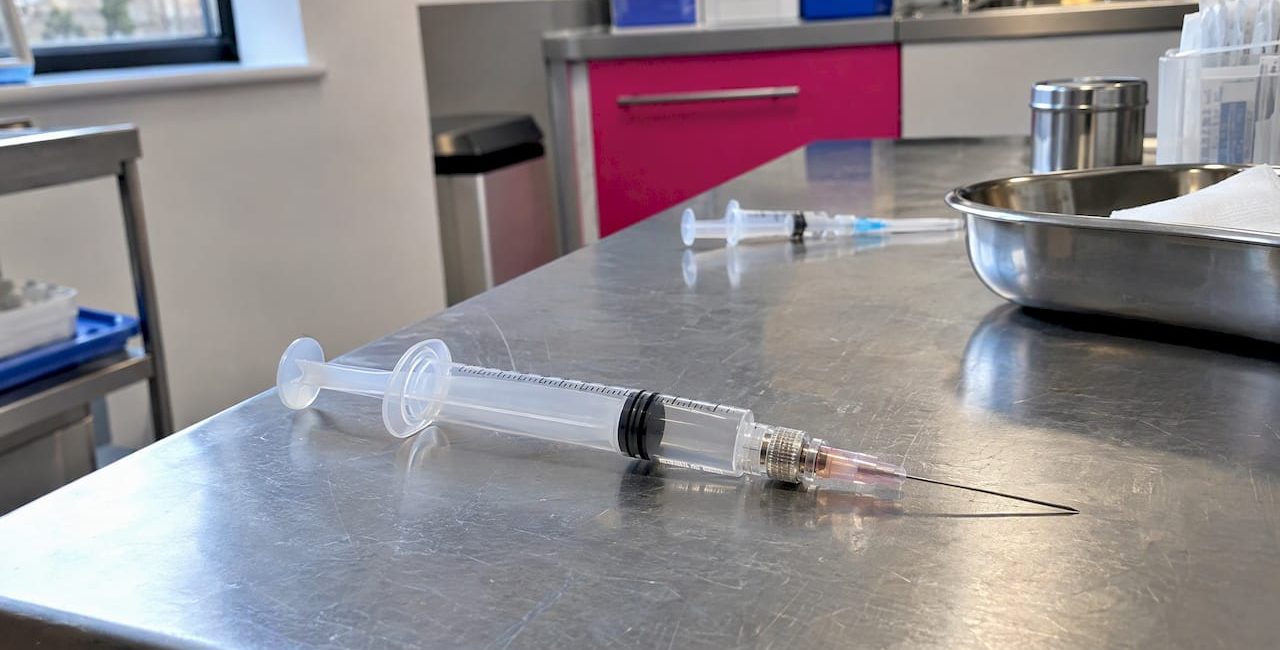
A Luer lock syringe has a threaded tip: the needle or connector twists onto it and locks, so it is far less likely to come off under pressure. For licensed practitioners and qualified aesthetic professionals, that makes it the default choice wherever a detached needle would cost you product, time or patient comfort. We supply 10 ml Luer lock syringes and needles and consumables to verified practitioners and prescribers, so this guide covers what you need to choose, fit and dispose of them properly.
TL;DR
- A Luer lock syringe screws the needle on with a threaded collar. A Luer slip syringe relies on friction alone.
- NHS Specialist Pharmacy Service guidance says Luer lock closures are more secure than Luer slip, so they are generally preferred for aseptically made medicines.
- Choose the smallest syringe that holds the full dose plus a small allowance for priming. A 1 ml syringe suits small volumes.
- Luer lock fittings can still loosen. Check the connection and never re-sheathe a used needle.
- Syringe and needle must both be Luer lock, and connectors in the UK follow BS EN ISO 80369-7:2021.
Table of Contents
- What a Luer lock syringe is
- Luer lock or Luer slip
- Choosing the size: 1 ml, 2 ml, 5 ml and 10 ml
- Matching syringe, needle and cannula
- Standards and regulation in the UK
- Fitting, checking and disposing safely
- Where our 10 ml Luer lock syringes fit
- Our view
- FAQ
- Sources
What a Luer lock syringe is
The Luer connector is the standard fitting between a syringe tip and a needle or line. There are two types. On a Luer slip syringe, the needle pushes on with a twist and is held by friction. On a Luer lock syringe, the tip is surrounded by a threaded skirt, and the needle hub screws into it. University of Southern California safety guidance describes the lock as an external screw thread engaging lugs on the needle, giving greater resistance to detachment. It recommends it for syringe filters and hazardous materials.
For injectable work in aesthetics, the practical benefit is simple. Viscous products, small-bore needles and cannulas create resistance when you push the plunger. A locked connection stays put under that pressure.
Luer lock does not mean latched
The name suggests more than it delivers. The Anaesthesia Patient Safety Foundation points out that Luer lock fittings have no latching mechanism and that the skirt adds no extra leak protection. Because the threads are very coarse, roughly a quarter turn can loosen the connection. So tighten firmly at fitting, and look at the connection again before you inject, particularly if you have handled the syringe or attached it to a stopcock or extension line.
Luer lock or Luer slip
Both connectors are standard and both are used in practice. The differences that matter to a practitioner:
| Factor | Luer lock | Luer slip |
|---|---|---|
| Attachment | Needle screws on | Needle pushes on with a twist |
| Security under pressure | Greater resistance to detachment | Can burst apart under high pressure |
| Speed of fitting | Slightly slower | Quick |
| Typical use | Viscous products, cannulas, transfers, anything needing a firm joint | Simple, quick injections |
The University of Nottingham clinical skills guidance notes that the simple push-fit hub is the most common connection for injections, and that a more secure Luer-lok device is used where a firmer connection is needed. The USC guidance adds that oil or grease on a slip tip can stop it seating securely.
For a fuller side-by-side, including when to choose each, see our Luer lock vs Luer slip clinical guide and its checklist for choosing the right connector.
Choosing the size: 1 ml, 2 ml, 5 ml and 10 ml
The barrel should match the dose, not the product pack. Two points from UK guidance:
- The University of Nottingham guidance says that for increased accuracy you should use the smallest syringe possible.
- NHS Greater Glasgow & Clyde’s good practice statement (April 2025) says syringe selection should consider dose volume and the syringe’s suitability to measure it. It notes that 1 ml syringes carry markers for each 0.1 ml, 2 ml syringes each 0.1 ml, and 5 ml syringes each 0.2 ml. Although written for depot injections, the principle applies to any measured injectable.
Working an example
Suppose you need to measure 0.4 ml of a prescribed product. A 1 ml Luer lock syringe lets you read that dose against the 0.1 ml markers with room for priming. A 10 ml barrel would have much coarser graduations relative to that volume and would be harder to read accurately. Conversely, if you are drawing up and transferring a larger volume, such as a reconstituted or diluted preparation for a number of treatment sites, a 10 ml Luer lock syringe is the practical size, and a smaller barrel would mean repeated refills.
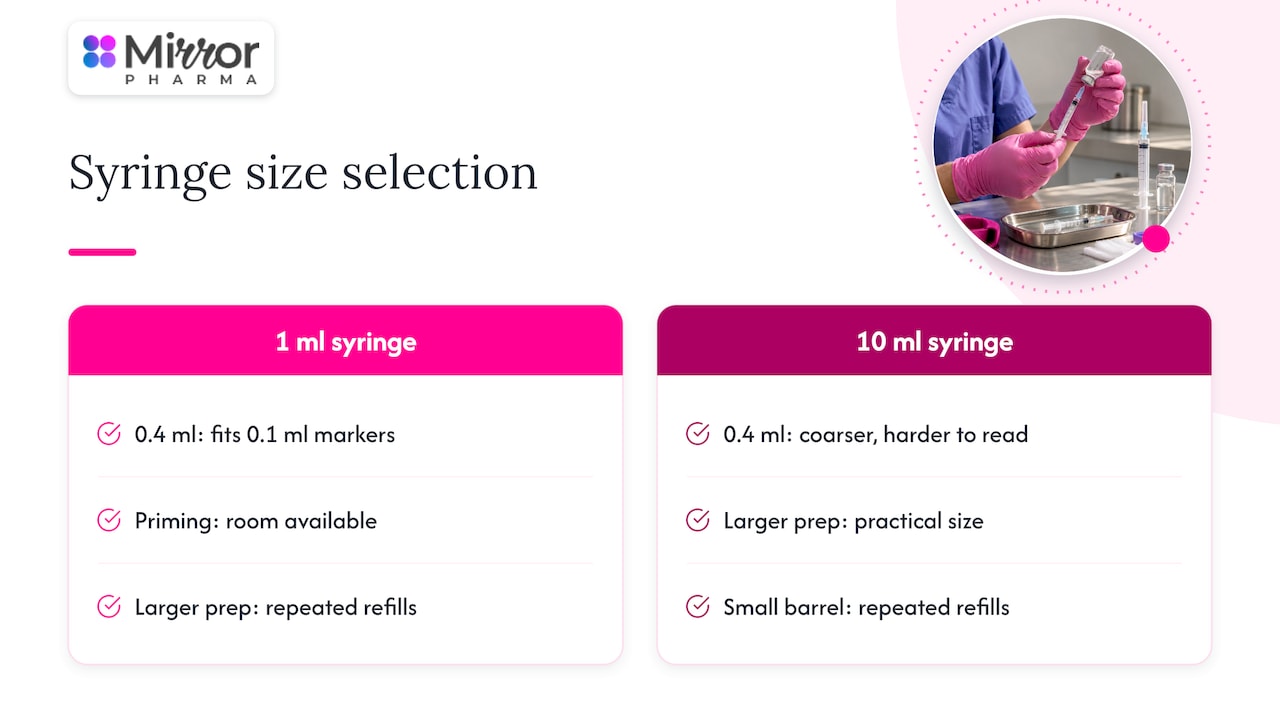
When you search for 1 ml Luer lock syringes, check three things on the pack: that the tip is Luer lock, that the graduations suit your smallest dose, and that the needles you plan to use are also Luer lock so the two fit together.
Matching syringe, needle and cannula
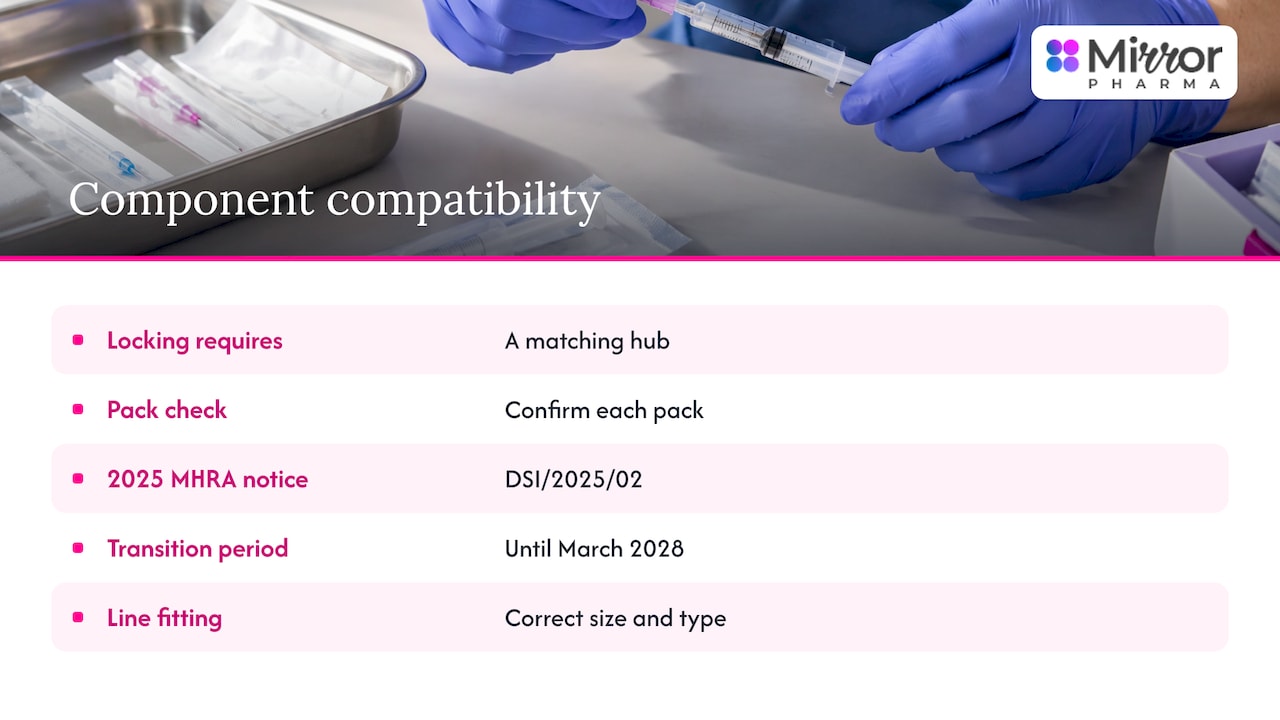
A Luer lock syringe only locks if the other part has a matching hub. Most needles and cannulas used in aesthetic practice are made with a Luer lock hub, but confirm it for each pack, especially when you mix manufacturers.
Compatibility is a patient-safety point, not a pedantic one. In 2025 the MHRA issued Device Safety Information DSI/2025/02 after incompatible needle-free connectors caused adverse incidents with pre-filled emergency syringes. During the transition period until March 2028, the agency says the Luer lock fitting on the line must be the correct size and type for the connector in use. The incident involved a hospital product, but the lesson carries over: read the instructions for use whenever you combine components.
Standards and regulation in the UK
Luer connectors are covered by BS EN ISO 80369-7:2021, the UK implementation of the European standard, which specifies dimensions and performance requirements for small-bore Luer slip and Luer lock connectors for intravascular or hypodermic use. It supersedes the 2017 edition, which had itself replaced the older ISO 594-1 based standard.
On the regulatory side, SHTN 00-04 (August 2024) states that medical devices must comply with the UK Medical Device Regulations and that front-line users are responsible for being trained, checking shelf life and physical condition, and reading the instructions for use before use. It is Scottish NHS guidance, but it is a sound statement of good practice for any clinic. Our guide covers the standards that govern connector compatibility in more detail.
Fitting, checking and disposing safely
- Inspect the pack. Check the expiry date, that the sterile packaging is intact and that the barrel and plunger are undamaged.
- Attach without touching the tip. Hold the hub, not the connector surface, and twist clockwise until firm.
- Check the fit. The NHS integrity-testing protocol advises checking that each syringe and hub have a firm fit. Re-check after any handling.
- Do not overfill stored syringes. For aseptically made medicines held in syringes, SPS guidance is not to fill beyond 85% of nominal capacity and to avoid bending the extended plunger.
- Do not re-sheathe. Dispose of the used needle and syringe straight into a sharps container, never a clinical waste bag, as the NHS GGC statement sets out.
Our guide on attaching and detaching Luer connections safely goes through the technique step by step.
Where our 10 ml Luer lock syringes fit
Our 10 ml Luer lock syringes, pack of 10 are available alongside the needles and consumables on our main shop. Ordering is online, with extended order cut-off times so that supplies reach your clinic when you need them. Access is for verified practitioners and prescribers only, and the same account covers the injectables you work with, from dermal fillers to skin boosters and IM/IV vitamins. Our orders are fulfilled by a dedicated team of healthcare professionals.
Our view
A syringe is the least glamorous item on the treatment tray and one of the few that touches every single procedure. We believe practitioners are best served by a supplier that treats consumables with the same seriousness as the medicines they go with.
That is why we put verification at the front of our process, supply only to qualified aesthetic professionals, and extend our order cut-off times: a clinic that runs out of the right syringe mid-week loses appointments, not just stock. Our view is that matching Luer lock syringes, needles and your product range in one order is the simplest way to keep a clinic stocked and consistent.
Choose the connector for the job, size the barrel to the dose, and check the fit every time. Those three habits matter more than any single product.
Rizwan
FAQ
What is a Luer lock syringe?
It is a syringe whose tip has a threaded collar. The needle or connector screws on and locks in place. This gives a more secure joint than a push-fit Luer slip tip, which is why it is used where pressure or a firm connection matters. It is intended for use by trained practitioners.
Are all Luer lock syringes and needles compatible?
Luer connectors follow BS EN ISO 80369-7:2021, so standard Luer lock syringes and needles are designed to fit together. Even so, the MHRA’s 2025 alert shows that specific components, such as needle-free connectors, can be incompatible. Check the instructions for use whenever you combine parts from different manufacturers.
What does a 1 ml Luer lock syringe suit?
It suits small, accurately measured doses, with markers every 0.1 ml. Use the smallest syringe that holds the full dose plus a small allowance for priming, and make sure your needle also has a Luer lock hub.
Can a Luer lock connection still come loose?
Yes. The Anaesthesia Patient Safety Foundation notes that the coarse threads can loosen with about a quarter turn. Tighten firmly when fitting and check the connection again before injecting.
Sources
- NHS SPS: Integrity of syringes for aseptically made medicines
- USC Environmental Health & Safety: Needle/Syringe Selection & Usage
- APSF: Managing Luer Connections
- University of Nottingham: Syringe, intramuscular and subcutaneous injection
- NHS GGC: Depot Good Practice Statement, April 2025
- MHRA DSI/2025/02: Aurum pre-filled syringes
- BS EN ISO 80369-7:2021
- BS EN ISO 80369-7:2017
- SHTN 00-04 V3, August 2024
- Integrity testing of syringes