
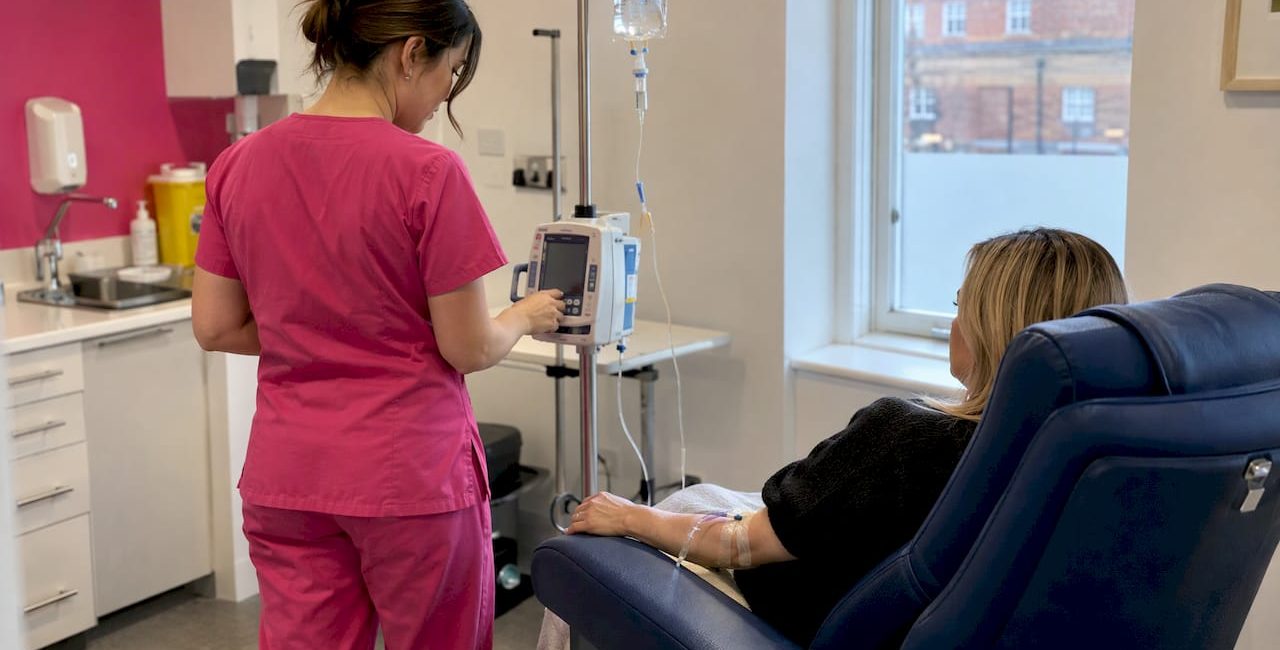
NAD+ IV therapy is the intravenous infusion of nicotinamide adenine dinucleotide, a coenzyme found in every cell, given by a trained clinician under a prescriber’s direction. For licensed practitioners, the questions that matter are what the human evidence supports, how to administer it safely, and how to source it in a way that stands up to MHRA scrutiny. This guide is for qualified aesthetic and wellness professionals, and covers all three.
TL;DR
- NAD+ is a coenzyme involved in cellular energy metabolism, and it is not simply vitamin B3, although B3 forms (such as nicotinamide riboside) are precursors the body uses to make it.
- Published human data on IV NAD+ is limited to small studies and case reports, so frame it with clients as an area of ongoing research, not a proven outcome.
- Reported short-term effects during infusion include nausea, flushing, cramping and chest pressure, mostly at faster rates, so rate control and monitoring are central to protocol.
- Supply must come through a prescriber-led, documented route. Verify your supplier’s documentation before every purchase.
- Magnesium IV infusion is a separate, long-established medical use with its own dosing and monitoring requirements.
Table of Contents
- What NAD+ IV therapy is
- What the human evidence shows
- Safety, monitoring and who to screen out
- Frequency: what you can and cannot say
- Magnesium IV infusion: a different use with different rules
- Prescribing and supply: getting the paperwork right
- Sourcing for licensed practitioners
- Our perspective
- FAQ
- Sources
What NAD+ IV therapy is
NAD+ (nicotinamide adenine dinucleotide) is a coenzyme that takes part in energy metabolism and in enzyme systems linked to DNA repair and cellular signalling. Levels in tissue are described as falling with age, which is the rationale behind supplementation research.
In an IV protocol, NAD+ is diluted and delivered through a cannula directly into the bloodstream, bypassing the gut. Because the route is parenteral, it should be treated like any other IV medicine: a prescriber’s assessment, aseptic technique, a controlled rate and a clinician present throughout.
A common confusion among clients is whether NAD+ is just vitamin B3. It is not. Niacin, nicotinamide and nicotinamide riboside are B3-related precursors the body converts into NAD+. The infused molecule is NAD+ itself, which is why the two should not be described to clients as interchangeable.
What the human evidence shows
Practitioners should be able to describe the evidence accurately, because client conversations depend on it.
A 2026 narrative review of intravenous NAD+ found the human data to be small uncontrolled studies, observational work and case reports. Short-term infusion was associated with transient rises in circulating NAD+ and changes in oxidative-stress, inflammation and metabolic biomarkers, with some self-reported changes in sleep and neurological symptoms. The authors describe the evidence as preliminary.
The best-known pilot, cited in that review, gave eight healthy adults aged 70 to 80 a daily 1,000 mg infusion for six days. Biomarkers shifted, but there was no control group, no randomisation and only a six-day follow-up. A separate 2019 pilot study in eight healthy men infused 750 mg over six hours and found plasma NAD+ and metabolites did not rise until after two hours, which suggests the molecule is cleared quickly from plasma at the start of an infusion. That is useful when thinking about infusion duration.
A systematic review published in 2026 covering January 2010 to October 2025 identified 113 studies, 33 of them in humans. Oral precursors showed biochemical target engagement and were generally well tolerated. No eligible outcomes trial had evaluated intravenous or intramuscular NAD+ itself for wellness. The reviewers call for larger randomised trials with longer follow-up and clinically meaningful endpoints.
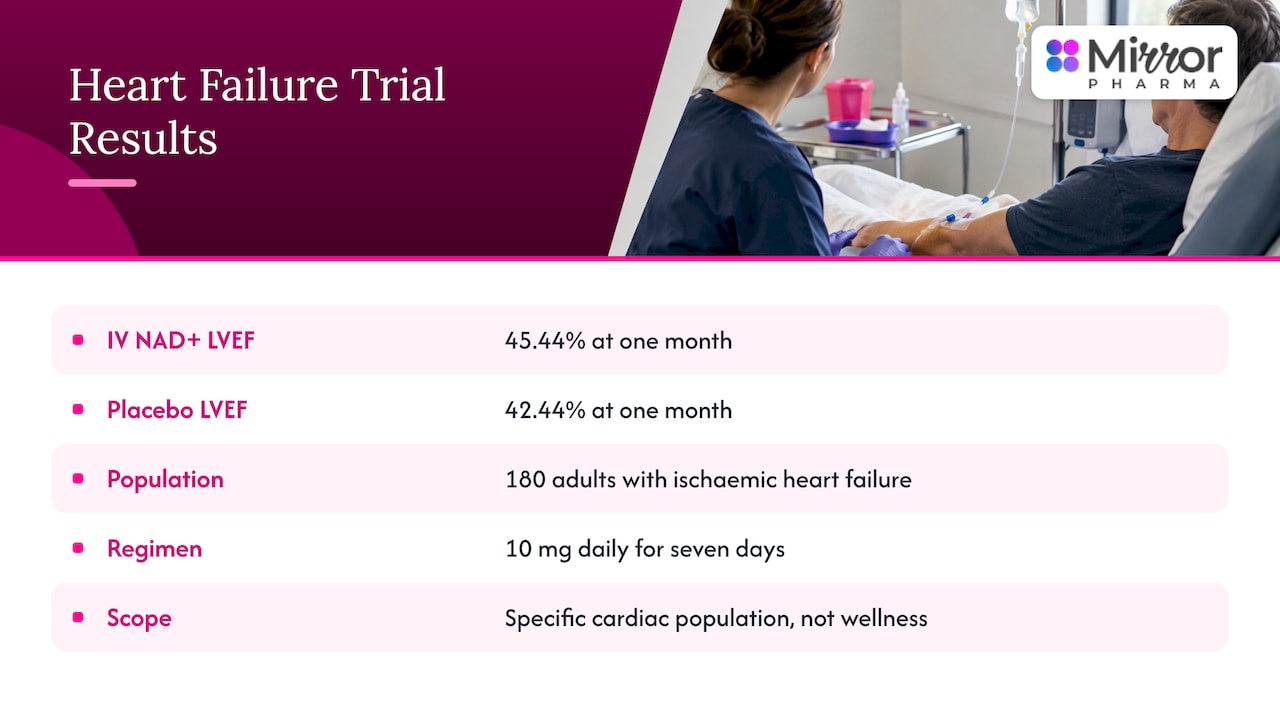
There is one randomised, placebo-controlled trial worth knowing about, in a clinical setting. A 2025 trial of 180 adults with ischaemic heart failure gave 10 mg a day of IV NAD+ for seven days alongside standard therapy and reported a higher left ventricular ejection fraction at one month than placebo (45.44% vs 42.44%). Other measures showed non-significant trends, and the authors call for multicentre trials. It concerns a specific cardiac population, not wellness clients, and should not be generalised.
For your consultation notes, this means: describe NAD+ IV as an area of active research, never promise an outcome, and never use language implying guaranteed, permanent or risk-free results. Claims about looking younger, in particular, have no human outcome data behind them in the sources above.
Safety, monitoring and who to screen out
The short-term effects reported in the Frontiers review include nausea, abdominal discomfort, flushing, cramping, chest pressure and infusion-related intolerance, particularly at faster rates. Long-term safety data are lacking.
Practical consequences for a protocol:
- Prescriber assessment first. A medical history, current medicines, pregnancy status and any cardiac, renal or hepatic problems should be reviewed by the prescriber before the first infusion.
- Start slow. Because symptoms cluster at faster rates, an initial slow rate with the option to pause or reduce is sensible. Your prescriber sets the protocol.
- Stay with the client. Chest pressure, cramping and flushing need an immediate response, so the clinician should be in the room, with emergency equipment and anaphylaxis kit to hand.
- Document the rate, the batch and the response. Batch traceability is essential if anything goes wrong.
- Keep sessions realistic. Clinics commonly book long appointments for NAD+ infusions because of the slow rate, so plan chair time and staffing accordingly.
Our IV vitamin therapy safety toolkit and the three conditions for safe IV vitamin therapy set out the wider governance an IV service needs, from consent to emergency preparedness.
Frequency: what you can and cannot say
Clients often ask how many sessions they need. No UK guideline sets a schedule for IV NAD+ in wellness, and the systematic review above found no outcomes trial of IV NAD+ for that purpose. Schedules published by clinics vary widely and reflect individual practice rather than trial evidence. The defensible approach is for the prescriber to set the dose and interval for the individual, review response and tolerance after each session, and record the reasoning.
Magnesium IV infusion: a different use with different rules
Magnesium sulfate infusion is often mentioned alongside NAD+ in IV menus, but its place in UK medicine is distinct. The BNF entry for magnesium sulfate lists IV doses for pre-eclampsia seizure prevention, eclampsia, hypomagnesaemia and emergency treatment of serious arrhythmias. It gives a maximum IV rate of 150 mg per minute and states the concentration should not exceed 20%.
The same BNF page lists the signs of excess magnesium: nausea, vomiting, flushing, thirst, hypotension, drowsiness, confusion, absent reflexes, respiratory depression, muscle weakness, arrhythmias, coma and cardiac arrest. In severe hypomagnesaemia it advises a controlled infusion device, preferably a syringe pump.
Two further points for practitioners:
- The UK patient leaflet for magnesium sulfate 20% solution says not to use it in people with allergy to it, or with kidney failure, liver problems or heart problems, and advises dose reduction in renal impairment.
- A hospital formulary, Wirral University Teaching Hospitals, gives normal serum magnesium as 0.7 to 1.0 mmol/L and treats severe or symptomatic deficiency with a single infusion over two to four hours, with repeat levels. It illustrates that clinical use is guided by measured levels.
Magnesium and NAD+ should therefore be assessed separately by the prescriber, each with its own indication and monitoring. Qualified practitioners can review the magnesium sulfate range alongside the NAD+ products.
Prescribing and supply: getting the paperwork right
IV NAD+ products are prescription medicines for use by qualified practitioners. In the UK, an unlicensed medicine, often called a special, can only be supplied under tight conditions. MHRA Guidance Note 14 says a special may be supplied only in response to an unsolicited order, made to the specification of a UK-registered prescriber for a patient whose special clinical needs it meets. It must not be for cost, convenience or operational reasons, and the product may not be advertised.
For your clinic that has three practical effects:
- The prescriber must be involved before the order, not after.
- Marketing a specific prescription-only product to the public is not permitted, so keep client-facing material educational and generic.
- Your supplier’s documentation matters. We explain the two MHRA checks prescribers should make for unlicensed medicines, the five documents a clinic should obtain from a medicine supplier, and the wider aesthetic prescribing rules.
Sourcing for licensed practitioners
Mirror Pharma is an online pharmacy supplying prescription medicines, vitamins and infusion therapies to healthcare professionals and aesthetic clinics. Access is restricted to verified practitioners and prescribers, and orders are fulfilled by a team of healthcare professionals, with extended order cut-off times to help clinics keep appointments running. For NAD+, qualified prescribers can view the NAD+ range, including the 1000mg 30ml vial for IM or IV use, and the wider IM/IV vitamins category. Needles and consumables for the same procedures are available from the same account.
Our perspective
Clinics that last in IV therapy treat it as a medical service first and a menu item second. That means a prescriber who owns the decision, a protocol that controls rate and monitoring, and a supply chain you can document line by line.
NAD+ is a good example. The science is interesting and still developing, so the honest consultation is educational and measured. What practitioners can control is everything around the infusion: who prescribes, how the product was sourced, how it was stored and how the session was recorded.
That is why we verify practitioner and prescriber access, staff fulfilment with healthcare professionals and keep order cut-offs generous. A reliable supplier should reduce the admin and risk in your day, so you can spend your attention on your client in the chair. This content is for licensed practitioners only.
Rizwan
FAQ
How long does NAD+ IV therapy take?
There is no UK guideline fixing a duration. Infusion rates are set by the prescriber, and because adverse effects such as nausea, flushing and chest pressure have been reported at faster rates, many protocols run slowly. Plan chair time with your prescriber’s protocol, not a generic figure.
Who should not receive an NAD+ infusion?
The prescriber decides after a full history. Pregnancy, significant cardiac, renal or hepatic disease, and any previous infusion intolerance call for particular care, and long-term safety data are lacking. If a client cannot be assessed properly, the answer is to defer.
Is NAD+ just vitamin B3?
No. NAD+ is a coenzyme, and B3-related compounds such as nicotinamide riboside are precursors the body converts into it. Oral precursors have more published human data than IV NAD+ itself, according to the 2026 systematic review.
Can NAD+ make clients look younger?
The sources reviewed here report changes in biomarkers, not cosmetic outcomes, and the reviewers conclude effectiveness for anti-aging remains inconclusive. Practitioners should avoid appearance promises and describe the therapy as an area of ongoing research.
What is IV magnesium used for in UK practice?
The BNF lists it for conditions such as hypomagnesaemia, eclampsia and serious arrhythmias, with specific rate and concentration limits. It should be prescribed and monitored on its own indication, separately from NAD+.
Sources
- Narrative review of intravenous NAD+ and NAD+ precursors, Frontiers in Aging
- NAD+ supplementation for anti-aging and wellness: systematic review, PubMed
- Effect of NAD on heart failure, randomised trial, PMC
- Pilot study of human plasma and urine NAD+ changes, PubMed
- Magnesium sulfate, BNF, NICE
- Wirral University Teaching Hospitals Formulary, magnesium
- Magnesium Sulfate 20% package leaflet, medicines.org.uk
- MHRA Guidance Note 14: supply of unlicensed medicinal products