
For licensed practitioners, a dilution chart is a quick way to turn vial units and diluent volume into units per 0.1 mL. It is not a licence to mix by habit. The units of each preparation are specific to that product, so the only authoritative figures are the ones in the Summary of Product Characteristics (SmPC) for the exact brand in your hand. This guide gives you the arithmetic, a working chart built from published SmPC figures, worked examples, handling steps and the checks that belong in your clinic protocol. It is written for qualified aesthetic professionals and prescribers, not for patients or the general public.
TL;DR
- Units per 0.1 mL = vial units ÷ diluent volume in mL ÷ 10. Work it out, write it down, then check it against the SmPC.
- Units are not interchangeable between products, so no single chart fits every toxin. Use the SmPC for the exact brand and strength.
- Reconstitute only with the diluent the SmPC names, typically preservative-free 0.9% sodium chloride, and mix gently without shaking.
- Record the dilution you used every time, so doses stay consistent between treatments and between colleagues.
- Some products are now ready to use and need no reconstitution at all. Do not apply a powder chart to them.
Table of Contents
- The one formula behind every dilution chart
- A working dilution chart
- Worked examples for licensed practitioners
- Forward and reverse dilution
- Handling steps that protect potency and safety
- When no dilution is needed
- Our perspective: the chart is the last step, not the first
- Safety and legal points to keep in your protocol
- Common mistakes to design out
- Stock your clinic with the right products
- FAQ
- Sources
The one formula behind every dilution chart
Every dilution table you will see reduces to a single piece of division. Divide the units in the vial by the millilitres of diluent you add, and you get units per millilitre. Divide that by ten and you get units per 0.1 mL, which is the volume most practitioners think in because it is easy to read on a 1 mL syringe.
Units per 0.1 mL = vial units ÷ diluent mL ÷ 10
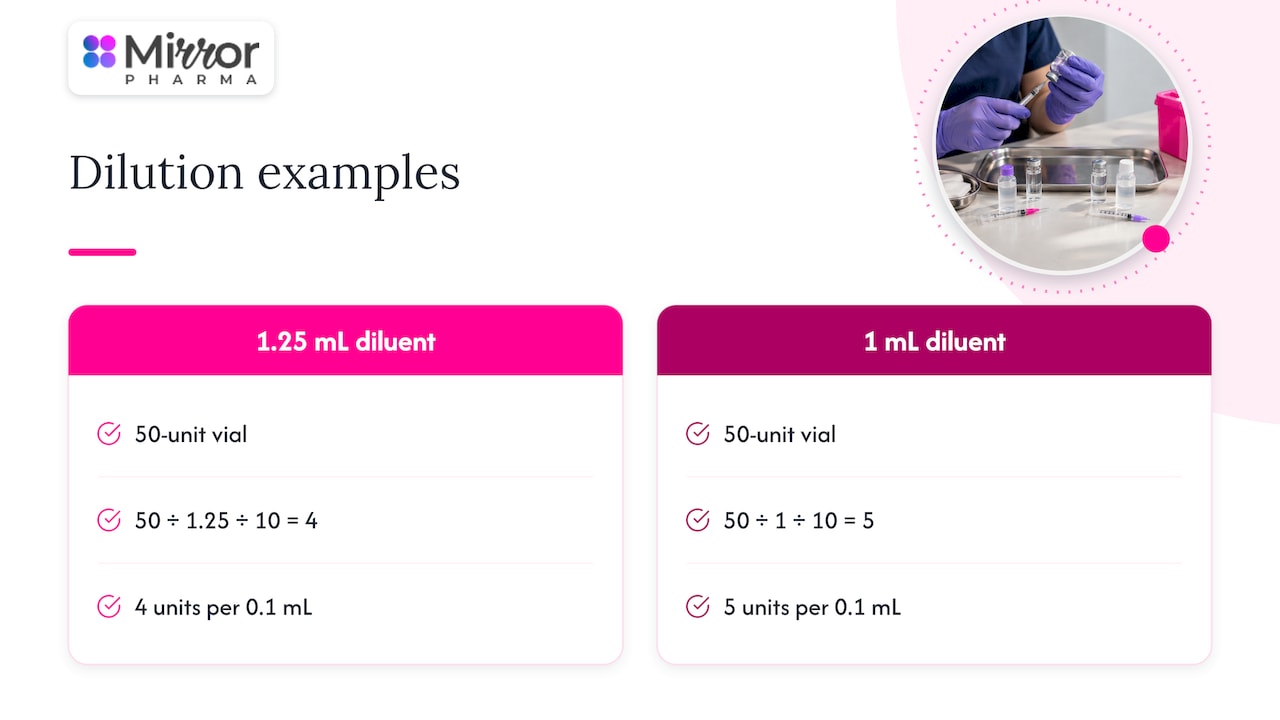
Two published examples show it working. According to the SmPC for a 50-unit botulinum toxin powder, a 50-unit vial reconstituted with 1.25 mL of 0.9% sodium chloride gives 4 units per 0.1 mL. The same document gives a 50-unit vial with 1 mL of diluent as 5 units per 0.1 mL. In both cases the maths is the one above: 50 ÷ 1.25 ÷ 10 = 4, and 50 ÷ 1 ÷ 10 = 5.
The formula tells you the concentration. It does not tell you whether that concentration is licensed or appropriate for your product and indication. That is a separate question, and the SmPC answers it.
A working dilution chart
The table below applies the formula to common vial sizes and diluent volumes. Rows marked as SmPC-published come from the document linked above. Other rows are plain arithmetic, shown so you can see the pattern, not as recommendations. Before you use any row, confirm that the product you are reconstituting permits that diluent volume.
| Vial strength | Diluent (0.9% sodium chloride) | Concentration | Units per 0.1 mL | Basis |
|---|---|---|---|---|
| 50 units | 1.0 mL | 50 units/mL | 5 | Published in the SmPC cited above |
| 50 units | 1.25 mL | 40 units/mL | 4 | Published in the SmPC cited above |
| 100 units | 2.5 mL | 40 units/mL | 4 | Published in the SmPC for a 100-unit product family, same ratio as above |
| 100 units | 2.0 mL | 50 units/mL | 5 | Arithmetic only, check the SmPC |
| 100 units | 1.0 mL | 100 units/mL | 10 | Arithmetic only, check the SmPC |
Note what the table shows about vial size. A 50-unit vial with 1.25 mL and a 100-unit vial with 2.5 mL end up at the same concentration. Only the total volume differs. If you open a larger vial, you simply scale the diluent in proportion.
What this chart cannot do
A chart for one powder will mislead you if you apply it to another. The SmPC for a 500-unit product states that its units are specific to the preparation and are not interchangeable with other botulinum toxin preparations. That means a 500-unit vial and a 100-unit vial can use entirely different volumes and dosing logic. Never convert a dose from one brand to another by reading across a table. Dose from the SmPC of the product you are injecting.
Worked examples for licensed practitioners
The examples below show the arithmetic only. They are not dosing advice, and they use generic figures so you can practise the method.
Example 1: from vial to syringe
You have a 50-unit vial and the SmPC permits 1.25 mL of diluent. The concentration is 4 units per 0.1 mL. If your prescription for a given site calls for 20 units, you draw up 0.5 mL. If it calls for 12 units, you draw up 0.3 mL. Because 0.1 mL is an easy graduation to read on a 1 mL syringe, this concentration is convenient, which is one reason it is widely used.
Example 2: scaling to a larger vial
You open a 100-unit vial and want the same 4 units per 0.1 mL. Divide 100 by 4 and multiply by 0.1: you need 2.5 mL. Check the answer with the formula: 100 ÷ 2.5 ÷ 10 = 4. If the formula and your intended concentration disagree, stop and recheck before you draw anything up.
Example 3: choosing a higher concentration
Some brands publish dosing for more than one concentration. The 50-unit SmPC cited earlier gives both 5 units per 0.1 mL and 4 units per 0.1 mL options. A stronger concentration means a smaller injection volume for the same dose, so 20 units is 0.4 mL at 5 units per 0.1 mL, against 0.5 mL at 4 units per 0.1 mL. Whichever you choose, use the dosing table that matches that concentration in the SmPC, and keep to it throughout the treatment session.
Forward and reverse dilution
Two ways of thinking come up on practitioner forums and training courses.
Forward dilution starts with the vial. You decide the diluent volume, work out the concentration, then work out what to draw up for each dose. The examples above are forward dilution.
Reverse dilution starts with the syringe. You decide how much volume you want per unit or per injection point, then work back to the diluent. For example, if you want 0.1 mL to equal 4 units in a 100-unit vial, you reach 2.5 mL. It is the same equation turned round.
Neither is better. What matters is that the concentration you end up with is permitted for the product and that you record it. Practitioners who work across several clinics find a one-line entry in the notes, such as vial size, diluent volume, concentration and batch, the simplest way to keep doses consistent between visits.
Handling steps that protect potency and safety
The SmPC sections on handling set the standard here. The points below follow the SmPC for a 50-unit powder, so always check your own product’s wording too.
- Use the named diluent. Reconstitution is carried out with sodium chloride 0.9% solution for injection, and the SmPC spells out the diluent for each product. Do not substitute.
- Work aseptically. Dilution and preparation should follow the principles of asepsis and local governance.
- Let the vacuum draw the diluent. The vial is under vacuum. If the diluent is not drawn in, the vial should be discarded.
- Inject gently. Direct the diluent slowly into the vial to avoid foam or bubbles, which can denature the protein.
- Swirl, never shake. Gently swirl or flip the vial to mix.
- Protect the surface. Reconstitute and prepare syringes over plastic-lined paper towels to contain spills.
- Dispose properly. Discard any unused reconstituted solution as clinical waste under your local guidelines.
You will find sodium chloride ampoules and related consumables in our toxin diluents category. Check that the product you choose matches the diluent your SmPC specifies.
When no dilution is needed
Not every toxin starts as a powder. The SmPC for a 100 units/mL solution describes a ready-to-use product, with a fixed concentration of 10 units per 0.1 mL. There is nothing to reconstitute, so a powder chart is irrelevant, and applying one would be an error. The same SmPC states that the potency units are specific to that product and not interchangeable with others.
If you are weighing up the workflow differences, our article on liquid botulinum toxin versus powder looks at preparation time and handling for clinicians.
Our perspective: the chart is the last step, not the first
We supply toxins, diluents and consumables to practitioners, and we hear the same pattern from clinics. Dilution errors rarely come from bad arithmetic. They come from a chart pinned to the wall that was written for a different product, or from a colleague who mixes differently to the person who treated the patient last time.
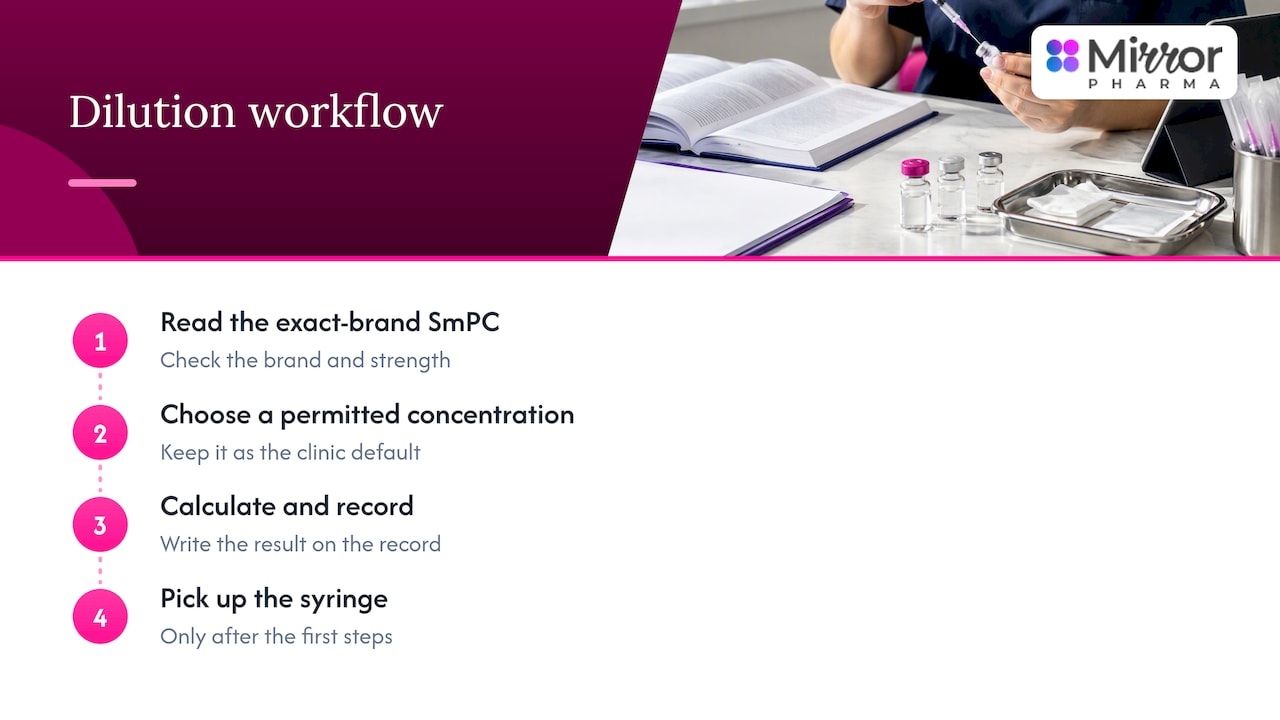
So we suggest a short order of operations. First, read the SmPC for the exact brand and strength. Second, choose a permitted concentration and keep it as your clinic default, so everybody works from one number. Third, calculate with the formula and write the result on the record. Fourth, only then pick up the syringe. A chart is useful for a sanity check, but it should never replace the first step.
We also verify that buyers are practitioners or prescribers before products are released, and our order is fulfilled by a team of healthcare professionals. That is not a sales line. Prescription-only medicines belong in the hands of people trained to use them, and dilution is one of the places where that training shows.
— Rizwan
Safety and legal points to keep in your protocol
Dilution sits inside a wider framework of prescribing and consent. Two points matter in UK clinics.
Age limits. Since 1 October 2021 it has been a criminal offence to administer botulinum toxin for a cosmetic purpose to anyone under 18 in England, even with parental permission, as the GOV.UK guidance sets out. Build age verification into the consultation, before you prepare a vial.
Prescribing and the 12 week rule. Prescribing and consultation requirements have their own rules, which we cover in our guide to the 12 week rule and safer prescribing for botulinum toxin in UK clinics. Read it alongside your professional body’s guidance.
Adverse reactions. Reactions range from temporary site discomfort to rare generalised muscle weakness. NHS patient information notes that difficulty swallowing, speaking or breathing needs urgent medical attention, even when it appears weeks after treatment. Make sure your aftercare advice tells patients this plainly, and that you know your own escalation route.
Common mistakes to design out
- Reading across brands. A dose in one product’s units says nothing about another’s. Treat each product as its own system.
- Changing the dilution without telling anyone. Two practitioners using different volumes from the same stock lead to inconsistent doses.
- Using the wrong diluent. Bacteriostatic or preserved solutions are not interchangeable with the diluent in the SmPC. Follow the document.
- Vigorous mixing. Shaking can foam the solution and risks denaturing the protein.
- Skipping the vacuum check. If the diluent does not draw in, the SmPC says to discard the vial.
- Trusting an old printout. SmPCs are updated. Check the electronic medicines compendium for the current version when you start a new batch.
Stock your clinic with the right products
If you are a licensed practitioner or prescriber, you can browse our toxins category and the matching diluents, with practitioner and prescriber verification at checkout and extended order cut-off times to help you meet appointments. For syringes, needles and other consumables, start at our main shop. Products are supplied for use by trained professionals only.
FAQ
How do I work out units per 0.1 mL?
Divide the vial units by the diluent volume in millilitres, then divide by ten. A 50-unit vial with 1.25 mL gives 50 ÷ 1.25 ÷ 10 = 4 units per 0.1 mL, which matches the published SmPC figure. Always confirm that the volume is permitted for your product.
Can I use one dilution chart for every toxin?
No. Potency units are specific to each preparation and are not interchangeable between products, as the SmPC for a 500-unit product states. Use the SmPC for the exact brand and strength, and use a chart only as a cross-check.
What diluent should I use?
Use the one named in the SmPC. For the 50-unit product cited here, that is sodium chloride 0.9% solution for injection. Some products are ready to use and need no diluent.
How should I mix the vial?
Inject the diluent gently so it does not foam, then swirl or flip the vial. Do not shake it. If the vacuum does not draw the diluent in, the SmPC advises discarding the vial.
Does the same chart apply to ready-to-use liquid toxins?
No. A ready-to-use solution has a fixed concentration and requires no reconstitution. Follow its own SmPC for dosing and handling.
Sources
- SmPC for a 50-unit botulinum toxin powder (electronic medicines compendium)
- SmPC for a 100-unit botulinum toxin powder (electronic medicines compendium)
- SmPC for a 500-unit botulinum toxin powder (electronic medicines compendium)
- SmPC for a 100 units/mL ready-to-use botulinum toxin solution (electronic medicines compendium)
- Botulinum toxin and cosmetic fillers for under 18s (GOV.UK)
- Treatment with botulinum toxin, patient information (Hull University Teaching Hospitals NHS Trust)