
For qualified aesthetic professionals, a biostimulator is an injectable material chosen to trigger a tissue response, such as new collagen or improved hydration, rather than to add instant volume. The main classes practitioners need to recognise are poly-L-lactic acid (PLLA), polycaprolactone (PCL), calcium hydroxylapatite (CaHA), polynucleotides (PN) and hyaluronic acid (HA). In practice, PN and skin boosters suit skin quality concerns, PLLA, PCL and CaHA suit longer-term tissue remodelling, and HA remains the choice when reversibility and immediate volume matter most.
TL;DR:
- A randomized trial found polynucleotides improved periorbital elasticity, hydration, roughness, and pore volume more than noncrosslinked hyaluronic acid, with no serious adverse events.
- Because PLLA, PCL, and CaHA lack an enzymatic reversal agent, clinics need documented emergency pathways and prompt referral plans before treatment begins.
- For PLLA and other bioinductive agents, follow manufacturer reconstitution and dilution instructions; insufficient dilution raises nodule risk, while injection plane must match material and anatomy.
- PCL clinical evidence and long term registry data remain limited, so explain uncertainty during consent and record local outcomes where possible.
- In England, administering cosmetic fillers or botulinum toxin to anyone under 18 is a criminal offense, so confirm age and local rules before treatment.
Table of Contents
- What counts as a biostimulator and why the term is an umbrella concept
- Material classes: PLLA, PCL, CaHA, polynucleotides and where hyaluronic acid fits
- Mechanisms of action explained for practice
- Clinical evidence and outcomes: what the trials and reviews show
- Safety, complications and emergency preparedness specific to biostimulators
- Practical selection and protocol guidance for clinic use
- Author perspective: integrating biostimulators into a modern treatment menu
- How Mirror Pharma supports clinicians with relevant products and sourcing
- FAQ
- Sources
What counts as a biostimulator and why the term is an umbrella concept
“Biostimulator” is not a regulatory category or a single ingredient class. It describes a treatment aim: stimulating a biological remodelling process rather than filling space mechanically. This matters for how we explain treatment to patients, because two products in the same loose category can behave very differently depending on formulation.
Carrier gel, particle shape, concentration and the product’s authorised indication all change how a material disperses, how long it persists and what complications it can cause. A microsphere suspended in a thick carrier behaves differently from a freeze-dried polymer that needs reconstitution, even when both are marketed under the biostimulator label.
- Formulation details (particle size, carrier viscosity, concentration) directly affect spread, persistence and nodule risk.
- Authorised indication and licensing status vary by product and market, which affects what a practitioner can lawfully claim or offer.
- Practitioners administering injectable fillers or botulinum toxin for cosmetic purposes must observe that the Botulinum Toxin and Cosmetic Fillers (Children) Act 2021 makes it a criminal offence in England to administer these treatments to anyone under 18 for cosmetic purposes. The Act defines “filler” broadly, including substances used for dermal or mucous membrane filling.
Treating “biostimulator” as a precise technical term invites confusion at the consent stage. Naming the specific material and its authorised use is the safer habit for qualified aesthetic professionals.
Material classes: PLLA, PCL, CaHA, polynucleotides and where hyaluronic acid fits
Each class has a distinct onset, durability and risk profile, and choosing between them starts with understanding what each one actually does in tissue.
- PLLA is a biodegradable polymer that induces neocollagenesis gradually; it is technique and dilution sensitive, and nodule risk makes careful reconstitution important.
- PCL works as a scaffold, with evidence pointing to adipogenesis and extracellular matrix remodelling alongside collagen stimulation; clinical evidence remains limited.
- CaHA combines immediate mechanical lift from its microspheres with a secondary, slower collagen-stimulating effect; it is plane sensitive and is increasingly used in hyperdiluted form for skin quality rather than volume.
- Polynucleotides (PN) act through a hydrophilic scaffold and nucleotide signalling that supports tissue repair and hydration, making them well suited to delicate or oedema-prone areas such as the periorbital region.
- Hyaluronic acid (HA) is a volumising option that can often be reversed with hyaluronidase, though its biostimulatory effect is modest compared with other classes.
Pro Tip: Match the material to the dominant clinical question first (volume or quality), then confirm the dilution and plane rather than choosing by brand familiarity alone.
Mechanisms of action explained for practice
Understanding mechanism helps practitioners consider how a material may act and what complications to monitor for. PLLA and CaHA are associated with bioinduction and gradual neocollagenesis.
PCL’s effect may involve scaffold-driven mechanotransduction, with the physical structure supporting adipose-derived stem cell differentiation and extracellular matrix remodelling. Polynucleotides work differently again: nucleotide-mediated cellular signalling, hydrophilic matrix formation and anti-inflammatory activity combine to improve skin texture and hydration rather than to build volume.
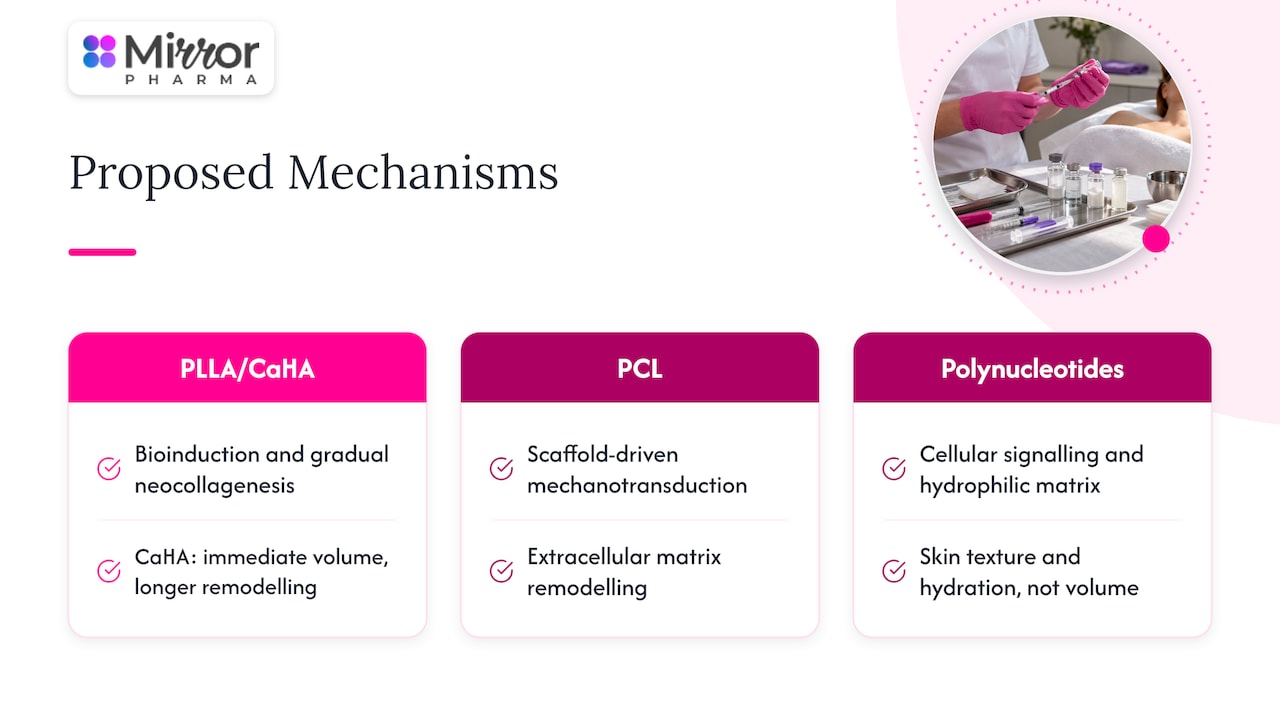
A recent literature review of biostimulators in adipose tissue describes PLLA, PCL and CaHA as acting through neocollagenesis, adipocyte stimulation and extracellular matrix remodelling, with PLLA supported by moderate to long clinical follow-up and PCL evidence still accumulating. These differing proposed mechanisms may affect the timing and type of response. CaHA can provide immediate volumising alongside longer-term remodelling.
Clinical evidence and outcomes: what the trials and reviews show
The evidence base varies considerably by material, and that variation should shape how confidently we discuss expected outcomes with patients. Evidence varies by material, so qualified aesthetic professionals should communicate uncertainty about expected outcomes. Comparative head-to-head trials across classes remain limited.
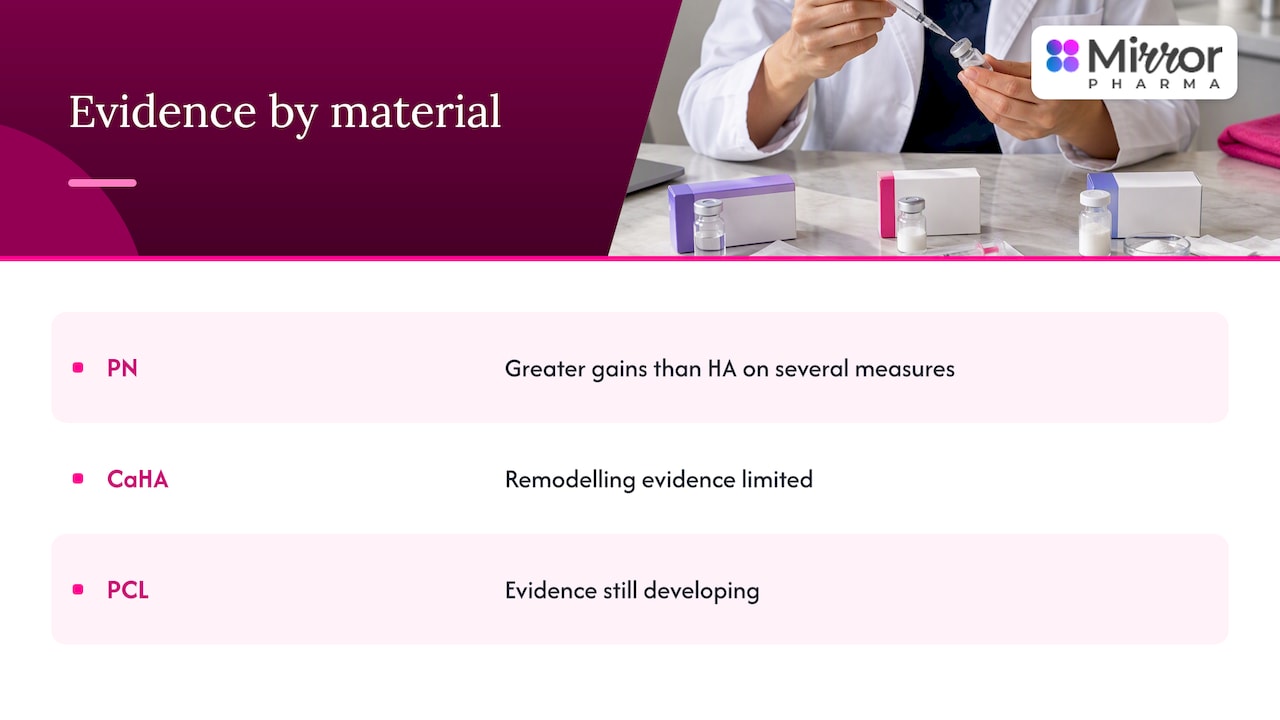
Polynucleotides have the clearest split-face trial data among the newer agents. A randomised, double-blind, split-face trial comparing PN against non-crosslinked HA in the periorbital area found PN produced greater improvement in skin elasticity, hydration, roughness and pore volume on several measures, with no serious adverse events recorded.
PN injections have been shown to improve skin roughness and pore volume more effectively than non-crosslinked HA fillers in split-face studies, a finding consistent across the comparative evidence on polynucleotides versus hyaluronic acid for under-eye rejuvenation, where PN is positioned as a regenerative option for skin quality rather than a volumising filler.
Evidence for CaHA and PCL remodelling claims is limited, with PCL evidence still developing. Differences in injection protocols and outcome measures make direct comparisons difficult, which qualified aesthetic professionals should explain when discussing expected results.
Safety, complications and emergency preparedness specific to biostimulators
A defining safety feature of most biostimulators, unlike HA fillers, is the absence of a direct reversal agent. Hyaluronidase dissolves HA quickly in an emergency, but PLLA, PCL and CaHA cannot be reversed enzymatically, so management of adverse events relies on early recognition, conservative measures and prompt specialist referral rather than a rescue injection.
- Possible procedure-related effects include bruising, swelling and tenderness at the injection site.
- Nodules and granulomas are possible complications; practitioners should follow the manufacturer’s protocol for dilution and injection plane.
- Vascular compromise is a possible complication of injectable treatments. Practitioners should have a documented emergency protocol and respond promptly to suspected complications.
- Long-term registry data for newer agents, especially PCL, remain limited, which should inform patient selection and the thoroughness of consent conversations.
Guidance from the ACE Group on managing vascular occlusion stresses that because most biostimulators lack a direct reversal agent, clinics need a documented emergency pathway in place before treatment begins, not after a complication arises. Reviewing our own complication recognition guide alongside that protocol helps keep escalation steps consistent across the team.
Practical selection and protocol guidance for clinic use
Choosing a material starts with naming the dominant clinical problem, not the product catalogue.
- Identify whether the presentation is primarily a volume deficit or a skin quality concern, then assess which material may be appropriate for the individual case.
- Confirm reconstitution and dilution according to the manufacturer’s current protocol, since under-dilution is a recognised driver of nodule risk in bioinductive agents.
- Select the injection plane and device based on the material and anatomical area, taking vascular anatomy into account.
- Plan session spacing according to the product’s instructions and the patient’s needs; some treatment plans use a course of sessions, with maintenance considered where appropriate.
- Document consent conversations covering realistic timelines, the possibility of further intervention if an adverse event occurs, and relevant age and regulatory considerations.
- Verify product authorisation and sourcing before ordering, following MHRA-aligned compliance checks for unlicensed or imported materials.
Pro Tip: Build the maintenance schedule into the first consultation rather than the follow-up appointment, since bioinductive agents rely on a planned course rather than a single visit.
Author perspective: integrating biostimulators into a modern treatment menu
For qualified aesthetic professionals, technique training and dilution discipline are important considerations when evaluating new materials. A clinic should establish appropriate training in reconstitution, injection plane and emergency response for each material. These practices support safer care.
I’d also encourage practitioners to record outcomes locally and feed them into registries where possible, since the evidence gaps around PCL and some PN protocols will only close with more real-world data. Biostimulators may be considered alongside HA and energy-based devices, depending on the clinical context.
— Rizwan
How Mirror Pharma supports clinicians with relevant products and sourcing
We supply polynucleotides and skin booster products, along with needles and consumables, to licensed practitioners and aesthetic clinics. Orders are subject to practitioner verification, and our extended cut-off times are built around clinics that need reliable delivery.
Before ordering, it’s worth checking our compliance guidance for aesthetics suppliers alongside the product pages, so sourcing and authorisation checks are in order from the first order. Browse our skin booster and polynucleotide ranges to see what’s available for your next clinic order.
This article is general information, not a substitute for advice from a qualified doctor. Consult a qualified healthcare professional about your own circumstances before acting on anything here.
FAQ
How do biostimulators work?
Biostimulators trigger a biological response in tissue, such as fibroblast activation, collagen production or improved hydration, rather than providing instant mechanical volume. The specific pathway depends on the material: PLLA and CaHA mainly work through neocollagenesis, PCL through scaffold-driven matrix remodelling, and polynucleotides through nucleotide signalling and hydration support.
What are the main biostimulator material classes?
The core classes recognised in clinical practice are poly-L-lactic acid (PLLA), polycaprolactone (PCL), calcium hydroxylapatite (CaHA) and polynucleotides (PN), with hyaluronic acid (HA) sitting alongside them as the main reversible volumiser. Each class has a different onset, durability and primary clinical aim, from immediate lift to gradual tissue remodelling.
How long do biostimulator results last?
Duration varies by material and depends on dose, area treated and individual metabolism, so it’s discussed as a range rather than a fixed figure during consultation. Bioinductive agents such as PLLA and PCL tend to produce gradual, longer-lasting remodelling, while CaHA combines an immediate effect with a slower collagen response, and PN typically requires a maintenance course to sustain skin quality improvements.
What complications should practitioners watch for with biostimulators?
Reported effects range from transient bruising and swelling to less common nodules, granulomas or, rarely, plane-dependent vascular compromise. Because most biostimulators, unlike hyaluronic acid fillers, lack a direct reversal agent, management centres on early recognition, conservative measures and a documented referral pathway rather than an enzymatic rescue.
Which biostimulator suits a skin-quality concern versus a volume deficit?
For skin quality and hydration, polynucleotides and hyperdiluted CaHA are generally preferred, supported by split-face trial data showing improvements in roughness and pore volume. For a genuine volume deficit, hyaluronic acid remains the first choice because it offers reversibility, while PLLA or standard-dilution CaHA suit patients seeking gradual, longer-term structural change.
Sources
- Hyaluronic Acid Fillers Versus Polynucleotides for Under-Eye Rejuvenation – PMC
- Comparison of the effects of polynucleotide and hyaluronic acid fillers on periocular rejuvenation: a randomized, double-blind, split-face trial
- Injectable Biostimulator in Adipose Tissue: An Update and Literature Review
- Gov