
Platelet-rich plasma tends to suit patients seeking collagen stimulation, improved texture and scar remodelling, while polynucleotides tend to suit those prioritising deep hydration and overall skin quality. Both are regenerative, progressive treatments rather than quick fixes, and the evidence base for each is still developing. For licensed practitioners weighing which to offer, the right choice usually depends on the primary concern and the realistic timeline a patient can accept.
TL;DR:
- Choose PRP for acne scars, uneven texture, mild sun damage, or hair support; choose polynucleotides for dehydration, elasticity, or thin under eye skin.
- Treatment courses usually span 2 to 4 sessions, spaced 2 to 4 weeks apart, with visible changes building over weeks or months.
- Evidence supports both treatments, but cosmetic trials are often small and use varied protocols; the clearest, most reproducible findings concern wound repair.
- Neither treatment replaces dermal filler for volume or structural lift; clinicians may combine polynucleotides for hydration with PRP for texture based on patient concerns.
- Before booking, verify clinician registration, training, and insurance; ask how PRP platelet concentration is documented, and check polynucleotide product brand, batch, and regulatory status.
Table of Contents
- PRP and polynucleotides compared at a glance
- How do PRP and polynucleotides work in the skin?
- Which concerns suit PRP and which suit polynucleotides?
- What does the clinical evidence actually show?
- How are treatment sessions and aftercare structured?
- What should clinicians and patients check before treatment?
- A clinician’s note on choosing a supply partner
- Sourcing polynucleotides for your clinic
- FAQ
- Sources
PRP and polynucleotides compared at a glance
Polynucleotides (PN) draw out water and support a hydration scaffold in the dermis, while platelet-rich plasma releases growth factors that drive fibroblast activity and collagen turnover. Each has a different clinical sweet spot, and for qualified aesthetic professionals, matching the mechanism to the concern is the starting point for any treatment plan.
- Mechanism: PRP delivers concentrated autologous growth factors; polynucleotides provide a hydrophilic scaffold with signalling effects.
- Best for: PRP suits texture, scarring and hair density support; polynucleotides suit hydration, elasticity and under-eye skin quality.
- Typical sessions: PRP protocols often run 3 sessions at monthly intervals; PN protocols commonly use 3 sessions spaced four weeks apart.
- Downtime: both cause mild redness or swelling that settles within days, with PRP sometimes producing slightly more initial bruising from the blood draw.
- Evidence strength: the clearest randomised evidence for either therapy currently sits with wound healing rather than cosmetic rejuvenation.
- Common combination: many clinicians layer polynucleotides with microneedling or energy-based devices to extend results.
How do PRP and polynucleotides work in the skin?
Platelet-rich plasma is prepared from the patient’s own blood through centrifugation, which concentrates platelets before they are injected back into the skin. Once in the dermis, those platelets degranulate and release growth factors such as TGF-β and FGF, which stimulate fibroblast proliferation and extracellular matrix remodelling. The same review describes additional antioxidant and anti-apoptotic effects, which helps explain why PRP is used across scarring, photodamage and general texture concerns, not just one indication.
Polynucleotides work through a different route. Derived from purified DNA fragments, they are intensely hydrophilic, drawing water into the tissue and forming a temporary scaffold that supports hydration and elasticity. Where the molecule is processed as PDRN, adenosine-receptor signalling is also thought to contribute to tissue repair, and the fragments persist intradermally for a period that supports a slower, cumulative effect rather than an instant one. A review of current clinical practice notes that polynucleotides are widely used as skin boosters for this reason, though protocols and reported outcomes still vary between studies.
In practice, injection technique differs too. PRP is typically layered with a standard mesotherapy or micro-bolus technique immediately after preparation, since the product cannot be stored. Polynucleotide injections are usually delivered with fine 33 to 34 gauge needles in a serial, superficial pattern, and are frequently paired with microneedling or radiofrequency to enhance penetration and offset the downtime of the device session.
Which concerns suit PRP and which suit polynucleotides?
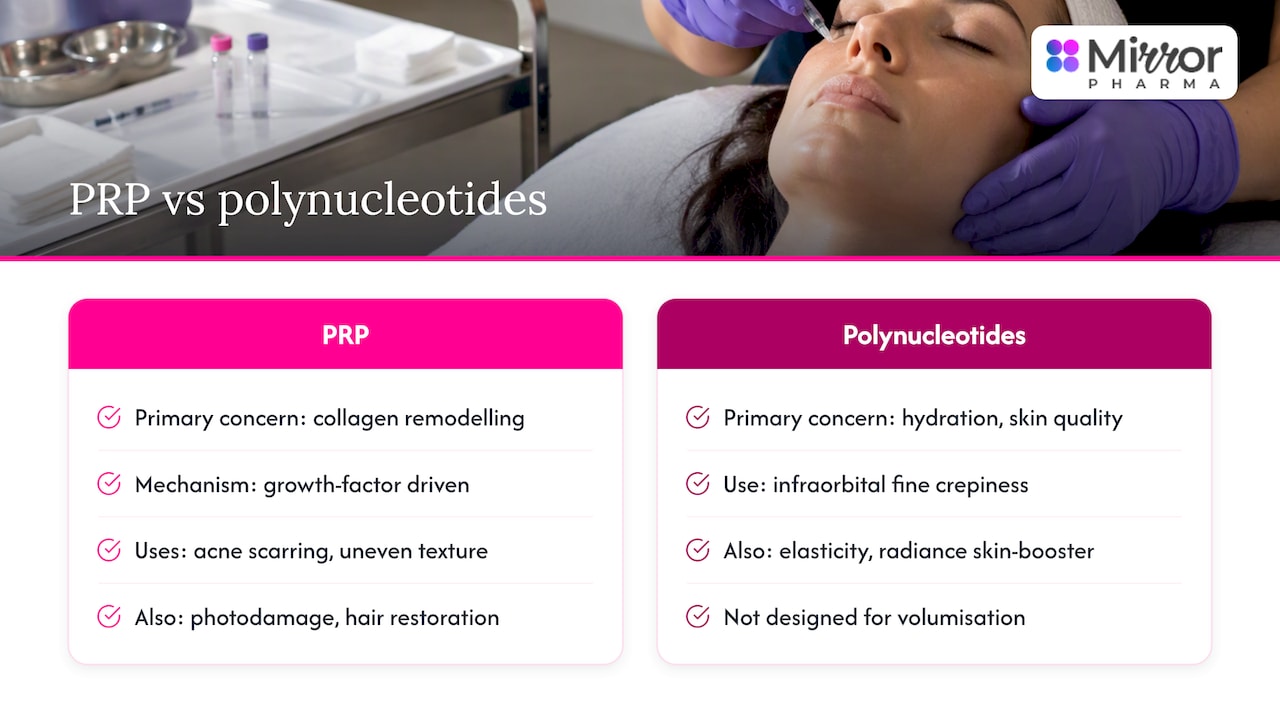
Platelet-rich plasma tends to be the default where the goal is collagen remodelling: acne scarring, uneven texture, mild photodamage and as an adjunct in hair restoration protocols where follicular support is the aim. Its growth-factor driven mechanism makes it a reasonable fit wherever fibroblast activity is the limiting factor in a patient’s skin quality.
Polynucleotides tend to be chosen where hydration and skin quality are the primary complaint rather than volume or deep lines. The infraorbital area, where skin is thin and prone to dehydration and fine crepiness, is a frequently cited use case, alongside general skin-booster roles for elasticity and radiance. Neither treatment is designed to replace volumisation: where a patient wants a structural lift or fuller contours, a hyaluronic acid dermal filler addresses a different problem entirely and sits outside this comparison.
Many clinics combine the two modalities rather than treating them as rivals. A course of polynucleotides for baseline hydration followed by PRP for texture, or the reverse sequencing depending on presentation, is a common additive strategy, since the mechanisms are complementary rather than overlapping.
What does the clinical evidence actually show?
The honest picture is that both therapies have supportive evidence, but neither has the depth of data seen with longer-established treatments. A cellular and molecular review of PRP confirms a clear mechanistic basis, growth-factor release driving fibroblast proliferation, collagen synthesis and matrix remodelling, and this translates into clinical support for scar management and general rejuvenation. The mechanism is well characterised even where individual trial sizes remain modest.
For polynucleotides, a systematic review of randomised clinical trials covering wound healing, scar prevention and skin rejuvenation found consistent benefits for wrinkle-related outcomes, elasticity and hydration, but noted that the strongest and most reproducible effects were seen in wound repair rather than purely cosmetic endpoints. The same synthesis flags that trials across both PN and PRP in aesthetic use are often small and use heterogeneous protocols, injection depth, product concentration and session spacing differ between studies, which limits how confidently results can be generalised to any one patient.
A smaller trial comparing microneedling combined with PDRN against microneedling combined with PRP found greater wrinkle reduction in the PDRN group at six weeks, though the sample size was small and follow-up short. Results like this are directionally useful but not conclusive, and they illustrate why patient counselling should frame outcomes as likely rather than guaranteed. Setting expectations around progressive, cumulative change rather than a single dramatic transformation remains the more defensible clinical position.
How are treatment sessions and aftercare structured?
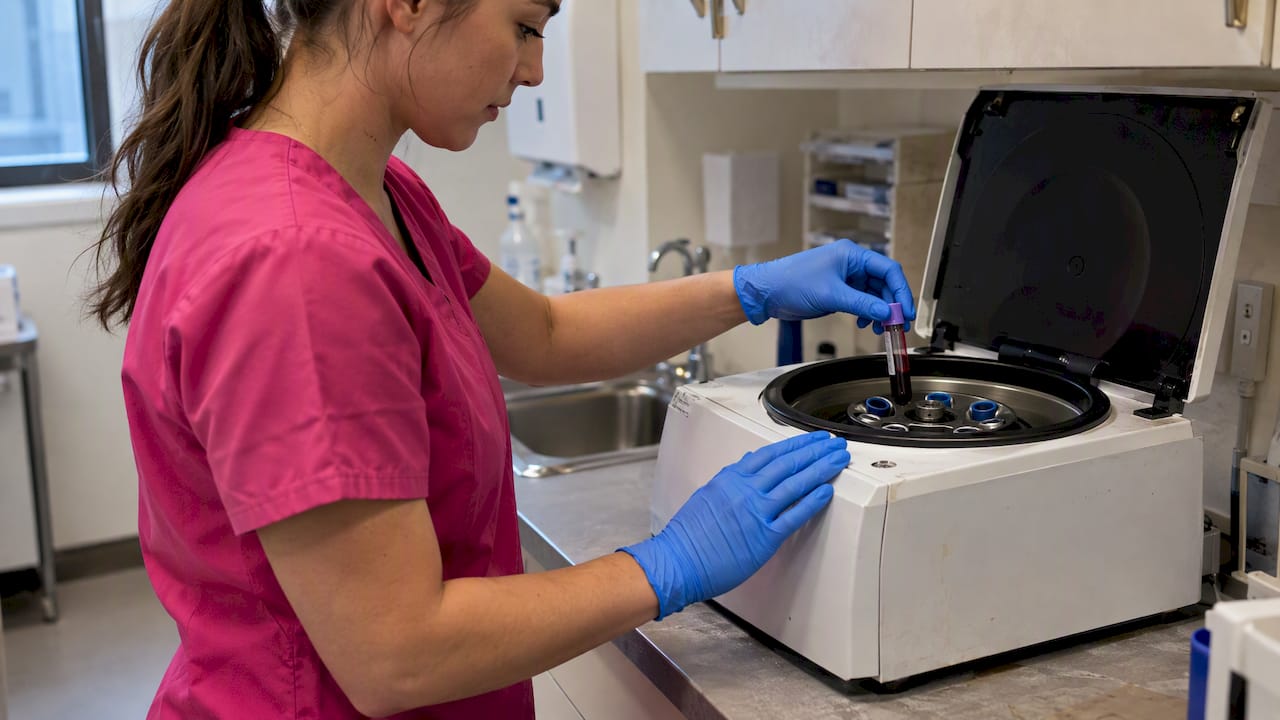
PRP sessions begin with a blood draw followed by centrifugation to isolate the platelet-rich fraction, which is injected the same day since it cannot be stored. Polynucleotide sessions use a pre-formulated product injected directly into the dermis with fine needles, with no blood preparation step required.
Scheduling for both tends to follow a similar rhythm: commonly 2 to 4 sessions spaced 2 to 4 weeks apart, with visible change building gradually over weeks to months rather than appearing after one visit. A hospital patient guide to PRP advises patients to avoid NSAIDs for a period before treatment to protect platelet function, and describes mild, short-lived local swelling or bruising as the expected immediate response. Equivalent caution around anti-inflammatory medication and sun exposure applies to polynucleotide sessions, where aftercare is similarly limited to gentle skincare and avoiding active ingredients on treated skin for a few days.
What should clinicians and patients check before treatment?
Quality assurance sits on both sides of the consultation. For practitioners, that means verifying registration and insurance, documenting the platelet-preparation method and expected concentration for PRP, and confirming the provenance and labelling of any polynucleotide product used.
- Confirm the clinician’s registration, training and insurance before booking.
- Ask how platelet concentration is measured and documented for PRP.
- Check the brand, batch and regulatory status of any polynucleotide product.
- Request a clear session plan with expected timeline for visible change.
Pro Tip: When combining polynucleotides with microneedling or radiofrequency, document the device settings and session interval alongside outcomes so results can be compared across a patient’s course.
A clinician’s note on choosing a supply partner
Our company was developed around the needs of clinicians sourcing polynucleotides and other regenerative injectables, so practitioner verification and compliant procurement sit at the centre of how we work. If you are weighing PN against PRP for a patient, our polynucleotide product range and regulatory sourcing guidance are there to support that decision.
— Rizwan
Sourcing polynucleotides for your clinic
We supply polynucleotides and related skin booster products to verified healthcare professionals, with order cut-off times designed to support timely treatment planning. Every account goes through prescriber and practitioner verification before an order is placed, and our polynucleotides category is the place to start for licensed practitioners ready to stock their next course of treatments.
This article is general information, not a substitute for advice from a qualified doctor. Consult a qualified healthcare professional about your own circumstances before acting on anything here.
FAQ
Can PRP lift jowls or sagging skin?
Platelet-rich plasma supports collagen remodelling and texture, but it is not designed to produce a structural lift of jowls or significant laxity. Where volume or lift is the main concern, a dermal filler or a surgical consultation addresses a different problem than PRP’s regenerative mechanism.
Is there a treatment more effective than PRP for skin rejuvenation?
No single treatment outperforms PRP across every concern. A systematic review of randomised trials found polynucleotides can offer comparable or complementary benefits for hydration and elasticity, so the better option depends on whether the goal is collagen-driven texture change or hydration and skin quality.
Will polynucleotides tighten loose skin?
Polynucleotides improve hydration, elasticity and overall skin quality rather than producing a tightening effect comparable to energy-based devices or surgery. A review of clinical practice describes consistent gains in hydration and texture, with evidence quality still variable across studies.
How do polynucleotides compare with skin boosters?
Polynucleotides are themselves a category of skin booster, used specifically for their hydration-scaffold and signalling effects rather than for volume. The choice between a polynucleotide-based booster and another hyaluronic acid based skin booster usually comes down to the specific product’s formulation and the practitioner’s assessment of the patient’s skin.
How effective is PRP for anti-aging compared with other regenerative options?
PRP has a well-documented mechanistic basis for stimulating collagen and improving texture, supported by cellular and molecular research. Results build progressively over several sessions, and outcomes vary by patient, so it is best framed as one effective regenerative option among several rather than a guaranteed result.
Sources
- Platelet-Rich Plasma (PRP) in Dermatology: Cellular and Molecular Mechanisms of Action – PMC
- A Patient’s Guide to Platelet Rich Plasma (PRP) Blood Injection :: Royal National Orthopaedic Hospital