
Exosomes are not categorically illegal in the UK, but the answer depends on the product, not the word. Human-derived exosomes are banned in cosmetics. Injectable exosome products have no UK marketing authorisation for aesthetic use. Topical, non-human cosmetic products may be lawful if the exact formulation and its claims stay within cosmetics rules. This guide is for licensed practitioners, prescribers and qualified aesthetic professionals who are being offered exosome products and need to decide what they can safely put into their clinic.
TL;DR
- “Legal or illegal” is the wrong first question. Ask what the product is made from, what the supplier says it does, and how you would administer it.
- Human-origin exosomes are banned in cosmetics sold in the UK, according to a Department for Business and Trade statement reported in March 2025.
- Injected exosomes are treated as medicinal products, and no injectable exosome therapy has a UK marketing authorisation.
- Lawful supply does not mean lawful or insured use. Get cover confirmed in writing for the exact product and procedure.
- Ask for full documentation before any order. If a supplier cannot provide it, walk away.
Table of Contents
- Why the question has no one-word answer
- Step 1: Source of the exosomes
- Step 2: Route of administration
- Step 3: What the label and the sales pitch claim
- Step 4: Insurance is a separate gate
- Step 5: Supplier evidence to request before you order
- Worked example: three offers, three outcomes
- Are exosomes worth the price? PRP versus exosomes
- Our perspective
- Where Mirror Pharma fits
- FAQ
- Sources
Why the question has no one-word answer
Search results for this topic are noisy. Some clinic pages describe exosome treatment as established and safe. Others, from regulators and insurers, warn of banned products. Both can be partly true, because “exosome” describes a type of tiny vesicle, not a regulated product category.
Exosomes can come from human, animal or plant sources. UK classification depends on the source, the composition, how the product is presented and the route of administration. Two vials that look identical on a supplier’s website can sit under different legal frameworks, or under none that permits your intended use.
That is why a practitioner needs a way to classify the product before worrying about price, results or patient demand. The sections below follow that order: source, then route, then claims, then insurance, then supplier evidence.
Step 1: Source of the exosomes
Human-derived products
This is the clearest red line. The Guardian reported in March 2025 that products derived from human cells, including umbilical cord blood, were being offered by some UK clinics, and that the Department for Business and Trade said human-origin exosomes are banned in cosmetics. The same report distinguishes them from plant- or salmon-derived formulations.
Insurance specialists say the same. Enhance Insurance’s guidance for UK practitioners states that human-derived exosomes are not legal in the UK.
Marketing language does not change this. Calling a human-origin product regenerative, premium or biocompatible does not make it acceptable as a cosmetic. Nor does using it topically or alongside microneedling. Do not assume the injection question is the only regulatory issue.
Plant- and animal-derived products
Non-human origin removes one problem, not all of them. Save Face, the register of accredited practitioners, says topical, plant or animal-derived cosmetic exosomes are legal in the UK when formulated correctly and not injected.
The qualifier “when formulated correctly” carries weight. A cosmetic must comply with UK cosmetics requirements, which include a safety assessment, proper labelling and a responsible person. Cosmetics law itself, as retained from Regulation (EC) No 1223/2009, sets out the rules a cosmetic product must meet.
Step 2: Route of administration
The route is where many clinics get into trouble. Cosmetic products are limited to functions such as cleaning, perfuming, changing appearance, protecting or keeping external body parts in good condition, as Bloom Regulatory explains. A product that is injected, or delivered into the skin in a way that reaches beyond the surface, is moving away from that definition.
Practical points:
- Injection (intradermal, subcutaneous or intravenous): Enhance Insurance describes this as prohibited. Save Face notes that the MHRA regards injected exosomes as medicinal products, and that no injectable exosome therapy has UK marketing authorisation.
- Microneedling or other delivery enhancement: a topical cosmetic does not become approved for this by being used with a device. Cosmetic status does not stretch to injection, microneedling delivery, hair treatment, tissue regeneration or medical claims.
- Topical application only: the only route where a compliant non-human cosmetic may be defensible, and only if the product itself and your claims remain cosmetic.
The MHRA position matters because medicinal products need the appropriate authorisation. If you want a refresher on how unlicensed medicines are treated in aesthetics, our guide on MHRA checks for prescribers using unlicensed medicines covers the basics.
Step 3: What the label and the sales pitch claim
Presentation can turn a cosmetic into a medicine. Claims that suggest regeneration, repair, treatment or alteration of biological function can move a product toward medicines regulation, even where the ingredient list looks harmless.
Be cautious about these supplier labels, none of which is conclusive:
| Label | What it does not prove |
|---|---|
| “Cosmetic” | That the formulation, safety assessment and claims meet UK cosmetics rules |
| “Research use” | That it may be used on patients at all |
| “Plant-derived” | That the exact product is compliant, sterile or suitable for your route |
| “CE marked” | That it is authorised in the UK for aesthetic use; a mark for another purpose is not a UK authorisation |
| “Available in another country” | That it is lawful to import or use in Great Britain |
Your own website, consent forms and social posts count as presentation too. If you describe a topical product in terms of repair or regeneration, you are making claims that your supplier may not be able to support.
Step 4: Insurance is a separate gate
Even where a product can lawfully be supplied, that does not make your use of it lawful or insured. Hamilton Fraser’s practitioner guide advises confirming cover for the exact product and procedure. Ordinary aesthetic liability cover may exclude unregulated products, non-compliant claims or microneedling combinations.
Before introducing any exosome product, a qualified practitioner should:
- Name the product, its source, the route and the claims you intend to make.
- Ask your insurer in writing whether that exact combination is covered.
- Keep the written reply with your treatment protocol.
- Do not rely on a supplier’s verbal reassurance that “insurers are fine with it”.
If the insurer declines or hedges, treat that as the answer.
Step 5: Supplier evidence to request before you order
A compliant supplier should expect these questions and answer them in writing. Before ordering, ask for:
- The full ingredient and source specification
- The intended-use statement
- The UK regulatory classification
- A safety assessment
- Batch and sterility documentation
- Responsible person details
- Labelling and claims substantiation
- Traceability back to the biological source and manufacturing controls
Professional guidance also recommends checking biological source, licensing or regulation for the intended use, peer-reviewed evidence, manufacturing quality and malpractice cover. If a supplier answers with enthusiasm but no paperwork, that is a warning in itself.
The same discipline applies to any aesthetic product. We cover it in more detail in our guides on the documents a UK clinic should get from a medicine supplier and four compliance checks for injectables suppliers.
Worked example: three offers, three outcomes
These are illustrative scenarios, not real suppliers.
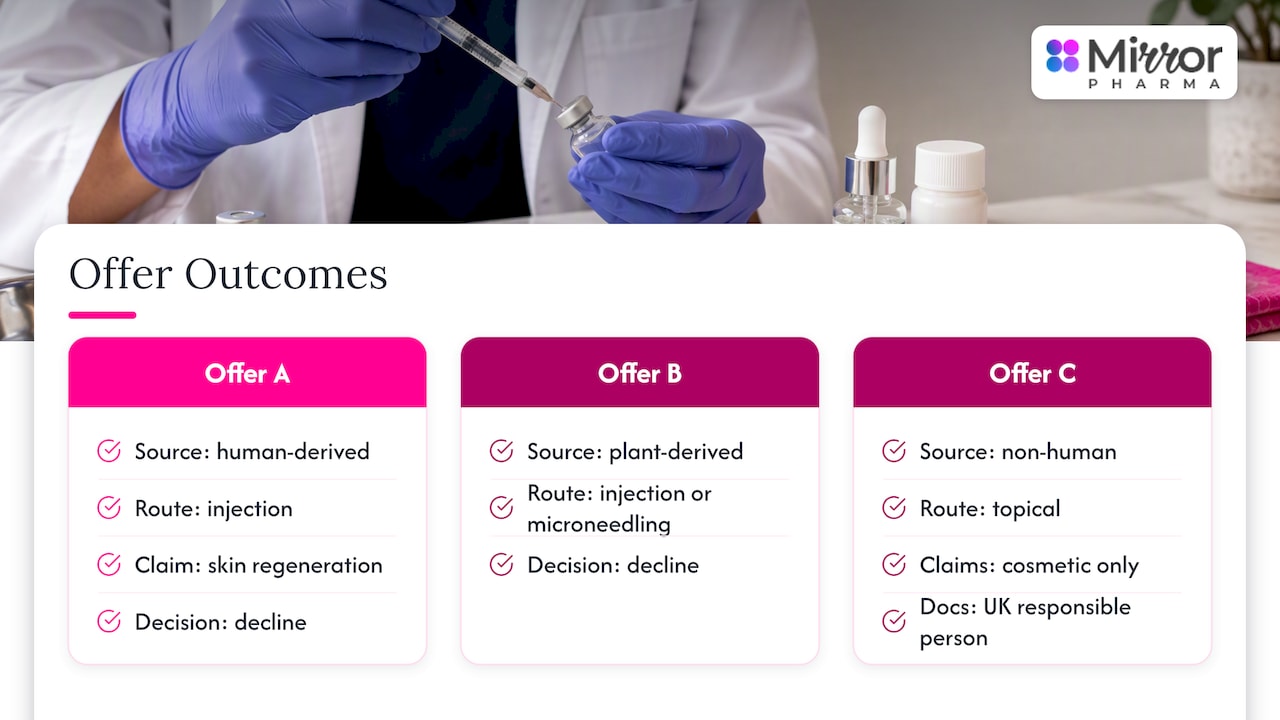
Offer A: a vial described as injectable, human-cell-derived, “for skin regeneration”. Fail at every step. The source is human, the route is injection, and the claim is regenerative. Decline.
Offer B: a freeze-dried product described as plant-derived, for injection or microneedling. The source may be acceptable, but the route is not. No UK authorisation for injection means you should not use it that way, whatever the label says. Decline.
Offer C: a topical serum from a non-human source, with a UK responsible person, a safety assessment, full labelling and cosmetic-only claims. This could be defensible as a cosmetic, if the documents check out and your insurer confirms in writing. It is not a medical treatment, and you should not describe it as one.
Are exosomes worth the price? PRP versus exosomes
Two questions come up repeatedly in searches. On cost, the UK sources reviewed do not establish a reliable national average price or a cost-effectiveness estimate, so we do not quote one. Aesthetics Unlocked’s review of the evidence describes the aesthetic evidence as still heterogeneous. A premium price is not evidence of regulatory approval or clinical effectiveness. Resolve legality, authorisation and insurance first, then consider value.
On PRP versus exosomes, the two are not interchangeable. PRP is an autologous, blood-derived procedure with a different regulatory and evidence pathway. Exosome products vary by source, formulation and route. The same review does not support a universal claim that one is better. Decisions should rest on indication, evidence quality, patient selection, governance and insurer acceptance, not marketing labels. If you are weighing regenerative options, our clinical comparison of polynucleotides and PRP sets out the evidence for qualified practitioners.
Our perspective
We supply prescription aesthetic medicines and consumables to verified practitioners, and exosomes are not among the categories on our site. We see the same pattern whenever a new product trend arrives: demand from patients moves faster than the regulatory position, and suppliers fill the gap with confident marketing.
Our view is simple. A practitioner is accountable for what goes into a patient, not the supplier who sold it. That is why we ask for professional verification before access, and why we would urge any clinic to demand documents rather than reassurance, whoever the supplier is. If a product’s status cannot be explained clearly in writing, it is not ready for your clinic.
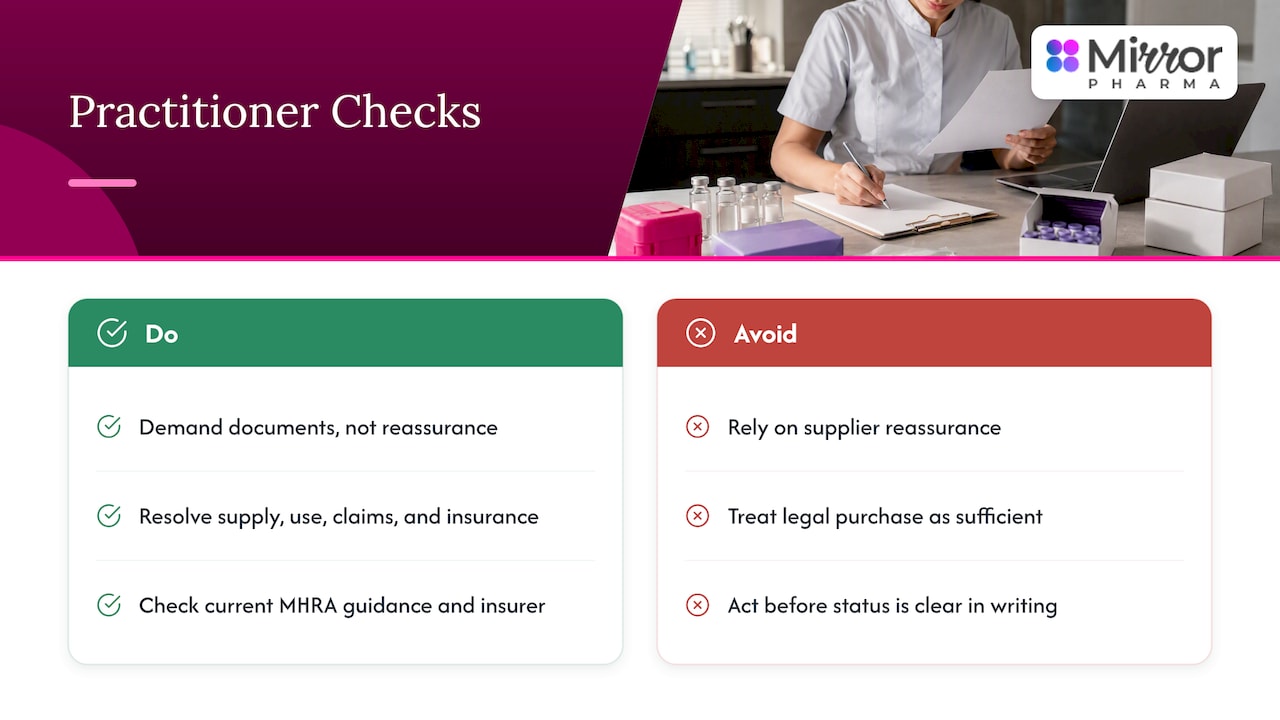
We also think “it is legal to buy” is a dangerous shortcut. Supply, use, claims and insurance are four separate questions. You need a clear answer to all four.
The position on exosomes continues to evolve, and the regulator, not a blog post, is the final word. Check current MHRA guidance and speak to your insurer before you act.
— Rizwan
Where Mirror Pharma fits
If you are looking for regenerative skin options within a clearly regulated supply route, our range for licensed practitioners includes polynucleotides and skin boosters. Access is limited to verified practitioners and prescribers, and orders are fulfilled by a team of healthcare professionals. You can browse the full range from our home page.
FAQ
Are exosomes legal in the UK?
Not as a simple yes or no. Human-derived exosomes are banned in cosmetics, and injectable exosome products have no UK marketing authorisation. Topical, non-human cosmetic exosomes can be lawful if properly formulated and presented with cosmetic claims only.
Is stem cell therapy legal in the UK?
That depends on the product and how it is made and used, and it is a different question from exosomes. Medicinal products need the appropriate MHRA authorisation, and a cell-derived product used for treatment is likely to be treated as one. Check the MHRA’s guidance and take regulatory advice before offering anything of this kind.
Can a licensed practitioner inject exosomes if the supplier says the product is CE marked?
No, a supplier’s CE mark is not a UK authorisation for aesthetic injection. A mark for another purpose, or sale in another country, does not establish that the product can be used this way in the UK. Confirm the UK classification in writing and your insurer’s position before use.
What should I ask my insurer about exosomes?
Name the exact product, its source, the route of administration, your claims and any device used alongside it, then ask for written confirmation of cover. Ordinary aesthetic liability policies may exclude unregulated products or non-compliant claims. Do not rely on what a supplier says insurers will accept.
Which is better, PRP or exosomes?
The evidence does not justify a universal answer. PRP is an autologous procedure with a different regulatory pathway, while exosome products vary widely by source, formulation and route. Qualified practitioners should decide by indication, evidence, patient selection and insurer acceptance.
Sources
- Beauty clinics in UK offering banned treatments derived from human cells, The Guardian
- Exosome Therapy in the UK: A Patient Safety Warning, Save Face
- Exosomes in Aesthetic Practice, Enhance Insurance Services
- Exosomes in cosmetics, Bloom Regulatory
- Exosomes in Aesthetics: Evidence, Regulation, Cover, Hamilton Fraser
- Exosomes in aesthetics: evidence, Aesthetics Unlocked
- Regulation (EC) No 1223/2009 on cosmetic products, legislation.gov.uk