

For licensed practitioners, a reliable authenticity check has two parts: confirming that the supplier is legitimate before you order, and inspecting every delivery against a fixed list when it arrives. A scan or a serial number alone proves less than it seems to. Official UK guidance puts the supply route first, then the pack in your hand. This article sets out both as a routine a qualified aesthetic professional can run in a few minutes per delivery. It is written for prescribers, practitioners and clinic managers, not for patients or the general public. At Mirror Pharma we supply prescription aesthetic medicines and consumables only to verified practitioners and prescribers, so the supply route is where we start.
TL;DR
- Start with the source: GOV.UK advises buying from the brand, an authorised distributor or a trade wholesaler the brand recognises, and treating marketplaces, social media sellers and unfamiliar websites with extra care.
- On delivery, check the company name and address, ingredients, instructions, safety warnings and batch traceability, and confirm that box, syringe and leaflet show the same batch number and expiry date.
- A genuine pack can still come from a compromised route. Authenticity of the pack and integrity of the supply chain are separate questions, so record both.
- If something is wrong, stop using the product, keep everything, and report it to the MHRA, Trading Standards or Yellow Card as the situation requires.
- Since 1 January 2025, medicines placed on the UK market must carry a “UK Only” label.
Table of Contents
- Why authenticity checks matter in aesthetic practice
- Stage one: check the supplier before you order
- Stage two: the goods-in inspection
- A quick reference table
- What QR codes, serial numbers and apps can and cannot tell you
- If something looks wrong
- Building the routine into the clinic
- Where Mirror Pharma fits
- Our perspective
- FAQ
- Sources
Why authenticity checks matter in aesthetic practice
Counterfeit and substandard products reach clinics by the same ordinary routes as genuine ones. The World Health Organization’s toolkit for healthcare professionals notes that falsified products can enter the legal supply chain through hospitals, clinics, pharmacies and wholesalers that obtained stock from unknown sources or intermediaries without checking credentials or carrying out due diligence.
For an injectable practice the consequences are clinical, not just commercial. A product with the wrong concentration, a missing active ingredient or compromised sterility harms the person you are treating, and it falls on the prescriber and the clinic to explain how it was sourced. The British College of Aesthetic Medicine now tells patients to ask which filler brand and model is being used and to see the box or leaflet. Patients are being taught to ask, so your records need to answer.
The practical answer is a routine in two stages: supplier checks before purchase, and product checks at goods-in.
Stage one: check the supplier before you order
Most authenticity failures are decided before the box arrives. The GOV.UK guidance for businesses is direct: buy from the brand itself, an authorised distributor, or a trade wholesaler recognised by the brand. It also warns against relying on price or appearance alone, because counterfeits can be priced only slightly below genuine products. A big discount is a warning sign, but a normal-looking price is not reassurance.
What to establish about any supplier
- Who they are. A registered business with a verifiable name and address, and, for prescription-only medicines, a registered pharmacy. GOV.UK states that prescription medicines should be supplied only after an appropriate clinical assessment and through a registered pharmacy.
- Where their stock comes from. The government’s counterfeit medicines guidance advises keeping a list of approved suppliers and requiring any alternative source to provide a pedigree back to the previous source, plus certification that the product is not diverted.
- Whether they verify you. A supplier that sells prescription products to anyone with a card is not protecting the supply chain, and that same looseness is where falsified stock hides. Prescription-only medicines should only be supplied to a verified prescriber or practitioner with an appropriate prescription route.
- How they behave on volume and availability. The same guidance asks for extra caution around unusually large quantities of the same batch. The WHO toolkit lists sudden availability of products that are usually in short supply as a warning sign.
Our own guides go further on the paperwork side: see the documents UK clinics should obtain from a medicine supplier and the four compliance checks for aesthetic injectable suppliers.
Extra caution channels
GOV.UK singles out marketplaces, social media and unfamiliar websites. For a clinic, that includes a message from an account offering a “surplus” of a product that is hard to obtain, and a bulk offer from a seller you cannot trace to a registered business. Treat them as unverified until proven otherwise, and do not place clinical stock on a basis you could not defend to a regulator.
Stage two: the goods-in inspection
Even with a sound supplier, check every delivery. A consistent routine takes minutes and produces a record that protects you.
1. Outer packaging and seals
Look at the box before you open it. The government’s FakeMeds campaign lists warning signs including a homemade appearance and open or damaged packaging. For filler, the BCAM campaign advises looking for sealed, tamper-evident packaging, with holograms, batch numbers and expiry dates visible. The counterfeit medicines guidance also lists altered expiry dates, label solvent residue, colour-shifting inks and breaks in sealing tape.
2. Label content
Check that the pack carries the company name and address, ingredients, instructions, safety warnings and batch or other traceability information. This is the list GOV.UK gives for checking products before use. For medicines, the FakeMeds campaign adds that active ingredients should be listed, a Patient Information Leaflet should be present, and the expiry date should be present and in the future.
3. The “UK Only” label
From 1 January 2025, all medicines placed on the UK market must be labelled “UK Only”, as the MHRA’s Windsor Framework explainer sets out. A medicine without it, or with a leaflet in another language, is a reason to pause. The WHO toolkit lists a leaflet in the wrong language as a warning sign.
4. Batch and expiry consistency
This is the check that catches the most. The WHO toolkit lists altered batch numbers or dates, and batch numbers on inner packaging that differ from the outer packaging, as warning signs. It adds that batch and lot numbers and dates should be clearly shown, not erasable and easily readable, with no irregularity in embossing or imprinting. The BCAM campaign applies the same logic to filler: box, syringe and leaflet should show the same batch number and expiry date.
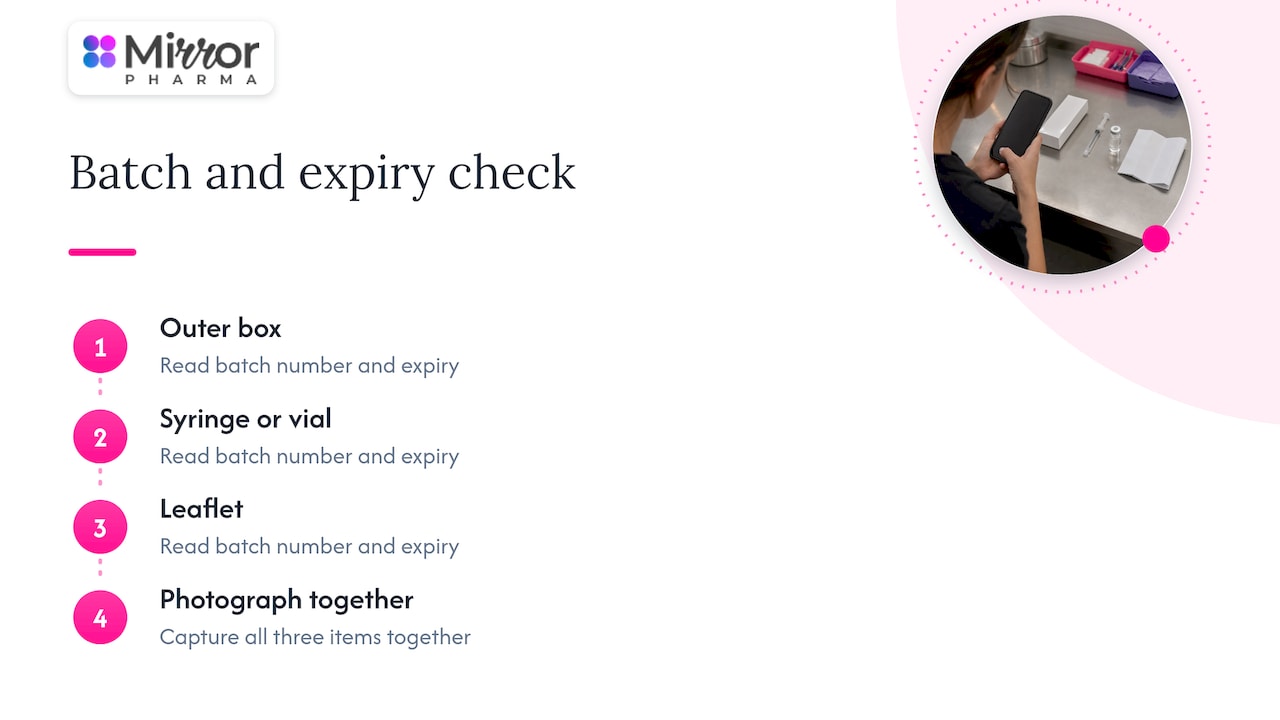
Practical routine: read the batch number and expiry on the outer box, then on the syringe or vial, then on the leaflet. Photograph all three together. Our guide to filler batch tracking covers how to turn this into a record that links each batch to each treatment.
5. The product itself
The WHO toolkit lists products that look, smell, taste or feel different from what you expect. The government guidance for medicines suggests comparing physical characteristics such as colour, markings, shape and thickness, and weighing the product to detect wide variations. For injectables, the equivalent is visual: colour, clarity, particles, fill level and how the product behaves in use, compared with a previous delivery of the same product.
6. What patients tell you
The counterfeit medicines guidance notes that counterfeit medicines are often first detected by patients. An unexpected reaction or an unexpected lack of effect is itself a signal. The WHO lists both as warning signs for healthcare professionals. Where you see an unexpected reaction, Yellow Card reporting is the route, and our guide on dermal filler complications helps with recognising them.
A quick reference table
| Check | What to look for | Source of the standard |
|---|---|---|
| Supplier | Brand, authorised distributor or brand-recognised trade wholesaler; registered pharmacy for prescription-only medicines | GOV.UK |
| Price | Unusually low, or only slightly below genuine, is not proof either way | GOV.UK, counterfeit medicines guidance |
| Packaging | Intact seals, no open or damaged boxes, no solvent residue on labels | FakeMeds, counterfeit medicines guidance |
| Labelling | Company name and address, ingredients, instructions, warnings, “UK Only” on medicines | GOV.UK, MHRA |
| Batch and expiry | Identical across box, syringe and leaflet; not erasable; clean printing | WHO toolkit, BCAM |
| Physical product | Consistent colour, shape and behaviour compared with previous stock | WHO toolkit |
What QR codes, serial numbers and apps can and cannot tell you
Much of what ranks for this topic is about scanning a code and getting a verdict. In UK medicines practice, that is less straightforward than many assume.
The EU Falsified Medicines Directive safety features, meaning the unique identifier, verification and decommissioning, ceased to have effect in Great Britain from 31 December 2020. They were disapplied for Northern Ireland from 1 January 2025 under the Windsor Framework, according to the post-implementation review of the Human Medicines Regulations 2012. Marketing authorisation holders may still choose to apply a 2D Data Matrix barcode, serial number or tamper-evident device, but these are optional. GOV.UK guidance for wholesalers and manufacturers adds that UK-licensed packs must not carry EU safety features that an EU repository could recognise.
In practice, this means:
- Do not assume every UK pack has a scannable code. The absence of a code on a UK pack is not in itself a sign of a fake.
- A code a manufacturer chooses to apply is only as useful as the verification behind it. A QR code printed on a pack can be copied onto a fake. What matters is whether the manufacturer’s own system confirms it, and whether the result matches the pack you hold.
- A passing scan is not a supply-chain guarantee. An MHRA Drug Alert on diverted genuine products shows that genuine packs with legitimate batch numbers can leave the legitimate supply chain and be reintroduced, so correct transport and storage cannot be guaranteed. The pack can be real while the route is not.
That last point is the reason the two stages belong together. A scan or a batch check tests the object. Supplier verification tests the route. For temperature-sensitive and sterile injectables, the route matters as much as the label.
If something looks wrong
Set out the response in your clinic’s procedure before you need it. GOV.UK’s guidance for businesses gives the sequence:
- Stop. Do not use or sell a product you suspect is fake. Quarantine the stock, and do not return it to general shelves.
- Keep everything. Retain the product, packaging, receipt and supplier details, as GOV.UK advises. Photograph the batch details, seals and labels.
- Report the seller. GOV.UK directs people to Trading Standards or Citizens Advice for beauty products. For medicines, you can report a suspicious online seller to the MHRA, anonymously if you wish, with the seller’s URL or social media name, product and packaging photos, screenshots, and emails or receipts.
- Report a suspected defect. The MHRA’s Guide to Defective Medicinal Products (February 2026) says a report should include the brand or generic name, the manufacturer, supplier or parallel importer, the strength and dosage form, the product licence number, the batch numbers, the expiry dates and the nature of the defect. The Defective Medicines Report Centre may ask for samples for analysis.
- Report adverse effects. Use the Yellow Card scheme for suspected side effects or suspected falsification, and keep the patient’s record linked to the batch.
If a patient has been treated with a batch you now doubt, the clinical follow-up is a matter for the prescriber responsible for that patient, in line with your clinic’s governance procedures.
Building the routine into the clinic
A routine only works if it is the same every time and anyone on the team can run it. A workable minimum:
- A written approved-supplier list, reviewed at set intervals, with the evidence you hold for each supplier.
- A goods-in checklist covering the six checks above, signed and dated by the person who opened the delivery.
- Photographs of batch and expiry details stored with the delivery record.
- A batch log linking each product to each treatment, so a problem can be traced to patients quickly.
- A named person responsible for reporting, and the reporting routes pinned where the team can find them.
Note that unlicensed products carry a further layer of obligations. Our guide to two MHRA checks for prescribers on unlicensed medicines in aesthetics covers that area. For product-specific safety knowledge, the hyaluronic acid filler safety guide is a companion to the goods-in routine.
Where Mirror Pharma fits
We supply prescription aesthetic medicines, toxins, weight loss medications, vitamins and infusion therapies, dermal fillers, skin boosters, fat dissolvers, syringes, needles and consumables, to healthcare professionals, clinics and aesthetic practitioners only. Access depends on practitioner and prescriber verification, and orders are fulfilled by a team of healthcare professionals. Extended order cut-off times help clinics receive stock when their treatment lists need it, so you can run your goods-in checks without rushing.
Licensed practitioners can browse dermal fillers, toxins, skin boosters and the rest of the range from our online pharmacy.
Our perspective
Authenticity is not a single check. We see it as a chain: a verified buyer, a verified source, an intact pack, matching batch details and a clear record. A break at any link is a reason to stop.
That is why we verify practitioners and prescribers before supplying prescription products, and why our orders are handled by a team of healthcare professionals. A clinic that cannot show where its stock came from has a problem that no scan can fix afterwards.
Our advice to qualified aesthetic professionals is simple. Choose a supplier you can verify, inspect every delivery the same way, and keep the batch record with the treatment record. It costs minutes per delivery and it is what you will want in your hand if a patient, an insurer or a regulator asks.
Rizwan
FAQ
Can I rely on a QR code to confirm a product is genuine?
No, not on its own. In the UK, serialisation features are optional for marketing authorisation holders, and a printed code can be copied. Use a scan only as one input alongside supplier checks, label content and batch consistency across box, syringe and leaflet.
What is the “UK Only” label?
It is a label that, from 1 January 2025, all medicines placed on the UK market must carry, according to the MHRA. Its absence on a medicine supplied to a UK clinic is a reason to pause and investigate before use.
What should the batch number on a filler pack match?
For licensed practitioners, the batch number and expiry date on the box, the syringe and the leaflet should all be the same, as the British College of Aesthetic Medicine advises. Any mismatch, or a number that looks altered or can be rubbed off, should be treated as suspicious and the stock quarantined.
Where do I report a suspected fake product or seller?
For medicines, report an online seller to the MHRA through GOV.UK, and use Yellow Card for suspected falsification or side effects. For beauty products, GOV.UK points to Trading Standards or Citizens Advice. Keep the product, packaging, receipt and supplier details.
Does a genuine pack mean the product is safe to use?
Not necessarily. The MHRA has documented genuine packs that left the legitimate supply chain and were reintroduced, with storage and transport conditions unknown. Check the route as well as the pack, and use only stock you can trace back to a verified source.
Sources
- Avoiding fake beauty products for businesses, GOV.UK
- FakeMeds: Spot a fake
- WHO: Identifying suspected substandard and falsified medical products, toolkit for healthcare professionals
- Counterfeit Medicines, UK government guidance
- BCAM: Vet It Before You Get It campaign
- MHRA Windsor Framework explainer
- Post-implementation Review of the Human Medicines Regulations 2012
- Wholesalers’ and manufacturers’ guidance following the Windsor Framework, GOV.UK
- MHRA Drug Alert on diverted genuine products
- Report a suspicious online seller of medicines, GOV.UK
- A Guide to Defective Medicinal Products, MHRA, February 2026