
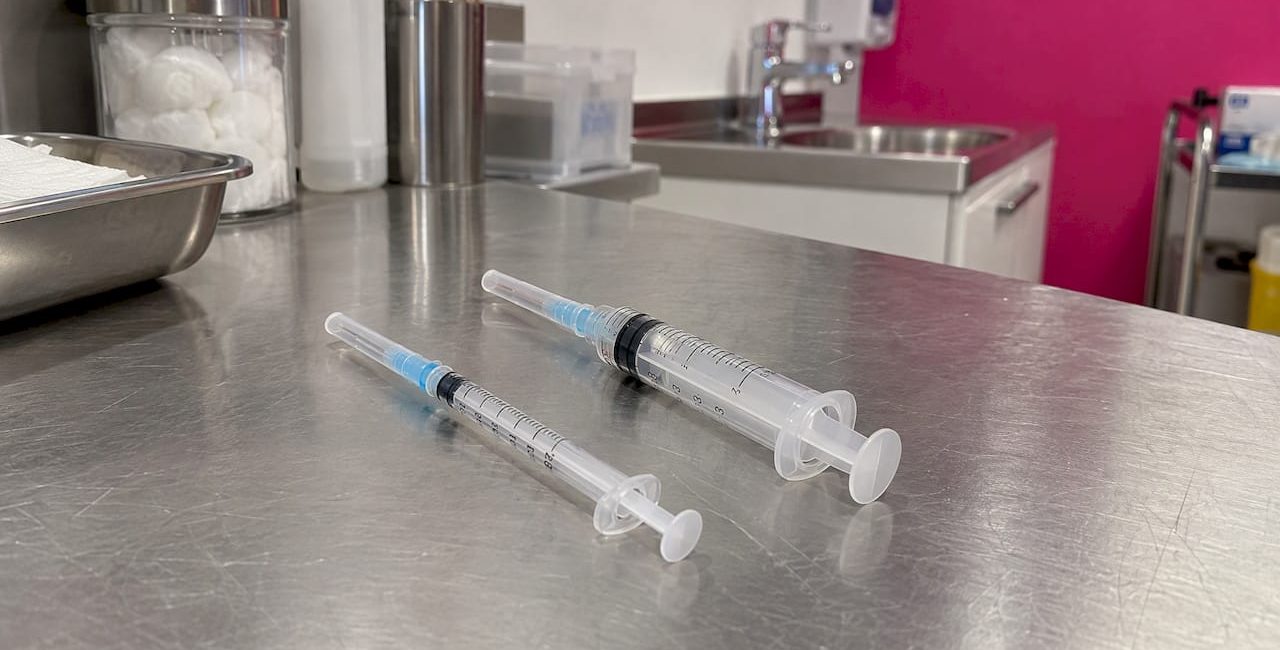
For licensed practitioners, the rule is simple: choose the smallest syringe that holds the volume you are drawing up. A 1ml syringe reads in finer steps, so it suits small, precise doses. A 3ml syringe suits larger volumes, diluent handling and transfers where fine resolution matters less. The harder part is matching the syringe, the needle and the graduation scale to the task, so the number you read is the dose the patient receives.
This guide is written for qualified aesthetic professionals, prescribers and clinic teams who buy and handle injectables and consumables. It explains the practical differences between the two sizes, where each earns its place in an aesthetics or wellness clinic, and how to avoid the reading errors that cause dosing mistakes.
TL;DR
- Use the smallest syringe that holds your volume: 1ml for small, precise doses, 3ml for larger volumes and reconstitution or transfer steps.
- A smaller barrel has a narrower bore, so each millilitre covers a longer stretch of scale and is easier to read accurately.
- Always read the scale on the syringe in your hand: units, millilitres and graduation steps differ between insulin-type and standard syringes.
- Match the fitting (Luer slip, Luer lock or fixed needle) and the needle gauge and length to the product and the injection depth.
- Mix-ups between insulin-type and tuberculin-type syringes have caused tenfold overdoses, so label, separate and double-check. This guidance is for licensed practitioners only.
Table of Contents
- What actually differs between a 1ml and a 3ml syringe
- Choosing by volume: the smallest syringe that fits
- Where each size fits in aesthetic and wellness practice
- Reading the scale correctly: units, millilitres and the tenfold trap
- Syringe, needle and fitting: getting the combination right
- Common mistakes with 1ml and 3ml syringes
- Quick decision guide
- Buying syringes for a clinic
- Our perspective
- FAQ
- Sources
What actually differs between a 1ml and a 3ml syringe
Both are small-volume syringes. The headline difference is capacity: a 1ml syringe holds up to one millilitre, a 3ml syringe up to three. Everything else follows from that.
Barrel diameter. The 3ml barrel is wider. For the same movement of the plunger, a wider barrel displaces more liquid. That means a 0.1ml dose occupies a short stretch of scale on a 3ml syringe and a much longer stretch on a 1ml syringe. A longer stretch is easier to read, and a small misjudgement of the plunger position changes the dose less.
Graduation steps. As a general pattern, 1ml syringes are marked in fine increments, often hundredths of a millilitre, while 3ml syringes are marked in coarser steps, often tenths. The exact marks vary by manufacturer and by product type, so read the packaging and the barrel rather than assuming. Many syringes also carry extra markings: some 3ml barrels are printed beyond 3ml to allow for the plunger tip position, so the “3ml” line is not always the last line on the barrel.
Dead space. Dead space is the volume of liquid left in the syringe tip and needle hub after the plunger is fully pressed. With a small dose, a fixed volume lost in the hub is a larger share of what you meant to give. Syringes with the needle permanently attached typically retain very little, whereas a detachable needle on a Luer fitting leaves liquid in the hub. When doses are small and the product is expensive, this matters for both accuracy and wastage.
Fitting. Both sizes are commonly supplied with a Luer slip tip (the needle pushes on), a Luer lock tip (the needle twists and locks) or a fixed needle. The fitting decides how securely you can attach a needle or transfer device, not how accurate the syringe is.
| Feature | 1ml syringe | 3ml syringe |
|---|---|---|
| Typical use | Small, precise doses and fine-step drawing up | Larger volumes, diluent handling, transfers |
| Barrel | Narrow | Wider |
| Scale resolution | Finer steps | Coarser steps |
| Effect of a small plunger error | Smaller change in dose | Larger change in dose |
| Best when | Accuracy at low volume decides the outcome | Volume and speed matter more than fine resolution |
Choosing by volume: the smallest syringe that fits
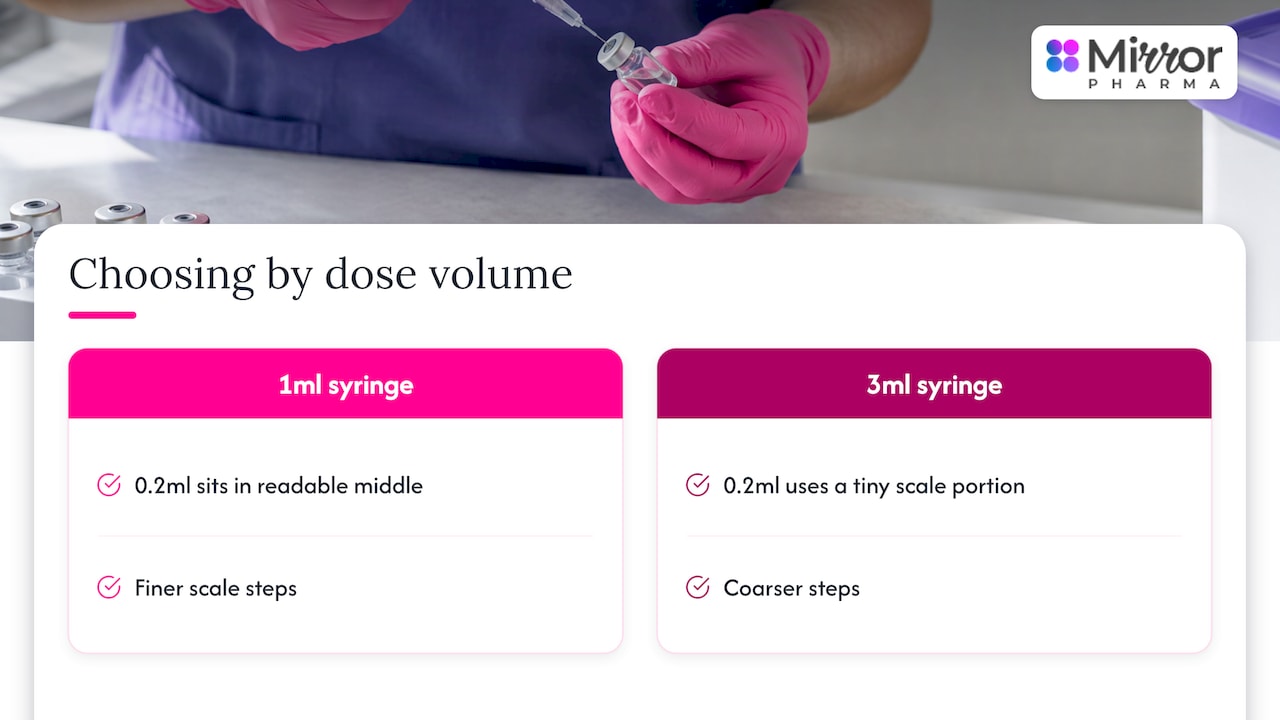
The working rule is to pick the smallest syringe whose capacity comfortably holds what you are drawing up. Why? Because accuracy is about resolution. If you draw 0.2ml in a 3ml syringe, you are using a tiny part of the scale, in the coarsest steps. Draw the same 0.2ml in a 1ml syringe and the dose sits in the readable middle of a finer scale.
A useful check is the one-fifth rule of thumb many clinicians apply: if your dose is under about a fifth to a quarter of the syringe capacity, step down a size. Treat this as a working habit, not a regulation, and follow your own clinic protocol and the manufacturer’s instructions for the product.
A worked example
Suppose a licensed practitioner needs to draw up 0.25ml of a prepared solution.
- In a 3ml syringe, the dose sits a little over the 0.2 line, in coarse steps. You are estimating the position between marks.
- In a 1ml syringe, 0.25ml falls on a clear, finely divided part of the scale, and you can read it directly.
The liquid is the same. What changes is how confidently you can read the dose. Now suppose the volume is 2.5ml. A 1ml syringe cannot hold it, and filling it three times creates more handling steps and more chances for an error. The 3ml syringe is the right tool.
Where each size fits in aesthetic and wellness practice
This section is for qualified professionals working within their own training and the product’s licence. It describes syringe choice, not clinical technique or dosing, which come from the product’s summary of product characteristics and your professional training.
Reconstitution and dilution
When a lyophilised (freeze-dried) product is reconstituted, the diluent is often drawn from a vial or ampoule in a larger syringe, then injected gently into the product vial. A 3ml syringe is a practical size here, since the diluent volume is often more than 1ml. The solution is then usually transferred into smaller syringes for the actual injections. For botulinum toxin products, always follow the product’s licensed instructions on diluent and handling. The range of toxin diluents is available for qualified prescribers and practitioners.
Fine-dose injection
For small aliquots, such as the individual doses used in anti-wrinkle treatments, low-volume syringes with fine graduation make reading easier. Many practitioners use insulin-type syringes with a fixed fine needle, such as a 0.3ml 32G micro syringe or a 0.5ml 32G insulin micro needle and syringe, because the scale is fine and the needle is permanently attached. A BD Micro-Fine 0.3ml U100 insulin syringe is another option in this category. Check the scale on whichever you use before the first draw: insulin-type syringes are marked in units, not millilitres (more on this below).
Prefilled dermal filler syringes
Dermal fillers are normally supplied by the manufacturer in prefilled syringes, so you do not choose the barrel size. What you do choose is the needle or cannula, using the gauge and length suited to the product and the plane of injection. Our guide to pen needle sizes, lengths and gauges explains how gauge and length are described, which helps when reading any needle specification. Browse the full range of dermal fillers for licensed practitioners.
IM and IV vitamins and infusion work
Intramuscular vitamin injections generally involve larger volumes than fine aesthetic doses, so 3ml syringes are common there, and bigger syringes are used for mixing and drawing up in infusion preparation. For a larger preparation step, a 10ml Luer lock syringe keeps connections secure. If your clinic is considering how the route affects onset, read IV vs IM injection: which route works faster. For protocols, see our safety toolkit for UK clinicians on IV vitamin therapy.
Reading the scale correctly: units, millilitres and the tenfold trap
The most dangerous error with small syringes is not choosing the wrong size. It is misreading what the scale means.
Insulin-type syringes are calibrated in units. A U100 syringe is designed for a solution of 100 units per millilitre, so its scale counts units, and 100 units equals 1ml. Tuberculin-type syringes are calibrated in millilitres, often with a 1ml capacity and fine 0.01ml steps. The two can look alike, with similar barrels and similar packaging.
This resemblance has caused harm. A patient safety advisory from Pennsylvania described reports of tenfold overdoses when a tuberculin syringe was used in place of an insulin syringe, including a nurse who drew up 0.9ml where 9 units had been intended. The cause was a reading of the scale in the wrong system, helped along by similar packaging. The advisory is American and over twenty years old, but the lesson applies to any clinic that stocks both types.
In aesthetics the same trap appears when a practitioner is used to thinking in units for a toxin dose and picks up an insulin-type syringe, then a different type the next day. Our clinician guide to insulin vs tuberculin syringes and how to prevent tenfold overdoses goes into the scale differences in detail.
Practical habits that reduce the risk:
- Read the barrel, not the box. Check whether the scale shows units or millilitres every time you open a new pack.
- Stock one type for each task. Avoid keeping lookalike syringes in the same drawer or tray.
- Write the dose in the same unit as the scale. If the protocol says millilitres, use a millilitre-scaled syringe.
- Label every prepared syringe with the product, concentration and time, following your clinic’s policy.
- Use a second check for any dose where a slip would be significant, particularly during training of new staff.
Syringe, needle and fitting: getting the combination right
A syringe is only part of the system. The combination you choose affects comfort, accuracy and wastage.
Fixed needle or detachable?
Fixed-needle syringes, common in the 0.3ml, 0.5ml and 1ml insulin-type range, keep dead space low and remove any chance of the needle coming off. Detachable-needle syringes give flexibility: you can draw up with one needle and inject with another, or switch to a cannula. That flexibility costs some dead space, which is why detachable designs are better for volumes where a small retained amount does not alter the result.
Luer slip or Luer lock?
Luer slip is quick to attach and remove. Luer lock screws on and resists accidental detachment, which helps when you apply firmer pressure on the plunger or connect to a line, a transfer device or an infusion set. For larger syringes used in preparation, many clinics standardise on Luer lock for security.
Gauge and length
Gauge describes needle width: the higher the number, the finer the needle. Length is chosen to reach the intended tissue plane. These decisions belong to the practitioner’s training and the product’s instructions. The needles and consumables range lists the options, and the BD Micro-Fine range covers fine insulin-type syringes and needles for clinics.
Common mistakes with 1ml and 3ml syringes
- Using a 3ml syringe for a tiny dose. You lose resolution. Step down to 1ml or a smaller insulin-type syringe where the product and protocol allow.
- Reading from the wrong part of the plunger. Read at the edge of the plunger tip nearest the needle, with the syringe held at eye level and upright. Check the manufacturer’s instructions for its marked reading line.
- Ignoring air bubbles. Air takes up volume on the scale. Expel it carefully before setting the final dose.
- Assuming every 3ml has the same markings. Scales vary, including how far the printing extends beyond 3ml.
- Mixing scale systems. Units and millilitres in the same workflow without a clear convention are where overdoses start.
- Re-using single-use items. Syringes and needles are single use. Dispose of them in an approved sharps container immediately after use, following your clinic’s sharps policy.
Quick decision guide
| Situation | Likely better choice | Why |
|---|---|---|
| Drawing up very small doses | 1ml, or a 0.3ml or 0.5ml insulin-type syringe | Finer scale, less estimation |
| Drawing up 1.5ml to 3ml | 3ml | Single fill, fewer handling steps |
| Moving diluent into a vial | 3ml, or larger if the volume needs it | Holds the full volume in one go |
| Transferring a prepared solution into several small syringes | 3ml to draw, 1ml or smaller to inject | Combines convenient volume with fine reading |
| Connecting to a line or transfer device | Luer lock | Secure connection |
| Fine intradermal or superficial work | Syringe and needle chosen to the product instructions | Product and technique decide, not syringe size alone |
This table is a general guide for qualified professionals. Your clinic protocol, the product’s licence and your training always take priority.
Buying syringes for a clinic
Consumables are bought in volume, so the practical questions are availability, consistency and delivery timing. Standardising on a small set of syringe types, one for fine doses, one for reconstitution and transfer, one for larger volumes, makes training easier and reduces the lookalike risk described above.
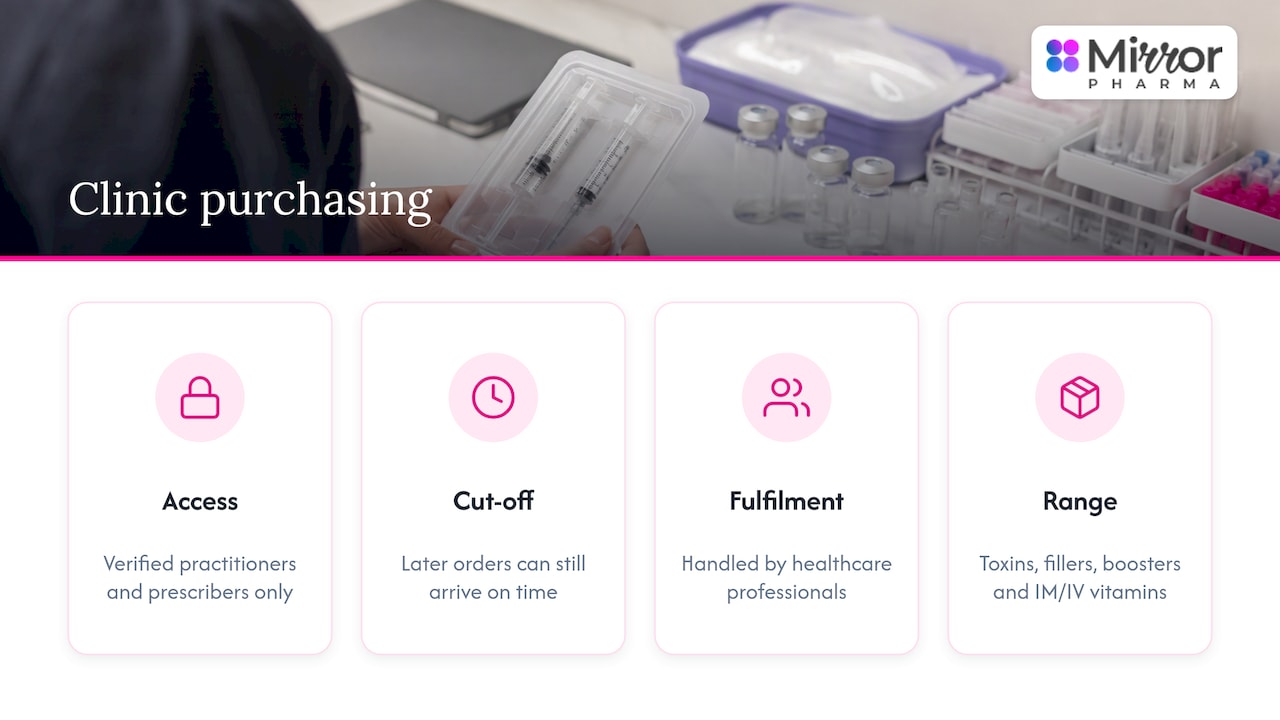
Mirror Pharma supplies injectables, needles and consumables online to healthcare professionals and aesthetic clinics. Access is for verified practitioners and prescribers, and our order cut-off times are extended so that orders placed later in the day can still be delivered on time. Fulfilment is handled by a dedicated team of healthcare professionals. Start from the needles and consumables range or go straight to the category you use most: toxins, dermal fillers, skin boosters or IM/IV vitamins.
Our perspective
Most dosing errors we hear discussed in aesthetics are not dramatic. They are small habits: a coarse scale used for a fine dose, a lookalike syringe in the wrong tray, a unit read as a millilitre.
That is why we think syringe choice deserves the same attention as product choice. A clinic that standardises its syringe types, keeps units and millilitres apart and trains every team member to read the barrel will make fewer mistakes than one that simply buys whatever is cheapest on the day.
It is also why we pair injectables with the consumables that go with them. When a practitioner orders a product, the right fine-dose syringe, needle and diluent should be easy to add to the same order, with verification of practitioner access and a later cut-off so the clinic day is not held up.
We built our service for licensed practitioners who want that kind of reliable, joined-up supply.
Rizwan
FAQ
Is a 1ml syringe more accurate than a 3ml syringe?
For small volumes, generally yes. The narrower barrel spreads each millilitre over a longer stretch of scale, with finer graduations, so small doses are easier to read. For volumes near the top of a 3ml syringe, the difference is small. Licensed practitioners should still follow the product instructions and clinic protocol.
What size syringe do I need for a given dose?
Choose the smallest syringe that comfortably holds the volume, so the dose sits in a readable part of the scale. A dose of a few tenths of a millilitre suits a 1ml or smaller syringe, while a volume of one to three millilitres suits a 3ml syringe. Always read the scale on the syringe you are holding.
Is 20 units the same as 1ml?
Not on an insulin-type syringe. On a U100 syringe, 100 units equals 1ml, so 20 units is 0.2ml. The conversion depends on the syringe type, which is why you must check whether the barrel is marked in units or millilitres before every draw.
What needle size goes with a 3ml syringe?
The syringe and needle are chosen separately. A 3ml syringe usually has a Luer slip or Luer lock tip that accepts a range of needles, and the right gauge and length depend on the product, the tissue plane and the practitioner’s training. Our needle size guide explains gauge and length.
Can I use a 3ml syringe to inject small doses?
It is possible to draw small volumes in a 3ml syringe, but the scale is coarser and the reading less precise. Many clinics transfer the prepared solution into a 1ml or smaller syringe for the injection itself, within the product’s licensed instructions.