
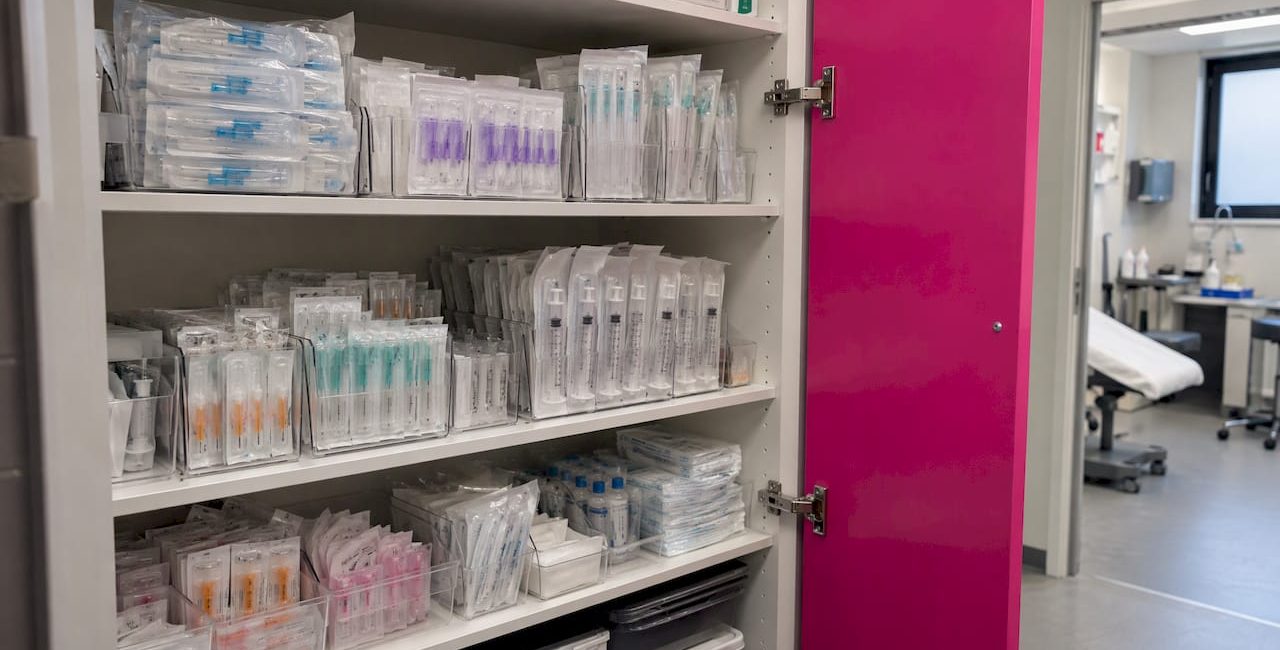
A well-run UK aesthetic clinic keeps seven groups of stock: prescription injectables supplied against a named-client prescription, needles and cannulas, syringes and diluents, skin-prep and infection-control items, sharps and clinical-waste containers, treatment-room disposables, and emergency equipment. This guide is for licensed practitioners, prescribers and clinic managers. It sets out what to list in each group, what to check on delivery, and how to stock without breaking UK prescribing rules.
TL;DR
- Build your list by treatment room, not by supplier: injectables, needles and syringes, skin prep, sharps and waste, disposables, emergency kit.
- Prescription-only medicines go to a named client and come through a UK pharmacy. Advance stock for unnamed clients is not permitted, so your list covers consumables and approved emergency items, not speculative medicine stock.
- Record batch numbers and expiry dates, keep fridge temperatures logged, and put a disposal container within reach of every point of use.
- Review the list each quarter and after any change to your treatment menu.
- Qualified aesthetic professionals can order injectables, skin boosters, polynucleotides, vitamins and consumables from one verified online account.
Table of Contents
- What a 2026 consumables list needs to do
- The master list at a glance
- Injectable medicines: what belongs on the list, and what does not
- Needles, cannulas and syringes
- Skin prep and infection-control supplies
- Sharps and clinical waste
- Treatment-room disposables
- Consumables for skin, infusion and wellness treatments
- Emergency equipment
- Storage, expiry and batch records
- Perspective
- How to build and maintain your list
- Order your clinic consumables in one place
- FAQ
- Sources
What a 2026 consumables list needs to do
A consumables list is not a shopping basket. It is a control document. It tells your team what must be on the shelf before the first appointment, who reorders it and what “in date and fit for use” means in your clinic.
Three things have changed the way clinics think about stock. First, treatment menus are broader: our own read of UK aesthetic trends for 2026 points to regenerative treatments, skin boosters and polynucleotides sitting alongside the long-established anti-wrinkle and filler work. Second, regulators and local authorities are paying closer attention to how injectables are sourced. Third, the government has committed to local-authority licensing in England for lower-risk non-surgical procedures under the Health and Care Act 2022, so documented stock control is becoming part of ordinary practice for clinics of every size.
A good list therefore has four columns for every line: the item, the par level (the minimum you hold), the reorder point, and the check you do on arrival. Everything below is organised so you can copy it into that format.
The master list at a glance
| Group | Typical lines | Check on arrival |
|---|---|---|
| Injectable medicines (prescription-only) | Botulinum toxin, hyaluronic acid fillers, skin boosters, polynucleotides, fat-dissolving products | Named-client prescription, batch, expiry, cold-chain condition |
| Diluents and adjuncts | Sodium chloride for reconstitution, local anaesthetic where prescribed | Single-use, sealed, in date |
| Needles and cannulas | Fine-gauge needles, blunt-tip cannulas, filter needles for drawing up | Sterile packaging intact, gauge and length match the protocol |
| Syringes | 1 ml, 2.5 ml, 5 ml luer-lock and insulin-type | Sterile, single-use, packaging intact |
| Skin prep | Antiseptic wipes or solution, sterile gauze, gloves, marking pencils | In date, correct antiseptic for the procedure |
| Sharps and waste | UN-approved sharps bins, clinical waste bags, spill kit | Correct lid colour, closure, fill line |
| Treatment-room disposables | Couch roll, headbands, single-use trays, disposable aprons, face masks | Stock count against par level |
| Emergency equipment | Anaphylaxis kit, hyaluronidase access for filler work, oxygen and airway items per your protocol | Monthly documented check, items in date |
The rest of this guide walks through each group.
Injectable medicines: what belongs on the list, and what does not
Injectables are the core of most aesthetic stock rooms, and they are also where the rules are tightest.
In the UK, prescription-only medicines must be issued to a named individual client and dispensed through a UK pharmacy. The same guidance says advance stock must not be held and that a medicine should only be used for the individual it was prescribed for. For your consumables list, that means two practical things:
- Injectable medicines appear on the list as product categories your prescriber can work with, not as stock to be held “just in case”.
- Every dispensed product is tied to a client record, a prescription, a batch number and an expiry date.
The categories most clinics plan around are:
- Botulinum toxin for anti-wrinkle treatment, with the matching diluent. See our toxins category and the diluents sub-category.
- Hyaluronic acid dermal fillers in the viscosities your menu requires. Browse the dermal fillers category.
- Skin boosters, used for hydration and skin quality rather than volume. Our guide to skin boosters, fillers and biostimulators explains where each fits, and the skin booster category lists what we supply.
- Polynucleotides for practitioners adding regenerative treatments. See the polynucleotides category.
- Fat-dissolving products for licensed practitioners with the relevant training: fat dissolving.
- IM/IV vitamins for wellness and infusion clinics: IM/IV vitamins.
- Weight management medicines for prescribers running medically supervised programmes: weight loss.
If you want the legal detail behind this section, our aesthetic prescribing rules for licensed practitioners explains who can prescribe, what a valid prescription looks like and how remote consultations fit in.
Why sourcing is a stock-control issue
The MHRA has reported that unlicensed botulinum toxin has been linked to serious illness and used in informal settings, including domestic kitchens. That is the reason supplier verification belongs on your consumables list as its own line. Before you add any injectable supplier, confirm that the medicine is licensed for the UK market, that the supplier is a registered UK pharmacy, and that your own prescriber is named on the order. We have set out four practical checks in what to look for in an aesthetics injectable supplier, and two MHRA-focused checks in our note on unlicensed medicines in aesthetics.
Needles, cannulas and syringes
These are the items that run out fastest, so they deserve the most generous par levels.
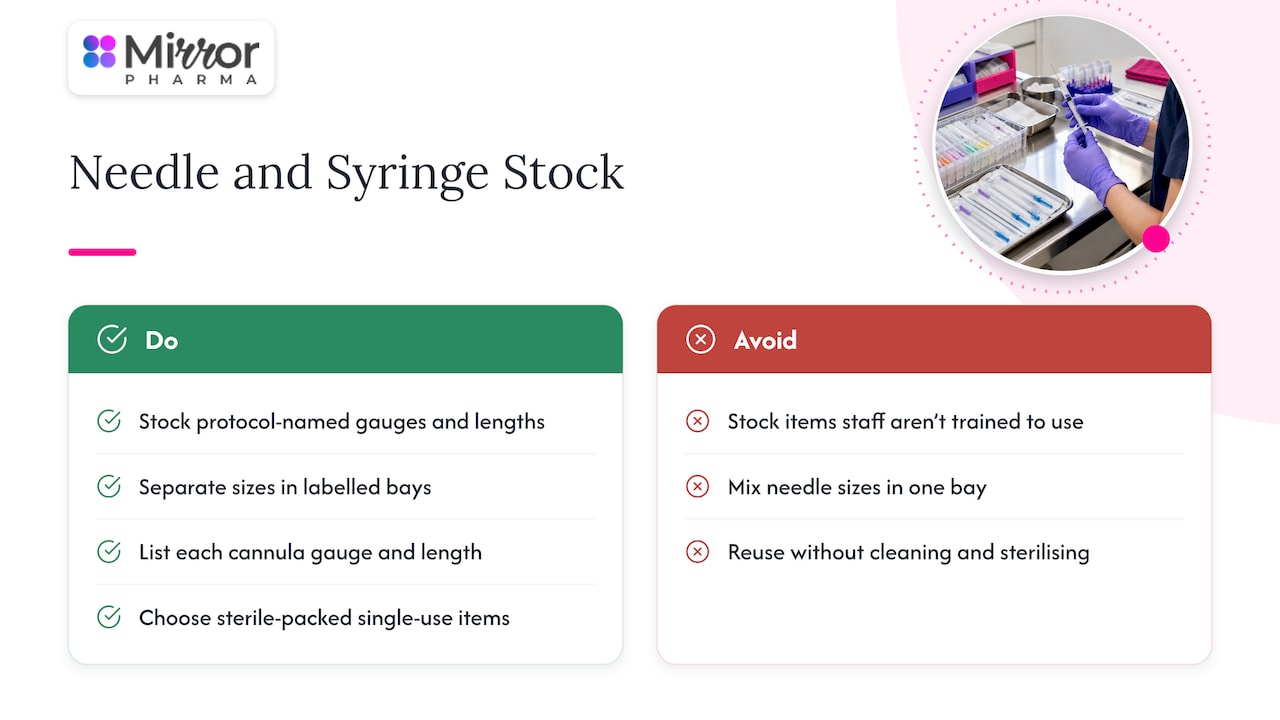
Needles. Stock the gauges and lengths your protocols name, and nothing that your team has not been trained to use. A typical menu needs fine needles for superficial work, a longer option for deeper injection, and a separate larger needle for drawing up where your protocol requires it. Keep needle sizes in separate, clearly labelled bays so nobody grabs the wrong one mid-treatment.
Cannulas. If your practitioners use blunt-tip cannulas for filler, list each gauge and length as its own line with its own par level, together with the entry needle used to create the port.
Syringes. Hold luer-lock syringes in the volumes your reconstitution and dilution protocols call for, plus small-volume syringes for precise dosing. Our needles and consumables range covers syringes, needles and related items, so a single order can cover injectables and the items used to administer them.
The rule that ties all three together comes from local-authority guidance: reusable equipment should be single-use and sterile where possible, or cleaned and sterilised between clients. Choosing single-use, sterile-packed items makes that rule far easier to meet and to evidence.
Skin prep and infection-control supplies
Infection prevention is where small gaps in stock cause large gaps in practice. A reasonable baseline for every treatment room:
- Non-sterile gloves in every size your team wears, plus sterile gloves for procedures where your protocol requires them
- Antiseptic skin-prep solution or single-use wipes, in date
- Sterile gauze and cotton buds
- Disposable aprons and face masks
- Alcohol-based hand rub at the point of care, as well as at the sink
- Surface disinfectant suitable for the couch and trolley
- Single-use trays or drapes for each client’s treatment set-up
- Disposable marking tools or sterilisable ones with a documented process
Two habits matter more than the items. Vials of prescription medicine are for one named client only: the council guidance states vials must not be shared. And every consumable that touches the treatment field is opened in front of the client or at the point of use, never pre-opened and left on a tray.
Sharps and clinical waste
Every needle that you list creates a disposal obligation, so sharps containers are not an afterthought.
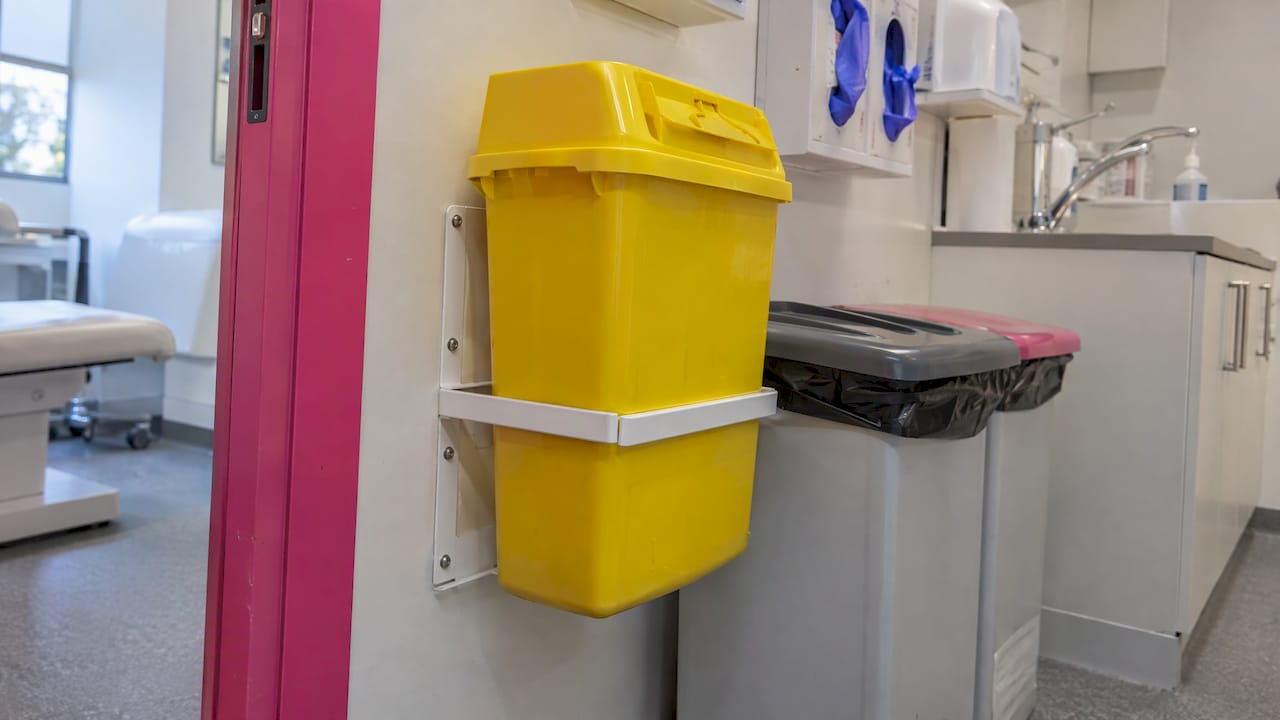
Under the Health and Safety (Sharp Instruments in Healthcare) Regulations 2013, employers must use safer sharps where reasonably practicable and place clearly marked, secure disposal containers close to where sharps are used. For an aesthetic clinic that translates into three list lines:
- A sharps container in every treatment room, sized to your volume, mounted or placed within arm’s reach of the practitioner.
- Spare containers in the store, so a full one is never left in use past its fill line.
- A contract with a licensed clinical-waste carrier, with consignment records filed with your other compliance documents.
Containers that held medicine-contaminated sharps are typically handled in a different waste stream from those that did not, so ask your waste carrier which container type applies to your treatments before you buy.
We have two checklists you can use to turn this into an audit routine: 5 essential sharps disposal checks for UK clinics and a 5-step sharps bin checklist.
Treatment-room disposables
These are low in cost and high in volume, and running out of them cancels appointments.
- Couch roll and pillow covers
- Disposable headbands and hair caps
- Single-use towels
- Clinical waste bags in the correct colour
- Disposable cups for client water
- Cotton pads and tissues
- Clear labels and pens for marking syringes and diluted products, with the date and time of reconstitution
- Consent and record-keeping stationery if you are not fully digital
Set these to a simple weekly count. Most clinics find a two-week buffer enough, provided the reorder point is written on the shelf.
Consumables for skin, infusion and wellness treatments
Your list changes with your menu. Here is how it extends by treatment type for licensed practitioners.
Skin boosters and polynucleotides
Beyond the product itself, list fine needles or cannulas matched to your technique, small-volume syringes, topical anaesthetic where your prescriber has approved it, sterile gauze and a post-treatment skincare line that you have the right to recommend. Treatment is commonly delivered in a short course; our skin booster injections guide for clinicians covers safety and technique, and skin booster versus filler helps you plan which products to hold access to.
Botulinum toxin
List the diluent, small-volume syringes, fine needles, alcohol-free skin prep if your protocol specifies it, and a cold-chain solution for any stock in transit between pharmacy and clinic. Prescribing for repeat treatment has its own timing rules, which we cover in our 12 week rule guide for botulinum toxin. If you are weighing products, our comparison of two purified toxin options explains when purity matters.
IM/IV vitamins and infusions
Infusion work adds a different set: IV cannulas, giving sets, infusion bags and diluents, tourniquets, dressings, extension lines where used, and a clear mixing protocol. Our IV vitamin therapy safety toolkit and 8-step protocol for mixing IV vitamins set out the process your list should support.
Weight management
For prescribers running supervised programmes, the consumables are modest: pen needles where the product requires them, sharps containers sized for client-returned pens if your service takes them back, record forms, and a scale and measuring tape that are cleaned between clients. Our overview of weight management medications for clinicians sets out the clinical context.
Emergency equipment
Emergency stock is the one category where you should never run lean. Before you open a treatment room for injectables, list and stock the items your protocol names for anaphylaxis and for filler complications, including access to hyaluronidase where your practitioners place hyaluronic acid fillers. Your prescriber and the clinic’s clinical lead should sign off the exact contents, doses and training requirements against current Resuscitation Council UK and professional-body guidance.
Whatever the contents, the control is the same: a named person checks the kit monthly, signs and dates the check, replaces anything near expiry and logs the replacement. A kit that has not been checked is, in practice, a kit you cannot rely on.
Storage, expiry and batch records
Stock management is where audit findings tend to cluster, so build the controls into the list itself.
- Receipt. Check the packaging, the product name and strength against the order, the batch number and the expiry date. Photograph or scan the label into your system.
- Temperature. Keep medicines within the range stated on the manufacturer’s product information. A dedicated medicines fridge with a min/max thermometer and a daily log is the usual way clinics evidence this.
- Separation. Store prescription medicines in a lockable cupboard or fridge, separate from consumables, with a clear shelf for each named client’s dispensed products.
- Rotation. First-expiry, first-out. Check dates monthly and remove anything within your cut-off window, for example one month before expiry.
- Batch traceability. Record the batch number in the client’s notes at every treatment, so a product alert can be matched to affected clients within minutes.
- Disposal. Expired medicines and used consumables follow your waste carrier’s streams, not the general bin.
Perspective
Clinics rarely get into trouble because they ordered too little tape or too few gloves. They get into trouble when the paperwork around a product is thin: a prescription that does not match the client, a batch number nobody wrote down, a delivery that arrived late and led to a workaround.
That is why we built our service around practitioners. Access is verified, so we know we are supplying licensed practitioners and prescribers. Our order cut-off times are extended, so you can reorder on the day you notice a gap instead of rescheduling clients. Orders are fulfilled by a team of healthcare professionals who understand what a cold-chain item or a prescription label means.
Our advice is to keep your consumables list short, specific and owned by one person. Put injectables, needles, syringes, skin prep and sharps on one reorder rhythm, so a single order covers the room. A smooth ordering process is not a luxury. It is part of your stock control.
Rizwan
How to build and maintain your list
- Walk each treatment room. Write down every item used in a normal day, including the ones nobody thinks about.
- Map items to treatments. For each service on your menu, list the consumables it needs from first contact to disposal.
- Set par levels. Use your busiest fortnight as the benchmark and add a small buffer. For prescription medicines, par levels apply to the categories and to the client orders in progress, not to a standing stock of unallocated vials.
- Assign an owner and a rhythm. One named person, one weekly count, one monthly expiry review.
- Link to your policies. Each group should point to the relevant policy: infection prevention, waste, medicines management, emergency response.
- Review quarterly and whenever the menu changes. A new treatment means new consumables, new training and new waste handling.
If you are setting up a clinic for the first time, our guide to the 12 to 16 week CQC timeline shows where stock control fits in the registration process.
Order your clinic consumables in one place
For licensed practitioners, prescribers and clinics, we supply prescription aesthetic medicines, skin boosters, polynucleotides, vitamins, weight management products and the needles and consumables that go with them. Access is verified for practitioners and prescribers, and our extended order cut-off times help you restock without cancelling appointments. Start with the needles and consumables range, or go straight to the toxins or dermal fillers categories once your account is verified.
FAQ
Can a clinic hold prescription injectables in stock for walk-in clients?
Not as unallocated stock. UK local-authority guidance states that prescription-only medicines are issued to a named client, that advance stock must not be held, and that a medicine is used only for the person it was prescribed for. Plan your ordering around prescribed clients and speak to your prescriber or the MHRA if you are unsure about a specific arrangement.
How often should a clinic review its consumables list?
Review it every quarter, and any time you add a treatment or change a protocol. Check expiry dates monthly and count disposables weekly. The monthly emergency kit check should be recorded separately and signed.
Where should sharps containers be placed?
Close to where the sharps are used, clearly marked and secure. The 2013 sharps regulations require employers to place disposal containers near the point of use, and to use safer sharps where reasonably practicable. A container in each treatment room, with spares in the store, meets the intent for most clinics.
Should single-use or reusable items go on the list?
Choose single-use, sterile items wherever possible. Council guidance for aesthetic premises says reusable equipment should be single-use and sterile where possible, or cleaned and sterilised between clients. Single-use items reduce the cleaning process you need to document.
Who can order from Mirror Pharma?
Our products are for trained practitioners and prescribers, and verification is required before you can buy. That is how we keep supply limited to qualified aesthetic professionals and clinics.
Sources
- Beauty and aesthetics industry guidance, Dartford Borough Council
- Aesthetic procedures, Telford & Wrekin Council
- Health and Safety (Sharp Instruments in Healthcare) Regulations 2013, HSE
- Licensing of non-surgical cosmetic procedures, GOV.UK
- MHRA crackdown on illegal botulinum toxin, GOV.UK