
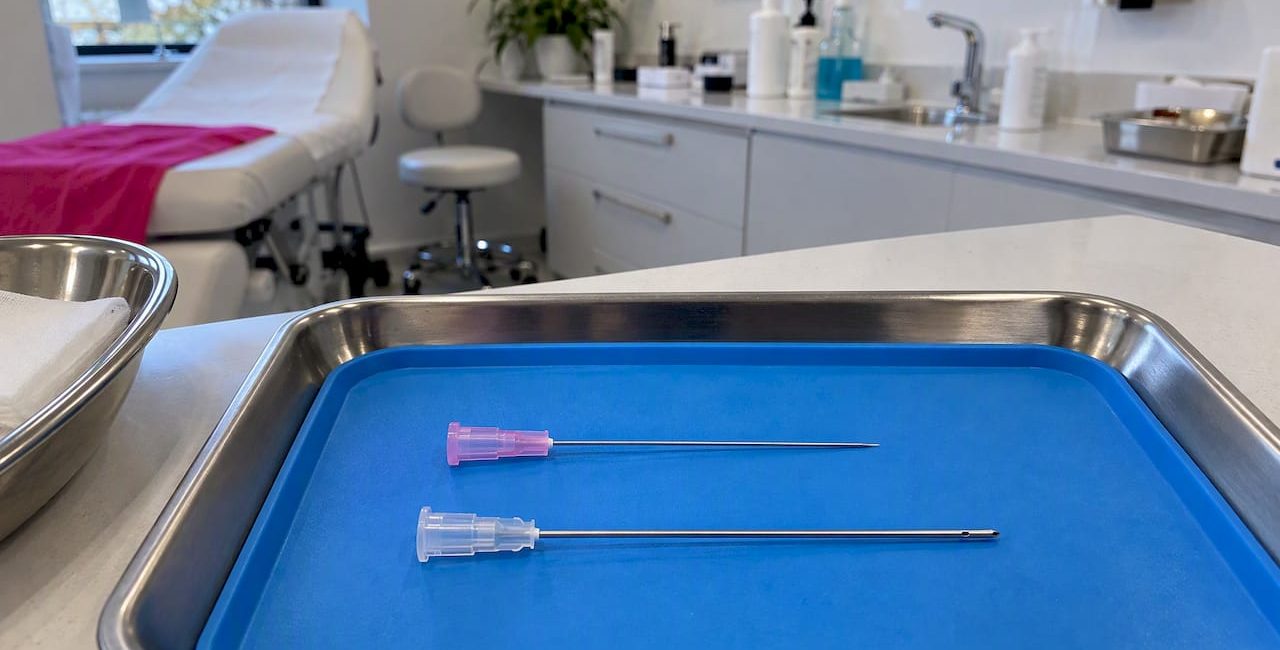
For most broad-area filler work, a blunt micro-cannula is the safer choice; for precise periosteal or micro-bolus points, a needle matched to the correct gauge and length is preferable. Typical ranges run from 30G to 32G for toxins and skin boosters through to 22G to 25G cannulas for deeper, viscous filler placement. Whichever instrument you choose, technique, correct plane selection and emergency readiness for vascular events remain the deciding factors in outcome, for licensed practitioners.
TL;DR:
- Using a cannula in vessel-dense areas significantly reduces the risk of vascular occlusion compared to needles, as shown by cohort studies.
- Safe injection techniques regardless of instrument include slow, small aliquots, continuous movement, deliberate plane selection, and readiness with hyaluronidase.
- Proper gauge and length matching to product viscosity and targeted tissue plane minimizes uneven deposition and operator fatigue during procedures.
- Needle work offers greater control for precise, micro-point injections, while cannulas are better suited for broad, low-risk volumizing regions like the midface and jawline.
- Practitioner-only supplies require verification of credentials, CE/UKCA marks, intact sterile packaging, compatible hub design, and proper documentation to ensure safety and compliance.
Table of Contents
- Cannula versus needle: pros, cons and clinical use-cases
- Gauge and length guidance: matching size to product viscosity and plane
- Safety, complications and technique safeguards
- Practical procurement checklist: what to check when purchasing needles and cannulas
- Tip design differences and what they mean for technique and comfort
- Checking compatibility between needles, cannulas and filler products
- Building skill with needles versus cannulas
- Patient selection and informed consent for needle or cannula procedures
- Reducing pain and bruising during injection
- Our perspective on practitioner-only supply
- Where to find practitioner-only needles and cannulas
- FAQ
- Sources
Cannula versus needle: pros, cons and clinical use-cases
A sharp needle creates a direct puncture track with minimal tissue drag, giving precise control over depth and placement, but it also pierces anything in its path, including vessels. A blunt-tipped cannula tends to push vessels aside rather than through them as it advances, which is the mechanical basis for its safety profile in vessel-dense regions. A narrative review comparing needles and cannulas concludes that cannulas reduce vascular trauma where vessel density is high, though the authors are clear that cannula technique differs from needle technique and carries its own risks when used incorrectly.
Needles remain necessary where precision outweighs the vascular argument: periosteal and ligamentous anchor points, the vermilion border, and fine micro-boluses where a cannula’s larger entry wound and reduced tactile feedback become a disadvantage. The trade-offs are practical as much as clinical. Needle work is typically faster per injection point but requires more entry punctures across a treatment area; cannula work uses fewer entry points and tends to produce less bruising and swelling, at the cost of a slightly longer procedure as the practitioner fans through tissue from a single access site. Selection should be indication and region-based rather than fixed to one instrument.
- Midface and cheek: cannula preferred for broad volumising with lower vascular risk.
- Tear trough: cannula strongly favoured given the density of the angular and infraorbital vasculature.
- Lips: needle commonly used for vermilion definition, cannula often used for body volume.
- Nose: needle only in experienced hands, with extreme caution due to end-artery supply.
- Chin and jawline: cannula for linear threading along the mandible, needle for discrete bolus points.
Gauge and length guidance: matching size to product viscosity and plane
Choosing the right bore size is a question of physics as much as anatomy. Flow through a needle or cannula follows the principle behind the Hagen-Poiseuille relationship: resistance rises sharply as the internal radius narrows, so a fine gauge pushing a highly viscous filler demands far more injection pressure and gives you less control over the exact volume deposited. Matching size to product rheology and to the tissue plane you are targeting reduces that pressure mismatch and improves deposition accuracy.
Practical ranges commonly used in UK practice, drawn from a clinical reference on needle choice, run from fine 30G to 32G needles for botulinum toxin and skin boosters, through 25G to 27G for most hyaluronic acid fillers, to 22G to 25G cannulas for deeper, more viscous filler distribution. Length should track the plane: short 13mm needles suit superficial toxin and skin booster work, while cannulas used for midface or jawline contouring often run 38mm to 50mm to allow a single entry point to fan across a wider area.
| Gauge | Typical length | Common use |
|---|---|---|
| 30G to 32G needle | 4mm to 13mm | Botulinum toxin, skin boosters |
| 25G to 27G needle | 13mm to 25mm | Most hyaluronic acid filler boluses |
| 22G to 25G cannula | 25mm to 50mm | Deep, viscous filler distribution, midface, jawline |
Mismatching a high-viscosity filler to a narrow gauge is a frequent cause of uneven deposition and operator fatigue, since the practitioner compensates with more force rather than adjusting equipment.
Safety, complications and technique safeguards
A large cohort study of dermatologists published in JAMA Dermatology found that filler-associated vascular occlusion is rare overall, and that cannula use was associated with a markedly lower occlusion signal than needle use in the study population, with occlusions being rare for both devices but less frequent with cannulas. The same data suggest that once an occlusion occurs, outcome severity does not differ substantially by device type, which means the instrument lowers your odds of an event but does not remove the need for vigilance.
One in 6,410 needle procedures versus one in 40,882 cannula procedures were associated with vascular occlusion in this cohort, a gap that supports cannula use in vessel-dense regions without implying a cannula is ever risk-free, as reported by the JAMA Dermatology cohort study.
Several technique habits reduce risk regardless of instrument:
- Inject slowly, in small aliquots, rather than a single large bolus.
- Keep the cannula or needle tip moving continuously while depositing product.
- Avoid high-pressure boluses in any vessel-dense plane.
- Select the plane deliberately before you begin, and confirm it as you advance.
- Aspirate where clinically appropriate and keep hyaluronidase immediately accessible.
Ultrasound guidance is increasingly used in high-risk zones to visualise vascular anatomy before injecting, and a review synthesising comparative evidence on needles and cannulas supports a region-tailored approach over a blanket preference for either device. On the regulatory side, MHRA guidance on single-use devices is explicit that single-use needles and cannulas are intended for one patient only, and that reprocessing without formal re-manufacturer arrangements transfers legal responsibility to whoever reprocesses the device. Disposal must follow your clinic’s sharps protocol in every case.
Practical procurement checklist: what to check when purchasing needles and cannulas
Buying decisions for consumables deserve the same scrutiny as product selection. Before ordering, confirm the basics that protect both patient safety and your professional standing.
- Confirm the supplier restricts sales to verified practitioners and asks for professional credentials before releasing an account.
- Check that every device carries a UKCA or CE mark, a single-use symbol, a visible batch or lot number and an expiry date.
- Inspect that sterile packaging is intact on arrival, with no tears or compromised seals.
- Verify the stated gauge, length, bevel type and hub compatibility match what you ordered.
- Ask about dead space in the hub and needle, which affects how much product is wasted or under-dosed, particularly relevant for toxin dilution.
- Review the supplier’s order cut-off times against your clinic diary, since late orders can delay a treatment day.
- Confirm a clear returns and complaint-handling process exists before you need it.
Pro Tip: Keep a photographed record of batch numbers and expiry dates for every box you open, so a traceability query never has to wait on a search through stock.
Tip design differences and what they mean for technique and comfort
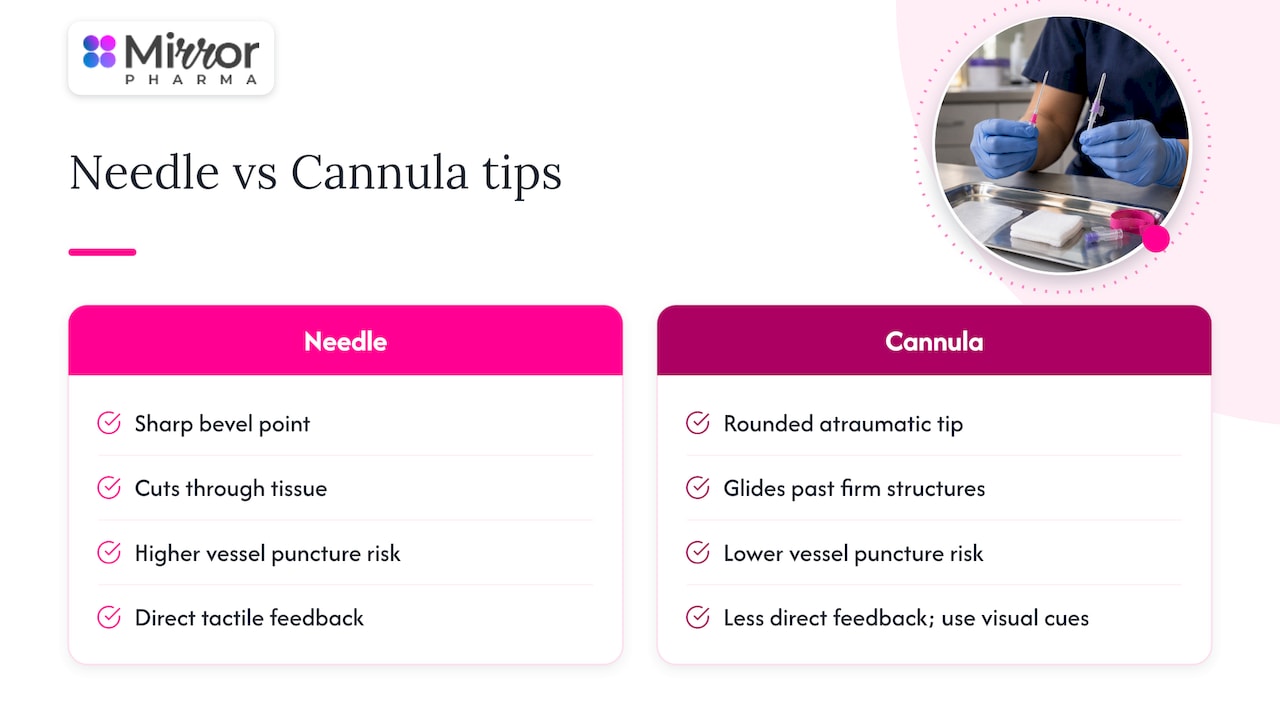
A needle’s bevel is ground to a sharp point that cuts cleanly through tissue, which is precisely why it carries vascular risk: the same sharpness that gives tactile feedback and placement accuracy will puncture a vessel wall with the same ease as it punctures dermis. A cannula’s rounded, atraumatic tip is designed to glide past firmer structures, including vessel walls, rather than through them, which is the physical reason cannula work tends to track with less bruising.
That blunt tip changes how the instrument handles in your fingers. Cannulas offer less direct tactile feedback than a needle, so practitioners often rely more on the resistance of the surrounding tissue and on visual cues such as skin tenting to judge depth and position. The entry point itself also differs: a cannula typically requires a small needle-made entry wound before insertion, meaning most cannula procedures still use one or more needles at the outset. Side-port cannulas, where the opening sits just behind the rounded tip rather than at the very end, allow product to be deposited slightly off-axis from the direction of travel, which some practitioners find useful for controlled fanning techniques. Patients generally report less discomfort from cannula threading across a wide area than from multiple separate needle punctures, though individual pain tolerance and the treatment area both affect that experience.
Checking compatibility between needles, cannulas and filler products
Not every needle or cannula performs equally well with every filler. Hub design and internal bore finish affect how smoothly a viscous, high-G′ filler extrudes, and a narrow or rough-walled lumen can create uneven flow or require excessive thumb pressure regardless of the gauge printed on the packaging. Luer-lock compatibility between the syringe and the needle or cannula hub is another practical point: a loose or mismatched fit risks product leakage or, worse, the cannula detaching mid-procedure.
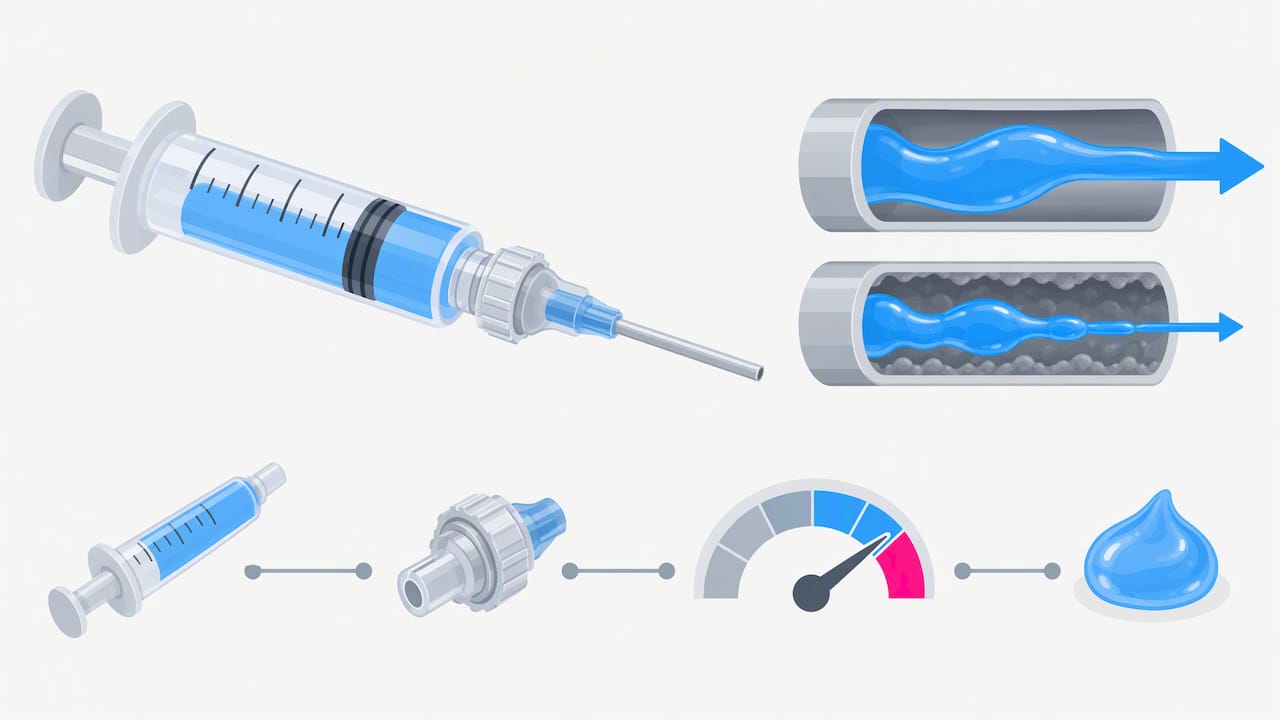
Manufacturers vary in how they specify compatibility, and a device rated for one filler’s viscosity range is not automatically suitable for another. Before adopting a new cannula or needle line, check the product literature for the gauge and viscosity range it is designed to handle, and cross-reference that against the specific filler’s rheological profile rather than assuming a generic fit. Where a filler’s technical data sheet recommends a specific gauge, that recommendation reflects testing against the product’s own flow characteristics and is worth following rather than substituting your usual preference. For background on filler rheology and how it interacts with device choice, see our hyaluronic acid filler safety guide.
Building skill with needles versus cannulas
Needle and cannula techniques are not interchangeable skills learned once and applied everywhere. Needle work rewards precise depth control and a steady hand at a single point, while cannula work rewards a different kind of spatial awareness: tracking the tip’s position through tissue you cannot see, using tenting, resistance and anatomical landmarks as your guide. Practitioners moving from needle-only practice to cannula techniques generally benefit from structured hands-on training before using a cannula on a patient, since the fanning and threading motions involved are distinct from a direct needle bolus.
Training should cover entry-point selection, how to create the initial needle puncture that most cannula procedures require, and how to recognise the feel of a cannula passing cleanly through a plane versus meeting unexpected resistance. Repeated supervised practice in low-risk areas before progressing to vessel-dense zones such as the tear trough or temple is a sensible progression. Ongoing skill development also means staying current on evolving technique recommendations, since the evidence base comparing needles and cannulas continues to develop, as reflected in recent comparative reviews of the literature.
Patient selection and informed consent for needle or cannula procedures
Device choice is a clinical decision that belongs in the consent conversation, not an afterthought decided at the injection chair. Patients on anticoagulant or antiplatelet medication, those with a history of bruising easily, and those being treated in high-risk vascular zones are all cases where your instrument choice and your reasoning for it should be documented and explained.
Consent discussions should cover the realistic range of outcomes for the chosen approach, including that bruising, swelling and, rarely, vascular complications can occur with either needles or cannulas, and that no technique eliminates risk entirely. Patients should understand why you have chosen a particular instrument for their anatomy and treatment area, and that choice should be revisited if their medical history, medication use or previous treatment response changes. Clear documentation of the device type, gauge and any complications discussed protects both patient understanding and your own clinical record.
Reducing pain and bruising during injection
Patient comfort and bruising risk respond to the same careful technique that reduces vascular risk. Topical anaesthetic applied with adequate dwell time before injection reduces the sting of initial needle entry, and many fillers now include lidocaine within the formulation itself to reduce discomfort during deposition. Ice applied before and immediately after treatment constricts superficial vessels and can reduce both pain perception and bruising.
Slow, low-pressure injection in small aliquots causes less tissue distension and less patient discomfort than a rapid bolus, and it gives you time to notice blanching or unexpected resistance before it becomes a problem. For cannula work, maintaining continuous tip motion rather than depositing product from a static position spreads the volume more evenly and reduces localised swelling. Applying firm, gentle pressure immediately after each injection point, rather than rubbing, helps limit bruising from any small vessels that were disturbed during the pass.
Our perspective on practitioner-only supply
We supply needles, cannulas and consumables exclusively to verified healthcare professionals and build extended order cut-off times into our fulfilment to support timely clinic deliveries. Our needle gauge chart and product pages are there for practitioners who want to check a specific gauge or length before ordering.
— Rizwan
Where to find practitioner-only needles and cannulas
We stock needles and cannulas as part of our needles and consumables range, available exclusively to verified healthcare professionals and aesthetic practitioners following our standard credential checks. Every order moves through the same extended cut-off times we apply across our catalogue, which is built to get consumables to your clinic in time for a scheduled treatment list rather than leaving you to plan around uncertain delivery windows.
If you are looking for a concrete example of fine-gauge supply for toxin dilution and reconstitution work, our FMS Insulin Micro Needle & Syringe 32G 0.5ml listing sits within the same practitioner-only range. Browse the full needles and consumables category to check current stock, specifications and batch information before you order, and reach our team directly if you need confirmation on compatibility with a specific filler or toxin before committing to a purchase.
This article is general information, not a substitute for advice from a qualified doctor. Consult a qualified healthcare professional about your own circumstances before acting on anything here.
FAQ
Is it harmful to inject filler using a micro-cannula?
A micro-cannula is not inherently harmful and is associated with a lower vascular occlusion signal than needles in cohort data from dermatologists. Risk still depends on correct gauge selection, plane awareness and technique, since cannula use has its own learning curve and is not risk-free.
What is an aesthetic injection?
An aesthetic injection is the administration of a cosmetic product, such as a hyaluronic acid filler, botulinum toxin or skin booster, into a specific facial or body tissue plane to achieve a defined cosmetic effect. It is performed using either a sharp needle or a blunt cannula, selected according to the treatment area and the product being used.
What is cannula injection?
Cannula injection uses a flexible, blunt-tipped tube inserted through a small needle-made entry point to deliver product while gliding past, rather than through, vessels and other delicate structures. This technique is commonly chosen for broader areas and vessel-dense regions such as the tear trough and midface.
What are some examples of medical aesthetics treatments?
Medical aesthetics covers treatments such as hyaluronic acid dermal fillers, botulinum toxin for dynamic lines, skin boosters, polynucleotide treatments and non-surgical fat-dissolving injections. All of these are prescription or prescription-adjacent treatments intended to be delivered only by qualified aesthetic professionals.
Sources
- Rates of Vascular Occlusion Associated With Using Needles vs Cannulas for Filler Injection | JAMA Dermatology
- Needles Versus Cannulas: Advantages, Disadvantages, and Selection Criteria for Injecting Dermal Fillers
- Single‑use medical devices: UK guidance on re‑manufacturing
- The art of needle choice (needle gauge chart and clinical reference)