

Hyaluronic acid (HA) fillers restore volume and soften contour by placing a cross-linked HA gel beneath the skin, and the effect is deliberately temporary. Results typically hold for 6 to 18 months, depending on the product, the injection site and how quickly the patient’s own tissue clears the gel. Skin boosters at the hydrating end tend to fade within 3 to 6 months, while dense volumisers placed deep can outlast that upper range.
The single most important safety habit for any injector is working within known facial anatomy and recognising the early signs of vascular occlusion before it becomes irreversible. Unlike older permanent fillers, HA gels can be dissolved with hyaluronidase, which is why every clinic offering this treatment should have it in stock and know the local emergency pathway.
- Indications: volume loss, static and dynamic lines, lip and cheek contouring, hydration
- Reversibility: yes, via hyaluronidase injection
- Typical longevity: 6 to 18 months, shorter for boosters, longer for high-G’ volumisers
- Non-negotiable: vascular occlusion recognition and a stocked hyaluronidase protocol
This article is written for licensed practitioners and qualified aesthetic professionals. It is not intended to promote prescription-only products to the general public.
Key Takeaways
Successful HA filler treatment depends on matching a product’s rheology and crosslinking chemistry to the anatomical plane being treated, while keeping hyaluronidase available for reversal at every appointment.
| Point | Details |
|---|---|
| Match G’ to anatomy | Use higher G’ gels for deep structural support and lower G’ gels for lips and mobile, superficial areas. |
| Expect 6 to 18 months | Duration varies by product and site; skin boosters fade fastest, dense volumisers last longest. |
| Reversibility is the safety net | Stock hyaluronidase and know the local dosing protocol before you ever need it in an emergency. |
| Recognise occlusion early | Disproportionate pain, blanching and any visual disturbance demand an immediate stop-and-treat response. |
| Source through verified suppliers | Mirror Pharma supplies licensed practitioners with traceable, correctly stored HA filler stock and a documented range from boosters to volumisers. |
Table of Contents
- What hyaluronic acid dermal fillers are and how they work
- Filler rheology, G’ and crosslinking technology explained
- Matching filler choice to the treatment area
- Who is a suitable candidate for HA filler treatment?
- The treatment pathway from consultation to recovery
- How long results last and what changes the timeline
- Safety, complications and how to manage a vascular event
- Aftercare and what counts as normal recovery
- How practitioners choose products and source them safely
- Where to source HA fillers as a licensed practitioner
- Sources
- FAQ
What hyaluronic acid dermal fillers are and how they work
An HA filler is a cross-linked hyaluronic acid gel, formulated for injection into the deep dermis, subcutaneous plane or supraperiosteal space to add volume, support tissue or fill a line. The cross-linking, usually achieved with BDDE (1,4-butanediol diglycidyl ether), turns the naturally short-lived HA molecule into a gel that resists breakdown long enough to produce a clinically useful result.
Hyaluronic acid’s defining property is that it is hygroscopic. It draws in and binds water many times its own weight, which is what gives an HA gel its volumising effect the moment it is placed. As the gel gradually degrades, it is thought to be replaced in part by newly generated water and, in some cases, by a degree of collagen stimulation from the mechanical and biochemical response to the implant. Clinicians often describe this as isovolumetric degradation. Volume is roughly maintained for a period even as the original gel is broken down, rather than the result simply collapsing the moment the product starts to clear.
The other defining property, and arguably the more clinically useful one, is reversibility. Hyaluronidase is an enzyme that cleaves HA into smaller fragments, making the gel susceptible to rapid clearance by the body. This matters for two distinct reasons: it gives you a genuine safety net in a vascular occlusion emergency, and it gives you a corrective option when a result is aesthetically unsatisfactory, lumpy, or simply not what the patient wanted. No other filler category offers this combination of predictable volumising effect and a reliable off switch.
Pro Tip: Build reversibility into your consent conversation explicitly. Tell patients the result is not permanent and that it can be dissolved if needed, but avoid implying hyaluronidase is a risk-free undo button. It carries its own, separate consent requirements and is a treatment in its own right, not a guarantee.
Filler rheology, G’ and crosslinking technology explained
Choosing a filler by brand name alone misses the point. What actually predicts how a gel behaves in tissue is its rheology, meaning how it flows, resists deformation and holds its shape under stress. The G’ or elastic modulus is the parameter practitioners lean on most: a higher G’ gel resists deformation and gives structural lift, while a lower G’ gel is softer, spreads more readily and integrates better into mobile, superficial tissue.
G" (the viscous modulus) and G* (complex modulus) complete the picture, and both are frequency-dependent, meaning a gel’s stiffness reading can shift depending on how fast it is being sheared during testing. A single G’ figure quoted at one frequency is a useful shorthand, not a full description. Full frequency-sweep data give a much better sense of how a product will actually perform once injected, and relying on one number from a marketing sheet risks a mismatch between what the lab says and what the tissue does.
Crosslinking technology is what produces these differences in the first place. Three broad approaches dominate current clinical use:
- RHA (resilient hyaluronic acid) technology uses a gentler crosslinking process intended to preserve the gel’s natural flexibility, aimed at dynamic areas that move constantly with facial expression.
- Vycross-style mixed molecular-weight crosslinking combines high and low molecular weight HA chains to achieve high cohesivity with comparatively lower BDDE content, often associated with longer duration and smoother integration.
- OBT-style (Optimal Balance Technology) crosslinking aims to balance elasticity and cohesivity through controlled crosslink distribution, giving a gel that holds shape without excessive stiffness.
None of these technologies is universally “better.” There is no single standardised rheology metric that fully predicts clinical behaviour, because crosslinking chemistry, HA concentration and particle size all interact to produce the final in-tissue result. That is precisely why the biggest mistake in filler selection is assuming stiffer always equals better. A gel with a G’ above roughly 250 Pa at low frequency sits toward the higher end of the reported clinical range and suits deep structural indications such as chin projection or malar support, but the same product placed superficially in the lip is a near-guaranteed route to palpable lumps.
As a working guide:
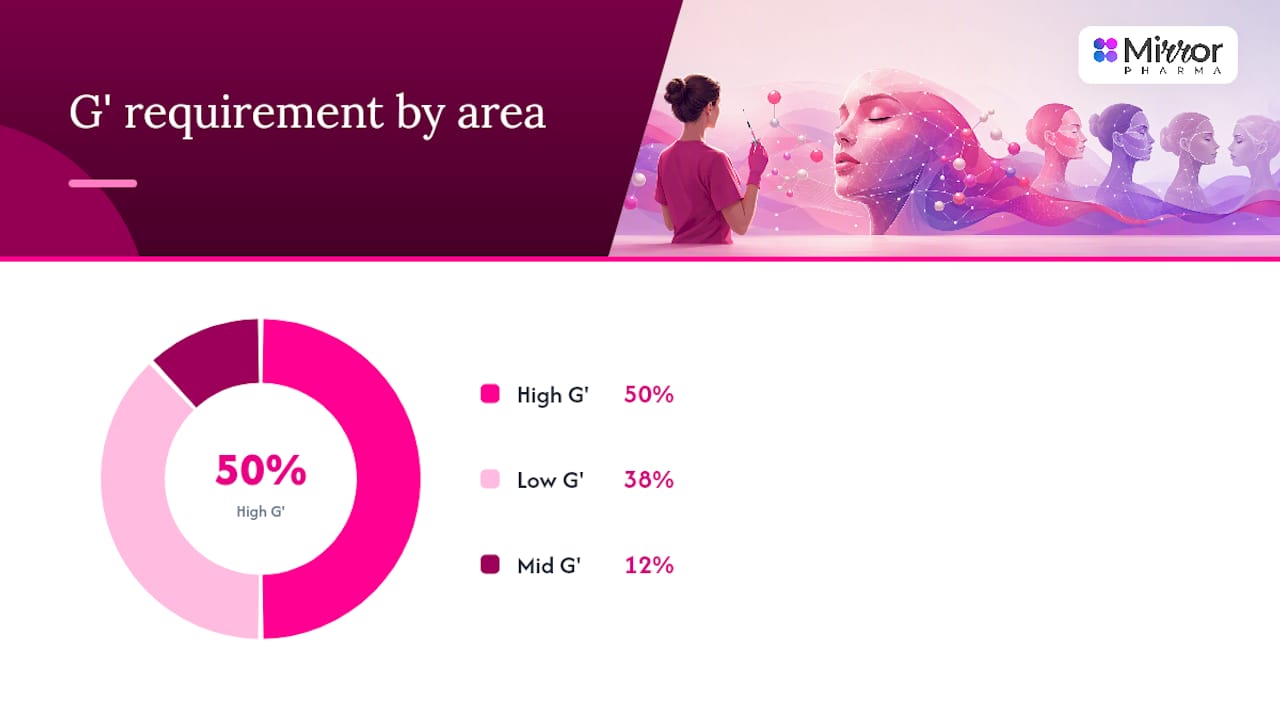
- High G’ gels suit deep, structural indications: chin, jawline, malar volume loss, supraperiosteal placement over bone.
- Low G’ gels suit superficial lines, tear troughs and highly mobile areas such as the lips and perioral region.
- Mid-range G’ gels cover the middle ground, including nasolabial folds and moderate cheek volume loss.
Duration and stiffness are not the same axis. A high G’ product is not automatically the longest-lasting one; crosslinking density, particle architecture and metabolic clearance all play a role independently. Before committing to a product for a new indication, it is worth reviewing that manufacturer’s own published rheology data rather than relying on a competitor comparison chart, since testing conditions and frequency ranges vary between studies.
Matching filler choice to the treatment area
Anatomy dictates rheology choice far more than brand preference should. Each facial region carries its own mechanical demands, and mismatching G’ to tissue behaviour is one of the most common causes of an unnatural result.
- Cheeks and malar area: structural support is the priority; higher G’ products placed at or near the periosteum give lift with minimal product volume.
- Chin and jawline: similar logic applies; firmer gels hold projection against gravity and repeated jaw movement.
- Nasolabial folds: mid-range G’ usually strikes the right balance between correction and natural movement during smiling.
- Tear troughs: this area punishes stiff, poorly chosen gels more than any other; low G’, highly cohesive, low-viscosity products reduce the risk of visible lumps or a blue-grey discolouration under thin skin.
- Lips: softer, low G’ gels that integrate smoothly are essential given constant muscle movement; a lip-specific formulation designed for that mobility tends to age better than a repurposed structural product.
- Perioral lines: very superficial, low-volume, low G’ placement only, and conservatively dosed.
- Temples: deep, supraperiosteal placement with structural gels, injected with particular respect for the underlying vasculature.
- Hands: higher-density product placed subcutaneously, chosen with the thin, mobile overlying skin in mind.
Injection depth planning should follow the same logic as product selection. Periosteal placement suits high G’ volumisers aiming for skeletal-style support; deep dermal or subcutaneous placement suits softer, more cohesive gels; and submucosal placement in the lip demands a product specifically designed for that tissue.
Pro Tip: In the tear trough, underfilling and reviewing at four weeks beats overcorrecting in one sitting. In the lips, inject in small aliquots along the vermilion border and body rather than one large deposit, which is the single biggest technique factor separating a natural result from an obviously “done” one.
Who is a suitable candidate for HA filler treatment?
The best candidates understand that hyaluronic acid injections deliver a temporary, reversible improvement rather than a permanent transformation, and they have realistic expectations about both the result and its lifespan. Anyone unable to grasp that distinction, or who is seeking a fix for a problem filler cannot solve, needs a longer consultation before you pick up a needle.
Several contraindications should stop or delay treatment:
- Active infection, cold sores or unhealed skin lesions at or near the intended injection site
- Known hypersensitivity to hyaluronic acid or to hyaluronidase, since this affects the safety net available if reversal is ever needed
- Pregnancy and breastfeeding, where data are insufficient to support treatment
- Recent dental work involving the maxillary or mandibular region, which raises infection and vascular risk in nearby soft tissue
- Anticoagulant or antiplatelet therapy, which does not rule out treatment but changes bruising risk and requires an informed conversation
- Recent vaccination, where many clinics apply a precautionary delay given reports of delayed inflammatory reactions at filler sites
A short consent checklist worth adapting into your own documentation: confirm medical history and allergies, confirm no active infection at the site, confirm medication and supplement use including NSAIDs and fish oils, discuss realistic outcome and duration, discuss reversibility and hyaluronidase, and record verbal and written consent with photographs.
The treatment pathway from consultation to recovery
A safe HA filler appointment follows a consistent sequence, even when the product and indication change.
- Pre-treatment review. Take a full medical history, check current medications and supplements (NSAIDs and fish oils increase bruising risk), obtain photographic consent, and talk through expected duration and reversibility before any product is opened.
- Preparation on the day. Cleanse and disinfect the treatment area, discuss anaesthesia options such as topical numbing cream or filler with integral lidocaine, confirm product storage conditions and check the batch label matches your records, then mark the treatment plan on the skin.
- Injection technique. Decide between needle and cannula based on the area’s vascular risk; a cannula’s blunt tip can reduce the chance of intravascular injection in higher-risk zones such as the tear trough and temple. Layer the product gradually rather than depositing a large single bolus, and start with a conservative volume you can build on at review rather than one you cannot easily undo.
- Immediate aftercare. Apply cold compress if needed, advise against strenuous exercise, alcohol and excessive heat for 24 to 48 hours, and give the patient clear written instructions for what to expect and when to call the clinic.
Pro Tip: A cannula is not a guarantee against occlusion, but in higher-risk anatomical zones it materially changes the risk profile compared with a sharp needle, and it is worth the extra minute of technique adjustment it requires.
How long results last and what changes the timeline
The honest answer is a range, not a number: most HA fillers last 6 to 18 months, with hydrating skin boosters typically sitting at the shorter end around 3 to 6 months and dense structural volumisers sometimes extending beyond 18 months.
- Shortens duration: a fast metabolism, high activity levels, placement in highly mobile areas such as the lips, lower crosslinking density and lower HA concentration
- Lengthens duration: deeper placement near bone, higher crosslinking density, larger particle size, and patient habits like reduced smoking and consistent sun protection
The myth worth killing outright is that any HA filler is permanent. It is not, and it was never designed to be. What patients actually experience is gradual, isovolumetric degradation, where the gel is slowly cleared and volume fades progressively rather than dropping off a cliff on a fixed date.
Safety, complications and how to manage a vascular event
Most adverse effects from HA filler treatment are mild and self-limiting: bruising, swelling and tenderness at the injection site typically settle within days. Less common complications include delayed-onset nodules, granuloma formation and localised infection, which usually respond to standard clinical management once identified. Regulatory and clinical guidance is unambiguous that products sourced outside verified medical supply chains carry a real risk of contamination and counterfeiting, which is one more reason procurement discipline matters as much as injection technique.

The serious end of the spectrum is where speed of recognition decides outcome. Vascular occlusion, skin necrosis and, in rare cases, vision compromise from retrograde embolism are the events every injector must be able to recognise within seconds, not minutes.
Watch for these early occlusion signs:
- Immediate, disproportionate pain during or after injection
- Skin blanching or a mottled, livedoid pattern around the injection site
- Delayed capillary refill on blanching test
- Any visual disturbance, however brief, reported by the patient during or shortly after treatment
Immediate emergency sequence:
- Stop injecting immediately and remove the needle or cannula
- Massage the area firmly and apply warm compresses to encourage vasodilation
- Administer hyaluronidase into and around the affected area without delay, since it is the recognised reversal agent for HA filler complications, with local protocols guiding dose and repeat dosing intervals
- Arrange urgent ophthalmology referral immediately if any visual symptom is reported, since retinal ischaemia has a narrow treatment window measured in hours, not days
Pro Tip: Keep hyaluronidase stocked and within its expiry at all times, keep a printed local emergency contact list including your nearest ophthalmology unit, and run a documented occlusion drill with your team at least annually. The clinics that manage these events well are the ones that rehearsed the sequence before they ever needed it.
Aftercare and what counts as normal recovery
Give patients a short, specific set of instructions rather than a vague “take it easy” and hope for compliance. Standard advice includes applying ice intermittently for the first 24 hours, avoiding strenuous exercise, alcohol and high-dose fish oil or vitamin E supplements for 48 hours, and avoiding facial massage or excessive heat exposure such as saunas.
- Days 0 to 3: bruising and swelling are common and expected; mild tenderness at injection points is normal
- Days 3 to 7: swelling should be visibly reducing; persistent firmness in some areas can still be normal at this stage
- Weeks 2 to 4: the result should be settling into its final appearance, which is the appropriate point for a review appointment
Red flags that need urgent review, not a routine follow-up: progressive or worsening pain rather than pain that improves day on day, any skin blanching or dusky discolouration, visual disturbance of any kind, and marked asymmetry that develops after the appointment rather than being present from the start. Document every consultation, the product batch used, and the review date agreed with the patient.
How practitioners choose products and source them safely
Product selection should follow a consistent checklist: intended anatomical plane, required G’ and cohesivity for that plane, the crosslinking technology behind the product, the published clinical data supporting its use in that indication, and your own hands-on familiarity with how it handles. Formal training that builds real familiarity with a product range before independent use is consistently identified by practising clinicians as one of the strongest predictors of safe, natural outcomes.
Sourcing matters just as much as selection. Batch traceability, correct cold-chain storage and purchasing exclusively through verified medical suppliers are standard procurement checks in any licensed clinic, and skipping them is how counterfeit or degraded product ends up in a syringe.
- Confirm the supplier is verified and requires practitioner registration before dispatch
- Check batch numbers and expiry dates on arrival against the delivery note
- Store products according to manufacturer guidance, typically in a temperature-controlled fridge
- Keep purchase records aligned with local prescribing and procurement requirements
Mirror Pharma operates as a licensed supplier for registered healthcare professionals and aesthetic practitioners, offering a documented product range alongside vitamins and infusion therapies for clinics that need reliable, traceable stock. Any purchase must still comply with local prescribing rules and be used only by qualified staff.
A practitioner’s take on rheology and restraint
My own priority when reading a rheology chart is not “which product is stiffest” but “which product suits this specific plane and this specific patient’s movement pattern.” The gap between a good and a mediocre injector rarely comes down to product choice alone; it comes down to whether they matched G’ to anatomy and stayed conservative on volume during the first session. This article is written for licensed practitioners and qualified aesthetic professionals, and nothing in it replaces formal, hands-on training or your local regulatory guidance. If you are early in your career with HA fillers, a structured foundation course pays for itself the first time you catch an occlusion sign a second earlier than you would have otherwise.
Where to source HA fillers as a licensed practitioner
Mirror Pharma gives licensed practitioners a direct route to traceable, correctly stored HA filler stock without the delays and guesswork that come from juggling multiple unverified suppliers. Where a clinic sourcing from scattered or unverified channels risks batch inconsistency and counterfeit product, Mirror Pharma’s model centres on verified procurement, clear batch documentation and extended order cut-off times built specifically around how aesthetic clinics actually schedule appointments.
The range spans skin boosters through to high-density volumisers, so whether you are stocking up for tear trough work with a softer, cohesive gel or need a higher-density formulation for structural cheek support, it sits within one verified account rather than several. Registered practitioners can browse the current product range and set up a verified account today to have stock ready before your next patient consultation.
Sources
For product-specific rheology metrics and regulatory detail beyond this overview, these papers are worth reading in full:
- Hyaluronic Acid – StatPearls – NCBI Bookshelf
- Hyaluronidase for management of complications related to hyaluronic acid fillers – PMC
This article is general information, not a substitute for advice from a qualified doctor. Consult a qualified healthcare professional about your own circumstances before acting on anything here.
FAQ
Is hyaluronic acid a good filler choice?
HA is the most widely used filler category because it offers a reproducible, immediately visible result with a low allergic response rate and, crucially, full reversibility with hyaluronidase if a correction is ever needed.
How long does hyaluronic acid filler last?
Most results last 6 to 18 months, with hydrating skin boosters at the shorter end and dense structural volumisers sometimes lasting longer, depending on placement and patient metabolism.
What is the best filler approach for older or thinner skin?
There is no single “best” filler; the safer principle is choosing a lower G’, highly cohesive gel for thin, mobile or superficial skin, and reserving higher G’ products for deeper structural support where the overlying tissue is thicker.
What is the downside of hyaluronic acid fillers?
The main downsides are that results are temporary rather than a permanent fix, mild bruising and swelling are common in the days after treatment, and rare but serious complications such as vascular occlusion require immediate recognition and management.
Can HA filler results be reversed if I am unhappy?
Yes. Hyaluronidase breaks the HA gel down and accelerates its clearance, which is why practitioners should discuss this option during consent as part of a realistic expectations conversation.
Where can licensed practitioners source HA fillers safely?
Registered professionals should buy only through verified medical suppliers with clear batch traceability, such as Mirror Pharma, rather than unverified online sellers where contamination and counterfeiting risks are well documented.