

To verify a UK medicine supplier, first confirm their licence numbers on MHRA registers, check pharmacy registration with the GPhC, and search MHRA’s suspicious seller lists. Only proceed once documents such as the WDA(H) or MS licence, Certificate of Analysis or Conformity, and batch data match official records. This applies to licensed practitioners and procuring organisations sourcing medicines for clinical use, not to individuals buying for personal use.
TL;DR:
- Confirm the supplier’s WDA(H) or MS licence number, company name, and site address on the MHRA register before placing any order, and verify continuous compliance over time.
- Use MHRA’s suspicious activity tool and GPhC register to check online seller legitimacy, ensuring prescription medicines are genuinely gated behind verified prescriber steps.
- Require and cross-check batch numbers, expiry dates, and certificates of analysis with the physical packaging and official documents before accepting stock from any supplier.
- Be cautious of prices below the market range, missing licence information, or inconsistent packaging details, as these are strong red flags for falsified or diverted medicines.
- Maintain a detailed record of verifications and supplier documentation, and treat verification as a routine process, not a one-time task, to ensure ongoing supply safety and legality.
Table of Contents
- Check official UK registers and databases
- How to verify online sellers and report suspicious websites
- Documentary checklist to request from any supplier before purchase
- Purchaser responsibilities and special cases
- Understanding the risks of buying from unverified suppliers
- How to identify genuine versus counterfeit packaging
- Verifying supplier credentials beyond MHRA and GPhC
- Background checks on medicine suppliers worth doing
- Legal responsibilities when sourcing medicines in the UK
- Practical verification habits for UK clinics
- How Mirror Pharma supports compliant procurement
- Sources
- FAQ
Check official UK registers and databases
The first stop for any verification is the MHRA register of licensed wholesale distribution sites, which lists every authorised wholesale dealer of human medicines in the UK. A supplier should appear here under a Wholesale Dealer’s Authorisation, known as WDA(H), with a licence number tied to a named company and a specific site address. This register is updated monthly, so a very recent change in ownership or address might not show immediately, which is itself a reason to ask the supplier directly when something looks out of date.
The MHRA also maintains a separate CMS listing of WDA(H) entries and inspection status, which some procurement teams use alongside the GOV.UK register to confirm a site’s authorised activities and its Good Distribution Practice standing. For manufactured products, particularly ‘Specials’ or anything made under a Manufacturer’s Licence (MS), the equivalent check runs through MHRA Products or EudraGMDP where the manufacturing site operates across the EU.
When running the check, match these fields exactly rather than approximately:
- The WDA(H) or MS licence number as printed on the supplier’s paperwork, not a shortened or rounded version.
- The company name registered against that licence, including the exact legal entity, not a trading name.
- The site address listed on the register, which should match where stock is actually held or dispatched from.
A mismatch on any of these three points is a reason to pause the order and ask the supplier to explain the discrepancy before any product changes hands.
How to verify online sellers and report suspicious websites
Buying medicines online carries extra risk because a professional-looking website says nothing about whether the seller is licensed. MHRA runs a dedicated check or report suspicious activity service that lets you search for a seller and see whether they appear on a ‘Not recommended’ list, and lets you submit a report when something looks wrong.
Work through the check in this order:
- Search the seller’s name and website address on the MHRA suspicious activity tool before placing any order.
- Look for a GPhC registration number displayed on the site, then verify it independently on the GPhC register rather than trusting the badge alone.
- Check that prescription-only medicines are gated behind a genuine prescriber or practitioner verification step, not just a tick-box age or profession declaration.
- Save screenshots of the website, including prices, claims and contact details, in case you need to report later.
- If anything fails these checks, submit a report through MHRA’s suspicious activity service rather than simply walking away.
Where you suspect the stock itself is falsified rather than just the seller being unlicensed, the correct channel is the Yellow Card scheme, which accepts detailed reports including GTIN, serial number, batch number, expiry date and photographs of packaging.
Pro Tip: Keep a standing folder for every supplier you deal with, storing register screenshots and GPhC checks from the date you first verified them, so you have a dated record if questioned later.
Documentary checklist to request from any supplier before purchase
No procurement decision should rest on a supplier’s say-so. Ask for documents, check them against official sources, and keep copies on file.
- The WDA(H) or MS licence number, checked against the MHRA wholesale distribution register before the first order and periodically after.
- A Certificate of Analysis or Certificate of Conformity specific to the batch being supplied, not a generic product-level document.
- The batch number and expiry date printed on the paperwork, which must match what is printed on the physical packaging on arrival.
- A finished product specification, particularly for manufactured ‘Specials’ where MHRA inspects the manufacturing site but does not evaluate each individual product.
- Evidence of cold chain handling for temperature-sensitive products, including transport logs where the product requires refrigeration.
WDA(H) licence holders are expected to comply with Good Distribution Practice, and MHRA guidance on wholesale dealer licensing flags diverted or abnormally cheap stock as a recognised risk factor for falsified medicines. That single line is worth repeating to any procurement team: price that looks too good against the market is a signal to check harder, not a reason to order faster.
Purchaser responsibilities and special cases
Standard licensed medicines carry MHRA oversight at the manufacturing stage, but ‘Specials’ and parallel imports shift more of the burden onto the purchaser. NHS Specialist Pharmacy Service guidance on evaluating Specials is direct on this point: MHRA inspects the manufacturer holding the MS licence, but it does not assess the quality of each finished ‘Special’. That assessment is the purchaser’s and prescriber’s job, which means requesting the MS licence number, a finished product specification and a batch-specific Certificate of Conformity before accepting stock.
Parallel imports add a further wrinkle. Some packs legitimately lack the 2D barcode safety feature required under the Falsified Medicines Directive framework, following guidance on disapplying certain safety feature requirements for parallel imports. An absent barcode on a parallel-imported pack is not automatically a red flag, but it does mean documentary provenance matters more, not less.
Treat these as immediate stop signals:
- No visible or verifiable WDA(H), MS or GPhC licence number anywhere in the paperwork.
- A price noticeably below the normal market range with no clear explanation.
- Missing or inconsistent batch numbers between the invoice, the Certificate of Conformity and the physical packaging.
Understanding the risks of buying from unverified suppliers
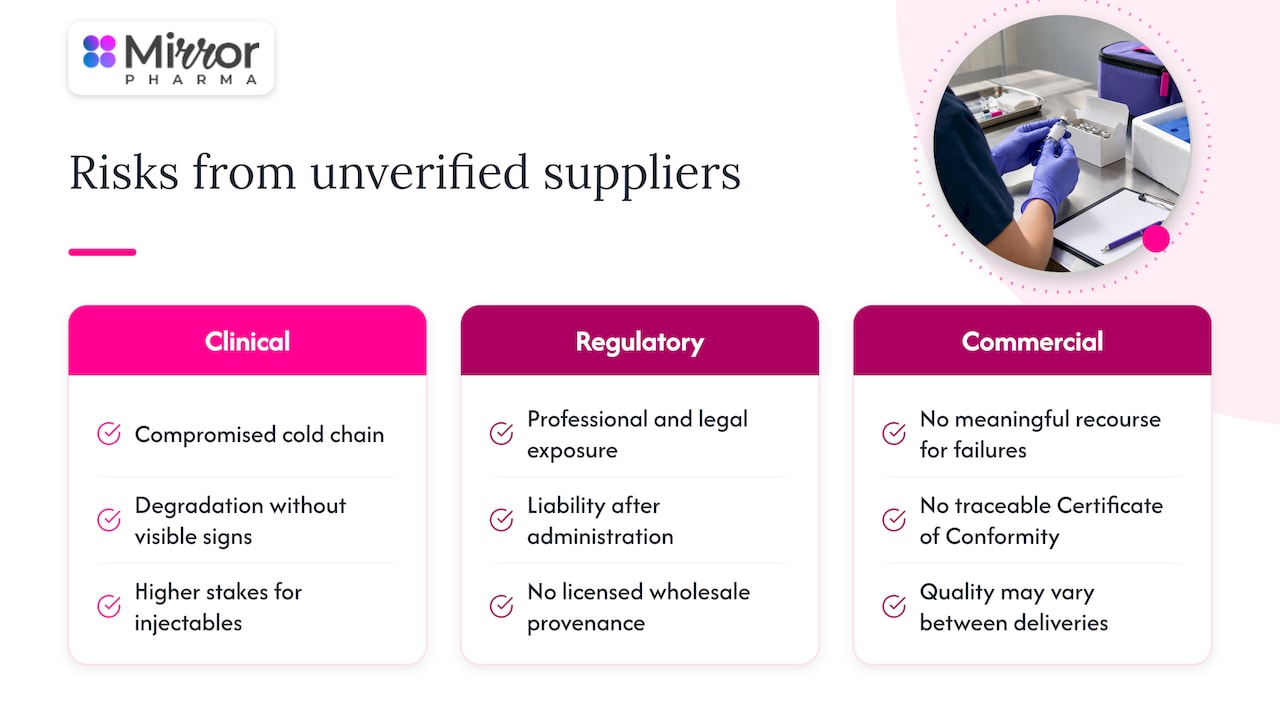
Buying from an unverified source exposes a clinic to several linked risks at once, and they rarely arrive in isolation. A product that has not passed through a licensed wholesale chain may have been stored outside validated temperature ranges, handled without the traceability that Good Distribution Practice requires, or diverted from a market where it was never intended for UK use.
For injectable aesthetic products and prescription medicines specifically, the clinical stakes are higher than for general consumer goods. A compromised cold chain can degrade a product without any visible change to the packaging, and a practitioner has no way to know this at the point of injection. There is also a regulatory dimension: a clinic that administers an unverified product to a patient carries professional and legal exposure if something goes wrong, independent of whether the product itself was defective.
The commercial risk compounds the clinical one. Unlicensed suppliers typically offer no meaningful recourse if a batch fails, no traceable Certificate of Conformity to support a complaint, and no guarantee that the next delivery will match the quality of the last. Treating supplier verification as a one-off check rather than an ongoing habit is one of the more common gaps procurement teams fall into, particularly when a cheaper source appears mid-contract.
How to identify genuine versus counterfeit packaging
Genuine licensed medicine packaging carries consistent, high-quality printing: sharp text, correctly aligned batch and expiry stamps, and tamper-evident seals that show no sign of having been opened and resealed. Counterfeit or diverted stock often shows the opposite: slightly blurred print, fonts that do not quite match previous batches from the same manufacturer, or seals that look subtly different from a known-good reference pack.
Cross-reference the batch number and expiry date printed on the outer box against the Certificate of Analysis or Conformity supplied with the order, and against the product leaflet where one is included. A mismatch between any of these, even a single digit, is worth querying before the stock is used.
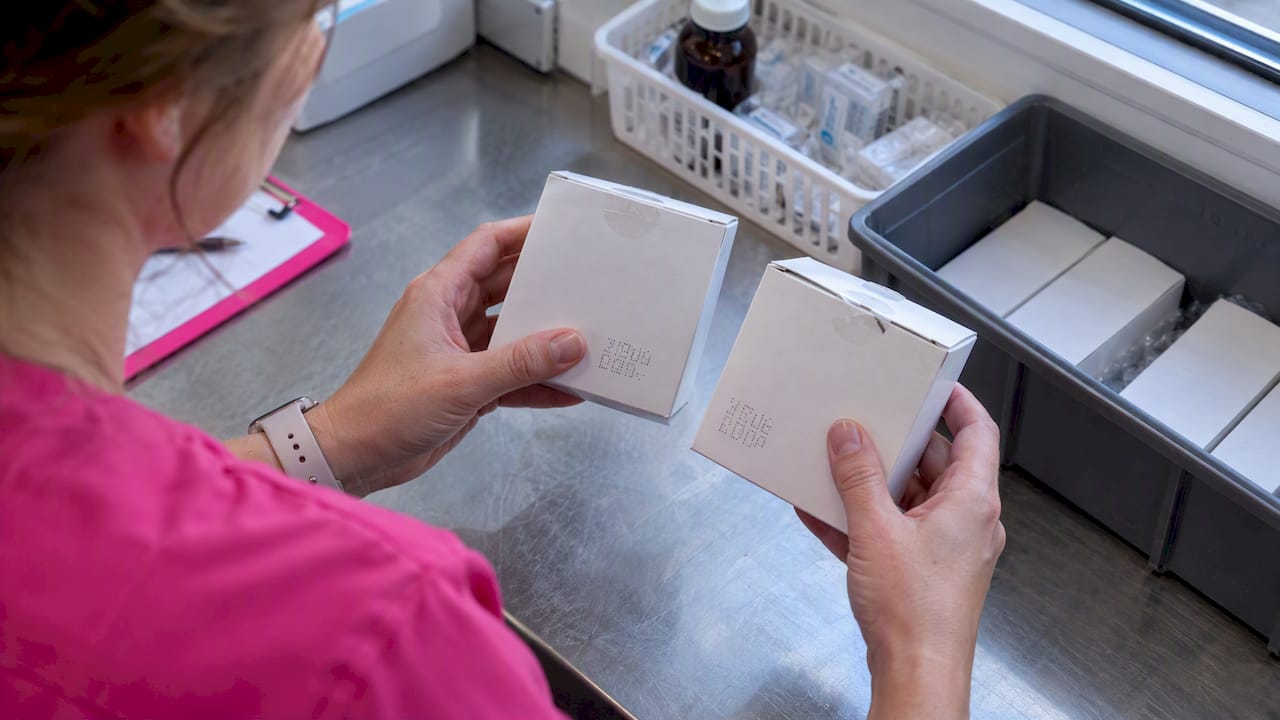
For products covered by Falsified Medicines Directive safety features, a 2D barcode and tamper-evident device should be present and scannable, except on certain parallel-imported packs where exemptions apply under current parallel import guidance. Where a barcode is present but will not scan, or scans to a different product, that pack should be set aside and reported rather than used.
Verifying supplier credentials beyond MHRA and GPhC
MHRA registers and GPhC checks cover the legal minimum, but several trade bodies and industry frameworks give a fuller picture of a supplier’s standing. Membership of a recognised wholesale or pharmaceutical trade association can indicate a supplier operates under an additional layer of peer scrutiny, though membership should always be verified directly with the body rather than taken from a logo on a website.
Good Distribution Practice inspection history is another layer worth asking about directly. MHRA’s inspectorate has written about the risks of accepting supplier claims without independent qualification, noting that qualification and re-qualification of suppliers and customers is one of the higher-risk areas in distribution practice. Their guidance is blunt: do not accept verbal assurances, and build a risk-based supplier qualification process rather than a one-off onboarding check.
For manufactured products, checking a supplier’s manufacturing partners against the MHRA Products database adds another confirmation point, letting a procurement team see the licence history and approved uses tied to a specific product rather than relying on the supplier’s own description of it.
Background checks on medicine suppliers worth doing
Licensing checks confirm legality. They do not tell you whether a supplier will still be operating reliably in a year, or whether other clinics have had problems with them. A short background check closes that gap.
Start with basic financial stability indicators, such as how long the company has been trading and whether it has a consistent registered address history, which is a reasonable proxy for operational continuity. A supplier that has changed its trading name or site address repeatedly in a short period is worth a closer look, not an automatic rejection, but a closer look.
Ask directly about complaint history and how the supplier handles a failed batch or a delivery issue. A supplier confident in its own compliance record will usually have a clear, documented process for batch recalls or quality queries, and will not hesitate to share it. One that is vague or defensive about this is giving you useful information.
Finally, treat the first few orders from any new supplier as a probation period: check every delivery against the documentary checklist rather than assuming the first clean order means every future one will be the same.
Legal responsibilities when sourcing medicines in the UK
Sourcing prescription medicines in the UK carries legal obligations that sit with the purchaser, not just the supplier. A practitioner or clinic that knowingly or negligently administers an unlicensed, falsified or improperly sourced medicine can face professional and legal consequences independent of any action taken against the supplier itself.
For ‘Specials’, the responsibility is explicit rather than implied. NHS Specialist Pharmacy Service guidance states that purchasers and prescribers, not MHRA, are responsible for assessing the quality of each finished unlicensed product they use. That means the legal duty to check documentation is not a best-practice suggestion, it is the mechanism by which the regulatory gap for unlicensed products is meant to be filled.
Good Distribution Practice requirements also place direct obligations on WDA(H) holders to verify the authenticity of supplies and to avoid distributing diverted or counterfeit stock, as set out in MHRA guidance for wholesale dealer licence holders. A buying clinic that deals only with properly licensed wholesalers inherits the benefit of that obligation; one that buys outside the licensed chain takes on the risk itself. Where the law turns on what a clinic knew or should reasonably have checked, keeping a documented verification trail is the clearest protection available.
Practical verification habits for UK clinics
The clinics that get this right treat verification as a workflow, not a one-off gate. Build the WDA(H) and GPhC check into supplier onboarding, require a Certificate of Analysis or Conformity for every batch rather than every order, and keep digital copies of register screenshots dated at the time you checked them. When a renewal or an address change happens at the supplier end, that paperwork trail is what lets you answer a question quickly instead of scrambling.
Some suppliers build verification touchpoints to provide documentation and restricted access designed to facilitate routine checks rather than leaving them as an afterthought for busy clinics. The goal is simple: a procurement team should be able to confirm a supplier’s standing in minutes, not days, every time it matters.
— Rizwan
How Mirror Pharma supports compliant procurement
Verification is only useful if the supplier on the other end makes it easy to act on. Some suppliers work exclusively with registered healthcare professionals and provide documentation on request to support verification checks, helping clinics avoid chasing paperwork after orders.
For qualified practitioners, that looks like:
- Access can be limited to verified prescribers and aesthetic professionals, confirmed before any account is allowed to place a prescription order.
- Documentation such as batch and supplier information can be made available to verified practitioners on request.
- Some suppliers offer extended order cut-off times designed to support reliable delivery scheduling for busy clinics.
Qualified practitioners can register as a prescriber to set up verified access, then browse categories including dermal fillers, anti-wrinkle treatments and IM/IV vitamins once their account is approved. This content is intended for licensed practitioners and qualified aesthetic professionals, not for members of the public seeking treatment.
Sources
Bookmark these before you need them:
- Human and veterinary medicines: register of licensed wholesale distribution sites
- Check registration for online health services (MHRA)
- Yellow Card scheme (MHRA)
- Evaluating the quality of UK manufactured Specials — NHS SPS
- Notes for applicants and holders of a Wholesale Dealer’s Licence (WDA(H)) or Broker Registration
This article is general information, not a substitute for advice from a qualified doctor. Consult a qualified healthcare professional about your own circumstances before acting on anything here.
FAQ
How can I verify the authenticity of my medicine?
Check the batch number and expiry date on the packaging against the Certificate of Analysis or Conformity supplied with the order, and confirm the supplying wholesaler’s WDA(H) licence on the MHRA register. If anything does not match, report it through the Yellow Card scheme rather than using the product.
Who are reliable medicine wholesalers in the UK?
A reliable wholesaler is one listed on the MHRA register of licensed wholesale distribution sites under a current WDA(H) licence, with a company name and address that match the paperwork they issue. Some licensed UK wholesalers operate within this framework, supplying registered healthcare professionals.
How do I check MHRA registration for a supplier?
Search the supplier’s company name and licence number on the MHRA wholesale distribution register and confirm the listed site address matches where your stock is dispatched from. For manufactured ‘Specials’, check the equivalent MS licence instead, since MHRA inspects the manufacturing site rather than each finished product.
What is the UK equivalent of FDA approval?
The MHRA is the UK’s medicines regulator and performs the licensing and inspection role that the FDA performs in the United States, though the two operate under separate legal frameworks. Medicines legally supplied in the UK are authorised or otherwise permitted under MHRA oversight rather than under any US approval system.