

For licensed practitioners the 12 week rule means do not retreat before 12 weeks unless you document a clear, clinical justification. Three reasons drive this: the toxin’s effect has not fully stabilised before that point, repeated early dosing raises the risk of neutralising antibody formation, and early retreatment makes it harder to judge true clinical need. Check the patient’s record for last treatment date, product identifier, SmPC guidance and documented rationale before booking any repeat appointment. The sections below cover the clinical, legal and operational detail behind each of these checks.
TL;DR:
- The 12 week interval is based on toxin pharmacology and aims to allow stabilization of effects while minimizing antibody development risks.
- Prescribers must conduct a face-to-face assessment, document clinical justification for early retreatment, and check product-specific dosing limits before scheduling any treatment.
- Breaching the 12 week rule increases the risk of serious complications like iatrogenic botulism, especially with high doses, unlicensed products, or switching brands without dose recalculation.
- Accurate record-keeping of treatment dates, product identifiers, doses, indications, and justification is essential to ensure legal compliance and patient safety.
- Clinics should implement automated booking controls, staff training, and clear patient instructions to uphold the 12 week rule and recognize early signs of toxin spread.
Table of Contents
- Why 12 weeks? pharmacology, stabilisation of effect and antibody risk
- Legal and regulatory duties that intersect with the 12 week rule
- Safety risks if the 12 week rule is breached and how to recognise them
- Practical clinic checklist: recording, dosing limits and safe workflows
- Counselling patients and structuring follow-up within the 12 week approach
- Clinical resources, prescriber support and author background
- Lessons from implementing the 12 week rule in real clinics
- Ordering practitioner-only products through Mirror Pharma
- FAQ
- Sources
Why 12 weeks? pharmacology, stabilisation of effect and antibody risk
The interval exists because of how botulinum toxin behaves once injected, not because of an arbitrary calendar convention. Clinical sources describe onset within days, with effect typically peaking somewhere between one week and one month, and duration extending to around three to four months before it wears off, which is the pharmacological basis for the retreatment window used across most aesthetic indications, as described in the clinical review of upper face treatment.
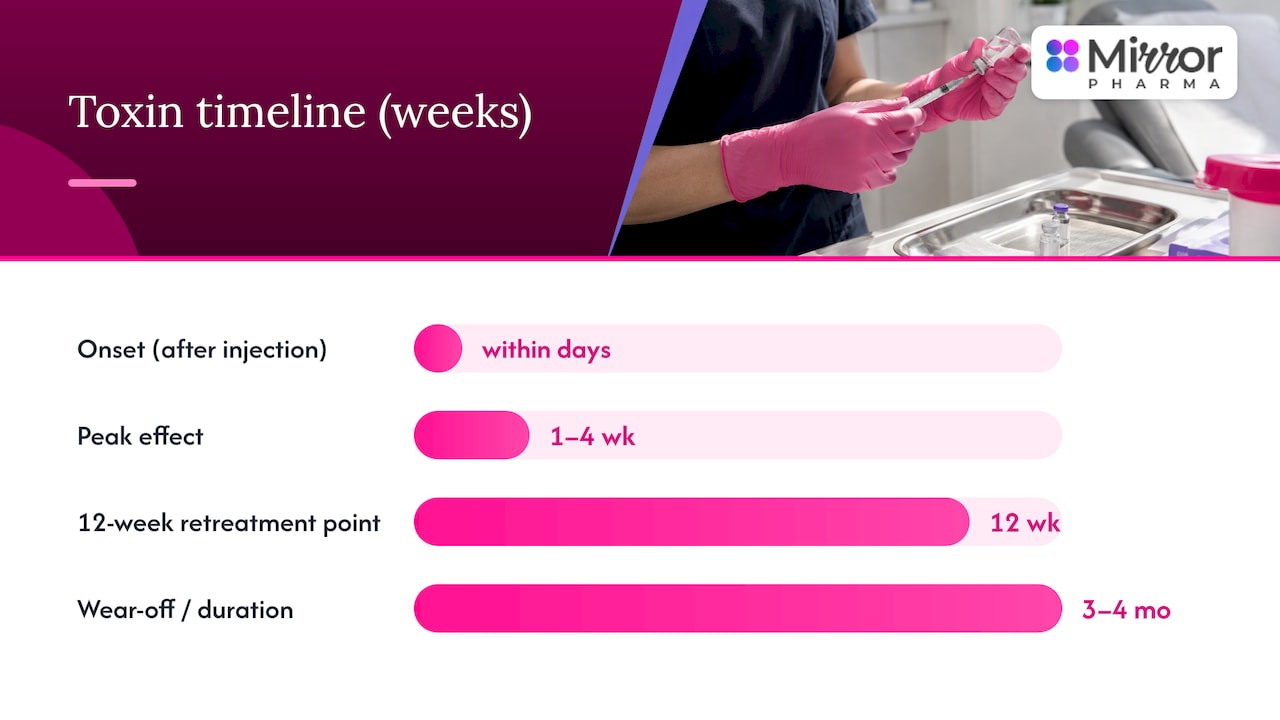
Retreating before the previous dose has stabilised makes it difficult to judge whether a touch-up is clinically needed or simply premature. It also raises the risk of forming neutralising antibodies against the toxin, which can blunt or eliminate response to future treatments, a consequence that is far harder to reverse than a short wait for a follow-up appointment.
Several points matter for day-to-day prescribing:
- Full assessment of response should wait until the previous dose’s effect has plateaued, not just started.
- Repeated short-interval dosing is the main modifiable risk factor for antibody-related non-response.
- Local formulary guidance generally cautions against retreatment sooner than 12 weeks for most indications.
Many specialties and trial protocols build their retreatment schedules around a three-monthly cycle, which is one reason the 12 week retreatment interval is included in technology appraisal evidence for chronic migraine and reinforces the same spacing used in aesthetic practice.
Legal and regulatory duties that intersect with the 12 week rule
Botulinum toxin is a prescription-only medicine in the UK, and the 12 week rule cannot be separated from the legal framework governing who may prescribe it and how.
- Only appropriate prescribers, meaning doctors, dentists, and independent nurse or pharmacist prescribers, may issue a patient-specific prescription, as confirmed in JCCP’s information sheet on botulinum toxins.
- A face-to-face consultation is a legal requirement before prescribing, and it must cover treatment history, the date of any previous dose, and relevant comorbidities that could affect suitability.
- Since 1 October 2021, administering botulinum toxin for cosmetic purposes to anyone under 18 is a criminal offence in England, and so is arranging or booking such treatment for a minor, under the Botulinum Toxin and Cosmetic Fillers (Children) Act 2021.
- Clinics should build age verification and a documented refusals register into booking workflows so under-18 enquiries are identified and declined consistently.
- Product-specific dosing, authorised indications and maximum units should always be checked against the relevant SmPC rather than assumed from habit or a previous brand’s protocol.
None of this replaces individual clinical judgement, but it does set the floor below which practice becomes unlawful rather than merely suboptimal.
Safety risks if the 12 week rule is breached and how to recognise them
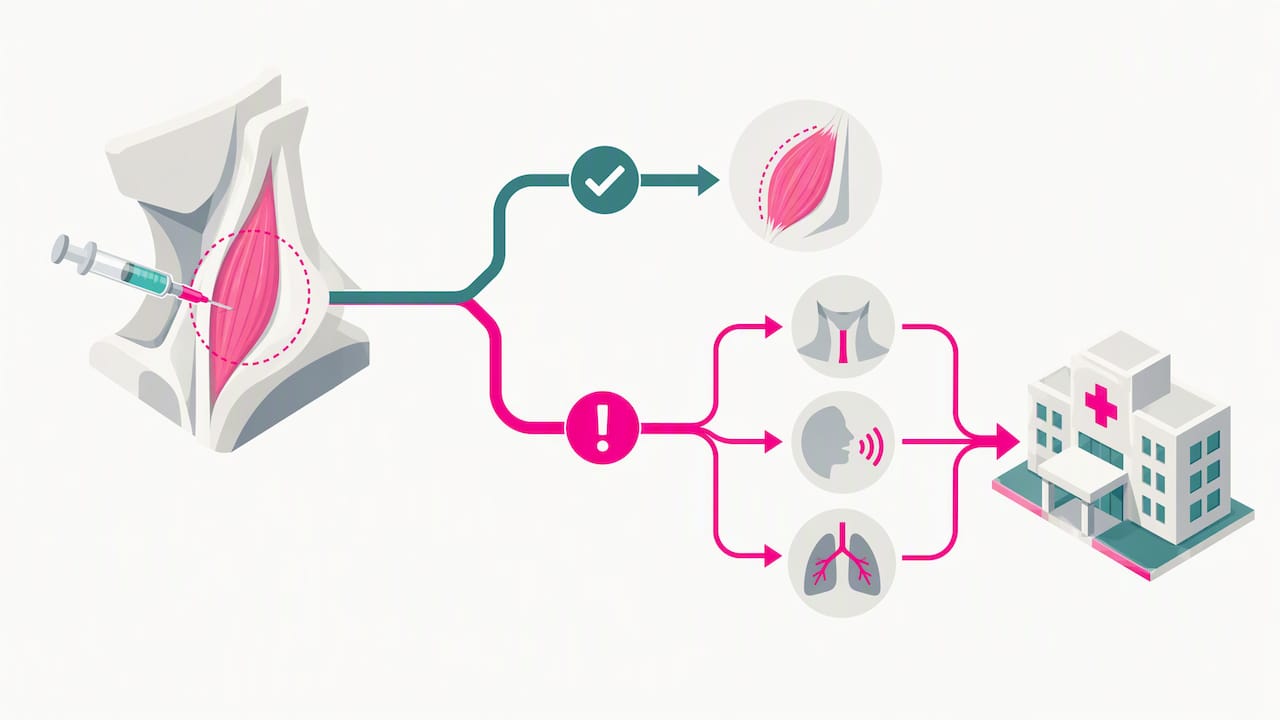
Breaching the interval without clinical justification does not just risk poor aesthetic outcomes. It increases exposure to a rare but serious complication: iatrogenic botulism from distant spread of the toxin. The MHRA drug safety update warns that symptoms can take up to four weeks to appear and may include difficulty breathing, swallowing problems and slurred speech.
Certain factors amplify this risk and deserve particular attention in clinic protocols:
- High cumulative dosing within a short period, especially when units from more than one treatment overlap before the first has cleared.
- Off-label injection sites used without documented justification or extra monitoring.
- Counterfeit or unlicensed products sourced outside verified supply chains.
- Switching brands without recalculating dose, since units are not interchangeable between products.
If a patient presents with any systemic symptom, speed matters more than certainty. Escalate to emergency services immediately for breathing or swallowing difficulty, follow current clinical management advice, and report the reaction through the Yellow Card scheme. Document the product identifier, dose, injection sites and timeline in full, since this record is often what distinguishes a defensible clinical decision from a liability.
Pro Tip: A purely local reaction stays confined to the treated muscle group and improves with time, while any hint of spread beyond it, such as neck weakness, voice change or breathing difficulty, warrants same-day medical assessment rather than a wait-and-see approach.
Practical clinic checklist: recording, dosing limits and safe workflows
A reliable record is the single biggest defence against accidental early retreatment and against disputes over what was actually given. Every entry should capture:
- Date of the previous treatment, visible at a glance when a new booking is made.
- The documented product identifier, recorded by its generic name rather than relying on memory of a brand.
- Units administered and the specific indication treated.
- The prescriber’s name and registration details.
- Any clinical justification recorded for retreatment before 12 weeks, including the discussion held with the patient.
Local formulary guidance notes that maximum cumulative doses within any 12 week period should not normally be exceeded, and that retreatment is generally not considered until that window has passed for most indications. Where off-label use is being considered, professional guidance expects a documented rationale and a preference for licensed alternatives wherever they exist, a point set out clearly in JCCP’s statement on unlicensed prescribing.
| Record field | Why it matters |
|---|---|
| Date of previous treatment | Prevents accidental early retreatment and flags cases needing justification |
| Product identifier | Units are not interchangeable between products; mix-ups cause dosing errors |
| Units and indication | Supports accurate cumulative dose tracking against SmPC limits |
| Clinical justification | Protects the patient and the prescriber if retreatment occurs before 12 weeks |
Booking systems should flag a return visit inside the 12 week window automatically, forcing a documented reason before the appointment is confirmed rather than relying on staff memory.
Counselling patients and structuring follow-up within the 12 week approach
Setting expectations early avoids most pressure for premature retreatment. A simple line that works well for licensed practitioners: “We’ll see you at two weeks to check how you’ve responded, and plan any further treatment from twelve weeks onward unless there’s a clear clinical reason to review sooner.”
A practical cadence looks like this:
- A two-week review to assess response and screen for early complications.
- Interim telephone or message-based advice if the patient has concerns before the formal review.
- Formal re-evaluation at 12 weeks, when the full effect of the previous dose can be judged accurately.
Where early retreatment genuinely is justified, the discussion and the patient’s agreement should be recorded as shared decision-making, not just a clinical note after the fact. Patients should also leave with clear written instructions on symptoms of toxin spread, such as drooping beyond the treated area, swallowing difficulty or breathing problems, and a direct instruction to seek emergency care if these appear.
Clinical resources, prescriber support and author background
Several primary documents are worth bookmarking rather than relying on memory. The MHRA drug safety update and each product’s SmPC should sit alongside JCCP prescribing guidance and the relevant excerpts of the Human Medicines Regulations in every clinic’s reference folder.
- MHRA drug safety updates, for the latest warnings on iatrogenic botulism and reporting routes.
- Product SmPCs, for authorised indications, maximum doses and administration detail.
- JCCP prescribing and unlicensed medicines guidance, for professional expectations around documentation.
- NCBI StatPearls clinical reviews, for mechanistic detail on onset, peak and duration of effect.
Registered prescribers can access practitioner-only ordering and supporting clinical toolkits, including protocols for IM/IV vitamin therapy, through our prescriber registration page.
Lessons from implementing the 12 week rule in real clinics
Clinics that run the 12 week rule well tend to do three things consistently: build booking controls that flag early retreatment automatically, require the full set of documentation fields before a treatment is confirmed, and train every member of staff, not just prescribers, to recognise early warning signs of toxin spread. None of these measures is complicated, but skipping any one of them is usually where things go wrong. The practical takeaway for clinic managers is simple: treat the record-keeping system as part of patient safety, not paperwork layered on top of it.
— Rizwan
Ordering practitioner-only products through Mirror Pharma
Running a compliant clinic depends on reliable access to practitioner-only products and the paperwork trail that goes with them. We supply registered prescribers and aesthetic clinics with prescription aesthetic medicines and consumables that support safe injection workflows, alongside clinical toolkits built for everyday practice. Extended order cut-off times help ensure timely delivery, and prescriber verification at registration keeps ordering access limited to licensed practitioners and qualified aesthetic professionals, in line with regulatory expectations. If you are a licensed practitioner, you can register as a prescriber to view our full toxins range and place an order through our verified ordering channel.
This article is general information, not a substitute for advice from a qualified doctor. Consult a qualified healthcare professional about your own circumstances before acting on anything here.
FAQ
What are the current regulations for botulinum toxin treatment in the UK?
Botulinum toxin remains a prescription-only medicine that can only be prescribed by an appropriate prescriber after a face-to-face assessment, as set out in JCCP’s information sheet. Since October 2021, it is also a criminal offence to administer or arrange this treatment for cosmetic purposes in anyone under 18, under the Children Act 2021.
Is there a standard safe distance rule for botulinum toxin injections?
There is no single universally agreed “2cm rule” set out in UK regulatory or professional guidance covered by the sources referenced here. Safe injection distances from structures such as the orbital rim vary by technique, product and training provider, so practitioners should follow their training protocol and the relevant SmPC rather than a generic distance figure.
Who is legally permitted to prescribe botulinum toxin in the UK?
Appropriate prescribers include doctors, dentists, and independent nurse or pharmacist prescribers operating under the Human Medicines Regulations, as confirmed by JCCP guidance. A patient-specific prescription following face-to-face assessment is required in every case, and non-prescribers cannot administer it without one.
Does botulinum toxin always require a prescription?
Yes, botulinum toxin is classed as a prescription-only medicine in the UK and cannot legally be supplied or administered without a valid, patient-specific prescription from an appropriate prescriber. This applies regardless of the setting, including aesthetic clinics, and is confirmed in JCCP’s information sheet on botulinum toxins.
What symptoms suggest iatrogenic botulism after treatment?
Warning signs include difficulty breathing, swallowing problems, slurred speech and unexpected muscle weakness beyond the treated area. The MHRA drug safety update notes these can appear up to four weeks after treatment and require urgent medical assessment.
Sources
- Drug safety update: botulinum toxin type A products – updated warnings
- JCCP information sheet: Botulinum toxins
- Botulinum Toxin and Cosmetic Fillers (Children) Act 2021
- Botulinum toxin treatment of the upper face — StatPearls (NCBI Bookshelf)