

FEFO (first expired, first out) wins for anything with an expiry date; FIFO (first in, first out) is fine for stock that doesn’t degrade on a clock. Use FEFO for dated, perishable, or regulated goods where the batch closest to expiry must ship first, and FIFO for non-dated items where receipt order is enough. The two rules also sit apart from stock valuation methods, which govern accounting cost, not physical picking sequence.
TL;DR:
- FEFO is essential for perishable goods with expiry dates, particularly when deliveries involve mixed shelf life batches that FIFO cannot address.
- Implementing FEFO requires accurate batch and expiry data at receiving, clear labeling, proper warehouse layout, and WMS enforcement, which can increase operational costs.
- Regular audit procedures, staff training, and staged rollouts are crucial to ensuring compliance and minimizing waste in expiry-led inventory management.
- Hybrid inventory management, applying FEFO to dated SKUs and FIFO to non-perishables, offers a practical solution instead of a full-site switch.
- Success depends more on disciplined data capture at receipt than on software features alone, making first-step focus on batch logging and staff adherence.
Table of Contents
- FEFO vs FIFO: the operational comparison
- When to choose FEFO, and when FIFO is sufficient
- Implementing FEFO: a practical warehouse checklist
- Costs, trade-offs and technical needs
- Migrating from FIFO to FEFO without disrupting operations
- Practitioner perspective: batch and expiry control in clinical settings
- Where to check the detail: primary sources worth bookmarking
- Ready to tighten up your rotation discipline?
- The editorial take: stop treating this as a policy decision
- Sources
- FAQ
FEFO vs FIFO: the operational comparison
FIFO issues stock by receipt date. FEFO issues stock by expiry date, regardless of when it arrived. That distinction sounds small until a later-arriving batch has a shorter shelf life than stock already on the shelf, which happens constantly with pharmaceutical and food deliveries. FIFO would ship the older batch first and let the shorter-dated one expire in the back corner.
| Dimension | FIFO | FEFO |
|---|---|---|
| Issue rule | Oldest receipt date ships first | Nearest expiry date ships first |
| Data required | Receipt date, location | Batch number, expiry date, receipt date |
| Best for | Non-perishables, tools, packaging | Food, pharmaceuticals, cosmetics, reagents |
| Operational cost/complexity | Low; minimal system configuration | Higher; batch capture and WMS enforcement needed |
| Failure mode prevented | Stock ageing on shelves indefinitely | Expired or short-dated stock reaching a patient or customer |
Two things follow from that table. First, if a SKU has no expiry date, FEFO adds cost with no safety benefit, so FIFO stays the right default. Second, wherever suppliers deliver mixed remaining shelf life on the same product, FEFO becomes necessary rather than optional, because FIFO cannot see expiry at all.
Waste from mismanaged dated stock is one of the most avoidable costs in a warehouse, and it compounds fast once short-dated batches get buried behind newer deliveries.
When to choose FEFO, and when FIFO is sufficient
Classify each SKU before deciding, rather than applying one rule site-wide. Ask four questions for every product line:
- Does the item carry a printed expiry, best before, or use-by date?
- Do incoming deliveries mix batches with different remaining shelf life?
- Does a regulator or client contract require documented batch traceability?
- Does the product have a commercial shelf life that affects resale value, even without a legal date?
Food falls under FEFO almost without exception, and the Food Standards Agency draws a firm line between “best before” and “use by”: “use by” is a safety cut-off, not a quality guideline, so anything carrying one needs strict expiry-led rotation. Pharmaceuticals and dermal filler stock sit in the same category for licensed practitioners and training academies, since batch traceability and expiry control are part of standard clinical governance, not a nice-to-have. Cosmetics with a period-after-opening symbol usually justify FEFO too. Reagents and lab consumables often need it for accuracy reasons rather than safety. Packaging, tools, and general consumables with no expiry marking can stay on FIFO indefinitely.
Once classified, set the rotation rule at the item-class level in your warehouse management system rather than leaving pickers to judge case by case. Avoid mixed rules across similar-looking SKUs since that can cause rotation errors.
Implementing FEFO: a practical warehouse checklist
Getting FEFO working reliably comes down to five operational habits, not a single software switch.
- Capture batch and expiry at receiving. Every inbound delivery needs its batch number and expiry date logged before it’s put away; without this, FEFO cannot be enforced, full stop.
- Reject deliveries below your shelf-life floor. Set a minimum acceptable remaining shelf life per product (commonly a percentage of total shelf life) and refuse or flag anything shorter at the dock.
- Label batches clearly and place short-dated stock at the front. Physical layout should mirror the picking rule, so the nearest-expiry batch is the easiest one to reach, not the hardest.
- Configure the WMS to enforce batch and expiry picks. Pick lists should display batch IDs directly, since vendor platforms that show batch data on pick lists cut human error far more than a policy memo ever will.
- Run expiry-horizon reports on a set schedule. Weekly reviews with staged thresholds, commonly 90/60/30 days or a tighter 30/14/7 window for fast-moving stock, trigger discounting, internal transfer, or recall action before stock actually expires.
Train receiving and picking staff separately on why the rule exists, not just how to follow it, and audit compliance monthly, rather than relying on the system to catch every override.
Pro Tip: Put the shortest-dated stock at hand height and the longest-dated stock up high or at the back. Pickers default to whatever’s easiest to reach, and if the “convenient” pallet is also the oldest one, you’ve built the correct behaviour into the shelf layout instead of hoping staff remember it.

Costs, trade-offs and technical needs
FEFO isn’t free to run. The real cost sits in four places:
- System configuration to enforce expiry-based picking logic in the WMS.
- Scanning and labelling hardware to capture batch and expiry data reliably at speed.
- Staff time at receiving, since checking and logging expiry adds seconds per line that FIFO doesn’t need.
- Training and audit time to keep the discipline from slipping once the novelty wears off.
Track waste rate, expiry-days-lost, and pick accuracy as your core KPIs. A rough ROI sketch is simple: multiply the value of stock previously written off to expiry by your margin, and weigh that against implementation cost. For most sites carrying meaningful dated inventory, the payback period is short, often inside the first two or three review cycles.
If only part of your catalogue is dated, run FEFO on that subset and leave the rest on FIFO. A hybrid setup, applied per item class rather than site-wide, is usually the pragmatic answer rather than an all-or-nothing switch.
Migrating from FIFO to FEFO without disrupting operations
Moving an existing FIFO operation to FEFO works best as a staged rollout, not a weekend cutover.
- Audit existing stock first. Walk every location and capture expiry dates on inventory already on the shelf; you cannot enforce FEFO on stock the system knows nothing about.
- Pilot on one product family or zone. Pick a single category with clear expiry data, measure near-expiry write-offs before and after, and use that result to justify wider rollout.
- Bridge the gap with manual controls during transition. Shelf stickers marking expiry windows, manual pre-pick checks, and flagged near-expiry batches keep stock safe while the WMS configuration catches up.
- Expand zone by zone once the pilot proves out. Rolling out gradually avoids the chaos of reconfiguring the entire warehouse and picking rules in one go.
Cross-border shipments deserve one extra check. Customs holds can quietly eat into shelf life on dated goods, so factor cash-account and declaration timing into your rollout plan if stock crosses borders regularly.
Practitioner perspective: batch and expiry control in clinical settings
Clinics and pharmacies run some of the strictest expiry discipline anywhere, because a short-dated batch reaching a patient isn’t a write-off problem, it’s a governance failure. Practical controls seen working well for licensed practitioners include:
- Cold-chain verification and temperature logging at every handover, covered in detail in the cold chain storage guide.
- Order cut-off times that help avoid rush deliveries with unnecessarily short remaining shelf life.
- Full audit trails linking batch number to the practitioner and patient record for every dose administered.
- Clear standard operating procedures for clinic inventory, outlined in the clinic inventory management playbook.
Related clinical procedure guides, such as the comparison of IV and IM injection routes, follow the same audit-ready logic: document the process once, then repeat it consistently rather than reinventing it per delivery.
Where to check the detail: primary sources worth bookmarking
- Food Standards Agency: best before and use by dates for the safety distinction behind FEFO’s legal weight.
- UK Trade Tariff commodity code finder for classification affecting storage or transport rules.
- Gov if dated stock crosses borders regularly.
Ready to tighten up your rotation discipline?
Getting FEFO right depends on the same batch and cold-chain discipline that underpins safe clinical stock handling. For licensed practitioners sourcing temperature-sensitive or short-dated products, working with a supplier that documents batch data clearly at every stage matters as much as the WMS logic on your own floor. Mirror Pharma’s IV vitamin therapy safety toolkit sets out the kind of batch and cold-chain verification qualified aesthetic professionals should expect from any supplier, and it’s worth measuring your own receiving process against it before you scale FEFO further.
The editorial take: stop treating this as a policy decision
Most advice on FEFO vs FIFO treats it as a strategic choice, something a supply chain director signs off in a boardroom. That framing is backwards. The decision is almost entirely mechanical: does the SKU have an expiry date and mixed shelf life on arrival? If yes, FEFO isn’t a preference, it’s the only rule that prevents waste and, in regulated categories, the only one that keeps you compliant.
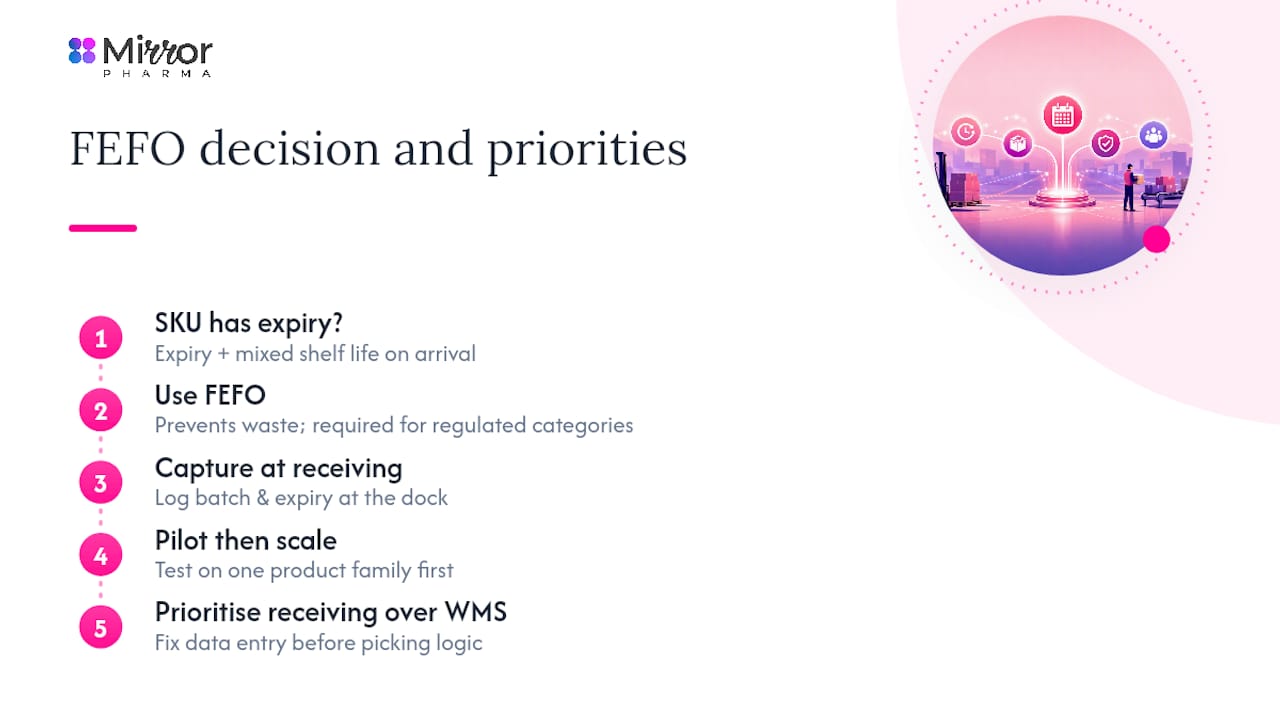
Where conventional advice falls short is the assumption that a WMS upgrade solves the problem on its own. It doesn’t. The AWRA research on this is blunt: FEFO collapses without batch capture at receiving, and no amount of clever picking logic fixes bad data entering the system in the first place. Software enforces a rule; it doesn’t create the discipline to feed it accurate expiry dates every single delivery.
If you’re starting from FIFO today, prioritise the receiving desk before the picking screen. Get batch and expiry logging right at the dock, pilot it on one product family, and only then worry about which WMS features look impressive on a vendor demo. The unglamorous part of the process is the part that actually prevents the write-offs.
— Rizwan
Sources
- Food Standards Agency: Best before and use by dates
- FEFO vs FIFO: Which stock rotation method and when — AWRA OpsHub
FAQ
Is FEFO or FIFO better for perishable stock?
FEFO is better for perishable stock because it issues the batch nearest expiry first, regardless of arrival order, which FIFO cannot account for when suppliers deliver mixed remaining shelf life.
Is it always better to use FIFO over FEFO?
No. FIFO suits non-dated items like packaging or tools, but for anything with a “use by” date, the Food Standards Agency’s safety guidance effectively requires expiry-led rotation instead.
What’s the difference between FEFO, FIFO, and stock valuation methods like LIFO?
FEFO and FIFO govern which physical batch ships first; LIFO and similar valuation methods relate to accounting cost calculation, not physical picking sequence, and the two are entirely separate decisions.
Do I need special software to run FEFO?
You need a system that captures batch and expiry data at receiving and enforces those picks on the pick list; many warehouse management platforms already include expiry-tracking features that flag near-expiry batches automatically.
Can I run FEFO and FIFO in the same warehouse?
Yes. A hybrid setup, applying FEFO only to dated SKUs and FIFO to everything else, is the most practical approach for most operations rather than converting the entire site to one rule.