

Clinic inventory management is the systematic tracking, storage, and replenishment of every item a clinic uses — prescription medicines, controlled drugs, consumables, devices, and cold-chain products — with batch-level expiry control at its core. The single most impactful action you can take this week is to enable FEFO (first-expiry, first-out) picking and assign batch numbers to every medicine and biological product on receipt. Before anything else, run through these quick wins:
- Audit your current stock for expired or near-expiry items and remove them immediately.
- Assign a batch number and expiry date to every medicine and consumable as it arrives.
- Set a weekly expiry check on your highest-risk categories (vaccines, biologics, reconstituted products).
- Identify your top 20 highest-cost or highest-risk SKUs and prioritise those for your first cycle count.
- Confirm that controlled drug (CD) registers are current and that storage meets Home Office requirements.
Key takeaways
Effective clinic inventory management rests on three controls applied consistently: batch-level expiry tracking, FEFO picking enforced by your system, and a weekly audit cadence that catches problems before they reach the treatment room.
| Point | Details |
|---|---|
| Start with FEFO and batch tracking | Assign batch numbers and expiry dates at receipt; enforce FEFO picking to cut expiry write-offs. |
| Use auto-deduction at dispensing | Automatic stock deduction at billing removes the most common cause of system-to-shelf drift. |
| Audit by category and cadence | Controlled drugs need a daily balance check; consumables need a monthly cycle count at minimum. |
| Track six core KPIs | Monitor DOI, turnover, stockout rate, fill rate, expiry write-off rate, and carrying cost monthly. |
| Mirrorpharma as supply partner | Mirrorpharma provides batch-documented UK supply of toxins, fillers, and consumables with extended cut-off times to support clinic restocking. |
Table of Contents
- What does clinic inventory management actually cover?
- Why does good inventory management matter for your clinic?
- What types of inventory does your clinic need to manage?
- What are the core components of an effective clinic inventory system?
- What is the best day-to-day workflow for clinic stock control?
- What should you look for in clinic inventory software?
- How do you implement or upgrade inventory management in your clinic?
- Which KPIs should you track for clinic stock performance?
- UK compliance essentials: MHRA, CQC, and controlled drugs
- How often should you check inventory and what does a good audit look like?
- What does better inventory control actually cost, and what will you save?
- A practical procurement checklist for clinic consumables
- What most clinic managers get wrong about inventory
- Mirrorpharma: a UK supply partner that supports your inventory goals
- Sources
What does clinic inventory management actually cover?
The scope is broader than most clinic managers initially expect. At its core, it covers four categories: prescription medicines (including controlled drugs), over-the-counter medicines, clinical consumables, and equipment. Each category carries different storage, documentation, and regulatory obligations.
Where clinics differ from hospital wards is primarily in scale and staffing. A hospital pharmacy has dedicated dispensing staff, automated dispensing cabinets, and a centralised procurement function. A clinic typically has one or two people managing stock alongside clinical duties, limited storage space, and a tighter budget. That constraint shapes every decision — from how often you count stock to which software is worth the investment.
Common clinic-specific constraints include:
- Limited dedicated storage (often a single locked cupboard or small dispensary).
- Mixed staff roles, where the person ordering stock is also treating patients.
- No on-site pharmacist in many aesthetic and outpatient settings.
- Tighter cash flow, making overstocking genuinely costly.
- Multi-location working, where a practitioner splits time across two or three sites.
Items typically tracked in a well-run clinic include prescription toxins and fillers, syringes and needles (such as BD Micro-Fine Plus consumables), IV dressings and wound care products, weight loss injectables, vitamin infusion components, cold-chain biologics, controlled drugs, and reusable instruments requiring sterilisation records.
The end-to-end healthcare inventory workflow — receiving, storage, distribution, and forecasting — applies to clinics just as it does to larger providers, but the tools and team size look very different.
Why does good inventory management matter for your clinic?
The operational case is straightforward: fewer stockouts mean fewer cancelled appointments, and tighter expiry control means less money written off. The patient safety case is more pressing. Dispensing an expired product, or reaching for a batch that has been recalled, is a clinical incident — not just a stock error.
The downstream benefits compound quickly once a system is in place:
- Fewer emergency orders at premium prices.
- Reduced administrative time reconciling paper records.
- Cleaner CQC inspection evidence (storage logs, temperature records, CD registers).
- Better purchasing decisions based on actual usage data rather than gut feel.
- Lower carrying costs from right-sized stock holdings.
Vendor data from Healcon suggests that clinics automating low-stock alerts, FEFO dispensing, and usage analytics can reduce inventory spend materially — though the scale of savings depends heavily on starting conditions and the categories involved. The principle holds regardless: unmanaged expiry and reactive ordering are the two biggest cost drivers in clinic stock, and both are addressable with process changes that cost very little to implement.
What types of inventory does your clinic need to manage?
Not all stock carries the same risk, and treating everything the same way is where clinics lose control. The practical categories are:
- Prescription medicines — including toxins such as BOTOX® and Dysport, weight loss injectables, and antibiotics. These require batch tracking, expiry management, and prescriber verification before purchase.
- Controlled drugs — subject to Misuse of Drugs Regulations 2001; require a separate locked cabinet, a running balance register, and destruction records.
- OTC medicines — lower regulatory burden but still require expiry checks and appropriate storage.
- Clinical consumables — syringes, needles, IV dressings, cannulas. High turnover, lower unit cost, but stockouts directly affect treatment capacity.
- Single-use devices — dermal fillers, skin boosters, fat dissolvers. Often cold-chain or temperature-sensitive; batch traceability is critical for recall management.
- Cold-chain items — vaccines, biologics, reconstituted products. Require continuous temperature monitoring and documented cold-chain records from supplier to point of use.
- Reusable instruments — require sterilisation records and periodic inspection.
- Capital equipment — lower frequency tracking but maintenance schedules and service records must be held.
The categories with the highest expiry risk are cold-chain biologics, reconstituted products (which have a short post-preparation shelf life), and any medicine with a shelf life under 12 months. For aesthetic clinics specifically, expiry-sensitive stock such as toxins and fillers requires FEFO picking, lot-level tracking, and configurable alert thresholds — not just a periodic manual check.
What are the core components of an effective clinic inventory system?
A functional system has six building blocks. Miss one and the others compensate poorly.
| Component | Purpose | Minimum acceptance criteria |
|---|---|---|
| Receiving and PO control | Match deliveries to purchase orders; capture batch and expiry at receipt | Every delivery matched to a PO; batch/expiry recorded on arrival |
| Batch/lot and expiry tracking | Prevent dispensing of expired or recalled stock | Batch number and expiry date on every medicine and device |
| Storage and segregation | Correct conditions; CD security; cold-chain integrity | Locked CD cabinet; fridge with temperature log; segregated returns |
| Picking and dispensing | Issue stock in FEFO order; deduct from system at point of use | Auto-deduction at billing or dispensing; FEFO enforced by system |
| Stock adjustments and audit trail | Record corrections, wastage, and returns with authorisation | Role-based access; every adjustment logged with reason and user |
| Reporting and integrations | Connect to billing, EMR, and finance for end-to-end visibility | Stock reports exportable; low-stock alerts configured |
Barcode scanning is the single biggest accuracy upgrade available to small clinics. Barcode-enabled receiving and automatic replenishment reduce manual ordering time and cut the transcription errors that cause system-to-shelf drift. A handheld scanner at the point of receipt, combined with auto-deduction at billing, removes the two most common sources of count inaccuracy.

Role-based access matters more than most clinic managers realise. The person who can adjust stock quantities should not be the same person who approves those adjustments — a basic segregation of duties that CQC inspectors look for.
Clinic inventory modules typically include real-time stock tracking, batch and expiry alerts, and automatic stock deduction at billing. That last feature — auto-deduction at the point of dispensing — is the most effective single control for keeping on-hand counts accurate.
What is the best day-to-day workflow for clinic stock control?
The five-step workflow below is repeatable, scalable to a small team, and directly addresses the most common failure points in clinic stock management.
- Receive — Check delivery against the purchase order. Record batch number, expiry date, and quantity for every medicine and device. Flag discrepancies immediately. Owner: reception or designated stock lead.
- Putaway — Place stock in the correct location using FEFO: shortest expiry to the front. Update the system before the delivery note leaves the building. Owner: stock lead or clinic manager.
- Dispense or issue — Pull stock in FEFO order. The system deducts quantity automatically at billing or dispensing. Never issue from a new batch while an older one remains open. Owner: treating practitioner or dispensing lead.
- Reorder — Trigger purchase orders when stock hits the reorder point. Use system-generated low-stock alerts rather than visual checks alone. Review supplier lead times quarterly. Owner: clinic manager or procurement lead.
- Audit and cycle count — Count a rotating subset of SKUs weekly (high-value and high-risk first). Run a full stocktake quarterly. Reconcile system counts against physical counts and investigate variances above a defined threshold. Owner: clinic manager, with sign-off from lead prescriber.
Pro Tip: For clinics with teams of two or three, combine the receive and putaway steps into a single 10-minute arrival routine. Print a receiving checklist and attach it to the delivery area — it takes the cognitive load off whoever happens to be on duty and keeps batch data consistent.
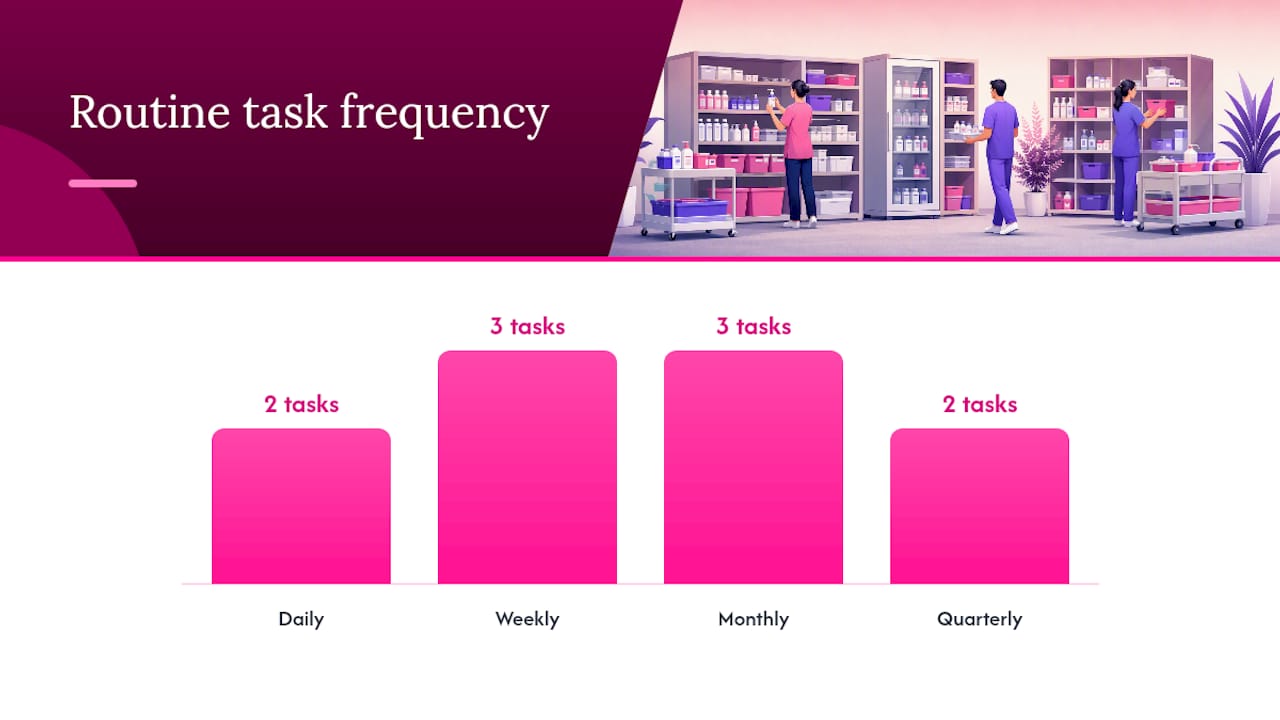
Daily and weekly task checklist:
- Daily: check fridge temperature log; confirm CD register balance matches physical count.
- Weekly: run expiry report for items expiring within 60 days; review low-stock alerts; check returns area.
- Monthly: cycle count top 20 SKUs; reconcile CD register; review reorder points against actual usage.
FEFO is a practical necessity, not an optional optimisation, wherever batches have variable shelf lives. Clinics that move from informal FIFO to enforced FEFO typically see a rapid decline in expiry write-offs.
What should you look for in clinic inventory software?
The feature list that matters for UK clinics is shorter than most vendor brochures suggest. Prioritise these:
- Batch and expiry date fields on every stock record.
- FEFO picking logic enforced by the system, not left to staff discretion.
- Barcode or QR scanning for receiving and dispensing.
- Mobile receiving capability (tablet or phone) for clinics without a dedicated goods-in area.
- Auto-deduction at point of billing or dispensing.
- Configurable low-stock and near-expiry alerts (30/60/90-day thresholds are standard best practice).
- Multi-site stock visibility for clinics operating across more than one location.
- PO management with supplier catalogue integration.
- Audit trail with user-level logging and role-based access controls.
- Exportable reports for CQC evidence and financial reconciliation.
Integration with practice management systems (such as Cliniko, Jane App, or Pabau, which are widely used in UK aesthetic and outpatient clinics) and with prescribing or billing platforms is the point where many small-clinic implementations stall. The prescription workflow integration between inventory and prescribing systems is particularly important for clinics dispensing prescription-only medicines — a disconnected system means manual reconciliation, which reintroduces the errors you bought software to eliminate.
| Clinic size | Practical tech option | When to upgrade |
|---|---|---|
| 1–2 practitioners, low volume | Structured spreadsheet with barcode add-on (e.g. Google Sheets + Scanbot) | When expiry errors or stockouts occur more than once per quarter |
| 3–10 practitioners, mixed stock | Dedicated clinic inventory module (e.g. NexOPD, Cliniko add-ons) | When multi-site or CD tracking becomes unmanageable manually |
| 10+ practitioners or multi-site | Integrated ERP or practice management platform with full inventory module | When procurement, billing, and stock need a single source of truth |
Batch-level expiry tracking with configurable 30/60/90-day alerts is the feature that separates a functional system from a basic one. Without it, expiry management remains a periodic manual task rather than an active workflow.
How do you implement or upgrade inventory management in your clinic?
A phased rollout reduces risk and keeps the clinic running during the transition. The roadmap below works for both a first-time implementation and an upgrade from spreadsheets to dedicated software.
| Phase | Activities | Suggested duration | Owner |
|---|---|---|---|
| Assess | Map current stock categories; identify gaps in batch data; document current processes | 1–2 weeks | Clinic manager |
| Pilot | Select 20–50 high-value or high-risk SKUs; run new process on those SKUs only | 2–4 weeks | Manager + stock lead |
| Data migration | Clean SKU names; add batch and expiry data; import to new system | 1–2 weeks | Manager + IT/vendor |
| Training | Train all staff on receiving, dispensing, and adjustment workflows | 1 week | Manager + vendor |
| Go-live | Switch all stock to new system; run parallel counts for first two weeks | 2 weeks | All staff |
| Review | Audit system vs physical counts; adjust reorder points; document lessons learned | Ongoing monthly | Manager |
Stakeholder roles during implementation:
- Clinic manager — overall accountability, process design, and sign-off on go-live.
- Lead prescriber — approves medicines management protocols and CD procedures.
- Dispensing or stock lead — day-to-day data entry, receiving, and cycle counts.
- IT or software vendor — system configuration, data import, and integration setup.
The most common migration pitfall is dirty SKU data: inconsistent product names, missing batch numbers, and no expiry dates on existing stock. Clean this before migration, not after. A simple SKU template (product name, supplier code, unit of measure, batch field, expiry field) applied consistently from day one prevents the systemic errors that undermine confidence in the new system post-go-live.
Pro Tip: Start the pilot with your 20–50 highest-value or highest-risk SKUs. This captures the majority of immediate ROI while keeping implementation risk low — and gives your team a manageable learning curve before the full catalogue goes live.
Which KPIs should you track for clinic stock performance?
Six metrics cover the territory for most clinics. Define them, calculate them monthly, and set a target range before you start measuring — otherwise the numbers sit in a report nobody acts on.
| KPI | Formula | Actionable use |
|---|---|---|
| Days of inventory (DOI) | (Average stock value ÷ daily cost of goods used) | Target 30 days for most consumables; lower for fast-moving items |
| Inventory turnover | Annual cost of goods used ÷ average stock value | Higher is better; below 6x per year suggests overstocking |
| Stockout rate | Number of stockout events ÷ total order lines × 100 | Target below 2%; above 5% indicates reorder points are too low |
| Fill rate | Orders fulfilled in full on first attempt ÷ total orders × 100 | Target above 90% for critical supplies |
| Expiry write-off rate | Value of expired stock written off ÷ total stock value × 100 | Target below 1%; above 3% signals FEFO or ordering discipline failure |
| Carrying cost as % of value | Annual holding costs ÷ average stock value × 100 | Typically 20–30% of stock value annually; reduce by tightening DOI |
The expiry write-off rate is the KPI most directly improved by FEFO and batch tracking. Disciplined FEFO processes, batch tracking, and expiry thresholds are the operational levers that move this number.
Stockout rate and fill rate are the two metrics most visible to patients and practitioners. A stockout on a toxin or filler on a treatment day is not just a financial loss — it is a patient experience failure that damages retention.
UK compliance essentials: MHRA, CQC, and controlled drugs
Regulatory obligations in UK clinics are not optional extras — they are conditions of registration and, for controlled drugs, conditions of the law. The practical requirements fall into three areas.
MHRA obligations cover the storage, handling, and traceability of licensed medicines. Clinics must store medicines in accordance with the summary of product characteristics (SmPC), maintain temperature records for cold-chain items, and hold batch documentation sufficient to support a recall. The MHRA’s Yellow Card scheme requires reporting of suspected adverse reactions and defective products.
CQC expectations for medicines management include documented storage procedures, evidence of regular stock checks, temperature monitoring records, and staff competency records for medicines handling. During inspection, CQC will ask to see your CD register, your temperature logs, and evidence that expired stock is removed promptly.
Controlled drug obligations are the most prescriptive. Under the Misuse of Drugs Regulations 2001:
- CDs must be stored in a locked, fixed cabinet that meets BS 2881 or equivalent standards.
- A running balance register must be maintained for Schedule 2 CDs, with every transaction recorded.
- Destruction of CDs requires an authorised witness and a destruction record.
- Only authorised personnel may access the CD cabinet.
Document retention for medicines management records is generally a minimum of two years for most records, and longer for CDs. Audit trail requirements mean that every stock adjustment, receipt, and dispensing event should be logged with a date, time, and user identifier.
Pro Tip: Appoint a named Controlled Drugs Accountable Officer (CDAO) even if your clinic is small. The CQC expects a named individual to be responsible for CD governance — and having one makes inspections significantly smoother.
Regulatory links for further reading:
- MHRA guidance on medicines storage and handling
- CQC medicines management guidance for registered providers
- Home Office controlled drugs licensing and registers
- Legislation
How often should you check inventory and what does a good audit look like?
Frequency depends on the category. The table below gives a practical cadence for the main stock types in a UK clinic.
| Stock category | Cycle count frequency | Full stocktake | Expiry check |
|---|---|---|---|
| Controlled drugs | Daily balance check | Monthly | At every receipt and weekly |
| Cold-chain biologics and vaccines | Weekly | Quarterly | At every receipt and weekly |
| Prescription medicines | Weekly (top 20 SKUs) | Quarterly | Monthly minimum |
| Clinical consumables | Monthly | Bi-annually | Quarterly |
| Reusable instruments | Monthly | Annually | N/A (maintenance schedule) |
| Capital equipment | Quarterly | Annually | N/A (service records) |
A practical audit checklist for each stage of the inventory cycle:
Receiving:
- Delivery matches purchase order (quantity, product, batch, expiry).
- Batch number and expiry date recorded in the system before goods are put away.
- Cold-chain items temperature-checked on arrival and result logged.
- Damaged or short-dated items quarantined and supplier notified.
Storage:
- Medicines stored per SmPC conditions (temperature, light, humidity).
- FEFO order maintained (shortest expiry to the front).
- CD cabinet locked; access log current.
- Fridge temperature within range; log reviewed and signed.
Dispensing:
- Stock issued from oldest batch first (FEFO confirmed).
- System deduction completed at point of dispensing or billing.
- Expired or recalled items not available for selection.
Documentation:
- CD register balance matches physical count.
- Temperature logs complete with no gaps.
- Adjustment records include reason, date, and authorising user.
What does better inventory control actually cost, and what will you save?
The cost components for a clinic implementing or upgrading inventory management are predictable. The savings are less certain but directionally consistent.
| Cost item | Typical range (UK clinic) | Notes |
|---|---|---|
| Inventory software licence | £50–£200 per month | Varies by features and number of users |
| Barcode scanning hardware | £150–£400 per device | One-off; handheld scanners last 3–5 years |
| Staff time for cycle counts | 2–4 hours per week | Absorbed into existing roles in most small clinics |
| Initial data migration and setup | £500–£1,500 one-off | Higher if vendor-assisted; lower for self-implementation |
| Training | 4–8 hours per staff member | Usually included in vendor onboarding |
Pro Tip: For slow-moving, high-cost items (certain biologics or specialist devices), negotiate a consignment arrangement with your supplier. You hold the stock but pay only when you use it — this eliminates carrying cost and expiry risk on your most expensive lines.
A practical procurement checklist for clinic consumables
Supplier selection is where inventory problems often start. A supplier who cannot provide batch documentation or who has unpredictable lead times creates downstream problems that no software can fix. Use this checklist before onboarding any new supplier.
- Supplier is registered with the MHRA (for medicines) or holds the appropriate device certification.
- Batch and lot numbers are provided on every delivery note and invoice.
- Expiry dates are clearly labelled on all products and confirmed in documentation.
- Cold-chain capability is documented, with temperature records available on request.
- Returns and recall process is clearly defined in the supplier agreement.
- Lead times are stated in writing and consistently met.
- Minimum order quantities are workable for your clinic’s usage volumes.
- Pricing is transparent, with no hidden handling or cold-chain surcharges.
- The supplier can provide a certificate of conformity or product specification on request.
Batch-level traceability from supplier to patient is not just good practice — it is the mechanism that makes a product recall manageable. Without it, a recall notice means manually checking every item in storage against a batch range, which is slow, error-prone, and potentially dangerous if a contaminated batch is missed.
Pro Tip: When negotiating with a new supplier, ask for their average lead time over the past six months, not just the stated lead time. Suppliers who quote 48 hours but routinely deliver in five days will disrupt your reorder planning. Get the actual performance data before committing.
Additional procurement considerations:
- Confirm that the supplier’s cold-chain packaging meets your journey time requirements (particularly for next-day deliveries in summer months).
- Check whether the supplier offers extended order cut-off times — this matters when a treatment day runs late and you need to restock the same evening.
- Verify that the supplier’s online ordering system provides batch and expiry information at the product level, not just at invoice level.
What most clinic managers get wrong about inventory
The conventional wisdom in clinic operations is that inventory management is a back-office function — something to sort out once the clinical side is running smoothly. That framing gets it backwards. Stock control failures show up at the front of house: a cancelled treatment because a product has expired, an emergency order that costs twice the normal price, a CQC inspection that flags a CD register with gaps.
The other persistent mistake is treating a software purchase as the solution rather than the enabler. A system with FEFO logic and batch tracking is only as good as the data entered at receipt. Clinics that implement software without fixing the receiving process first end up with a digital version of the same problem they had on paper.
The incremental approach works better than a big-bang implementation. Start with your 20 highest-risk SKUs, get the receiving and FEFO discipline right on those, then expand. The accuracy gains from that small group will be visible within weeks — and they build the team confidence that makes the full rollout stick.
Mirrorpharma: a UK supply partner that supports your inventory goals
Procurement friction is one of the most underestimated costs in clinic inventory. When a supplier is slow, inconsistent with batch documentation, or unable to meet a same-day restock need, the burden falls on your team to compensate — with manual chasing, emergency orders, and workarounds that introduce errors.
Mirrorpharma supplies prescription aesthetic medicines, toxins, weight loss injectables, vitamins, infusion therapies, dermal fillers, and clinical consumables directly to UK healthcare professionals and aesthetic clinics. Every order includes batch and expiry documentation at product level, which feeds directly into your receiving workflow without additional chasing. Extended order cut-off times mean that a treatment day that runs late does not automatically mean a gap in tomorrow’s stock. Products such as BOTOX® 200 Units, Dysport 500 Units, and Aqualyx fat dissolve are available with the batch traceability your inventory system needs. Register as a prescriber with Mirrorpharma to access the full product range and place your first order at Mirrorpharma.
Sources
The sources below are the primary references for regulatory and operational guidance on medicines management and inventory control in UK clinical settings.
- Medical Supply Inventory Management – McKesson Medical-Surgical
- Healthcare Inventory Management: A Guide
- Manage expiry-sensitive inventory in fulfilment
- Clinic Inventory Management Software India | Stock & Expiry Tracking | NexOPD
For operational and software guidance, the MHRA and CQC sources are the primary regulatory references. NHS England and NICE provide operational best practice. Vendor resources (McKesson, NexOPD, StockPilot) are useful for feature benchmarking and workflow design but should not be treated as regulatory authority.
This article is general information, not a substitute for advice from a qualified doctor. Consult a qualified healthcare professional about your own circumstances before acting on anything here.
Recommended
- Register as Prescriber – Mirror Pharma
- Why Online Consultations Are Changing the Way We Access Medicines – Mirror Pharma
- Understanding Weight Management Medications: What You Need to Know – Mirror Pharma