

Valid consent in UK aesthetics is voluntary, informed and given by a person with capacity. A signed form does not prove any of those three things. It is a record of a conversation, and the conversation is what the law and the regulators look at. This guide is for licensed practitioners and qualified aesthetic professionals who prescribe, supervise or administer injectable treatments. It sets out what to explain, how to check understanding, when to take consent and what to write down.
TL;DR
- Consent is a process that runs from consultation to follow-up. The form is evidence of it, not a substitute for it.
- Disclose material risks and reasonable alternatives, including having no treatment, in a way this particular patient can understand.
- The practitioner who will treat should seek consent personally and should not delegate that duty.
- Give people time. Revisit consent on the day and accept that the patient may change their mind at any point before treatment begins.
- Take clinical photography and marketing permissions separately from treatment consent, and write your own note of the specific discussion.
Table of Contents
- What valid consent means in aesthetic practice
- Which rules apply across the UK
- What to explain before treatment
- Checking understanding, capacity and voluntariness
- When to take consent and giving time to reflect
- What to record
- Photography, marketing and data: keep permissions separate
- Consent and the products you use
- Our perspective
- Supplying qualified practitioners
- A practical consent workflow
- FAQ
- Sources
What valid consent means in aesthetic practice
The NHS states that valid consent must be voluntary and informed, and given by a person with capacity. Informed means the person understands what the treatment involves, its benefits and risks, the reasonable alternatives and what may happen if treatment is not carried out.
The GMC frames the same idea as a duty to give patients the information they need, plus time and support to understand it. That second half matters in a clinic setting. Handing over a leaflet and a clipboard on arrival gives information, but it rarely gives time or support.
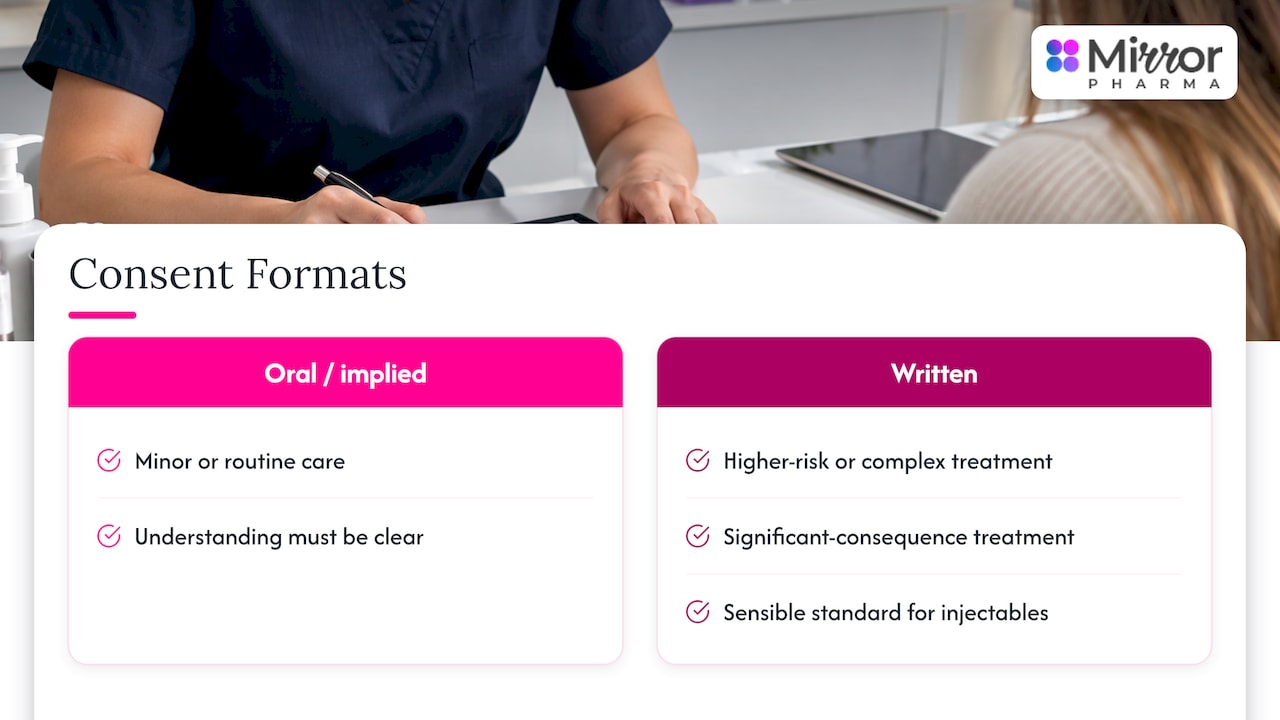
The GMC’s guidance also makes clear that the form of expression is less important than the patient’s information and understanding. Consent may be oral or implied for minor or routine care when understanding is clear, but written consent is particularly important for higher-risk, complex or significant-consequence treatment. In practice, most injectable aesthetic treatments are elective, carry real material risks and have consequences the patient may live with for months, so written consent supported by a documented discussion is the sensible standard for qualified aesthetic professionals.
Which rules apply across the UK
There is no single aesthetics consent statute. Several layers sit on top of each other.
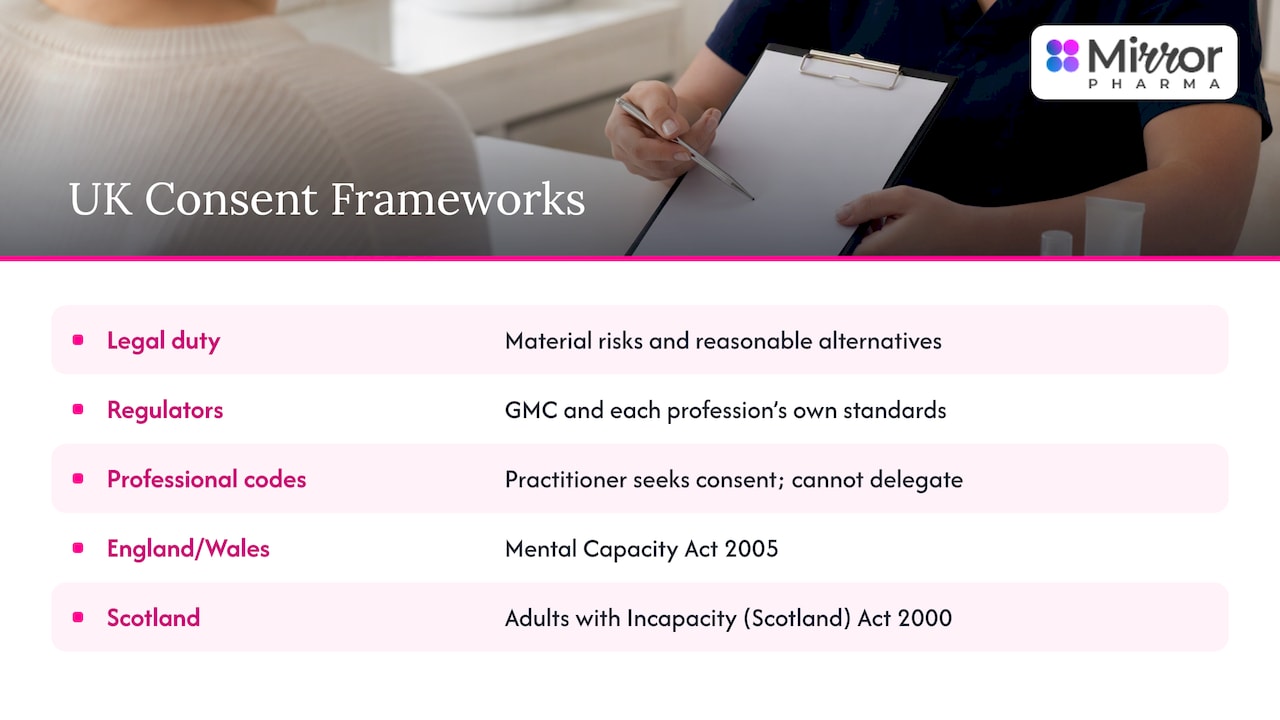
The legal duty. The Supreme Court’s decision in Montgomery v Lanarkshire Health Board [2015] UKSC 11 requires reasonable care to ensure the patient is aware of the material risks of the recommended treatment and of reasonable alternative or variant treatments. A 2026 legal briefing from DWF sets this out for cosmetic practice.
Regulator standards. Doctors must follow the GMC’s decision-making and consent guidance and its guidance on cosmetic interventions. Nurses, pharmacists, dentists and other registered practitioners follow their own regulator’s standards, which sit on the same principles.
Professional codes. The JCCP and CPSA Code of Practice says practitioners must seek the patient’s consent themselves rather than delegate it. The Royal College of Surgeons’ professional standards for cosmetic surgery apply to surgery but are a useful benchmark for non-surgical work.
Differences between nations. Capacity law is not uniform. The Mental Capacity Act 2005 applies in England and Wales, while Scotland uses the Adults with Incapacity (Scotland) Act 2000, as the RCS standards identify. If you practise in Northern Ireland, or you are unsure which framework applies, check with your regulator or employer. Licensing and premises rules for aesthetics are also changing across the UK nations, so confirm the current position for your location with the relevant authority.
What to explain before treatment
The GMC expects practitioners to explain the nature and purpose of the intervention, the expected and realistic outcomes, limitations, benefits, material risks, possible adverse outcomes and reasonable alternatives, including no treatment.
Material risks
DWF’s briefing describes materiality as depending on the nature of the risk, its potential impact on the patient’s life, the importance of the intended benefits to that patient, and the available alternatives and their risks. That makes materiality personal. A small risk of asymmetry may be material to a presenter or a musician and less so to someone else. Ask what matters to them, then disclose with that in mind.
For injectable work, think through the categories you would want to hear about as a patient:
- common, short-lived effects such as swelling, bruising and tenderness;
- less common effects that need clinical review;
- rare but serious complications, and what your clinic does if one occurs;
- the likelihood that the result will not match the patient’s hope, and that any effect is temporary and varies between individuals;
- what aftercare you provide and how the patient reaches you out of hours.
Never describe a treatment as guaranteed, permanent or risk-free. That is both inaccurate and the opposite of informed consent.
Reasonable alternatives
The Montgomery duty requires reasonable alternatives to be identified using clinical judgement, and these include doing nothing. Depending on the concern, alternatives might include a different product type, a different modality, skincare, a delayed decision or referral. If you conclude a treatment is not beneficial, the JCCP/CPSA Code requires a contemporaneous record of that conclusion.
Ask why they want it
The GMC requires practitioners to ask why the patient wants the intervention and what outcome they hope for before deciding whether it is appropriate and likely to meet their needs. This is the step that most templates skip, and it is the one that protects both parties. Write the patient’s own words down.
Checking understanding, capacity and voluntariness
Explaining is not the same as being understood. The GMC suggests using clear language and reasonable communication support, inviting questions and asking the patient to explain their understanding in their own words where appropriate.
Capacity
Adults must be presumed to have capacity. The GMC’s mental capacity guidance says they must not be treated as lacking it because of age, disability, appearance, behaviour, diagnosis, beliefs, communication difficulty or an unwise decision. Where you have a decision-specific concern, assess whether the person can understand the relevant information, retain it, use or weigh it to make the decision, and communicate their choice. Record your conclusion.
Communication support
The GMC supports interpreters, translation, advocates, reasonable adjustments, written or audio formats, pictures and other aids where needed. A patient who has English as a second language or who is neurodivergent may need a different format, not a different standard.
Pressure and vulnerability
The JCCP/CPSA Code requires consideration of vulnerabilities, psychological needs and voluntariness. Watch for signs that a decision is driven by someone else, by a recent life event, by social media pressure or by a time-limited promotion. Offers that push a quick decision sit uneasily with the principle that patients must not be rushed.
Who takes consent
For doctors undertaking cosmetic interventions, the GMC says the practitioner who will perform or supervise the intervention is responsible for discussing it and seeking consent, and must not delegate that responsibility. The JCCP/CPSA Code says the same for registered practitioners. A coordinator can book appointments and send information in advance, but the conversation about risks and the decision belongs to the treating clinician. Where a prescriber and an administering practitioner are different people, agree in your protocol who holds the conversation, and see our guide on remote prescribing in aesthetics for the wider prescribing checklist.
When to take consent and giving time to reflect
The GMC describes consent as developing during consultation, being revisited immediately before treatment and being confirmed again when the treatment, practitioner or circumstances differ from what was discussed. The patient must have enough time for the complexity and risks of the intervention, must not be rushed, and may change their mind at any point before treatment begins.
How long is long enough? The GMC’s cosmetic guidance says the time and information needed depend on how invasive, complex and permanent the intervention is, what the risks are, which options are being considered and how much the patient has already thought about it.
One figure is often quoted. The Royal College of Surgeons recommends a two-stage process for cosmetic surgery, with at least two weeks between information and consent unless good reasons are recorded. That is a professional standard for cosmetic surgery, not a statutory period for every aesthetic treatment, and the GMC does not set one universal period. For injectables, a sensible approach is proportionate:
| Situation | Suggested approach |
|---|---|
| First-time patient, new treatment type | Separate consultation and treatment appointments where practical, written information sent in advance |
| Repeat patient, same treatment, same area | Confirm nothing has changed, update medical history, reconfirm consent on the day |
| Larger or more complex plan, new area or new product | Treat as a fresh discussion with a documented reflection period |
| Patient hesitates or asks to leave | Stop, record, and offer to rebook with no pressure |
This table is an illustration of proportionate practice, not a regulatory requirement. Use your own judgement and your regulator’s standards.
What to record
A well-kept record is how you show that a discussion took place. DWF’s guidance suggests recording:
- the patient’s objectives and relevant patient-specific factors;
- the options discussed, including doing nothing;
- the risks, benefits and disadvantages of each option;
- any leaflets or written material provided;
- the outcome and next steps.
The GMC’s consent guidance adds that the medical record or consent form should capture the key elements of the discussion: information discussed, specific patient requests, written, visual or audio information provided, and decisions made.
The Journal of Aesthetic Nursing makes a distinction worth adopting: consent documentation should include the practitioner’s own note of the specific discussion, not just a standard leaflet or signed form, and consent continues from consultation through treatment and follow-up. A generic form cannot show that this patient’s goals, risks and questions were addressed. A two-line note in your own words often does.
Product traceability belongs in the same record. Our guide to five-year documentation with orders explains how prescriber and order records fit together for UK practitioners.
Photography, marketing and data: keep permissions separate
Treatment consent covers treatment. It does not cover using a patient’s face on your website or social channels. The RCS standards say surgeons should obtain the patient’s written agreement if video, photographic or audio records are to be made available for purposes beyond the patient’s records. The same logic applies to injectables: permission to use clinical photographs for marketing or other secondary purposes should be separate from treatment consent, specific about where images will appear, and withdrawable.
Clinical photographs taken for the record, to document baseline and outcome, are a different purpose from promotion. Explain both, and let the patient decline the second without affecting their treatment. Data protection is its own layer, covering how you store and share patient information, and should be handled through your clinic’s privacy notice and registration obligations rather than folded into the treatment form.
Avoid before-and-after material that implies a guaranteed result. Individual outcomes vary, and imagery should never suggest otherwise.
Consent and the products you use
Consent depends on the practitioner knowing what is being injected and on what legal basis it was supplied. Three practical links:
- If any product you plan to use falls outside its marketing authorisation, the patient needs to know, and you need to understand your obligations. Our guide to unlicensed medicines in aesthetics covers two MHRA checks for prescribers.
- Prescribing routes affect who must be involved in the consultation. See PGD vs PSD in the UK for which applies to your clinic.
- Supply-chain confidence feeds your risk discussion. Our four compliance checks for injectables suppliers set out what to ask before you buy.
For botulinum toxin specifically, our page on the 12 week rule and safer prescribing is a companion to the consent conversation.
Our perspective
Consent is where a clinic’s standards are most visible, and it starts before the patient walks in. Practitioners who do this well have the product facts, the prescribing route and the paperwork settled before the consultation, so the conversation can be about the patient.
That is why we built Mirror Pharma around practitioners. Access is verified for practitioners and prescribers, orders are fulfilled by a team of healthcare professionals, and our extended order cut-off times are designed to help you plan treatment days without cutting the reflection time your patients deserve.
Our view is simple: a patient should never be hurried because stock, paperwork or logistics were left late. When your supply is dependable, you can offer a proper consultation, a proper cooling-off period and a proper record.
Rizwan
Supplying qualified practitioners
Mirror Pharma supplies prescription aesthetic medicines and consumables to verified healthcare professionals and aesthetic clinics. If you are a licensed practitioner or prescriber planning your next treatment list, you can browse our toxins, dermal fillers and skin booster ranges, or visit our homepage for the full catalogue. Practitioner and prescriber verification applies to all orders.
A practical consent workflow
Use this as a starting point and adapt it to your regulator’s standards.
- Before the appointment. Send written information about the treatment type, typical effects, risks and alternatives, plus your photography policy as a separate document.
- Consultation. The treating clinician asks why the patient wants treatment and what they hope for. Take a medical history and screen for vulnerability or pressure.
- Disclosure. Explain material risks tailored to this person, realistic outcomes, limitations and alternatives including no treatment.
- Check understanding. Ask the patient to say it back in their own words. Offer interpreters or other formats if needed. Invite questions.
- Reflection. Agree a period proportionate to the treatment. Make clear they can withdraw at any time.
- Day of treatment. Revisit consent, confirm nothing has changed in health, product or plan, and ask for written confirmation.
- Record. Add your own note of the discussion, the options, the decision and any leaflets given.
- Follow-up. Review the result, record any complications and refresh consent before any further treatment.
FAQ
Is a signed consent form enough on its own?
No. The GMC says the patient’s information and understanding matter more than the form of expression. A signed form is useful evidence, but it should accompany your own note of the specific discussion with that patient.
Can another member of staff take consent for me?
For doctors, the GMC says the practitioner who will perform or supervise the cosmetic intervention must discuss it and seek consent, and must not delegate. The JCCP/CPSA Code says the same for practitioners. Others can supply information beforehand, but the decision conversation is yours.
Is there a mandatory cooling-off period for injectables?
There is no single statutory period for every aesthetic treatment. The RCS recommends at least two weeks between information and consent for cosmetic surgery unless reasons are recorded, and the GMC asks for time proportionate to the intervention. Set a documented, proportionate policy for your clinic.
Can a patient change their mind after signing?
Yes. The patient can withdraw at any point before treatment begins, and you should confirm consent again immediately before treating. Record the change and rebook without pressure.
Do I need separate consent for photographs?
Yes, where images will be used beyond the clinical record, for example for marketing. RCS standards call for written agreement, and the permission should be separate from treatment consent.
Sources
- Consent to treatment, NHS
- Decision making and consent, GMC
- Consent: patients and doctors making decisions together, GMC
- Consent in cosmetic surgery and aesthetics, DWF
- Cosmetic interventions, GMC
- JCCP and CPSA Code of Practice 2023
- JCCP and CPSA Code of Practice and Guidance
- Mental capacity, GMC ethical hub
- Professional Standards for Cosmetic Surgery, Royal College of Surgeons
- Professional Standards for Cosmetic Surgery, capacity law
- Informed consent in medical aesthetics, Journal of Aesthetic Nursing