

Batch number traceability means you can link every vial, syringe or ampoule used in your clinic to the production run it came from, and then to the patient who received it. For licensed practitioners, it is the record that lets you act quickly when a safety alert, a recall or an adverse reaction appears. This guide explains what a batch number is, where to find it, what to record and how to respond when a batch is affected.
It is written for qualified aesthetic professionals, prescribers and clinic managers. It is educational and does not replace regulatory advice from the MHRA or your own governance lead.
TL;DR
- A batch number identifies one production run. A serial number identifies one individual item. Many medicines carry a batch number only.
- Record the product name, batch number and expiry date at delivery, in storage and again in each patient record.
- Keep your records so a batch can be traced from supplier to patient within minutes, not days.
- When an alert arrives, you need a system to receive it, check stock, and identify and follow up affected patients.
- Scanning barcodes where available reduces transcription errors and helps you catch short-dated stock.
Table of Contents
- What traceability and a batch number mean
- Where to find the batch number
- What a clinic should record, and when
- How long to keep batch records
- Using batch data for expiry checks and quality concerns
- What to do when a batch is recalled
- Choosing a supplier that supports traceability
- Our perspective
- Ordering for licensed practitioners
- FAQ
- Sources
What traceability and a batch number mean
Product traceability is the ability to follow a product through its life: from manufacture, through supply and storage, to the patient. UK guidance on continuous product and batch traceability explains the purpose: products must be readily distinguishable so that safety concerns can be detected and evaluated rapidly throughout the product’s life cycle. That guidance is written for decentralised manufacture, but the principle applies to any clinic handling prescription-only products.
A batch (or lot) number is a code assigned by the manufacturer. According to GS1 UK recommendations, it associates an item with information the manufacturer considers relevant for traceability. A serial number, by contrast, is assigned to an individual instance of a product for its lifetime.
Batch number or serial number?
The difference matters for how you log stock:
| Batch / lot number | Serial number | |
|---|---|---|
| Identifies | A production run of many units | One individual unit |
| Typical use | Medicines, ampoules, vials, consumables | Devices, instruments, implants |
| Recall scope | All units in the affected run | One named unit |
| What you record | Batch and expiry date | Serial number alongside the product identifier |
GS1 UK’s surgical instrument traceability guide notes that a serial number only guarantees uniqueness in combination with the product’s GTIN. It also explains that, in that context, the batch number identifies a sterilisation cycle, while the serial number identifies an instrument or set.
In medical device labelling, the Unique Device Identification system splits into a device identifier, which identifies the model, and a production identifier. GS1 UK explains that the production identifier can be a serial number, a batch or lot number, a date of manufacture or a use-by date. So a device label may carry a batch number, a serial number or both.
Where a batch number is not available, the UK pharmacovigilance guidance says other product identifiers must be used to keep full traceability. Never leave the field blank: record whatever identifier the pack carries.
Where to find the batch number
The location varies by pack type, so train every team member to know where to look. Official UK recall notices show the typical places:
- Outer carton. In a recent precautionary recall notice, the batch number and expiry date are on the outer carton.
- Foil of blister strips. Another GOV.UK alert states the batch is printed on the foil of the strips.
- Base of the box. A paracetamol recall notice gives the batch number as printed on the bottom of the box, alongside an item code and expiry date.
For injectable products, expect the batch and expiry on the carton, the vial or ampoule label, and sometimes the syringe label. The carton is the one to photograph or scan at goods-in, because vial labels are small and the carton is often discarded after the first treatment.
If the outer carton is thrown away, the batch number can be lost. Make a habit of logging it before the carton goes in the bin, not after the treatment.
What a clinic should record, and when
The aim is an unbroken chain with no gaps between the supplier’s delivery note and the patient’s notes. Build it in three stages.
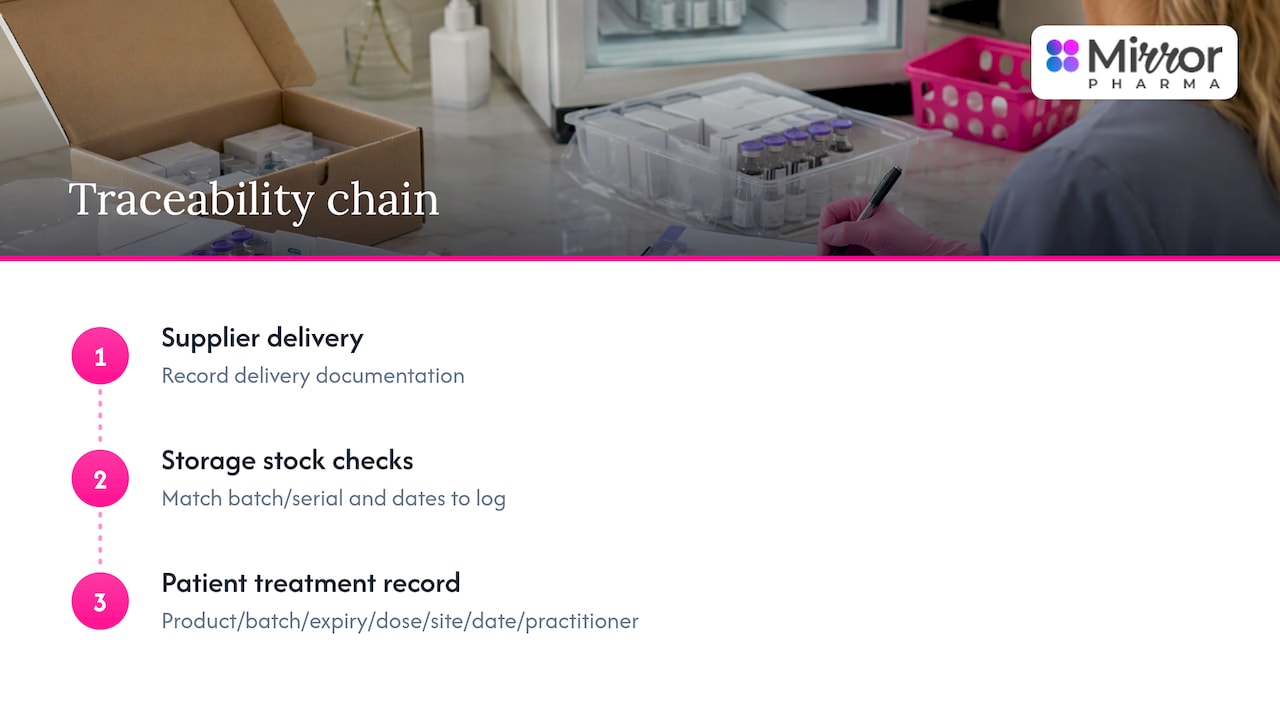
1. At goods-in
Check each delivery against the order and the delivery note. Record:
- Product name and strength or presentation
- Batch number
- Expiry date
- Quantity received and date of receipt
- Supplier and the person who checked the delivery
- Storage condition on arrival, where the product has a temperature requirement
If your suppliers’ records and your own do not match, query it on the day. Our guide to documentation that should come with orders covers what a UK practitioner should expect to receive and keep.
2. In storage
The GS1 UK inventory management guidance says that, when stock is counted, a system must be able to identify and validate the specific batch or serial number and the manufacture and expiry dates against what is already captured. In practice, a stock count should compare the batch on the shelf with the batch in your log, not just the quantity.
GS1 UK also notes that batch, serial and date data may be encoded in GS1-128 or GS1 DataMatrix barcodes, and that scanning expiry dates can highlight items with short expiry so that expired products are removed. Systems should be able to extract the expiry date from the barcode and alert on upcoming expiry, helping to keep waste to a minimum.
Rotation rules support this. Our FEFO versus FIFO guide explains how to decide which stock is used first, and the clinic inventory management playbook covers the wider stock routine. If you are deciding how much to hold, see how much stock a clinic should keep.
3. At the point of treatment
Every patient record should show the product, batch number, expiry date, dose, site of administration, date and the practitioner. This is the link that turns a stock log into patient traceability. The UK pharmacovigilance guidance says product name and batch number should be recorded and passed to the administering healthcare professional and provided to the patient, for the products it covers. Following the same habit for all injectables is sound practice for licensed practitioners.
For reconstituted products, add the time of reconstitution and the discard time. Our note on shelf life after reconstitution sets out the points to document.
For vials from which more than one patient is not treated, note which batch each patient received. For multi-use situations governed by your protocols, record each draw against its patient.
How long to keep batch records
The retention period depends on who holds the record and under what rule.
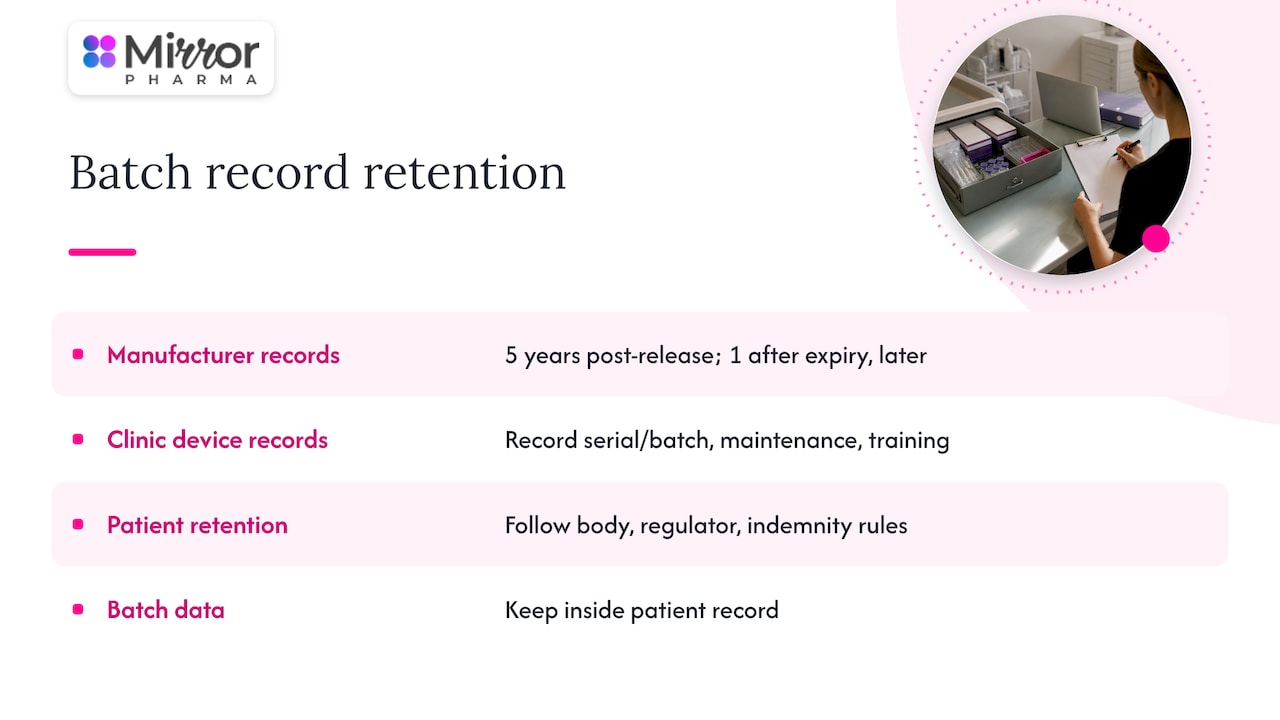
The Human Medicines Regulations 2012, Schedule 9, requires manufacturers to keep durable records of manufacture and assembly of each batch, and of the tests carried out, in a form that is identifiable from the batch number shown on each container. Those records must not be destroyed for five years from the date of release of the batch, or one year after expiry, whichever is later. That is a manufacturer’s duty, so it will not be your retention rule as a clinic.
For your own practice, the GOV.UK checklists for using medical devices say records should show the serial or batch number of a device, its maintenance history and any training carried out on its proper use.
Patient-record retention follows your professional body, regulator and indemnity requirements. Confirm the period with your governance lead or insurer, and keep batch data inside the patient record so it lives as long as the record does. Our article on five-year documentation with orders sets out how that supports a prescriber’s own audit trail.
Using batch data for expiry checks and quality concerns
Good batch records do three jobs day to day.
- Expiry control. A weekly shelf check, matched against your log, catches short-dated stock before it becomes waste.
- Complaint investigation. If a patient reports an unexpected reaction, the batch tells you whether other patients received the same run, and gives you the detail needed to report.
- Supplier accountability. If a product arrives damaged or mislabelled, the batch lets you tell the supplier exactly what you received.
On adverse reactions, UK guidance for the products it covers says that marketing authorisation holders must report the product name and batch number or other identifier for each case. Practitioners reporting a suspected reaction through the Yellow Card scheme should likewise have the batch to hand.
What to do when a batch is recalled
The Care Quality Commission’s guidance on patient safety alerts is written for GP practices, but its framework is a sensible model for any clinic. It says a practice should have a system to receive, disseminate and act on alerts, decide who receives them and that they have the competence to judge whether action is needed, and have systems to identify, recall and follow up affected patients, including a process to recall a medicine or device.
Turn that into a clinic routine:
- Receive. Name one person and one deputy to monitor alerts, and make sure your email is registered with the relevant alert service.
- Check. Compare the alert’s product, batch and expiry with your stock log and shelves.
- Quarantine. Label and separate affected stock. Do not use it.
- Trace. Search patient records by batch number to list everyone treated.
- Contact. Follow your protocol to inform affected patients and offer follow-up.
- Close out. Return or dispose of stock as instructed, and record the actions and dates.
The test of your system is speed. If finding every patient treated from one batch takes an afternoon of paper searching, improve the process now.
Choosing a supplier that supports traceability
Traceability starts before the product reaches your door. Use a supplier that can show you their licensing and supply chain, and that sends clear documentation with each order. Our guides on checking a medicine supplier, questions to ask before choosing a wholesaler and MHRA checks for unlicensed medicines set out what to verify.
Sharps and consumables need tracking too, since the syringes and needles you use are part of the treatment record. See our checklists on sharps disposal and sharps bins.
Our perspective
We supply prescription aesthetic medicines and consumables to verified practitioners and prescribers, and we see the same pattern in clinics that struggle with traceability: the batch is written down somewhere, but not in the same place twice.
Our view is that the batch number should be captured once, at goods-in, and carried unchanged into the stock log and the patient record. That is why we put weight on strict verification of practitioner access, fulfilment by a dedicated team of healthcare professionals and a smooth online ordering process: a clean order record is the first link in your chain.
We would rather a clinic spend ten minutes at delivery than ten hours during a recall.
Rizwan
Ordering for licensed practitioners
If you are a verified practitioner or prescriber, you can order toxins, dermal fillers, skin boosters and needles and consumables online, with extended order cut-off times for timely delivery. Access is for qualified aesthetic professionals and requires verification.
FAQ
How do I find a batch number on a medicine?
Look on the outer carton first, then the vial, ampoule or blister foil. UK recall notices show batch numbers printed on cartons, foil strips and the base of boxes. Photograph or log it at delivery so you are not relying on a carton you may have discarded.
What is the difference between a batch number and a serial number?
A batch number marks a production run shared by many units. A serial number marks one individual unit, and only guarantees uniqueness together with the product’s GTIN. Medicines usually carry batch numbers, while some devices carry both.
Should the batch number go in the patient record?
Yes. Record product, batch, expiry, dose, site and date for each treatment, so you can find every patient quickly if an alert is issued. For licensed practitioners, this is the link between stock and patient.
How long must batch records be kept?
The five-years-or-one-year-after-expiry rule in the Human Medicines Regulations 2012 applies to manufacturers’ batch records. For a clinic, retention follows patient-record rules from your regulator, professional body and insurer, so confirm the period with them.
Sources
- Decentralised manufacture: UK guideline of good pharmacovigilance practices (GOV.UK)
- GS1 UK: Recommendations on medical device and IVD field safety corrective actions
- GS1 UK: Surgical instrument traceability guide
- GS1 UK: Inventory management systems guidance
- GOV.UK: Precautionary recall of ramipril capsules
- GOV.UK: Lercanidipine packs alert
- GOV.UK: Paracetamol 500mg tablets recall
- The Human Medicines Regulations 2012, Schedule 9
- GOV.UK: Checklists for using medical devices
- CQC: GP mythbuster 91, patient safety alerts