
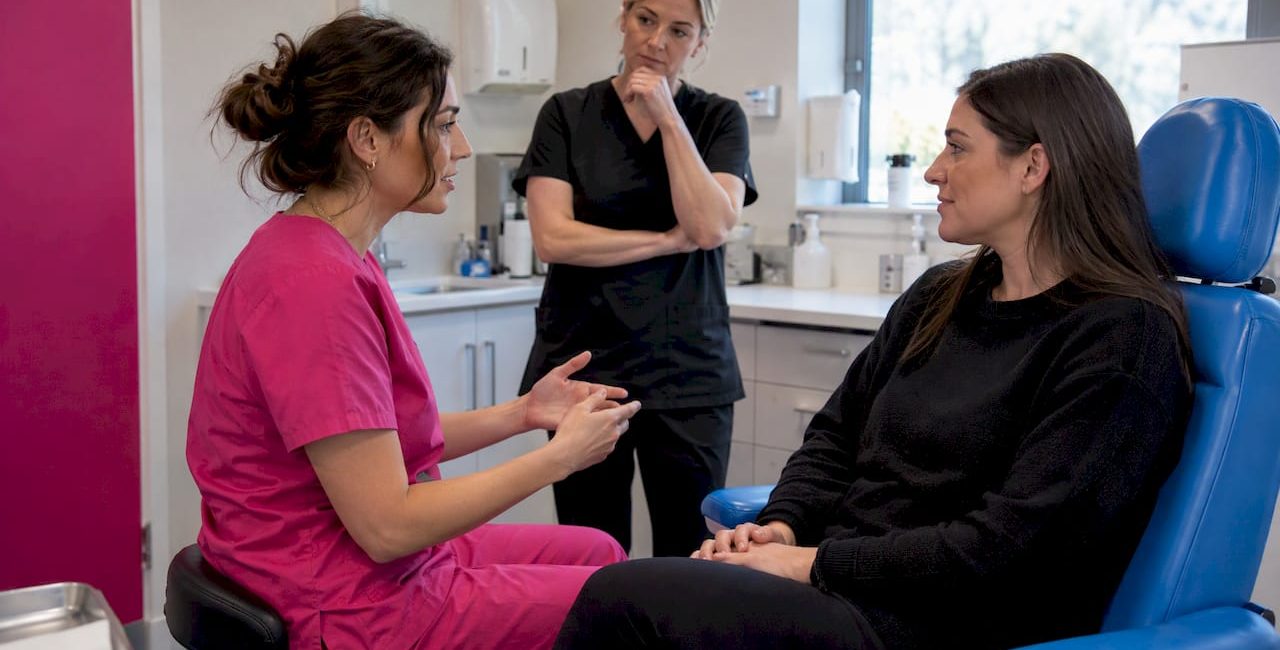
In the UK, prescription-only medicines used in aesthetics, such as botulinum toxin, can only be prescribed by a regulated prescriber with the right legal status. That prescriber must assess the patient face to face, and any other practitioner who administers the product needs a valid direction from them. This guide is for licensed practitioners, prescribers and clinic managers. It sets out who can prescribe, what the regulators expect, how delegation works and which rules differ across the four nations.
TL;DR
- Only appropriate practitioners (doctors, dentists, supplementary prescribers, and nurse and pharmacist independent prescribers within their limits) can prescribe prescription-only medicines.
- A prescribing qualification is not enough on its own: prescribers must also be competent in aesthetic assessment and treatment.
- Remote prescribing of injectable cosmetic medicines is not accepted by the GMC, the GPhC or the voluntary standards bodies. A face-to-face consultation comes first.
- When someone else administers, the prescriber stays responsible, and a Patient Specific Direction (PSD) is the recommended mechanism.
- It is a criminal offence in England to administer botulinum toxin or cosmetic fillers to under-18s, and licensing rules differ across the nations.
Table of Contents
- Who can legally prescribe aesthetic medicines
- Training and competence: more than a prescribing qualification
- The face-to-face consultation requirement
- Prescriber and practitioner are different people: how delegation works
- Under-18s
- Four nations, different rules
- Unlicensed medicines and sourcing
- A prescribing compliance checklist for your clinic
- Our perspective
- Ordering for qualified practitioners
- FAQ
- Sources
Who can legally prescribe aesthetic medicines
Prescription-only medicines (POMs) are controlled by the Human Medicines Regulations 2012. The regulations define who counts as an appropriate practitioner: doctors, dentists, supplementary prescribers, nurse and pharmacist independent prescribers and certain other independent prescribers, each subject to the limits set out in regulation 214.
Two practical points follow.
- Prescribing is a legal status, not a job title. A practitioner who is not on the list above cannot prescribe a POM, however experienced they are in injecting.
- Prescribing scope still matters. An independent prescriber is expected to prescribe only within their own competence. Being allowed to prescribe in law does not make every aesthetic indication appropriate for every prescriber.
If you are a non-prescribing practitioner, the route to treating patients with a POM runs through a prescriber who assesses the patient and issues a lawful direction. We cover that below.
Training and competence: more than a prescribing qualification
A recognised prescribing qualification opens the door, but aesthetics expects more. Professional guidance for pharmacists says they must follow GPhC prescribing guidance, complete appropriate training and supervised practice, demonstrate competence and hold adequate insurance for the procedures they perform.
The same principle applies across professions. Industry guidance for practitioners choosing a prescriber makes the point that a prescribing qualification alone is not enough: the prescriber must also be trained in aesthetics so they can assess and prescribe safely for cosmetic treatments such as injectables.
In practice, a prescriber should be able to evidence:
- current registration with their regulator (GMC, GDC, NMC or GPhC);
- their prescribing qualification and its scope;
- aesthetic-specific training in facial anatomy, complication management and patient selection;
- indemnity or insurance that covers the treatments they prescribe for;
- a clear record of the patients and practitioners they take responsibility for.
If you work with an independent prescriber, asking for this information is normal professional diligence, not an insult.
The face-to-face consultation requirement
This is the rule practitioners most often ask about. The position from each regulator is consistent.
- Doctors: the GMC says doctors must physically examine patients before prescribing non-surgical cosmetic medicines and must not prescribe them remotely.
- Pharmacists: GPhC standards require a face-to-face consultation before prescribing non-surgical cosmetic products, which rules out remote prescribing for these interventions.
- Voluntary sector standards: the JCCP and the Cosmetic Practice Standards Authority state that remote prescribing for injectable cosmetic medicines is unacceptable across the sector.
For nurses, see our own note on remote prescribing in aesthetics, which includes a five-step checklist for UK clinicians.
What a good consultation covers
The JCCP says prescribers need adequate knowledge of the patient’s physical and psychological health. A defensible consultation record normally includes:
- medical history, medications, allergies and any contraindications;
- the patient’s goals and a discussion of realistic outcomes, without any promise of a guaranteed result;
- a facial or physical assessment by the prescriber;
- the risks and possible complications of the proposed treatment, and the patient’s consent;
- the treatment plan, product, dose and review arrangements.
When you need another consultation
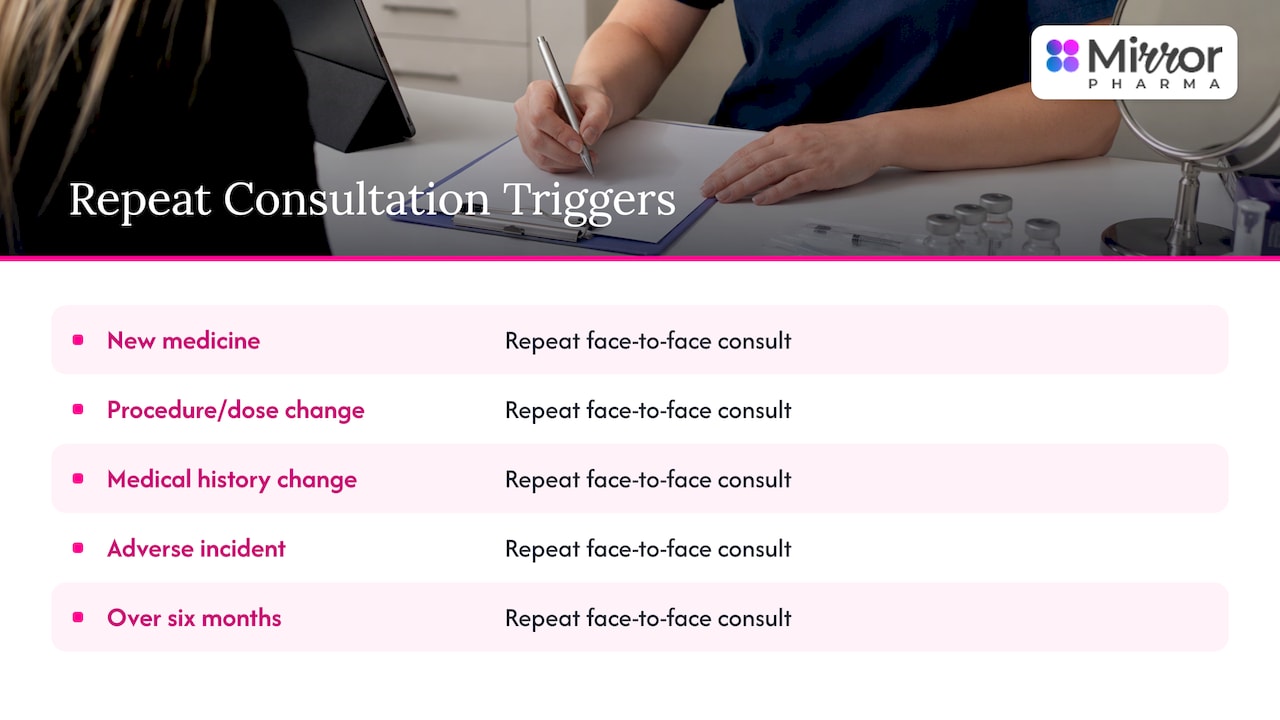
The JCCP says a repeat face-to-face consultation is needed when a new medicine is prescribed, the procedure or dose changes, the patient’s medical history changes, an adverse incident occurs, or more than six months have passed since the last one. Build these triggers into your booking system so a patient cannot be rebooked on an old prescription by accident.
Prescriber and practitioner are different people: how delegation works
Many clinics separate the two roles. The prescriber assesses and prescribes, and another registered professional administers. The JCCP guidance is clear on the responsibilities.
- The prescriber retains ongoing responsibility for the patient and must be satisfied that the person administering is competent.
- A direction must be provided, and the JCCP considers a Patient Specific Direction the most appropriate form.
A PSD is the standard, recognised way for a prescriber to instruct another registered professional to administer a POM to a named individual after a face-to-face assessment. Two features matter:
- it is written for one named patient, not for a group or a clinic list;
- it follows a face-to-face assessment by the prescriber, not before it.
A PSD is typically checked by dispensing pharmacies before supply. Our guide to PSD requirements for aesthetics lists the seven fields pharmacists look for, which helps you avoid delays at the point of ordering.
No advance stock for non-medical practitioners
The JCCP guidance also reflects MHRA advice: doctors and dentists may hold POM stock for their own use, but they cannot provide advance stock to non-medical practitioners. Supply and administration must be clearly directed through a legal mechanism such as a PSD. If a clinic model relies on a prescriber handing over a shelf of product to be used as and when patients appear, it needs to be reviewed.
Under-18s
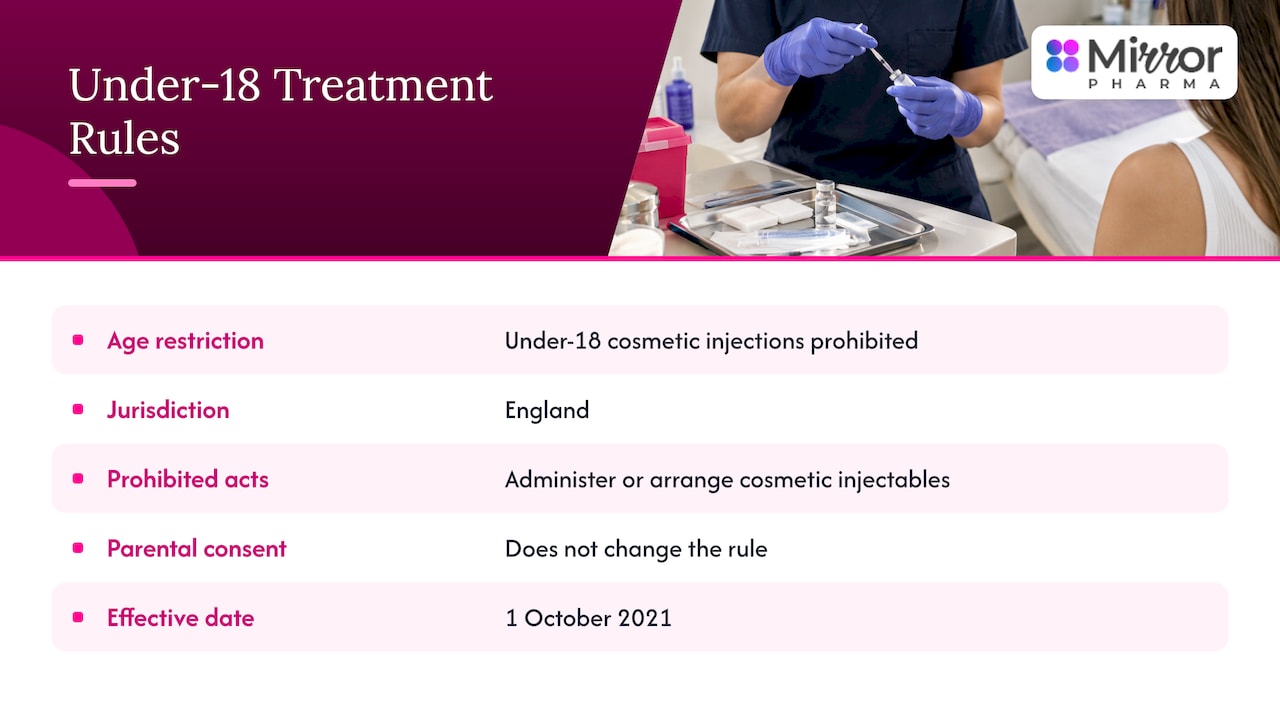
The Botulinum Toxin and Cosmetic Fillers (Children) Act 2021 makes it a criminal offence in England to administer botulinum toxin or injectable fillers for cosmetic purposes to anyone under 18, or to make arrangements for such treatments. Parental consent does not change this. The law came into force on 1 October 2021.
The government guidance is aimed at businesses, so build age verification into your intake process for England and keep a record that it was done. Do not rely on a patient’s word alone.
Four nations, different rules
Aesthetics regulation in the UK is a patchwork, and the position is changing. The medicines rules above apply UK-wide, but licensing of premises and practitioners is devolved and is being developed at different speeds.
| Area | What to know |
|---|---|
| England | The under-18 offence is in force. A wider licensing scheme for practitioners and premises has been proposed. Check the current position before you assume it applies. |
| Scotland | New legislation has been enacted, with requirements phased in over time. |
| Wales | A licensing scheme exists for a defined group of procedures. |
| Northern Ireland | Existing registration categories apply, and the position on any new scheme should be checked with the regulator. |
This area moves quickly, so treat the table as a prompt to check, not a final answer. Confirm the current status on the relevant government or regulator page for the nation where you practise. Our own piece on where UK injectables licensing stands sets out the evidence practitioners should keep while licensing remains unsettled.
If you practise across more than one nation, apply the strictest requirement you meet and document it.
Unlicensed medicines and sourcing
Prescribers are also accountable for what they prescribe. If a product lacks a UK marketing authorisation, the prescriber has additional obligations. We summarise the two MHRA checks prescribers should make in our note on unlicensed medicines in aesthetics. More broadly, a supplier check is part of compliance, and our short guide to what to look for in an injectable supplier gives four checks to run.
A prescribing compliance checklist for your clinic
- Confirm the prescriber’s status. Check the register entry, prescribing annotation and scope.
- Confirm aesthetic competence. Ask for training evidence and insurance that covers the treatments.
- Hold a face-to-face consultation. Record history, examination, consent and the treatment plan.
- Issue a PSD for each named patient where someone else will administer, and make sure the administering professional is competent for the procedure.
- Set review triggers. Repeat the consultation when the product, dose or history changes, after an adverse incident, or after six months.
- Verify age. In England, do not arrange or carry out cosmetic toxin or filler treatment for under-18s.
- Source from a verified pharmacy. Keep the prescription, PSD and supply records together and auditable.
- Recheck the licensing position for your nation at least when you renew insurance or registration.
Our perspective
Every week we speak to practitioners who want to do the right thing and are unsure what the paperwork should look like. The biggest gap we see is not intent, it is process: a consultation done properly but not recorded, or a PSD that arrives after the patient has already been booked.
That is why we verify practitioner and prescriber access before an order is accepted, and why our team of healthcare professionals handles fulfilment. We want the supply side of your clinic to be as orderly as the clinical side. Our extended order cut-off times are designed to help you keep treatment lists on schedule once your prescribing is in place.
We would rather you take the time to get the consultation, PSD and sourcing right than rush a treatment. Good governance protects your patients, your registration and your reputation.
Rizwan
Ordering for qualified practitioners
If your prescribing and consultation processes are in place, we supply prescription aesthetic medicines and consumables to verified healthcare professionals and clinics. You can browse our toxins, dermal fillers and needles and consumables ranges. Access is for licensed practitioners and prescribers only, and verification is required before an order is fulfilled.
FAQ
Can a nurse prescribe botulinum toxin?
Only a nurse who is also a qualified independent or supplementary prescriber, acting within the limits of the regulations and their own competence. A nurse without a prescribing qualification can administer only under a valid direction from an appropriate prescriber. The prescriber stays responsible for the patient.
Can I prescribe aesthetic injectables after a video consultation?
No. The GMC and the GPhC both require a face-to-face assessment before cosmetic injectable medicines are prescribed, and the JCCP and CPSA say remote prescribing is unacceptable. A video call can support follow-up conversations but cannot replace the initial in-person consultation.
What is a Patient Specific Direction?
It is a written instruction from a prescriber to another registered professional to administer a named medicine to a named patient, issued after a face-to-face assessment. The JCCP considers it the most appropriate form of direction when delegating administration of a POM.
How often must a patient be reassessed?
The JCCP says a new face-to-face consultation is needed if a new medicine is prescribed, the procedure or dose changes, the medical history changes, there is an adverse incident, or more than six months have passed. Many clinics reassess at every course for simplicity.
Are the licensing rules the same across the UK?
No. The medicines law is UK-wide, but licensing of practitioners and premises is devolved, and England, Scotland, Wales and Northern Ireland are at different stages. Check the current position for the nation where you practise.
Sources
- The Human Medicines Regulations 2012, prescription-only medicines (legislation.gov.uk)
- Aesthetic practice and pharmacy (Royal College of Pharmacy)
- Finding the right aesthetic prescriber (Aesthetics Associates)
- Deciding if it is safe to prescribe (GMC)
- JCCP Guidance Statement: Responsible Prescribing, revised May 2025
- JCCP Guidance Statement: Responsible Prescribing, 2019
- Botulinum toxin and cosmetic fillers for under 18s: guidance for businesses (GOV.UK)