

For licensed practitioners, a vitamin B complex injection is a prescription-only parenteral product. It is chosen for a documented deficiency or a clear clinical indication, not as a general energy shot. Used that way it sits comfortably within UK guidance, and the supply chain behind it matters as much as the vial. This guide covers what injectable B vitamins contain, where biotin (vitamin B7, sometimes called vitamin H) fits, what the evidence supports, and how to supply and administer them safely. It is written for qualified aesthetic and healthcare professionals, not for members of the public. Our IM/IV vitamins range is available to verified practitioners and prescribers only.
TL;DR
- Injectable B vitamins are prescription-only medicines for licensed practitioners, indicated for deficiency or defined clinical need, with the rationale recorded.
- Treatment of B-vitamin deficiency other than B12 generally uses thiamine (B1), riboflavin (B2) and nicotinamide (B3). Biotin, choline and pantothenic acid in a B-complex have no evidence of value as B-vitamin preparations, according to the BNF.
- Biotin can distort laboratory results, including thyroid immunoassays, so tell the laboratory before testing.
- General pick-me-up use is of unproven value. Frame consultations around assessed need and informed consent.
- Verified supply, clear storage and documented administration protect both your patient and your registration.
Table of Contents
- What a B complex injection actually contains
- Where biotin (vitamin H) fits
- What the evidence supports
- Identifying need before you inject
- Biotin and laboratory tests
- Safe supply and administration
- Choosing a supplier for injectable vitamins
- Frequently asked questions
- Sources
What a B complex injection actually contains
The phrase “vitamin B complex” covers eight water-soluble vitamins: thiamine (B1), riboflavin (B2), niacin or nicotinamide (B3), pantothenic acid (B5), pyridoxine (B6), biotin (B7), folate (B9) and cobalamin (B12). An injectable product does not necessarily contain all of them, and the combination varies by formulation. Always read the summary of product characteristics (SmPC, the legal licence document for a medicine) for the exact composition, route and licensed indications.
Two points help when a patient arrives with a half-remembered idea from social media:
- B12 is usually given alone. Hydroxocobalamin is the form generally used for intramuscular injection in the UK. Our hydroxocobalamin 1 mg/1 ml vial is supplied to verified prescribers for this purpose.
- High-potency B and C combinations are a different class. These are used in specific clinical settings such as the prevention and treatment of Wernicke’s encephalopathy, a neurological emergency linked to thiamine deficiency, often in alcohol dependence. Supply of the intramuscular form changed in late 2024: NHS guidance from the East of England records that the IM presentation of one long-standing product was discontinued from December 2024, and NHS Tayside’s formulary says the same while listing a generic intravenous B and C concentrate. Check current availability and licence status before building a protocol around any single presentation.
Where biotin (vitamin H) fits
Biotin is vitamin B7. The older name “vitamin H” comes from the German words for skin and hair, which is why patients often connect it with cosmetic goals. In clinical medicine its injectable role is narrow. The BNF for children lists biotin for oral or slow intravenous treatment of isolated carboxylase defects and biotin-metabolism defects, with doses varying by age and condition.
For general B-complex use the BNF is direct: biotin, choline and pantothenic acid, which are sometimes added to B-complex preparations, have no evidence of value as B-vitamin preparations. Practically, that means you should be able to state the indication for any biotin product you supply or administer. Our biotin ampoules and single ampoule are for qualified practitioners acting within their prescribing competence and the product licence.
What the evidence supports
Deficiency and defined need
The BNF’s vitamins summary supports vitamin treatment for specific deficiency states or known inadequate diets. It notes that B-vitamin deficiency other than B12 deficiency is rare in the UK, and that treatment generally uses thiamine, riboflavin and nicotinamide. Severe Wernicke’s encephalopathy and Korsakoff psychosis are best treated initially with parenteral B vitamins followed by oral thiamine.
NHS England’s March 2024 policy on over-the-counter items in primary care allows exceptions for medically diagnosed deficiency and for malnutrition, including malnutrition from alcoholism, with continuing need reviewed. That is a useful frame for your own records: diagnosis, rationale, review date.
Use without a diagnosed deficiency
A 2021 peer-reviewed article on prescribing vitamin B complex found no clear evidence of benefit in peripheral neuropathy caused by diabetes or alcoholism and discouraged routine use in well-nourished adults. A 2021 systematic review and meta-analysis of 16 randomised trials with 6,276 participants found no evidence that B12 or B-complex supplementation improved cognitive outcomes in people without overt B12 deficiency. The same review found no overall effect on depressive symptoms and too little data on idiopathic fatigue for firm conclusions.
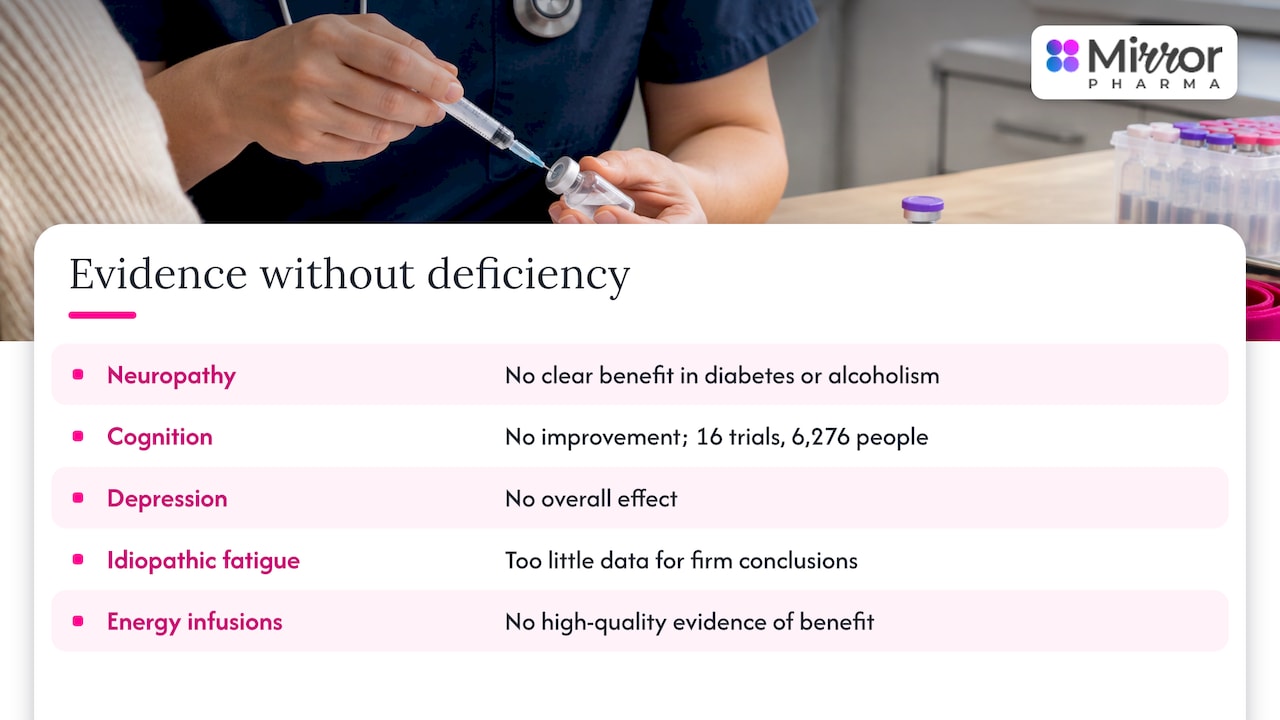
The BMJ Drug and Therapeutics Bulletin review of vitamin infusions and injections adds that high-dose products promoted for energy, stress or immunity lack high-quality evidence of benefit in people without a specific deficiency or medical condition.
What this means in the consultation room: your strongest position is a documented assessment, a defined indication and honest information. Do not promise an energy boost, weight change or any other guaranteed outcome. Outcomes vary between patients, and no vitamin injection is risk-free.
Identifying need before you inject
The decision to inject begins before the needle. For B12, the clinical picture (symptoms, diet, medications, gastrointestinal history, pernicious anaemia risk) and appropriate blood tests guide whether a patient has a deficiency and whether oral or intramuscular replacement is suitable. Injection is generally reserved for situations where absorption is a concern or where a clinician judges that parenteral treatment is warranted. Follow current NICE guidance and your local pathway for diagnosis, initial loading and maintenance, and record the product, dose, batch number, site and date at every administration.
For aesthetic clinics adding wellness services, the practical rule is simple. If you are not the prescriber, the prescriber must have assessed the patient and issued the prescription for that named patient. If a patient needs diagnostic work-up beyond your scope, refer them to their GP.
Biotin and laboratory tests
This is the safety point most often missed. The BNF warns that biotin interference can distort thyroid immunoassays, with the risk increasing at higher biotin doses. Results can be falsely high or low, which may lead to misdiagnosis or inappropriate management. The BNF advises informing laboratory personnel before testing, as alternative assays may be available.
Build this into your routine:
- Ask every patient about biotin from any source, including supplements and injections, before they have bloods taken.
- Record biotin treatment in the patient’s notes and in any correspondence to their GP.
- Advise the patient to tell whoever takes their blood, and to tell the laboratory, that they are taking biotin.
- Where a thyroid or other immunoassay result looks out of line with the clinical picture, consider biotin as a possible cause and discuss with the laboratory.
Safe supply and administration
The BMJ DTB review states that licensed injectable vitamins that are prescription-only medicines should not be advertised to the public and should be supplied and administered only by appropriately qualified healthcare professionals. That has two consequences for a clinic. Your patient-facing material should be educational and should not promote a prescription medicine by name or by claim. And your purchasing should come from a supplier that verifies who it sells to.
A sound intramuscular workflow for licensed practitioners looks like this:
- Verify the prescription and the patient. Confirm identity, allergies, current medicines, pregnancy status and the indication.
- Check the product. Read the label and SmPC, check expiry, inspect the ampoule or vial for particles or discolouration, and keep products at the storage conditions stated on the packaging.
- Use appropriate consumables. Select needle length and gauge for the patient and the site, and use single-use sterile equipment with correct sharps disposal.
- Obtain consent. Explain the purpose, the limits of the evidence for your indication, possible reactions such as injection-site pain, bruising or hypersensitivity, and what to do if symptoms develop.
- Have anaphylaxis equipment and training in place. Hypersensitivity is rare but must be managed immediately when it occurs.
- Document everything. Batch, expiry, dose, site, time, operator, and the review plan.
If you also offer intravenous vitamin services, our guides cover safety conditions for IV vitamin therapy and an eight-step protocol for mixing IV vitamins. For a broader overview of the category, see our clinical guide to vitamins for UK practitioners.
Choosing a supplier for injectable vitamins
When the evidence is this specific about indication, the product you order has to match the prescription exactly: the right active ingredient, strength and pack size, delivered when the appointment list needs it. Mirror Pharma supplies prescription aesthetic and wellness medicines to healthcare professionals and aesthetic clinics. Access depends on strict verification of practitioner and prescriber status. Orders are fulfilled by a dedicated team of healthcare professionals, and our extended order cut-off times are designed to help practitioners meet client appointments. You can browse the vitamin B products or the full IM/IV vitamins category once your account is verified.
Our perspective
We talk to qualified practitioners about injectable vitamins every day, and the strongest clinics share one habit: they begin with the indication, not the product. The UK guidance is clear that vitamin treatment belongs where there is a deficiency or a defined clinical need, so a protocol that starts with assessment, consent and a review date is the one that stands up to scrutiny.
That is why we built our service around verification. Our products are for trained practitioners and prescribers, and every account is checked before supply. Behind the order is a team of healthcare professionals who understand what a prescription, a batch record and a cold-chain label mean for you.
Reliability is the other half. A clinic that books a patient for a hydroxocobalamin injection needs the product when the diary says, so we extended our order cut-off times and kept the online ordering simple. We would rather you spend your time on assessment and documentation than chasing stock.
Rizwan
Frequently asked questions
What is the difference between a B complex injection and a B12 injection?
A B12 injection contains cobalamin alone, usually hydroxocobalamin in UK practice. A B complex injection combines several B vitamins, and the exact mix depends on the licensed product. The choice follows the diagnosis, so check the SmPC and the prescriber’s rationale.
Does biotin affect blood test results?
Yes. The BNF warns that biotin can cause falsely high or low results, particularly in thyroid immunoassays, and the risk rises with higher doses. Tell the laboratory about any biotin treatment before tests are taken, and record it in the patient’s notes.
Who can administer vitamin B injections in the UK?
These are prescription-only medicines, so they must be supplied and administered by appropriately qualified healthcare professionals, as the BMJ Drug and Therapeutics Bulletin review states. A prescriber must assess the patient and prescribe for them. Administration is by a competent, trained practitioner working within their scope.
Are B complex injections proven to boost energy?
The evidence does not establish an energy benefit in people without a deficiency. A 2021 meta-analysis found too little data on fatigue for firm conclusions. For licensed practitioners, the sound approach is to assess for a deficiency and explain the limits of the evidence in consent.
Sources
- Vitamins treatment summary, BNF, NICE
- Biotin, BNFC, NICE
- Vitamins with minerals and trace elements, BNF, NICE
- Prescribing vitamin B complex: Need for reassessment
- Effects of Vitamin B12 Supplementation on Cognitive Function and Depressive Symptoms
- Vitamin infusions and injections, BMJ Drug and Therapeutics Bulletin
- Formulary and Prescribing Guidelines, East of England NHS, January 2025
- Tayside Area Formulary, NHS Tayside
- NHS England policy on over-the-counter items, March 2024