
A sound weight loss clinic protocol has five parts: a structured assessment, eligibility checks, a titration schedule, scheduled reviews with stopping rules, and a safety-netting routine. This guide is for licensed prescribers and qualified aesthetic professionals who run or supply clinics in the UK. It follows NICE, MHRA and GPhC guidance and shows where reliable, verified supply keeps the protocol running without gaps. At Mirror Pharma we supply weight loss products only to verified practitioners and prescribers, and a protocol is only as dependable as the product reaching the clinic on time.
TL;DR
- Assess before you prescribe: medical history, medicines, height, weight, BMI, comorbidities and eating disorder screening, recorded each time.
- Use a stepped approach: lifestyle support alongside medicines, with agreed goals and tracked progress.
- Titrate on schedule: tirzepatide and injectable semaglutide move up in steps of at least four weeks, and oral semaglutide in steps of at least one month.
- Review at six months and consider stopping if less than 5% of initial weight is lost.
- Build safety-netting for pancreatitis and sudden vision loss into every consultation. All of this is for licensed practitioners.
Table of Contents
- Step 1: Assessment and eligibility
- Step 2: Wrap medicines in a stepped programme
- Step 3: Choose the medicine and set out titration
- Step 4: Scheduled follow-up and stopping rules
- Step 5: Contraindications and safety-netting
- Step 6: Keep the supply chain from breaking the protocol
- Our perspective
- FAQ
- Sources
Step 1: Assessment and eligibility
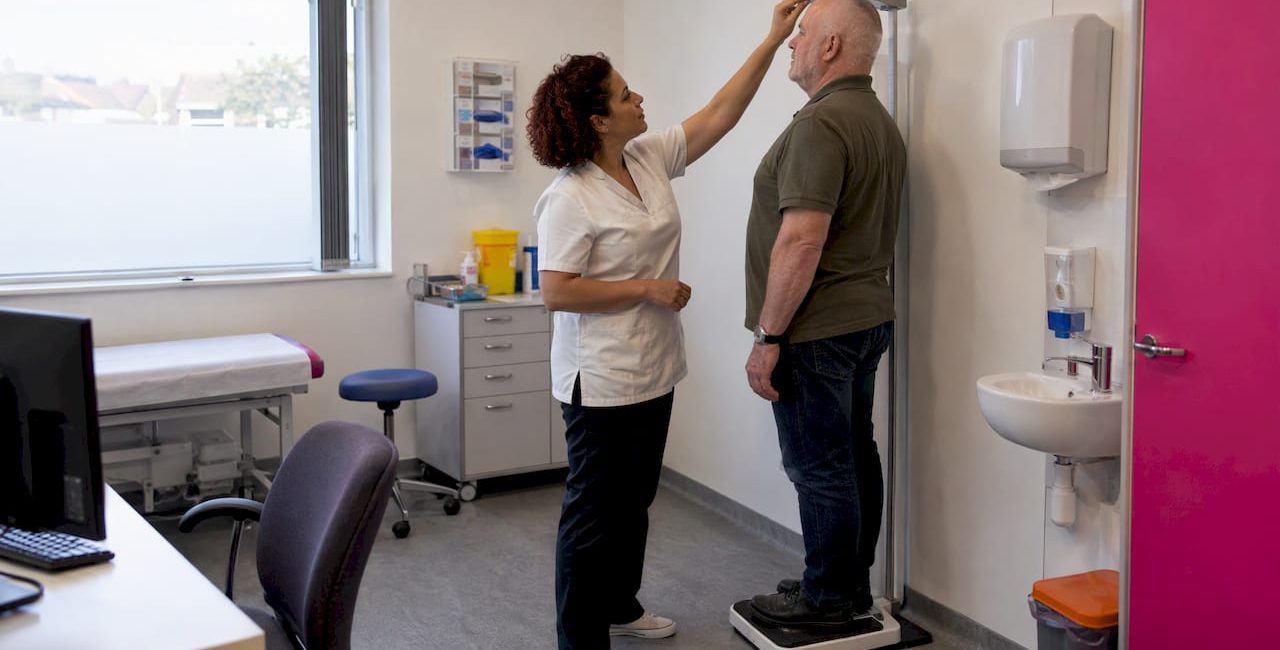
NICE’s guide for prescribing medicines to manage overweight and obesity sets out what a first appointment should cover. Check eligibility and willingness to engage with a reduced-calorie diet and more physical activity. Take a full medical history, including current medicines and weight-related comorbidities. Record height, weight and BMI, undertake investigations the history and examination indicate, and refer on where needed, including to eating disorder services.
NICE’s assessment guidance (NG246) adds practical points for your template:
- Ask permission each time before discussing weight or taking measurements.
- Avoid diagnostic overshadowing, where a symptom is put down to weight without proper investigation.
- Record waist circumference too, in people with a BMI below 35 kg/m², so waist-to-height ratio can be calculated.
- Keep records current and share them between providers with the person’s permission.
Remote consultations
The General Pharmaceutical Council’s weight loss medicines FAQ says a face-to-face consultation is not required, but the consultation must use two-way communication and not rely only on an online questionnaire. Weight, height and BMI must be independently verified, for example by video consultation, clinical records or contact with the GP. The same page expects ongoing monitoring, advice on side effects, and consideration of eating disorders, body dysmorphia and mental health. Prescribers need the training, knowledge, skills and experience for the role.
Ethnicity-adjusted thresholds
For tirzepatide, semaglutide and liraglutide, NICE NG246 applies lower BMI thresholds, usually reduced by 2.5 kg/m², for people from South Asian, Chinese, other Asian, Middle Eastern, Black African or African-Caribbean backgrounds. Build this into the eligibility check rather than leaving it to memory.
Step 2: Wrap medicines in a stepped programme
Medicines are one component. NICE NG246 expects adult interventions to be multicomponent: diet, physical activity and behaviour change, lasting at least three months with weekly or fortnightly sessions, led by a multidisciplinary team, with agreed, achievable weight-loss goals and tracked progress. NHS Greater Manchester’s weight management pathway describes the same stepped logic: behavioural interventions are started and evaluated before pharmacological or surgical options, and comorbidities are managed straight away without waiting for weight loss.
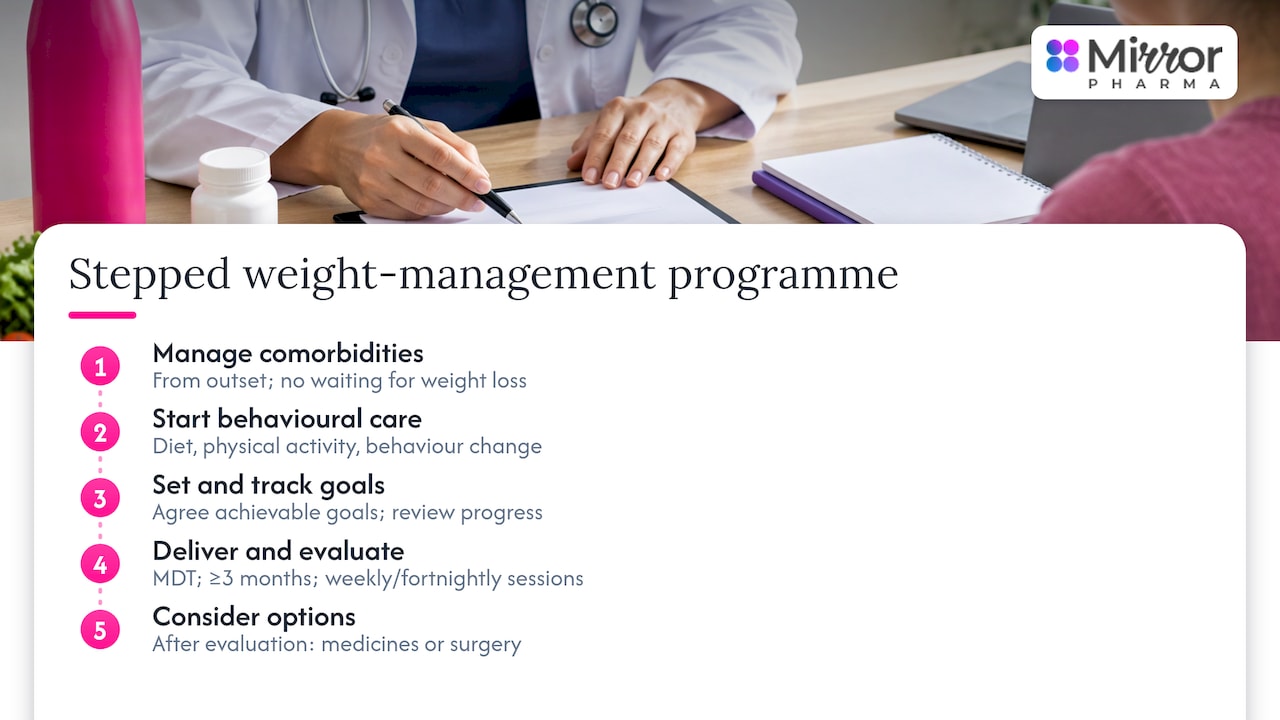
In practice, write the programme into the protocol: who delivers the lifestyle sessions, how often, what goal is agreed at baseline, and when progress is reviewed.
Step 3: Choose the medicine and set out titration
NICE NG246 lists four adult weight-management medicines: tirzepatide, semaglutide, liraglutide and orlistat, all alongside a reduced-calorie diet and increased activity. The setting differs. Semaglutide is recommended within a specialist overweight and obesity service, tirzepatide in primary care or a specialist service, and liraglutide in secondary care. For a side-by-side view, see our tirzepatide and semaglutide comparison and semaglutide and liraglutide comparison.
| Medicine | Starting dose | Step interval | Maintenance |
|---|---|---|---|
| Tirzepatide (weekly injection) | Per NICE guide | 2.5 mg increases every 4 weeks | 5, 10 or 15 mg weekly (maximum 15 mg) |
| Semaglutide injection (weekly) | 0.25 mg | At least 4 weeks per step: 0.5, 1, 1.7 mg | 2.4 mg, increased if necessary to 7.2 mg |
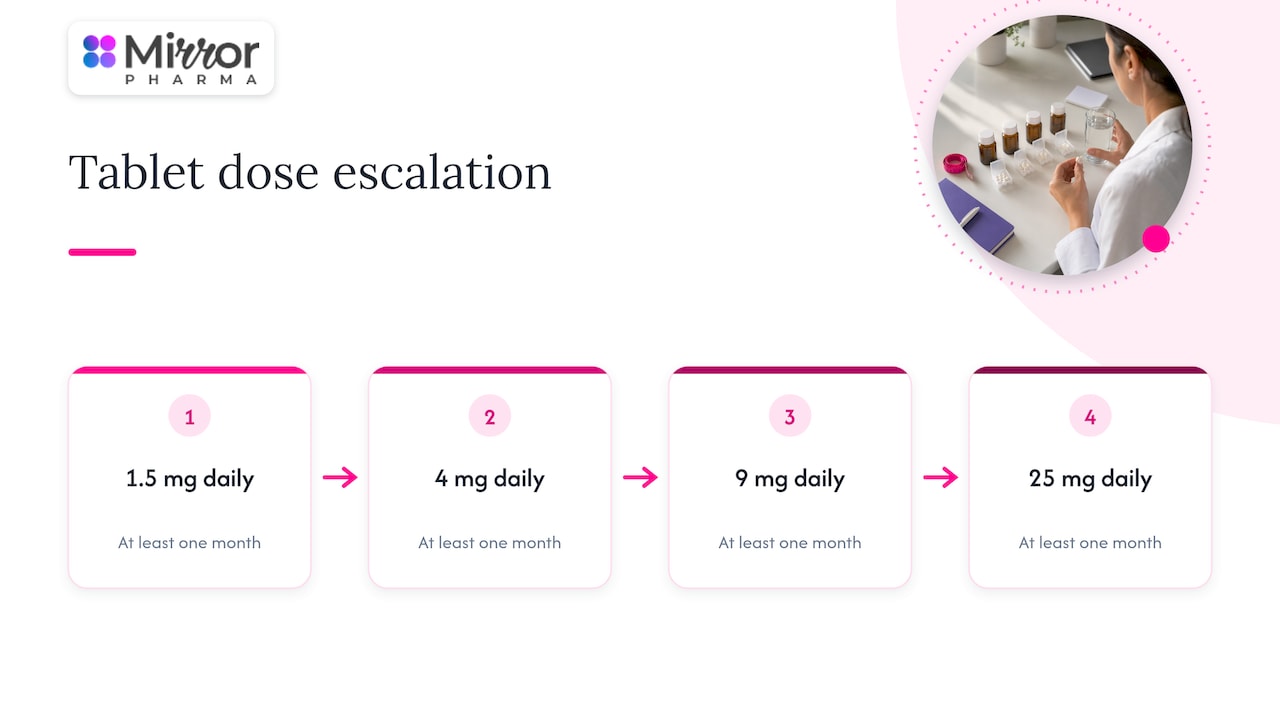
| Semaglutide tablet (daily) | 1.5 mg | At least 1 month per step: 4, 9 mg | 25 mg |
Sources: NICE tirzepatide prescribing guide and the BNF semaglutide entry. The BNF notes that semaglutide is a biological medicine, so it must be prescribed and dispensed by brand name, and that taking more than one tablet to reach a higher tablet dose is not recommended. Our GLP-1 dosing schedule lays out the timelines to 2.4 mg and 15 mg for clinicians.
The 7.2 mg injection dose
The MHRA’s January 2026 Safety Roundup states the maximum weekly dose is 7.2 mg for adults with a BMI of 30 or above, alongside diet and exercise. Stay on 2.4 mg for at least four weeks before going higher if clinically indicated. The 7.2 mg dose is three 2.4 mg injections on the same day, with sites at least 5 cm apart, so your patient instructions should say this explicitly.
Oral semaglutide in 2026
The MHRA approved the semaglutide tablet on 11 June 2026 as the UK’s first GLP-1 tablet for weight loss. It can be prescribed to adults with a BMI of 30 or above, or 27 to under 30 with at least one weight-related comorbidity, alongside diet and activity. It is prescription-only and not currently available on the NHS; NHS use depends on a NICE evaluation.
The tablet starts at 1.5 mg daily and rises through 4 mg and 9 mg to 25 mg, with at least a month at each level. It is taken whole on an empty stomach after at least 8 hours’ fasting, with a sip of water, and nothing else for at least 30 minutes. Patients on 2.4 mg weekly injection can move straight to 25 mg tablets. The most common effects are gastrointestinal: nausea, diarrhoea, constipation and vomiting.
One point to hard-code into your protocol: oral semaglutide licensed for type 2 diabetes is a different product. The Greater Manchester incretin commissioning position (September 2026) states it is licensed solely for type 2 diabetes and is not interchangeable with the weight management tablet. Our guide to oral versus injectable semaglutide covers the formulation question in more depth, and the semaglutide prescribing guide covers the pathway.
Step 4: Scheduled follow-up and stopping rules
For tirzepatide, NICE specifies follow-up every four weeks during titration, then a review at six months on the highest tolerated dose. If less than 5% of initial weight has been lost, the prescriber decides whether to continue, weighing benefits and risks. At each follow-up record injection difficulties, adverse effects, micronutrient concerns and pregnancy plans. The same guide gives safe weight loss as generally 0.5 to 1 kg a week.
For semaglutide, NICE TA875 advises considering stopping if less than 5% of initial weight is lost after six months. In specialist NHS services it is recommended for up to two years. Our tirzepatide prescribing and 6-month review guide shows how to structure that review.
A workable follow-up template:
- Weight and BMI (and waist measures where relevant), with consent for measurement noted.
- Tolerability: gastrointestinal effects, hydration, injection technique.
- Dose decision: escalate, hold or step down, with the reason recorded.
- Lifestyle goals reviewed against the baseline agreement.
- Safety-netting advice given and documented.
Our GLP-1 side effects management plan can support step 2.
Step 5: Contraindications and safety-netting
The BNF lists diabetic ketoacidosis as a contraindication to semaglutide. Cautions include delayed gastric emptying, severe gastroparesis, general anaesthesia or deep sedation (risk of pulmonary aspiration), a history of pancreatitis and severe congestive heart failure.
Pancreatitis
The MHRA’s Drug Safety Update of 29 January 2026 strengthened pancreatitis warnings across GLP-1 and dual GLP-1/GIP medicines. Between 2007 and October 2025 it received 1,296 Yellow Card reports of pancreatitis with these drugs, 19 fatal and 24 necrotising. Stop treatment immediately if pancreatitis is suspected, do not restart if it is confirmed, and use caution with a history of pancreatitis. Early symptoms such as abdominal pain, nausea and vomiting overlap with common GLP-1 gastrointestinal effects, so tell patients plainly which pain pattern needs urgent review.
Sudden vision loss
The MHRA’s February 2026 Safety Roundup says semaglutide has very rarely been associated with non-arteritic anterior ischaemic optic neuropathy (NAION), causing sudden painless vision loss, usually in one eye. Refer urgently for ophthalmological examination, and discontinue semaglutide if NAION is confirmed. The roundup also asks clinicians to enquire about privately prescribed semaglutide, so put a medicines-source question in your history template.
Step 6: Keep the supply chain from breaking the protocol
Titration schedules are time-bound. A late delivery forces a held dose or a missed step, and that undermines the plan you agreed with the patient. We supply weight loss products to verified practitioners and prescribers, and our order cut-off times are extended so that clinics can order later and still plan around delivery. Fulfilment is handled by a dedicated team of healthcare professionals. Browse the weight loss range or the needles and consumables your injection clinics need alongside it. Access is for licensed practitioners and prescribers, with verification required.
Our perspective
A protocol is a promise that every patient gets the same safe sequence of care, whoever is on shift. The strongest clinic protocols we see in the guidance are not clever. They are consistent: the same assessment fields, the same review intervals, the same stopping rules.
Our job at Mirror Pharma is to remove the avoidable failure point, which is access to product. That is why we verify practitioner and prescriber status, why our online ordering is built to be smooth, and why our cut-off times are extended: so a titration step planned for a Monday is not lost to a logistics gap.
For licensed prescribers building or tightening a service, start with the clinical framework above, then choose a supplier that matches the discipline of your protocol.
Rizwan
FAQ
How do I prescribe weight loss injections safely?
Start with a full assessment of history, medicines, BMI and comorbidities, and check eligibility against NICE criteria, including ethnicity-adjusted thresholds. Use two-way consultation with independently verified measurements if you consult remotely. Titrate on schedule, arrange monitoring, and record consent and advice on side effects. This applies to appropriately trained, licensed prescribers.
Is oral semaglutide available in the UK in 2026?
The MHRA approved the semaglutide tablet for weight management on 11 June 2026. It is prescription-only and not currently available on the NHS, with NHS use depending on a NICE evaluation. Prescribers should not treat the diabetes-licensed tablet as interchangeable with it.
When should a clinic review or stop treatment?
NICE guidance for tirzepatide and semaglutide points to a six-month review, with a decision on whether to continue if less than 5% of initial weight has been lost. Stop immediately if pancreatitis is suspected, and discontinue semaglutide if NAION is confirmed.
Does a weight loss clinic need a face-to-face consultation?
The GPhC states it is not required, but the consultation must involve two-way communication, independent verification of weight and height, and arrangements for ongoing monitoring. A questionnaire alone is not enough.
Sources
- NICE: guide for prescribing medicines to manage overweight and obesity
- NICE NG246: identifying and assessing overweight and obesity
- GPhC: weight loss medications FAQ
- NICE NG246: medicines and surgery
- NICE NG246: planning and delivering services
- NHS Greater Manchester: weight management clinical pathway
- NICE: prescribing, reviewing and stopping tirzepatide
- BNF: semaglutide
- NICE TA875: semaglutide recommendations
- MHRA: first GLP-1 tablet for weight loss approved
- MHRA Safety Roundup, January 2026
- MHRA Safety Roundup, February 2026
- MHRA Drug Safety Update: GLP-1 and pancreatitis, 29 January 2026
- NHS Greater Manchester: incretin therapy commissioning position, September 2026