

If you are a licensed prescriber comparing the two best-known botulinum toxin type A products in UK aesthetic clinics, here is the short answer. Both are botulinum toxin type A, and both relax targeted muscles to soften dynamic lines. They are not the same medicine, though. One (incobotulinumtoxinA) is a 150 kD molecule free from complexing proteins. The other (onabotulinumtoxinA) has a wider range of licensed medical uses. Their units are not interchangeable, and the choice comes down to the indication, the patient’s anatomy and your own training. This guide is written for qualified aesthetic professionals, prescribers and clinic owners. It is educational, not for patients or the general public.
TL;DR
- Both products are botulinum toxin type A, but they are separate medicines with their own formulations, potency assays and summaries of product characteristics.
- IncobotulinumtoxinA is free from complexing proteins. Published studies report non-inferior efficacy to onabotulinumtoxinA in glabellar lines under specific study conditions, but the clinical profiles are not identical.
- Units cannot be converted between the two. Dose each product only according to its own SmPC.
- Results from either typically last 3 to 4 months, and both are prescription-only medicines for licensed practitioners.
- Choose by indication, anatomy, training and the individual patient, never by a conversion ratio.
Table of Contents
- What we are comparing
- Formulation: complexing proteins and what they mean
- Licensed indications in the UK
- Efficacy and duration
- Why units cannot be converted
- Safety, side effects and immunogenicity
- Choosing between them for a given indication
- Our perspective
- Ordering for your clinic
- FAQ
- Sources
What we are comparing
In UK clinics, most conversations about “which toxin” come down to a handful of botulinum toxin type A products. This article looks at two of them, using their generic names: incobotulinumtoxinA and onabotulinumtoxinA. The trade names are the ones patients search for, but practitioners prescribe, document and consent by the medicine and its licence, so the generic names are the useful handle here.
Both are prescription-only medicines. In the UK they may only be supplied against a valid prescription and administered by an appropriately qualified healthcare practitioner. The incobotulinumtoxinA SmPC states that it should only be given by a qualified practitioner with expertise in the relevant indication, in accordance with national guidelines. The same principle underpins the JCCP information sheet on botulinum toxins, which describes them as prescription-only and stresses careful muscle targeting so that treatment moderates expression rather than abolishing it.
Two things are shared by the products and worth saying plainly before the differences:
- Mechanism: both are botulinum toxin type A, used to temporarily relax targeted muscles.
- Manufacturing heritage: the three main botulinum toxin type A products in use are all derived from Hall strains, according to an academic review of their differential characteristics. Purification and manufacturing steps are where they diverge.
Formulation: complexing proteins and what they mean
The most discussed structural difference is the presence or absence of complexing proteins. The incobotulinumtoxinA SmPC describes the product as 150 kD botulinum toxin type A, free from complexing proteins. The same academic review notes that manufacturing and purification differences produce different formulations across the main products, including differences in complexing protein content.
Why might a practitioner care?
- Protein load. A formulation with fewer accessory proteins presents less foreign protein per dose. The review suggests that the absence of complexing proteins may reduce the potential for neutralising antibody production. That is a hypothesis about potential, not a guarantee of any clinical outcome.
- Product-specific handling. Reconstitution volumes, storage and shelf life are set by each SmPC. Follow the licence for the product in your hands, and do not carry habits from one product to another.
- Consistency. Different formulations can behave differently in the hands of different injectors, which is one reason practitioners often settle on one or two products and learn them thoroughly.
The formulation difference is real, but it is only one input. A product with an attractive profile on paper still needs correct dilution, placement and dosing to perform well.
Licensed indications in the UK
Licensing is where the two products look most different, and it matters for documentation and consent.
The incobotulinumtoxinA SmPC lists temporary improvement of moderate to severe glabellar lines, crow’s feet and horizontal forehead lines in adults below 65, where the severity has an important psychological impact on the patient. The onabotulinumtoxinA SmPC covers a much wider list, including specified spasticity, blepharospasm, hemifacial spasm, cervical dystonia, chronic migraine, bladder dysfunction, severe axillary hyperhidrosis and specified facial lines.
| Point of comparison | IncobotulinumtoxinA | OnabotulinumtoxinA |
|---|---|---|
| Active substance | Botulinum toxin type A, 150 kD | Botulinum toxin type A |
| Complexing proteins | Free from complexing proteins | Formulated differently, per its SmPC |
| Aesthetic licence (per SmPC) | Glabellar, crow’s feet and horizontal forehead lines in adults below 65 | Specified facial lines, among other indications |
| Therapeutic licence breadth | Narrower | Wide, including spasticity, dystonia, migraine and hyperhidrosis |
| Unit equivalence | Not interchangeable with other products | Not interchangeable with other products |
| Supply | Prescription-only | Prescription-only |
Check the current SmPC for exact wording, age limits and the lines covered, because licences are updated. The emc pages linked above are the live record.
A wider licence does not make one product better for an aesthetic purpose, and a narrower licence does not make it weaker. It tells you what each manufacturer has formally evidenced and what the regulator has approved. Any use outside the licence is off-label, which carries its own consent and professional responsibility.
Efficacy and duration
The evidence base for head-to-head comparison is less tidy than marketing suggests. The review of differential characteristics reports studies finding non-inferior or equivalent efficacy between incobotulinumtoxinA and onabotulinumtoxinA in glabellar lines, under the conditions of those specific studies. It also cautions that the clinical profiles are not identical, and that comparative studies use varied outcome definitions and limited follow-up time points, which makes full comparison difficult.
What that means in practice:
- Glabellar lines: both have supportive data, and the published comparisons point to similar efficacy in the settings studied.
- Onset and duration: the JCCP guidance says results typically last 3 to 4 months. Individual variation is considerable, and published studies rarely follow patients long enough to separate products on duration.
- Other areas: do not assume that glabellar data transfer to other muscles or dosing schemes. Muscle bulk, patient sex, previous treatment and technique all shift the result.
So be wary of any claim that one product “lasts longer” or “works faster” in general. Where the data are thin, the honest statement to a patient, within your consultation, is that results vary and no outcome can be promised.
Why units cannot be converted
This is the single most important safety point in the comparison. The incobotulinumtoxinA SmPC states that its unit doses are not interchangeable with those of other botulinum toxin type A preparations, because of differences in the potency assay. Each manufacturer measures biological activity with its own method, so a unit of one product is not a unit of another.
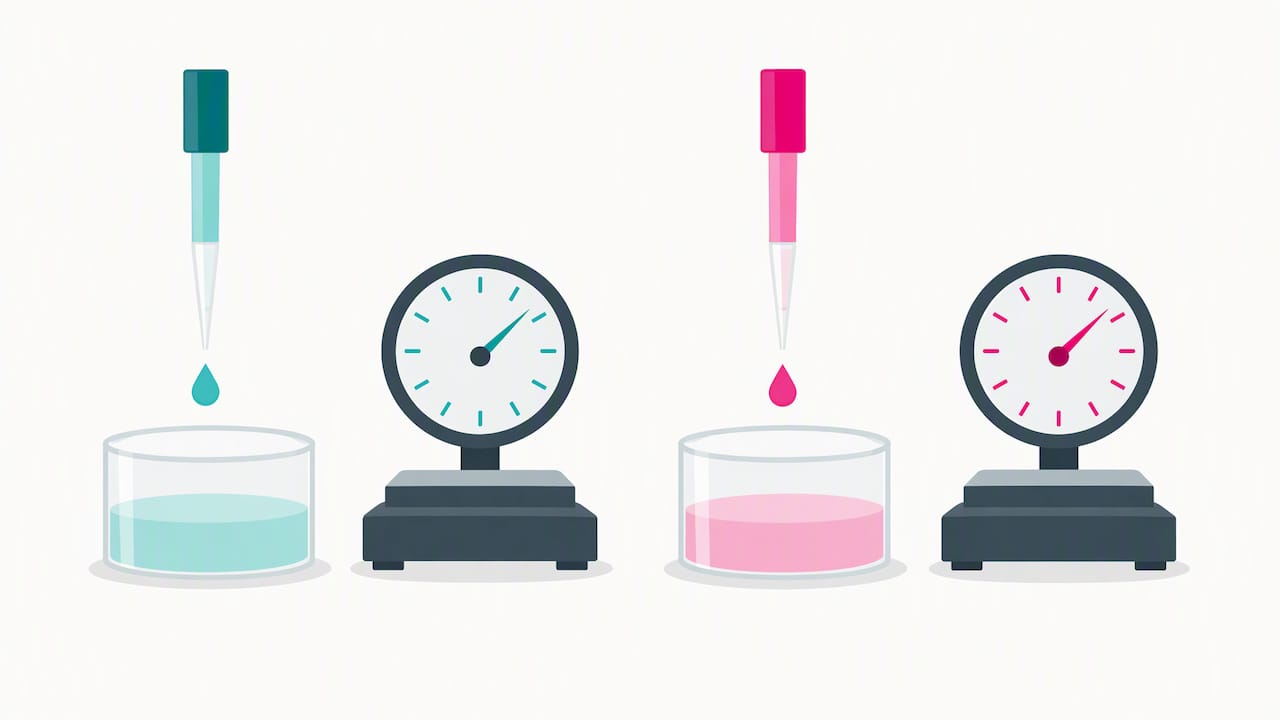
An academic paper on non-interchangeability makes the related argument that the absence of a significant efficacy difference at limited time points does not show that the products are interchangeable. Without standardised assays across manufacturers, there is no sound way to convert units directly.
Practical consequences for your protocols:
- Do not use a conversion ratio. Ratios circulate informally, but they are not in the licence and they are not a safe basis for dosing.
- Write protocols per product. Keep separate dosing maps, dilution sheets and consent wording for each.
- Treat a switch as a new treatment. When a patient moves from one product to another, start from the SmPC and your clinical assessment, not from their previous unit count. Review at follow-up and document the outcome.
- Train the whole team. Reconstitution errors often occur when a clinic stocks two products with different vial sizes and different habits.
Safety, side effects and immunogenicity
Both products share the class profile of botulinum toxin type A. Injection site reactions and headache are among the commonly reported effects, and eyelid ptosis and brow asymmetry are recognised complications that follow from the muscle-relaxing action when the toxin reaches unintended muscles. Consent should cover these, and you should be able to explain how placement and dose lower, but do not eliminate, the likelihood.
The onabotulinumtoxinA SmPC carries a warning that effects related to toxin spread distant from the administration site have been reported, in some cases fatal. This is mostly relevant to higher-dose therapeutic use, but it is part of the licensed warnings and belongs in your risk thinking. If a patient has a neuromuscular disorder or is taking medicines that affect neuromuscular transmission, read the relevant SmPC sections and decide whether treatment is appropriate at all.
Neutralising antibodies
Loss of response through neutralising antibodies is uncommon. A systematic review of immunogenicity found estimated incidence of 0.3% for both incobotulinumtoxinA and onabotulinumtoxinA. The review of differential characteristics suggests that a formulation without complexing proteins may lower the potential for antibody formation, though at those incidence levels the practical difference is hard to demonstrate.
When a patient reports that treatment has stopped working, true resistance is a late diagnosis. Check the basics first:
- Dilution and reconstitution technique, and how the vial was stored.
- Injection depth and muscle targeting.
- Dose relative to the patient’s muscle mass.
- Interval since last treatment, and whether frequent top-ups have been given.
Only after those are excluded should you consider immunogenicity, and then in line with your own clinical governance.
Choosing between them for a given indication
There is no universal winner, and the evidence does not support one. The review of differential characteristics recommends that each product be used according to its own manufacturer guidelines. The consensus literature on aesthetic use also points towards tailoring treatment to facial anatomy, muscle size and tone, rather than one fixed protocol for everyone.
A workable decision framework for licensed practitioners:
- Start with the indication. If the treatment is for glabellar, crow’s feet or forehead lines in an adult under 65, both are relevant. If the clinical need falls outside the aesthetic licence, the licence itself narrows your options.
- Match the product to the patient’s anatomy. Strong corrugators, a low brow or heavy lids call for conservative placement whichever product you use.
- Consider your familiarity. Your dilution habits, injection maps and complication-management experience with a product are worth more than a marginal paper advantage.
- Think about the patient’s history. Previous response, prior product and any reported reaction should guide you.
- Consider practicalities. Vial sizes, ordering lead times and storage capacity affect which products suit your clinic’s throughput.
- Document the reasoning. Note the product, batch, dose per site and the rationale in the record.
For a closer look at a related decision, our clinician guide on when a purified toxin matters covers formulation purity in more depth.
Our perspective
At Mirror Pharma we supply practitioners, not patients, and that shapes how we talk about toxins. We see the same pattern repeatedly: clinics ask which product is “best”, when the more useful question is which product the prescriber knows best and which one fits the indication. Both products in this comparison are established, and both have a place on a well-run clinic shelf.
What we would stress is process. Verified prescriber access, accurate dosing records and separate protocols per product protect patients more than any brand preference. Our pharmacy ordering is built around that: practitioner and prescriber verification at account level, an extended order cut-off so a clinic can restock ahead of a busy list, and fulfilment by a team of healthcare professionals who understand what they are packing. We would rather help you order the right product with confidence than push a particular one.
— Rizwan
Ordering for your clinic
If you are a verified practitioner or prescriber building your toxin range, you can see the full selection on our botulinum toxin category page. Account verification is required before purchase, and all products are supplied for use by trained practitioners. Reconstitution diluents and consumables are available alongside, so you can order the full set for a session in one place.
FAQ
Are these two products the same thing?
No. Both are botulinum toxin type A, but they are separate medicines with their own formulations, potency assays, licences and SmPCs. Public conversation often treats the trade names as shorthand for all botulinum toxin, which is inaccurate and can cause consent and dosing errors.
Can I convert units from one product to the other?
No. The SmPC states that unit doses are not interchangeable with other botulinum toxin type A preparations because of differences in the potency assay. Dose each product from its own licence and your clinical assessment, and treat a switch as a fresh treatment plan.
Which lasts longer?
The evidence does not support a general claim either way. Professional guidance describes results typically lasting 3 to 4 months, while published comparisons use differing outcome definitions and limited follow-up. Individual response varies, so no duration can be promised to a patient.
Does a lack of complexing proteins prevent resistance?
Not as a certainty. Academic literature suggests it may reduce the potential for neutralising antibody formation, but a systematic review estimated incidence at 0.3% for both products. Technique and dosing problems are far more common causes of a poor response.
Who may administer these products in the UK?
Only appropriately qualified healthcare practitioners with expertise in the relevant indication, working within national guidelines, and supplied on a valid prescription. Verification of both prescriber and practitioner is a standard part of our ordering process.
Sources
- IncobotulinumtoxinA 50 and 100 units SmPC, emc
- IncobotulinumtoxinA 100 units SmPC, emc
- OnabotulinumtoxinA 100 units SmPC, emc
- Differential characteristics of incobotulinumtoxinA and its comparators, PMC
- Botulinum toxin type A products are not interchangeable, PMC
- Immunogenicity to botulinum toxin type A, systematic review
- JCCP Information Sheet 2: Botulinum Toxins