
Injectable semaglutide typically delivers stronger, more predictable weight loss and HbA1c control than the oral tablet, largely because it reaches the bloodstream far more reliably. Oral semaglutide remains a genuinely useful option for patients who decline injections, but it demands strict fasting rules and shows more variable absorption. For licensed practitioners, the right formulation depends on cardiovascular risk, adherence reliability, and individual patient preference, reviewed against UK monitoring thresholds at three months.
TL;DR:
- Injectable semaglutide offers significantly higher bioavailability than oral, with roughly 89% versus less than 1.4%, affecting absorption and efficacy.
- Discontinuation rates are higher for oral semaglutide due to strict fasting protocols and administration complexity, which impact real-world adherence.
- Cardiovascular risk reduction benefits are proven for injectable semaglutide but remain unconfirmed for the oral form, guiding prescribing preferences.
- Proper patient adherence to oral dosing protocols is crucial; even small deviations can substantially reduce treatment effectiveness compared to injections.
- Monitoring at three months is essential, with continued treatment justified only if weight loss exceeds 3% or HbA1c reduces around 1%.
Table of Contents
- Oral vs injectable semaglutide: comparing HbA1c and weight outcomes
- Why the delivery route changes everything: pharmacokinetics and dosing
- What are the safety and discontinuation differences?
- Cardiovascular outcomes: where the evidence base still differs
- How should clinicians choose between oral and injectable semaglutide?
- What does real-world evidence add beyond the trials?
- A practitioner’s perspective on prescribing semaglutide
- How Mirror Pharma supports clinicians prescribing semaglutide
- Sources
- FAQ
Oral vs injectable semaglutide: comparing HbA1c and weight outcomes
The efficacy gap between the two formulations is real but not enormous, and it shows up differently depending on which outcome you’re measuring.
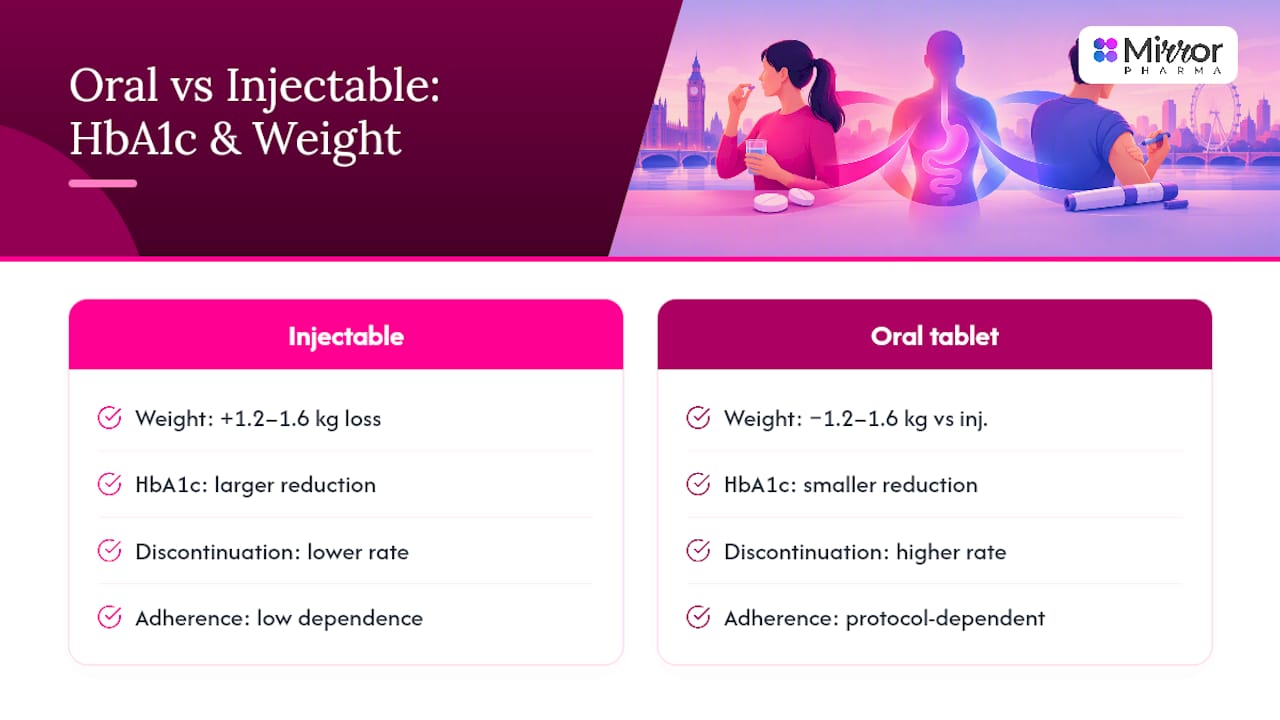
For weight loss, real-world cohort data comparing the two routes head-to-head found injectable semaglutide produced an average advantage of roughly 1.2 to 1.6 kilograms over oral semaglutide, alongside a meaningfully higher discontinuation rate for the oral group. That’s not a dramatic gulf for an individual patient, but across a clinic population it adds up, particularly when discontinuation is factored in rather than just the on-treatment result.
HbA1c reductions tell a similar story. Registry data from the UK’s ABCD national audit found injectable semaglutide tended to produce greater HbA1c reduction than oral semaglutide in routine clinical practice, echoing findings from controlled trials. Systematic reviews of the oral formulation’s trial programme (commonly referred to by its PIONEER designation in the literature, though we’re avoiding branded names here) generally support non-inferiority against comparator drug classes at higher doses, but “non-inferior to a comparator” and “equivalent to the injectable form of the same molecule” are different claims. A broader review of oral semaglutide’s efficacy and safety profile notes that outcomes vary considerably by dose and by how consistently patients follow the administration protocol, which is arguably the single biggest confound in comparing the two routes fairly.
What does this mean practically? If a patient is metabolically similar to the trial populations and takes the oral tablet exactly as directed, the gap narrows substantially. If adherence to the fasting protocol slips, even slightly, the gap widens. That single variable, more than the drug itself, tends to decide how “oral semaglutide effectiveness” plays out for any given patient.
Injectable dosing, delivered once weekly by subcutaneous injection, removes that variable almost entirely. The exposure a patient gets is far less dependent on what they ate that morning or how much water they drank with their tablet. This is the crux of most semaglutide comparison study findings: the molecule works. How much of it actually gets absorbed is the real point of divergence.
Why the delivery route changes everything: pharmacokinetics and dosing
The efficacy differences above aren’t really about the drug. They’re about how much of the drug survives the journey into the bloodstream, and that comes down to basic pharmacokinetics.
Injectable semaglutide has an absolute bioavailability of roughly 89%. Oral semaglutide achieves somewhere between 0.8% and 1.4% bioavailability, a difference of roughly ninetyfold. That’s not a typo, and it’s not a flaw in the oral formulation either. It’s the reason the tablet is co-formulated with a substance called SNAC (sodium N-[8-(2-hydroxybenzoyl) amino] caprylate), which locally raises stomach pH and helps the semaglutide molecule pass through the gastric lining before it’s broken down by digestive enzymes. Without SNAC, oral semaglutide simply wouldn’t work at any practical dose.
Because so little of the oral dose actually gets absorbed, the tablet has to contain a much larger nominal amount of drug than the injection to achieve a comparable therapeutic effect. This is why oral doses are measured in milligrams (3 mg, 7 mg, 14 mg) while injectable doses are measured in fractions of a milligram (0.25 mg up to 2 mg or higher, depending on the indication). There’s no validated one-to-one conversion between the two; some clinical analyses suggest oral 14 mg produces exposure roughly comparable to injectable 0.5 mg, but clinicians should never assume equivalence when switching a patient between forms. Response has to be reassessed, not extrapolated.
The administration rules for the tablet exist entirely because of that fragile absorption window. Patients need to take it on an empty stomach after at least eight hours of fasting, with no more than 120 mL of plain water, and then wait at least 30 minutes before eating, drinking anything else, or taking other oral medicines. Deviate from this and the consequences are measurable: taking the tablet with a larger volume of water, for instance, can reduce exposure by around 40%. That is a substantial drop for a drug that already has a razor-thin absorption margin.
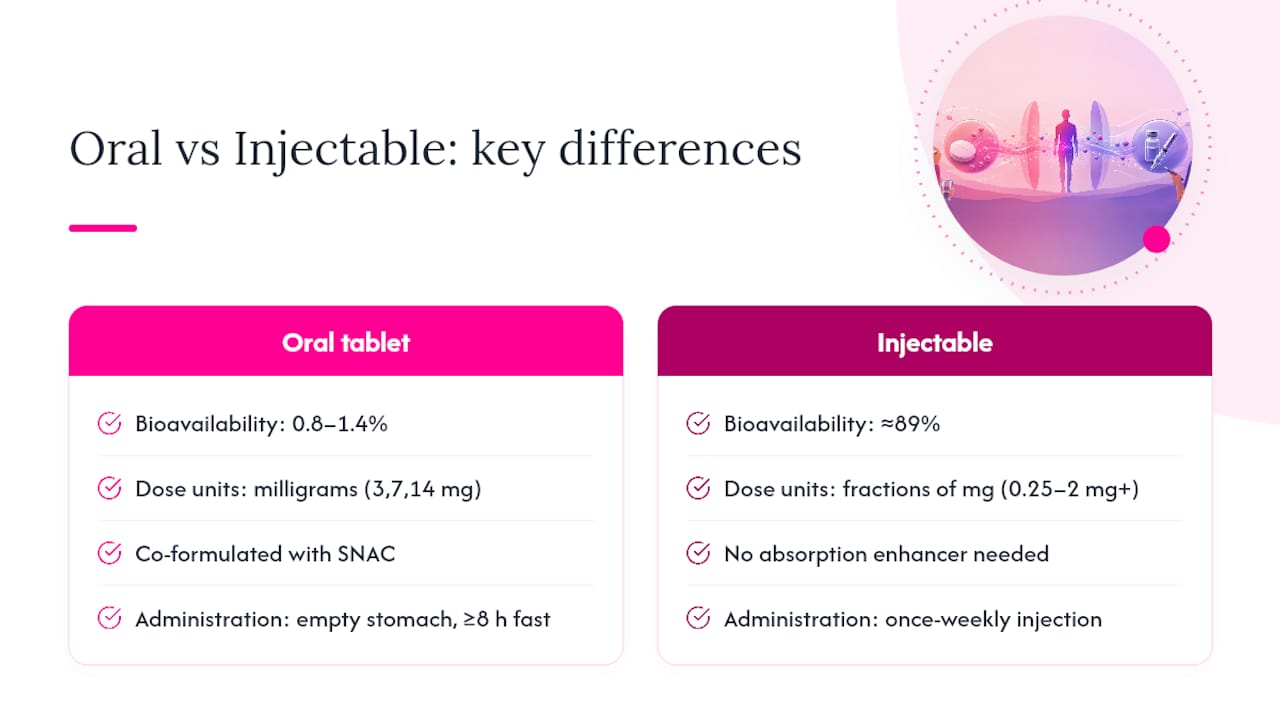
Injectable semaglutide asks nothing of the patient beyond a once-weekly injection, at any time of day, with or without food. For anyone managing multiple medications or an unpredictable schedule, that flexibility is not a minor convenience. It’s arguably the more clinically decisive difference between the two administration routes, well ahead of anything to do with the molecule itself.
What are the safety and discontinuation differences?
Gastrointestinal side effects, nausea, vomiting, diarrhoea, and reduced appetite, are common to both formulations and stem from the same GLP-1 receptor mechanism rather than the delivery route. Gradual dose titration over several weeks remains the standard way to blunt these effects for either form, and most patients see symptoms ease within the first few weeks of each dose step.
Where the two routes diverge is discontinuation. Pooled real-world analysis comparing oral against injectable semaglutide found a discontinuation risk ratio of 1.79 (95% CI 1.13 to 2.83) for oral versus injectable, meaning patients on the tablet were considerably more likely to stop treatment. That confidence interval is wide, which tempers how firmly you can state the finding, but even the lower bound suggests oral patients stop more often than injectable patients.
Some of that gap is likely administration burden rather than pure drug tolerability. A tablet that has to be taken fasted, first thing, with a tiny water allowance and a 30 minute waiting period, is simply harder to sustain than a weekly injection that fits around a patient’s life. One clinical perspective on both formulations notes that non-adherence to the fasting protocol is itself a common driver of apparent non-response to oral semaglutide, which muddies the line between “the drug didn’t work” and “the drug never really got the chance to.”
Injection-related issues are a different category entirely: mild injection-site reactions, redness or minor bruising at the injection site, occur in a minority of patients and rarely lead to stopping treatment. Needle aversion is a genuine barrier to starting injectable therapy for some patients, but it’s a starting barrier rather than a sustaining one. Once a patient is comfortable with the weekly routine, injection-site issues rarely drive discontinuation the way GI symptoms or protocol fatigue can with the tablet.
Cardiovascular outcomes: where the evidence base still differs
This is the area where the two formulations diverge most sharply in the eyes of UK guidance, and it’s worth being precise about why.
Injectable semaglutide has trial evidence demonstrating a reduction in major adverse cardiovascular events in patients with established cardiovascular disease or high cardiovascular risk. That evidence base is one of the reasons injectable semaglutide has moved beyond glycaemic control into a broader cardiometabolic role.
Oral semaglutide doesn’t yet have equivalent proof. Its pivotal trials weren’t statistically powered to detect cardiovascular superiority, only to rule out unacceptable cardiovascular harm, and they succeeded at that narrower goal without establishing benefit. A dedicated cardiovascular outcomes trial for the oral formulation is ongoing and could shift this picture, but until results are published and reviewed, the evidence gap stands.
UK formulary guidance reflects this distinction directly. Local prescribing guidance for oral semaglutide states plainly that injectable semaglutide is the preferred option when cardiovascular risk reduction is a treatment priority, positioning the oral tablet as an alternative for patients who find injections unacceptable rather than a first-line choice on cardiovascular grounds. That’s not a minor caveat buried in a footnote. It’s the explicit rationale UK commissioners give for which formulation to reach for first when cardiovascular disease is part of the clinical picture.
None of this means oral semaglutide is cardiovascularly unsafe. The trials showed no signal of harm. It simply means the proof of benefit that exists for the injectable form hasn’t yet been replicated for the tablet, and prescribing decisions should reflect that asymmetry rather than assume the two are interchangeable on this specific outcome.
How should clinicians choose between oral and injectable semaglutide?
There’s no universal answer here, but the decision usually comes down to a manageable set of patient factors rather than guesswork.
Injectable semaglutide tends to be the stronger fit when:
- The patient has established cardiovascular disease or a high cardiovascular risk profile, given the outcome evidence gap discussed above.
- Adherence to a strict fasting and administration protocol is unlikely, whether due to lifestyle, shift work, or other medication timing conflicts.
- Maximum weight loss or glycaemic effect is the clinical priority and injection is acceptable to the patient.
- The patient is already comfortable with, or has previously used, injectable therapy.
Oral semaglutide tends to be the more sensible starting point when:
- Needle aversion or a firm patient preference against injections would otherwise delay or prevent starting GLP-1 therapy at all.
- The patient can reliably follow a fasting, low-water, 30-minute-wait routine, ideally verified early through a structured counselling conversation.
- Injectable options are contraindicated or logistically unavailable for the individual.
Monitoring should follow the same rhythm regardless of formulation. UK prescribing guidance recommends a review at three months, with continuation justified only if the patient has achieved at least 3% weight loss or roughly 1% (10 mmol/mol) reduction in HbA1c. The same guidance flags that an estimated 2 to 4% of patients on oral semaglutide may have negligible drug exposure altogether, often traceable to administration errors rather than true non-response, which is why that three-month checkpoint matters so much for the tablet
Pro Tip: If a patient switching between oral and injectable semaglutide, never assume a dose equivalence and jump straight to a “matching” dose. Exposure overlaps exist in some pharmacokinetic analyses, but they’re approximations, not conversion tables. Restart titration cautiously and reassess glycaemic and weight response at the next scheduled review rather than carrying over the previous dose logic wholesale.
Clinicians can find structured titration timelines for GLP-1 agents, including both semaglutide formulations, in this GLP-1 dosing schedule reference.
What does real-world evidence add beyond the trials?
Randomised trials tell you what a drug can do under controlled conditions. Real-world data tells you what actually happens once thousands of ordinary patients, with ordinary schedules and ordinary lapses in routine, start taking it, and the two pictures don’t always match perfectly.
The real-world comparison referenced throughout this article, drawn from routine clinical practice rather than a trial protocol, found the same directional pattern as the controlled studies: injectable semaglutide outperformed oral on both weight and HbA1c, and oral semaglutide carried a notably higher discontinuation rate. What real-world data adds that trials can’t is visibility into why. Administration errors, missed fasting windows, tablets taken with breakfast out of habit, cut far more deeply into oral outcomes than any equivalent slip could affect an injection given once a week under nursing or self-administered supervision.
The UK’s ABCD national audit reinforces this from a different angle, using registry data collected across routine NHS practice rather than a research setting. It similarly found injectable semaglutide producing greater HbA1c reductions than oral in comparable patient cohorts.
Observational data has limits. It can’t fully control for why a clinician chose one formulation over another in the first place, and sicker or less adherent patients may have been steered toward one route more than the other for reasons the data doesn’t capture. But when trial evidence and multiple independent real-world cohorts point the same direction, that convergence is worth taking seriously. It’s the difference between a result that only holds in a controlled study and one that holds up when patients are managing the medication themselves, at home, around everything else in their lives.
A practitioner’s perspective on prescribing semaglutide
The oral versus injectable debate often gets flattened into a simple “which is better” question, and that framing misses what actually matters in practice. Both formulations are the same molecule with genuinely different clinical personalities. Injectable semaglutide is the more forgiving option pharmacologically. Oral semaglutide is the more forgiving option for a patient who would otherwise refuse GLP-1 therapy entirely.
The evidence doesn’t support treating the tablet as a lesser substitute, but it also doesn’t support pretending the fasting protocol is a minor detail. It’s the single variable most likely to determine whether an oral prescription succeeds or quietly fails. Guideline-aligned prescribing means being honest with patients about that trade-off before they start, not discovering it at the three-month review when the weight loss numbers don’t match expectations.
What remains genuinely uncertain is how the ongoing oral cardiovascular outcomes trial will reshape formulary positioning. Until then, individualised prescribing, grounded in patient preference, cardiovascular risk, and realistic adherence, is the only defensible approach.
— Rizwan
How Mirror Pharma supports clinicians prescribing semaglutide
Clinicians can source weight management and metabolic treatment supplies without delays that come from juggling multiple wholesalers. This supplier works exclusively with licensed practitioners and verified clinics to support prescribing and administration in professional settings, not to promote treatment to the public.
Beyond the weight loss category, where clinics can source both oral and injectable formulations alongside consumables, extended order cut-off times mean stock ordered later in the day still arrives on schedule, which matters when a clinic’s diary is already full of appointments waiting on delivery. Fulfilment is handled by a dedicated team familiar with the compliance and verification steps that this category demands, so orders move through without the friction that slows down less specialised suppliers.
For clinicians reviewing broader prescribing considerations before placing an order, this guide to weight management medication classes is a useful next stop. Verified practitioners can register and browse current stock directly through Mirror Pharma’s site to plan their next order.
This article is general information, not a substitute for advice from a qualified doctor. Consult a qualified healthcare professional about your own circumstances before acting on anything here.
Sources
- Real-World Comparison of Oral Versus Injectable Semaglutide for the Reduction of Hemoglobin A1C and Weight in Patients with Type 2 Diabetes
- Semaglutide oral (Rybelsus®) prescribing guidance (SW London)
- NHS BSW Prescribing guidance for Oral Semaglutide (Rybelsus®▼)
FAQ
Does oral semaglutide work as well as injectable semaglutide?
Not quite, on average. Real-world data shows injectable semaglutide typically produces greater weight loss (around 1.2 to 1.6 kg more) and stronger HbA1c reduction than oral semaglutide, largely because far more of the injected dose is actually absorbed. Oral semaglutide can still produce clinically meaningful results, particularly when the fasting protocol is followed precisely.
What are the disadvantages of oral semaglutide?
The main drawbacks are a strict administration protocol (fasting, minimal water, a 30 minute wait before eating or other medicines), much lower and more variable absorption than the injection, and a higher discontinuation rate in pooled comparisons. It also currently lacks the cardiovascular outcome evidence available for injectable semaglutide.
Is the semaglutide injection more effective than the tablet?
For most patients, yes, particularly for weight loss and consistency of glycaemic control, largely because injectable bioavailability (around 89%) is roughly ninety times higher than oral bioavailability (around 0.8 to 1.4%). Oral semaglutide remains a valid choice when injections are unacceptable to the patient, provided the administration rules are followed closely.
How often should treatment be reviewed after starting semaglutide?
UK prescribing guidance recommends a formal review at three months, continuing treatment only if the patient has achieved at least 3% weight loss or around 1% (10 mmol/mol) HbA1c reduction. This threshold applies to both oral and injectable formulations and helps identify patients with minimal drug exposure early.
Can Mirror Pharma supply both oral and injectable semaglutide to clinics?
Mirror Pharma supplies both formulations, alongside broader weight management and consumable stock, exclusively to verified licensed practitioners and clinics. Current availability and product listings can be checked directly through the weight loss category on Mirror Pharma’s site.