

If you are a licensed practitioner, the first steps to opening an aesthetics clinic are working out whether your planned services count as regulated activities under Care Quality Commission rules, securing verified clinical training with appropriate indemnity cover, and preparing compliant premises and policies. You should also track the Department of Health and Social Care’s licensing consultation, which is reshaping obligations for higher-risk procedures. What follows is an ordered checklist for licensed practitioners covering registration, training, premises, insurance, sourcing and launch.
TL;DR:
- Practitioners should verify if their planned treatments involve inserting instruments or are classified as surgical before applying for CQC registration, which takes 12 to 16 weeks.
- Accredited training from recognized bodies is essential, with documented supervised practice, as insurers increasingly refuse coverage for insufficiently verified qualifications.
- Clinics must have dedicated, compliant treatment rooms with appropriate infection control, waste management, and optional local licensing for laser or IPL equipment.
- Adequate insurance includes employer, public liability, and clinical indemnity coverage, with documentation needed to satisfy insurers and inspectors.
- Starting with lower-risk, non-regulated treatments during early stages reduces regulatory and clinical risks while building compliance infrastructure.
Table of Contents
- Understanding the regulatory landscape and when CQC registration applies
- Training, qualifications and acceptable pathways to practise
- Premises, local licences and clinical governance for treatment rooms
- Insurance and indemnity: securing appropriate cover
- Business plan essentials and realistic start-up cost ranges
- Operational compliance: policies, inventory management and safety systems
- Marketing and advertising: staying compliant with ASA/CAP and POM rules
- Sourcing medicines, consumables and supplier selection
- Practical timeline and pre-opening checklist
- Guidance on data protection and patient confidentiality standards
- Detailed overview of staffing requirements and hiring considerations
- Financial management aspects: taxation, VAT and bookkeeping
- Technology and equipment maintenance best practices
- Patient consultation and consent processes
- What experienced clinicians wish they had known sooner
- How Mirror Pharma supports licensed practitioners launching a clinic
- Sources
- FAQ
Understanding the regulatory landscape and when CQC registration applies
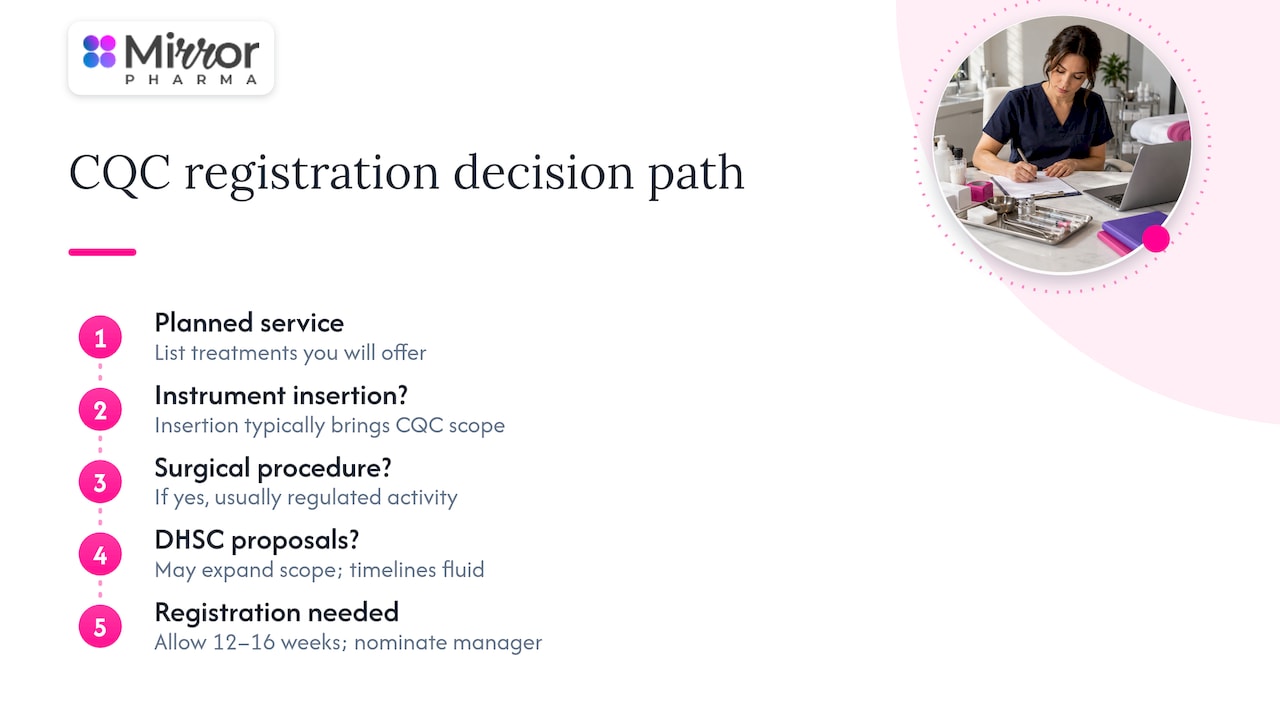
Not every aesthetic treatment triggers CQC registration. The CQC’s guidance on regulated activities explains that surgical procedures involving the insertion of instruments into the body typically fall within scope, while treatments using only external energy application, such as certain laser or IPL work without insertion, generally do not unless combined with other regulated care. Standard subcutaneous injectable treatments are often outside CQC’s remit for this reason, though this is shifting.
The government’s consultation on licensing non-surgical cosmetic procedures sets out plans to introduce legal restrictions on the highest-risk procedures and to develop local-authority licensing for lower-risk work, with age restrictions also under consideration. The Department of Health and Social Care and CQC are working through the detail together, and any changes will proceed through secondary legislation and parliamentary process, so timelines remain fluid.
Where registration is required, the application process typically takes 12 to 16 weeks and requires a nominated registered manager accountable for quality and safety.
Before you commit to premises or staffing, run through a short decision checklist: does any planned service involve inserting an instrument into the body, does it fall under the surgical procedures definition, and could the DHSC proposals bring it into scope soon. Answering these honestly now avoids a costly registration surprise later.
Training, qualifications and acceptable pathways to practise
Medical and beauty routes into aesthetics diverge sharply, and regulators and insurers treat them differently. A prescriber or clinician, such as a doctor, dentist, nurse prescriber or pharmacist prescriber, must be involved wherever a prescription-only medicine is used, since these cannot be self-administered by non-prescribing staff. Beauty and therapy-trained practitioners can deliver a narrower range of non-prescription treatments but should not be positioned as equivalent to prescribing clinicians.
Recognised training references from Health Education England and the Joint Council for Cosmetic Practitioners matter because insurers and inspectors use them as a benchmark for competence. When selecting a training provider, check accreditation against a recognised standard, confirm hands-on supervised practice hours rather than theory alone, and keep every certificate, case log and supervision sign-off on file.
Treat a one or two-day course with no verifiable supervised practice as a red flag. Insurers increasingly decline claims or refuse cover where training evidence is thin, so thorough documentation protects both the practitioner and the business.
Premises, local licences and clinical governance for treatment rooms
A compliant treatment room needs a dedicated clinical space separate from reception and waiting areas, proper infection control procedures, secure clinical waste management with a licensed collection contract, and clear documentation trails for every procedure performed.
Laser and IPL equipment, or any service edging towards surgical intervention, tends to increase local-authority or CQC oversight, since these fall closer to the regulated activities boundary described earlier. Where your local authority operates a special treatments licence, laser and IPL premises usually need separate approval before you open.
Inspectors and licensing officers commonly request evidence including staff training certificates, infection control policies, equipment maintenance logs, insurance certificates and consent documentation templates.
A practical premises tick-list before opening:
- Confirm room layout meets infection control and privacy standards.
- Arrange a licensed clinical waste contract and sharps disposal system.
- Check whether your local authority requires a special treatments licence for lasers or IPL.
- Assemble a folder of policies and certificates ready for inspection.
Insurance and indemnity: securing appropriate cover
Clinics typically need three types of cover: employers’ liability insurance if you employ any staff, public liability insurance for visitors and clients on the premises, and medical malpractice or indemnity insurance for the clinical treatments themselves. Each protects against a different risk, and gaps between them are a common cause of uninsured claims.
The JCCP’s insurance charter argues for mandatory adequate indemnity linked to verified training, reflecting how insurers already operate in practice: they frequently ask for documented evidence of practical competence and ongoing CPD, and may restrict or refuse cover where that evidence is missing.
Before applying, gather full training records, define the exact scope of procedures you intend to offer, and list your medicine and consumable suppliers. Once cover is in place, display your certificate where clients can see it and register with an approved alternative dispute resolution or redress scheme so complaints have a clear route.
Business plan essentials and realistic start-up cost ranges
A workable business plan needs sections covering your service mix, the regulatory classification of each service, staffing structure, projected revenue, cashflow forecasts and total capital required. Lenders and investors will expect all five before releasing funds.
Sector guidance from the National Hair and Beauty Federation points to start-up budgets typically ranging from around £20,000 to £50,000 depending on the equipment and treatments involved. The main cost drivers are premises fit-out, clinical equipment, initial stock and consumables, staff wages and any licensing or registration fees.
Funding routes include self-financing, bank loans and government-backed start-up loan schemes, each with different requirements around personal guarantees and business plans. Bring in an accountant early, particularly one familiar with healthcare or clinic accounting, since aesthetics businesses have specific VAT treatment that a general small-business adviser may miss.
In year one, prioritise a cash buffer for slow months, contingency funds for equipment repairs and enough working capital to maintain consistent stock levels without overextending credit with suppliers.
Operational compliance: policies, inventory management and safety systems
Every clinic needs a written set of core policies before treating a single client:
- Informed consent procedures for each treatment type.
- Infection control and cross-contamination prevention protocols.
- Sharps handling and disposal procedures.
- Incident reporting and emergency response plans.
Inventory discipline matters as much as clinical protocol. A practical inventory playbook covering batch tracking, expiry monitoring and reorder points helps prevent both clinical risk and wasted stock.
Suspected adverse reactions should be reported through the MHRA Yellow Card scheme as part of your standard incident policy, with every report logged alongside the client’s clinical notes.
Pro Tip: Write a one-page SOP covering your first 30 treatments, from consultation through to aftercare calls, so early mistakes are caught by protocol rather than memory.
Marketing and advertising: staying compliant with ASA/CAP and POM rules
ASA and CAP guidance is explicit that prescription-only medicines cannot be advertised to the public, and this extends to hashtags and indirect references, not just direct product mentions. Focus marketing copy on the consultation, safety process and practitioner qualifications rather than naming any prescription treatment.
On social media, avoid before-and-after language that implies a guaranteed result, and never promise permanent or risk-free outcomes. Compliant calls-to-action invite a consultation booking rather than a treatment purchase. Keep dated records of every advert and caption in case a complaint is raised, since evidence of your claims and their basis is what regulators ask for first.
Sourcing medicines, consumables and supplier selection
Prescription-only medicines must be obtained through lawful prescribing and supply channels, with every order tied to a verified prescriber and clinic registration. This is not optional paperwork: it is the mechanism that keeps supply traceable back to a named, accountable clinician.
When choosing a supplier, check for practitioner verification at account setup, reliable delivery windows that match your appointment schedule, clear product information and access to clinical resources such as needle charts and safe-handling guidance.
A reliable supplier should have a verified ordering system for licensed practitioners, extended order cut-off times for dependable delivery, and provide clinical resource pages for prescribers and clinics.
This section, like all supplier information here, is written for licensed practitioners and qualified aesthetic professionals only, never as promotion of a prescription-only medicine to the public.
Practical timeline and pre-opening checklist
Typical lead times run in parallel rather than sequence: training and CPD (weeks to months depending on pathway), premises fit-out (4 to 8 weeks), supplier and insurance setup (2 to 4 weeks), and any CQC registration running the 12 to 16 weeks noted earlier.
- Register your business entity and open a business account.
- Complete accredited training and gather all certificates.
- Secure employers’ liability, public liability and medical indemnity insurance.
- Confirm whether CQC registration or local licensing applies to your services.
- Fit out premises and finalise waste and infection control contracts.
- Set up verified supplier accounts and place initial stock orders.
- Write core policies and consent documentation.
- Soft-launch with non-regulated services before adding higher-risk treatments.
Starting with lower-risk, non-regulated treatments while registrations and higher-risk training complete reduces both clinical and regulatory exposure during your first months.
Guidance on data protection and patient confidentiality standards
Clinics hold special category health data, which UK GDPR treats with stricter conditions than ordinary personal information. You need a lawful basis for processing (usually explicit consent or, for some clinical purposes, provision of healthcare), a documented retention policy, and a clear record of who can access client files.
Practical steps include encrypting or password-protecting electronic records, restricting physical file access to clinical staff, and using a clinic management system that logs who viewed or edited a record and when. Photographs used for clinical assessment need their own explicit consent, separate from general treatment consent, and should never be used in marketing without a distinct, specific agreement from the client.
You should also register with the Information Commissioner’s Office if your processing activities require it, appoint a named person responsible for data protection decisions, even if not a formal Data Protection Officer, and have a breach response plan ready before you open. Confidentiality extends to conversations at reception: staff need training on not discussing client details within earshot of other clients, and consultation rooms should be soundproofed enough to prevent casual overhearing.
Data protection failures are a common source of complaints even when clinical care is sound, so build this into your opening checklist rather than treating it as an afterthought once trading begins.
Detailed overview of staffing requirements and hiring considerations
Staffing structure depends on your service mix and regulatory classification. A clinical director, typically a prescribing clinician, holds overall responsibility for treatment protocols, prescribing decisions and clinical governance. Where CQC registration applies, a nominated registered manager is a specific legal requirement, and this role can sit with the clinical director or a separate accountable individual.
Nursing and prescribing staff need their professional registration verified and kept current, along with documented aesthetics-specific training beyond their core qualification. Reception and administrative staff are not clinical roles, but they still need training on confidentiality, basic safeguarding awareness and how to handle a client who reports an adverse reaction, since they are often the first point of contact.
When hiring, check professional indemnity cover extends to each individual’s scope of practice, not just the clinic as a whole, and keep DBS checks current for any staff member working unsupervised with clients. Build a simple staff file for each employee containing qualifications, registration numbers, indemnity confirmation and CPD records, since this is exactly what an insurer or inspector will ask to see.
Rotas should reflect that a prescriber needs to be reachable, in person or remotely, whenever prescription-only medicines are administered, even if they are not the one delivering the treatment.
Financial management aspects: taxation, VAT and bookkeeping
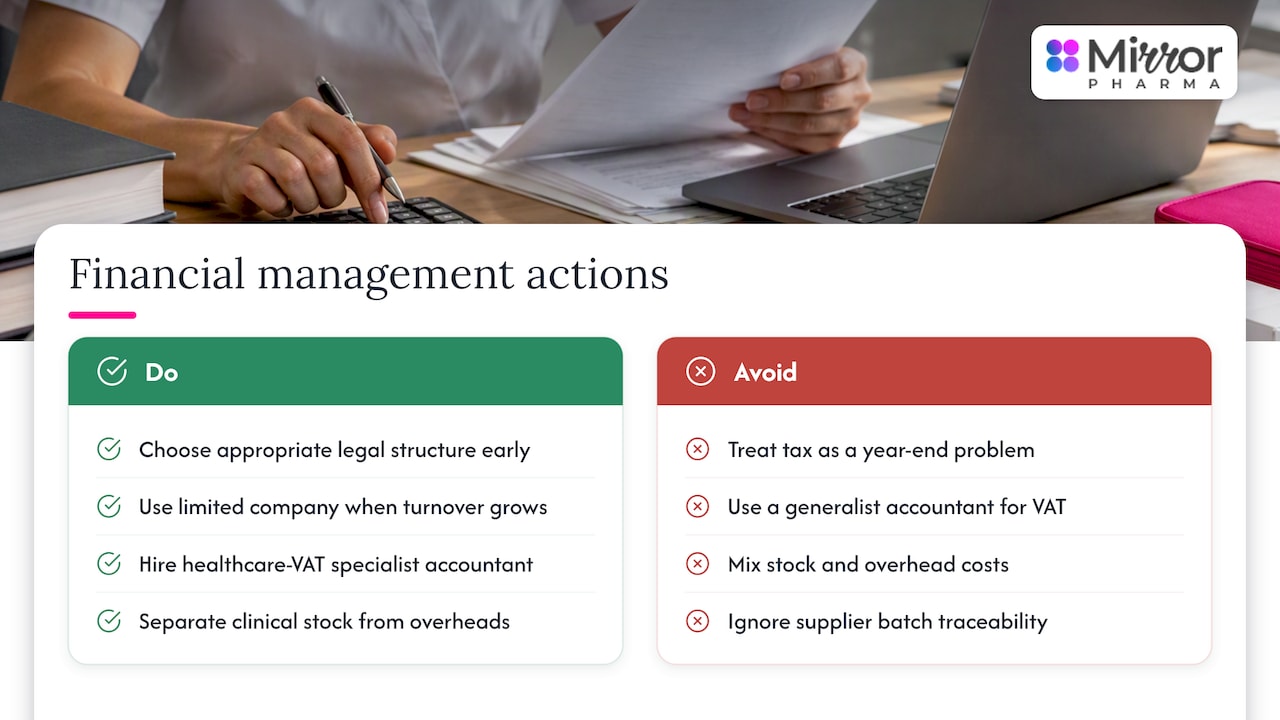
Most aesthetics clinics operate as either sole traders, partnerships or limited companies, and the choice affects both your tax liability and personal financial exposure. A limited company structure is common once turnover grows, since it separates personal and business liability, though it brings additional reporting obligations.
VAT treatment in aesthetics is genuinely mixed and a frequent source of errors. Purely cosmetic treatments with no medical purpose are generally standard-rated for VAT once you cross the registration threshold, while treatments delivered for a genuine medical or therapeutic purpose by a registered healthcare professional can qualify for exemption. Getting this wrong in either direction creates a real financial and compliance risk, so an accountant familiar with healthcare VAT rules, not a generalist, is worth the fee.
Bookkeeping specific to clinics should separate clinical stock costs (which move with treatment volume) from fixed overheads (rent, insurance, staff salaries), since this split is what makes your margins visible service by service. Track supplier invoices against batch numbers for traceability, and reconcile stock use against appointments booked to catch discrepancies early.
Set aside funds for tax and National Insurance from day one rather than treating them as a year-end problem, and review pricing at least twice a year against your actual product and staffing costs, since aesthetics stock prices and wage costs both move independently of your fee list.
Technology and equipment maintenance best practices
Clinical equipment, from laser devices to microneedling systems, needs a documented maintenance schedule, not an informal “call someone when it breaks” approach. Manufacturers typically specify service intervals, and skipping them risks both equipment failure mid-treatment and invalidated warranties or insurance cover.
Keep a maintenance log for every device recording service dates, calibration checks and any faults reported, since inspectors and insurers may ask to see it alongside your training records. Software systems used for booking, client records and consent should be checked for UK GDPR compliance before adoption, particularly around data storage location and access controls.
Refrigeration for medicines requiring cold storage needs its own temperature monitoring log, checked and recorded daily, since a break in the cold chain can render stock unsafe to use even if it looks unchanged. Build equipment replacement costs into your annual budget rather than treating a major device failure as an emergency expense, and keep a backup plan, such as a loan device arrangement or a shortlist of alternative suppliers, for anything central to your core services.
Patient consultation and consent processes
A thorough consultation, not just a signature on a form, is the foundation of defensible consent. It should cover medical history, current medications, allergies, previous aesthetic treatments and a realistic discussion of expected outcomes, including that no treatment can be guaranteed to produce a specific result.
Consent documentation should be tailored to each treatment type rather than using one generic form for every procedure, since the risks, aftercare and contraindications differ significantly between, for example, a dermal filler and a course of vitamin infusions. Include space for the client to note questions asked and answered, and record the date and the clinician who conducted the consultation.
A cooling-off period between consultation and treatment is good practice for anything irreversible or high-risk, giving clients time to reflect rather than consenting under time pressure in a single visit. Store consent forms with the same security as other clinical records, and review your templates periodically against current guidance, since consent standards in aesthetics have tightened as regulatory scrutiny has increased.
What experienced clinicians wish they had known sooner
The most common early mistake is underestimating how much time compliance paperwork takes against actual clinical work. Build in more admin time than feels necessary, and lean on established clinical resources rather than reinventing protocols from scratch.
— Rizwan
How Mirror Pharma supports licensed practitioners launching a clinic
Getting a new clinic stocked without delays or verification headaches is one of the quieter challenges of opening. Mirror Pharma is built specifically for licensed practitioners and qualified aesthetic professionals, with an ordering system that verifies practitioner credentials before releasing access and extended order cut-off times designed to keep delivery reliable when your appointment book is already full.
Suppliers provide various products for injectable treatments, including dermal fillers and hyaluronic acid fillers, toxins for anti-wrinkle treatments available to verified prescribers, IM/IV vitamins and infusion therapies, weight loss medications, polynucleotides, skin boosters, fat dissolving products, as well as needles, syringes and clinical consumables.
Browse the dermal fillers category or the full shop to review verification requirements and clinical resources before placing your first order. This information is intended for licensed practitioners and qualified aesthetic professionals, not for members of the public seeking treatment.
This article is general information, not a substitute for advice from a qualified doctor. Consult a qualified healthcare professional about your own circumstances before acting on anything here.
Sources
- Gov
- Treatment of disease, disorder or injury – Care Quality Commission
- NHBF beauty start-up guide
- Prescription-only medicine advertising guidance – ASA
- Joint Council for Cosmetic Practitioners – Insurance charter (draft)
FAQ
How much does it cost to start an aesthetics business?
Sector guidance suggests start-up budgets typically range from around £20,000 to £50,000, depending on the equipment and treatments offered. Fit-out, initial stock, staffing and insurance are the main cost drivers.
Do I need a licence to practise aesthetics?
Whether you need CQC registration depends on whether your services are classed as regulated activities, such as certain surgical procedures involving instrument insertion, under CQC guidance. Many standard cosmetic injectable treatments fall outside this scope currently, but local-authority licensing is expanding under proposed reforms.
What is the new law on aesthetics treatments?
The government is consulting on legal restrictions for the highest-risk non-surgical procedures, alongside new local-authority licensing for lower-risk treatments and possible age restrictions. These proposals are still progressing through consultation and secondary legislation, so the final framework has not yet taken effect.
How do I start an aesthetic clinic as a licensed practitioner?
Start by confirming your services’ regulatory classification, completing accredited training with verifiable supervised practice, and securing employers’ liability, public liability and medical indemnity insurance. From there, arrange compliant premises, verified supplier accounts and core policies before a staged launch beginning with non-regulated treatments.
Where can licensed practitioners source dermal fillers and toxins compliantly?
Licensed practitioners should use verified suppliers that check prescriber credentials before releasing prescription-only medicines, such as Mirror Pharma’s clinician-facing categories. This information is for qualified aesthetic professionals only and is not a promotion of prescription medicines to the public.