

Yes: licensed UK prescribers may prescribe tirzepatide when patients meet NICE TA1026 eligibility criteria and local commissioning rules. Before any prescription, verify the patient’s identity and BMI independently, document wraparound care arrangements and confirm pregnancy and contraception status. This applies to licensed practitioners, aesthetic prescribers and clinic teams working within their scope of practice, not to unsupervised self-prescribing or online sale without verification.
TL;DR:
- Prescribers must verify BMI, weight, and patient identity independently before prescribing tirzepatide, in line with NICE and GPhC requirements.
- Treatment continuation depends on a six-month weight loss of at least 5%, calculated precisely and recorded at review.
- Screening involves full blood, kidney, liver, thyroid tests, and medication review, especially for insulin or sulphonylureas, before the first dose.
- Women of childbearing potential must use effective contraception during treatment, with detailed guidance on switching or barrier methods and stopping before pregnancy.
- Accurate documentation of eligibility, dose changes, adverse effects, and clinical decisions is essential to ensure compliance and patient safety.
Table of Contents
- NICE eligibility, dosing and titration: the prescribing essentials you must record
- Clinical screening, contraindications and safety checks before prescribing
- Compliant sourcing, verification and supply for clinic prescribers
- Patient counselling, contraception and consent: what to tell patients at start and at each escalation
- Monitoring, review and stopping: follow-up schedule and the 6-month effectiveness check
- A note on compliance and clinical judgement in tirzepatide prescribing
- How Mirror Pharma supports verified prescribers with tirzepatide supply
- Sources
- FAQ
NICE eligibility, dosing and titration: the prescribing essentials you must record
NICE TA1026 sets out who qualifies for tirzepatide as an option for managing overweight and obesity, based on BMI thresholds, defined comorbidities and, for some groups, adjusted BMI cut-offs reflecting ethnicity-related risk. Local commissioning rules can add further conditions, so check the relevant pathway before initiating treatment rather than relying on the national appraisal alone.
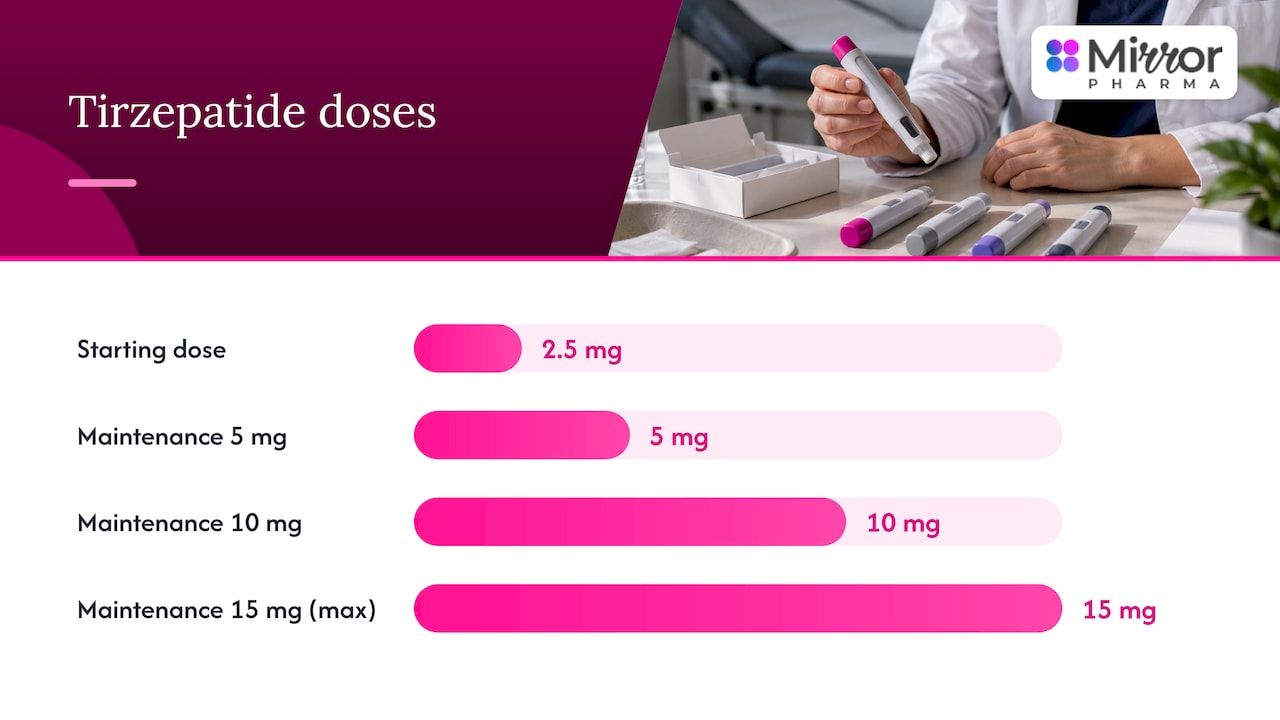
The standard titration schedule, as described in CKS prescribing information, starts at 2.5 mg once weekly, with incremental increases at set intervals through maintenance doses of 5 mg, 10 mg and 15 mg, up to a maximum of 15 mg weekly. Each increase should be reviewed against tolerability rather than pushed through on a fixed timetable.
Document each of these at initiation and at every dose change:
- Current weight, BMI and the comorbidities that justified eligibility.
- The exact dose, injection date and site used.
- Any gastrointestinal or other adverse effects reported since the last dose.
- Contraception status for patients of childbearing potential.
Injection sites should rotate between abdomen, thigh and upper arm to reduce local irritation. The NICE practical guide also sets storage expectations for the pre-filled pen: keep it refrigerated at 2 to 8°C, with a 30 day out-of-fridge limit once in use, as noted in the appraisal’s practical guidance.
The 6-month, 5% threshold decides whether treatment continues. NICE TA1026 frames review at six months on the highest tolerated dose as the point to assess whether the patient has lost at least 5% of their starting weight, a figure that should be calculated and recorded at every review rather than estimated.
Clinical screening, contraindications and safety checks before prescribing
Screening tirzepatide candidates means ruling out absolute contraindications and flagging cautions that change how closely you monitor. Hypersensitivity to tirzepatide or any excipient rules out prescribing outright. A history of pancreatitis, severe gastrointestinal disease or diabetic retinopathy calls for caution and closer follow-up rather than automatic exclusion, per the description in CKS.
Before the first prescription, document:
- Renal and liver function tests, plus a full blood count.
- Thyroid function, given the relevance to metabolic assessment.
- A full medication review, particularly insulin or sulphonylureas, where hypoglycaemia risk rises when tirzepatide is added.
- Pregnancy status and current contraceptive method.
- Any personal or family history relevant to pancreatic or thyroid disease.
Patients on insulin or sulphonylureas need their doses reviewed at initiation and at each escalation, since the added effect of tirzepatide can push blood glucose too low. Where a patient has complex comorbidities, uncontrolled diabetic retinopathy or an unclear diagnostic picture, refer to an endocrinologist or the patient’s GP before proceeding, and record the reasoning and outcome of that referral in the clinical notes rather than simply noting that a referral was made.
Compliant sourcing, verification and supply for clinic prescribers
The GPhC has been explicit that supplying weight management medicines requires independent verification of weight, height and BMI, plus two-way communication with the patient before any prescription is issued. An online questionnaire completed without that verification and dialogue does not meet the regulator’s expectations, regardless of how detailed the form is.
Online or hybrid clinic models may also fall within CQC registration requirements for online primary care services, so check whether your delivery model needs registration before advertising remote prescribing.
For procurement, follow this sequence:
- Confirm the supplier or wholesaler holds the correct licences and check their verification process for practitioner accounts.
- Check batch numbers and expiry dates against the delivery note on arrival.
- Record cold-chain confirmation for every delivery, including transit temperature evidence where supplied.
- Store pens in a monitored fridge with access limited to authorised staff, and log fridge temperature checks.
- Retain procurement and dispensing records for the period set by your indemnity provider and professional body.
Pro Tip: Keep a single log linking each patient’s dose record to the batch number dispensed, so a supply issue or adverse event can be traced in minutes rather than hours.
Where a patient refuses GP contact or declines part of the verification process, document the refusal, the risks explained and the clinical rationale for proceeding or declining, since a risk-based decision recorded at the time is your strongest protection if questioned later.
Patient counselling, contraception and consent: what to tell patients at start and at each escalation
MHRA guidance issued in June 2025 urges that women taking GLP-1 medicines such as tirzepatide use effective contraception, given the uncertainty around interaction with oral contraceptives and the risks of pregnancy during treatment. Advise switching to a non-oral method or adding a barrier method during initiation and for four weeks after each dose increase, and advise stopping tirzepatide one month before a planned pregnancy.
Cover these points at every initiation and dose change:
- Common gastrointestinal effects such as nausea, vomiting and diarrhoea, and the dehydration risk that follows.
- When to seek urgent care, including persistent vomiting, severe abdominal pain or signs of pancreatitis.
- How to report suspected adverse reactions through the Yellow Card scheme.
- Correct injection technique, site rotation, and using a separate site from insulin injections if the patient also uses insulin.
- Safe sharps disposal using an approved container.
MHRA safety communications treat contraception counselling as a near-universal requirement for patients of childbearing potential on GLP-1 medicines, a point that should be documented at every consultation rather than assumed from the initial visit alone.
Consent should be tied to a documented plan for diet, activity and behavioural support, not the prescription in isolation, reflecting the wraparound care expectations set out by NICE.
Monitoring, review and stopping: follow-up schedule and the 6-month effectiveness check
Follow-up during titration should happen roughly every four weeks, tapering to a cadence set by local pathways once the patient reaches a stable maintenance dose. Each visit should record:
- Current weight and BMI, compared against the starting figure.
- Hydration status and any gastrointestinal symptoms since the last visit.
- Concomitant medication changes, particularly insulin or sulphonylurea adjustments.
- Contraception status and any change in pregnancy plans.
- Injection site condition and technique check.
At six months on the highest tolerated dose, calculate the percentage weight lost against the starting weight. The NICE practical guide sets this as the point to decide whether to continue treatment or stop, based on whether the 5% weight loss threshold has been met. Record the calculation and the decision, not just the outcome. Serious adverse events, including suspected pancreatitis or severe allergic reactions, should be escalated immediately and reported through the Yellow Card scheme, alongside a referral to the patient’s GP where ongoing care is needed.
A note on compliance and clinical judgement in tirzepatide prescribing
The gap between what tirzepatide’s licence permits and what a clinic actually documents is where most compliance problems start. Eligibility criteria, titration tables and review points are published and clear. What gets missed is the paperwork trail: the verification call that was rushed, the contraception conversation that was assumed rather than confirmed, the batch number that was never logged against a patient record.
Clinics that treat documentation as a formality rather than clinical practice are the ones that struggle if a regulator or indemnity provider asks questions later. The tools mentioned throughout, from dosing timelines to comparison notes on tirzepatide versus semaglutide, only help if the underlying verification and consent process is solid. Clinical judgement, not a checklist alone, is what protects the patient and the prescriber.
— Rizwan
How Mirror Pharma supports verified prescribers with tirzepatide supply
Aesthetic product suppliers work with licensed practitioners and prescribers who need reliable access to weight management products alongside verification standards regulators expect. Professional accounts go through verification before any prescription-only item ships, and extended order cut-off times mean clinics ordering later in the day can still expect prompt fulfilment rather than a lost day in the schedule.
Verified prescribers can browse the Weight Loss category alongside clinical resources such as the GLP-1 dosing schedule guide. For practitioners setting up a professional account or confirming eligibility to order, the Mirror Pharma clinical team is the first point of contact, reachable through the main site.
This article is general information, not a substitute for advice from a qualified doctor. Consult a qualified healthcare professional about your own circumstances before acting on anything here.
Sources
- Supplying medicines for weight management — GPhC
- Women on ‘skinny jabs’ must use effective contraception, MHRA urges
- Tirzepatide | Prescribing information | Obesity | CKS | NICE
- Prescribing, reviewing and stopping tirzepatide | NICE practical guide
FAQ
What BMI qualifies a patient for tirzepatide under NICE TA1026?
NICE TA1026 sets specific BMI thresholds alongside comorbidity requirements, with adjusted thresholds for some ethnic groups reflecting different obesity-related risk. Check the full appraisal and any local commissioning addition before confirming eligibility for an individual patient.
How often should patients be reviewed while titrating tirzepatide?
Review roughly every four weeks during dose escalation, checking weight, adverse effects, concomitant medication and contraception status at each visit. Cadence can extend once the patient reaches a stable maintenance dose, following local pathway guidance.
What contraception advice applies when starting tirzepatide?
MHRA guidance recommends switching to a non-oral contraceptive method or adding a barrier method during initiation and for four weeks after each dose increase. Patients should also stop tirzepatide one month before a planned pregnancy.
Can a clinic prescribe tirzepatide based on an online questionnaire alone?
No: the GPhC requires independent verification of weight, height and BMI plus two-way communication before supply, and an online questionnaire alone does not meet this standard. Clinics using remote or hybrid models should also check whether CQC registration applies to their service.
When should a prescriber stop tirzepatide after starting treatment?
The NICE practical guide sets the six-month point on the highest tolerated dose as the review stage, where the decision to continue or stop depends on whether the patient has lost at least 5% of their starting weight. This calculation and the resulting decision should be documented at that review.