

The best injection pain management comes from stacking three things together: a topical or vapocoolant agent, vibration or counter-stimulation applied at the injection site, and a slow, low-pressure injection technique using micro-boluses. Nerve blocks add real value in a small number of high-sensitivity cases, but only for practitioners with the training to use them safely. For licensed practitioners working under UK medicines guidance, some suppliers provide the consumables and lidocaine-containing fillers that make this combined approach practical in daily clinic work.
TL;DR:
- Combining topical anesthetics, vibration, and slow micro-bolus injections significantly reduces facial injection pain, especially in highly sensitive areas.
- Proper timing of topical anesthetic application is critical, with licensed products like Pliaglis requiring 30 to 60 minutes under occlusion for optimal depth.
- Vibration devices outperform cold and cream in pain reduction, but should be used with topical agents for deeper or more sensitive zones.
- Nerve blocks are reserved for high-sensitivity cases or large areas, requiring trained practitioners and careful dosing to prevent complications.
- Injectable local anesthetics are prescription-only in the UK, and clinics must record usage, doses, and patient responses to maintain governance and safety standards.
Table of Contents
- Topical pharmacological options: creams, formulations and practical use
- Vapocoolant sprays, ice and vibration devices compared
- Slow injection, micro-boluses and choosing between needle and cannula
- Nerve blocks for facial injections: when they earn their place
- UK medicines regulation and clinic governance for anaesthetic use
- A pre-treatment to aftercare checklist for pain-aware clinics
- Oral pre-medication and sedation: pharmacological options beyond topical creams
- Distraction, breathing and other behavioural techniques that reduce perceived pain
- Warming and buffering injectable solutions before use
- How to assess and monitor pain during the injection itself
- Author perspective — practical reflections from a practising supplier
- How Mirror Pharma supports pain-aware injection practice
- Sources
- FAQ
Topical pharmacological options: creams, formulations and practical use
Lidocaine and prilocaine combination creams remain the first line for many practitioners, but timing matters more than most injectors assume. Depth of dermal penetration follows a predictable curve: around 3mm after 60 minutes under occlusion, extending to roughly 5mm by 120 minutes. Apply too briefly and you numb the surface while deeper periosteal or subcutaneous pain remains untouched, which is exactly where topical anaesthesia falls short for many facial injection sites.
Licensed products carry their own application windows. The lidocaine/tetracaine combination Pliaglis demonstrated statistically significant pain reduction against placebo in dermal procedures, applied for 30 to 60 minutes depending on the procedure per its licensed monograph.
Practical points for clinic use:
- Apply under occlusion to improve penetration, particularly around the lips where landmark distortion can complicate injection accuracy.
- Respect maximum surface area and dose limits stated on the product licence; do not extrapolate beyond it.
- Maintain strict infection control when removing occlusive dressings before antisepsis.
- Topical anaesthesia is often impractical for mucosal or highly vascular zones, where absorption and irritation risk both increase.
The JCCP guidance on topical anaesthetics sets out which products sit on pharmacy-only versus prescription-only status, and who may lawfully supply or apply them in a non-prescribing setting. Get this wrong and you have a governance problem, not just a clinical one.
Vapocoolant sprays, ice and vibration devices compared
Vibration analgesia outperformed both cold and topical cream in a randomised controlled trial of 100 volunteers undergoing forehead injections, with statistically significant results (P < 0.015) favouring vibration over the alternatives tested in that study. That single finding has reshaped how many injectors think about counter-stimulation.
Pooled evidence backs the combination. A systematic review pooling multiple RCTs and controlled trials found an overall effect size of minus 1.20 on the VAS scale favouring topical gels, vibration and cooling collectively over no analgesia at all. Earlier work also documented vapocoolant sprays and contact cooling reducing both pain and ecchymosis across several device studies.
Application guidance that actually matters in clinic:
- Never place ice directly on skin. Wrap it in a disinfected glove or use a sterile gel pack, particularly where infection control protocols demand it.
- Time vapocoolant sprays to the moment of needle entry rather than holding a continuous spray, which risks tissue cooling injury.
- Combine vibration devices with topical cream for deeper or more sensitive zones rather than relying on either alone.
- Mucosal areas and highly sensitive patients may tolerate vibration poorly, so assess before committing to a device.
Slow injection, micro-boluses and choosing between needle and cannula
Consensus recommendations for facial aesthetic injections consistently point to slow injection technique and micro-boluses as the single most controllable variable in reducing patient discomfort. Injecting under 0.1mL per bolus, at low extrusion pressure, spreads tissue distension over time rather than delivering a sudden bolus that stretches nerve endings and triggers a sharper pain response. It also reduces the risk of vascular compromise, since a slow push gives you time to notice resistance or blanching before it becomes a complication.
Cannula versus needle is not a simple either-or. Needles offer precision and are essential for superficial, controlled deposits; cannulas reduce bruising and vessel trauma across larger treatment planes because the blunt tip displaces rather than pierces vessels. Choice depends on the treatment area and your comfort with the tool, not fashion.
Practical points for the injecting hand:
- Match needle gauge to the product viscosity; thicker fillers generally need a wider bore to avoid excess pressure at the syringe.
- Change needles after multiple passes through skin, since a blunted tip increases both pain and drag.
- Favour a cannula entry point away from known vascular danger zones, then fan internally rather than making multiple skin punctures.
- Withdraw slightly before each micro-bolus to confirm you are not intravascular.
Pro Tip: Practise micro-bolus timing on saline before moving to product. Counting a slow, silent one-two as you depress the plunger builds the muscle memory faster than trying to judge volume by feel alone.
For instrument selection in more detail, the cannula versus needle comparison covers safety trade-offs by treatment zone.
Nerve blocks for facial injections: when they earn their place
Facial nerve blocks, infraorbital, mental and supratrochlear among the most commonly used, give genuinely superior analgesia for patients with high pain sensitivity or for procedures covering a wide area of a single nerve’s distribution. They are not a routine tool for standard cosmetic injections. Reserve them for cases where topical and physical methods have already proven insufficient, or where the treatment plan itself demands broader coverage than micro-boluses can comfortably deliver.
Using a nerve block safely requires:
- Documented training in facial anatomy and block technique, ideally with supervised practice before independent use.
- Precise dosing and awareness of maximum local anaesthetic limits, especially when combining with other anaesthetic exposure earlier in the same session.
- Monitoring for early signs of systemic toxicity, and clear staff awareness of escalation steps.
- Full documentation of the block performed, dose used, and patient response.
Complications from facial nerve blocks are rare but can escalate quickly. Every member of clinic staff needs to know who to call and what constitutes an emergency before the needle goes in, not after.
UK medicines regulation and clinic governance for anaesthetic use
Injectable local anaesthetics are prescription-only medicines in the UK, full stop. There is no route to lawful supply outside a prescriber or someone administering under a valid prescription. Topical anaesthetics sit in a more mixed category: some formulations are pharmacy-only, others prescription-only, and the JCCP guidance is the clearest UK-specific reference for working out which applies to a given product and setting.
Governance essentials for clinic protocols:
- Record every anaesthetic used, dose, application time and any adverse response, alongside the treatment record.
- Know the maximum safe dose for each local anaesthetic in use and check it against the patient’s total exposure that session.
- Confirm informed consent covers the anaesthetic method, not only the injectable treatment itself.
- Non-prescribing practitioners should direct patients to obtain pharmacy-only topical products themselves where that is the lawful supply route.
Check dosing specifics against the electronic medicines compendium product monograph for whichever licensed anaesthetic your clinic stocks, rather than relying on memory or a colleague’s habit.
A pre-treatment to aftercare checklist for pain-aware clinics
A workable protocol needs three phases, each with its own actions:
- Pre-treatment. Counsel the patient on what to expect, address anxiety directly rather than glossing over it, apply topical anaesthetic for the correct duration for that product, and complete antisepsis and anatomical marking before the first injection.
- During treatment. Follow your analgesic sequence in order: topical or vapocoolant first, vibration device engaged at the entry point, then slow micro-bolus injection. Talk the patient through each step with a short, consistent script, and check in verbally rather than assuming silence means comfort.
- Aftercare. Give written aftercare advice covering expected sensations versus warning signs. Avoid immediate ice application directly after filler in most cases, since it can mask early signs of vascular compromise. Provide a direct contact route for escalating pain, visual disturbance or skin colour change.
Copy this three-phase structure directly into your clinic’s standard operating procedure and adjust the script wording to match your own consent language.
Oral pre-medication and sedation: pharmacological options beyond topical creams
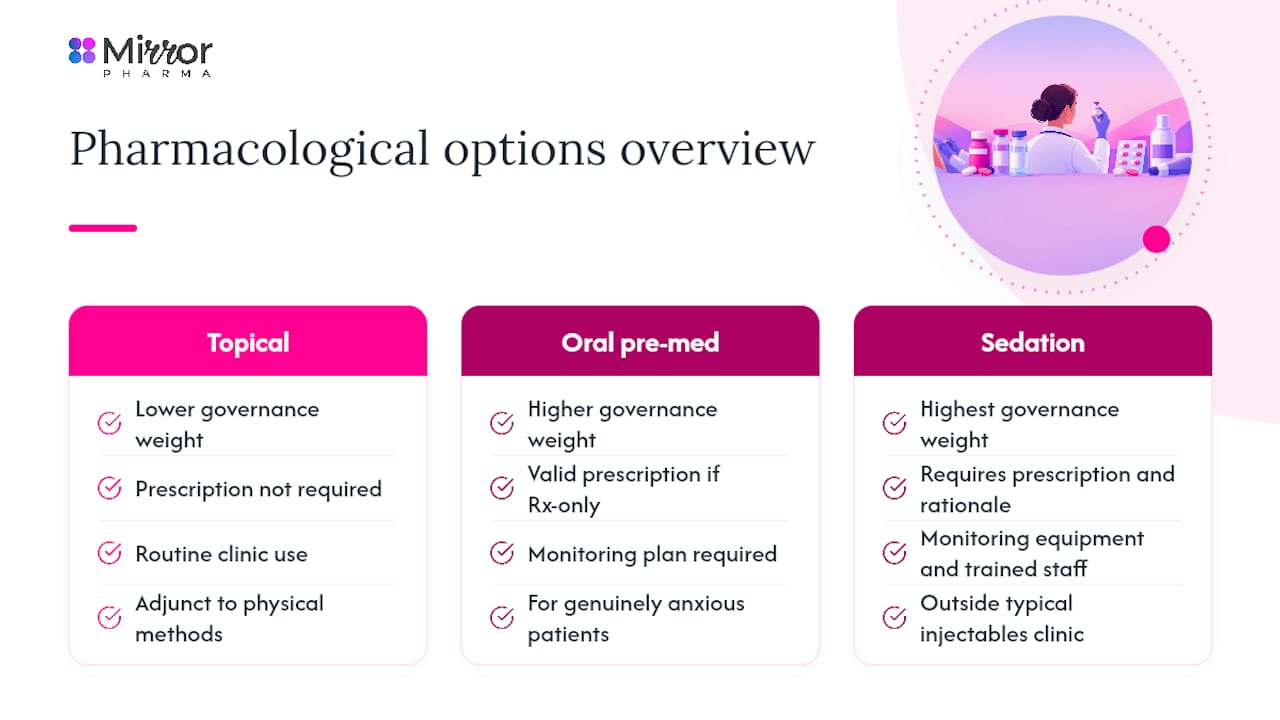
Topical and injected local anaesthesia are not the only pharmacological tools available. For patients with documented high anxiety or pain sensitivity, some practitioners use oral pre-medication as an adjunct, typically a mild anxiolytic or analgesic taken ahead of the appointment under appropriate prescribing arrangements.
This route carries more governance weight than topical products. Any oral pre-medication involving a prescription-only medicine requires a valid prescription and a documented clinical rationale, not a routine offer to every anxious patient. It also demands a monitoring plan, since sedative agents affect a patient’s ability to consent meaningfully partway through treatment and their capacity to drive afterwards.
Sedation proper, whether oral or otherwise, sits largely outside standard aesthetic practice and belongs in settings with appropriate monitoring equipment and trained personnel, not a typical injectables clinic. For most licensed practitioners, the practical ceiling is a well-timed oral analgesic taken beforehand for genuinely anxious patients, combined with the topical and physical methods already covered.
The safety caveat that applies to nerve blocks applies equally here: any pharmacological option beyond topical anaesthesia needs the same standard of dosing awareness, monitoring, and documented escalation pathway before it enters your protocol.
Distraction, breathing and other behavioural techniques that reduce perceived pain
Pain perception is not purely physiological, and behavioural methods can meaningfully shift how a patient experiences the same physical stimulus. Simple distraction, conversation, a stress ball, or asking the patient to focus on a fixed point, reduces the attentional bandwidth available for processing pain signals.
Controlled breathing works through a related mechanism. Slow, paced breathing during the injection moment lowers general sympathetic arousal, which tends to reduce the intensity of the pain signal the patient reports afterwards, even though the physical stimulus is unchanged.
Pre-treatment expectation setting deserves more credit than it usually gets. Patients told honestly what a sensation will feel like, rather than reassured it will not hurt, generally report less distress than those given vague or overly optimistic descriptions. Anxiety amplifies pain perception, and a patient bracing for an unknown sensation tends to tense the treatment area, which itself increases discomfort during injection.
None of these techniques replace topical anaesthesia, vibration or slow injection technique. They work best layered underneath the pharmacological and physical methods already in your protocol, particularly for patients whose anxiety is the dominant factor rather than genuine pain sensitivity.
Warming and buffering injectable solutions before use
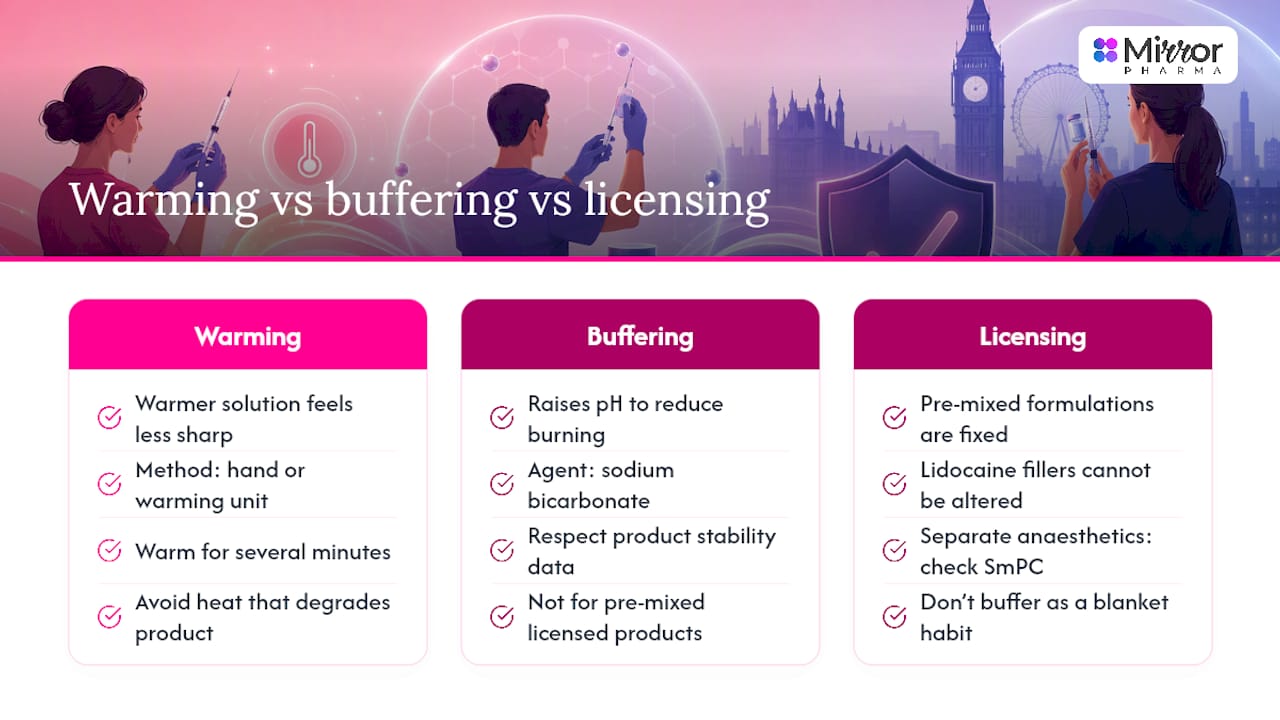
Solution temperature and pH both influence how much a patient feels on injection, and both are adjustable without changing the product itself. Cold solution straight from clinic refrigeration tends to feel sharper on entry than solution brought closer to body temperature; some practitioners warm syringes gently in their hand or a warming unit for several minutes before use, avoiding any method that risks degrading the product.
Buffering addresses a different mechanism. Many local anaesthetic solutions are formulated at a lower pH for stability, and that acidity itself contributes to the burning sensation patients report on injection. Adding sodium bicarbonate to buffer the solution closer to physiological pH is a recognised technique in general medical practice for reducing this specific discomfort, though any buffering approach needs to respect the product’s own stability data and licensing conditions rather than being applied as a blanket habit.
For pre-mixed licensed products, including lidocaine-containing dermal fillers, buffering is not something practitioners can alter, since the formulation is fixed at manufacture. Where a licensed anaesthetic is drawn up separately for a nerve block or local infiltration, check the product’s summary of characteristics before attempting to buffer it, since not every formulation tolerates pH adjustment safely.
How to assess and monitor pain during the injection itself
A verbal numeric rating scale, asking the patient to rate discomfort from zero to ten during the procedure, remains the simplest reliable tool for real-time monitoring and is the same scale used in the RCT evidence comparing analgesic techniques referenced earlier. It takes seconds to use and gives you an immediate, comparable readout between injection sites within the same session.
Watch for non-verbal signals too, since not every patient will vocalise discomfort clearly. Flinching, breath-holding, gripping the chair, or sudden muscle tension around the treatment area often precede a verbal report and give you a chance to pause before pain escalates further.
Document pain scores alongside your treatment record where the patient consents to it, particularly for repeat patients where you are adjusting technique across visits. A consistent record lets you see whether a change in your protocol, a different needle gauge, an added vibration device, actually moved the needle on that patient’s experience, rather than relying on memory or assumption.
Author perspective — practical reflections from a practising supplier
The evidence on injection pain management is more settled than most clinic conversations suggest. Vibration beats cold and cream in controlled testing, slow micro-boluses reduce both pain and risk, and no single method covers every patient or every anatomical site. What separates a good protocol from a mediocre one is usually not access to fancier kit. It is whether a practitioner actually layers the methods in sequence, every time, rather than defaulting to whichever one they reached for first that day.
Some suppliers provide guides on IV versus IM injection technique because practitioners keep asking the same practical questions, and reliable procurement matters as much as protocol. Order cut-offs and verification checks exist for good reason: they keep the right products in the right qualified hands.
— Rizwan
How Mirror Pharma supports pain-aware injection practice
Getting the technique right matters less if the products behind it are inconsistent or arrive late. Certain suppliers provide needles and consumables alongside lidocaine-containing dermal fillers, giving licensed practitioners the tools to run a combined analgesic protocol without juggling multiple suppliers. Extended order cut-off times can enable clinics to order next week’s treatment list with reliable delivery, and verification processes help ensure stock goes to qualified practitioners only. Nothing here claims a specific clinical outcome, since results depend on technique, patient factors and product choice, not the supplier. If your protocol depends on lidocaine-containing options, browse the dermal fillers category to see what is currently available for licensed practitioners and qualified aesthetic professionals.
This article is general information, not a substitute for advice from a qualified doctor. Consult a qualified healthcare professional about your own circumstances before acting on anything here.
Sources
Injection pain has at least three distinct sources, and treating them as one problem is why single-method approaches often disappoint. Needle puncture activates surface nociceptors almost instantly, a sharp, localised signal that topical anaesthetics handle reasonably well when given enough contact time.
Tissue distension is different. As product volume displaces surrounding tissue, mechanoreceptors and deeper nerve fibres fire in response to stretch and pressure, not puncture. This is the pain that topical creams frequently miss, because it originates below the depth most topical agents reach and continues for as long as the bolus is being delivered.
A third source is chemical or osmotic irritation from the injected substance itself, particularly with denser fillers, unbuffered solutions, or agents with a pH significantly different from tissue. Some patients also report a delayed ache from localised inflammatory response in the hours after treatment, distinct from the immediate pain during injection.
Anatomical location changes the picture further. Areas with dense nerve supply, such as the lips and nasal tip, register far more discomfort per unit volume than looser tissue on the cheek or temple. Recognising which mechanism dominates in a given injection site helps you choose the right combination of methods rather than defaulting to the same protocol everywhere.
- A randomized controlled trial of three noninvasive analgesic techniques for the prevention of pain during facial injections
- The use of local anaesthetics in dermatology, aesthetic medicine and plastic surgery: review of the literature (PMC)
- Systematic review of topical analgesics for botulinum toxin injection pain (abstract)
- The use and supply of topical anaesthetics (JCCP guidance)
- Pliaglis (lidocaine/tetracaine) product information (eMC)
FAQ
What is the most effective method for injection pain management?
No single method wins outright. The strongest evidence supports combining a topical or vapocoolant agent with vibration and slow, low-pressure micro-bolus injection, since a randomised trial found vibration significantly outperformed cold and cream alone.
How long should topical anaesthetic cream be left on before injecting?
Depth of penetration depends on time under occlusion, reaching around 3mm at 60 minutes and up to 5mm by 120 minutes for standard lidocaine/prilocaine formulations. Licensed products such as Pliaglis specify their own application windows of 30 to 60 minutes depending on the procedure.
Do vibration devices actually reduce injection pain?
Yes. A controlled trial of 100 volunteers found vibration produced statistically significantly better pain control than cold application or topical anaesthetic cream for forehead injections.
Are injectable local anaesthetics prescription-only in the UK?
Yes, injectable local anaesthetics are prescription-only medicines with no lawful route to supply outside a valid prescription. Topical anaesthetics vary by formulation, and the JCCP guidance sets out which products sit on pharmacy-only versus prescription status.
Where can practitioners source lidocaine-containing fillers and consumables?
Mirror Pharma supplies needles, consumables and lidocaine-containing dermal filler options to verified licensed practitioners, with current product availability listed on the dermal fillers category page.