

A pharmacy cut-off time is the latest point in the day at which an order, once complete and verified, can still be picked, checked and handed to a courier for that day’s collection. It is not the same as opening hours. For licensed practitioners and clinics ordering aesthetic or wellness products, it decides whether stock arrives before a clinic day or a day later. This guide explains how cut-offs work in the UK, what moves them, and how to build a routine that stops a late order costing you a treatment list.
TL;DR
- A cut-off is the deadline for an order to be fully processed and dispatched that day. A pharmacy can be open long after its cut-off has passed.
- Orders involving prescription-only medicines need a valid prescription and a verified prescriber before dispatch, so incomplete paperwork is the commonest reason a “before the cut-off” order misses the day.
- Weekends, bank holidays, courier collection times and temperature-controlled stock all change when an order actually leaves.
- For qualified aesthetic professionals, the safest habit is to order a clear working day ahead, with the prescription and account verification already in place.
- At Mirror Pharma we extend our order cut-off times to help practitioners, and we show the current time on our site.
Table of Contents
- What a pharmacy cut-off time actually means
- What has to happen before a dispatch
- The factors that move your real cut-off
- How the NHS frames notice periods (and what clinics can borrow)
- A practical ordering routine for licensed practitioners
- Planning by product type
- Common mistakes that cost a delivery day
- Why we extended our cut-off times
- Ordering from Mirror Pharma
- FAQ
- Sources
What a pharmacy cut-off time actually means
Two different clocks run in any pharmacy, and they are easy to confuse.
The first is opening hours. These are the hours the premises is open to the public or staffed to take calls. Under NHS rules, community pharmacies must provide services for 40 hours each week, or at least 100 hours where a 100-hour condition applies, and supplementary hours are extra hours notified to NHS England (NHS Resolution guidance note on opening hours). Those rules govern when a pharmacy serves people on the premises.
The second is the order cut-off time. This is an operational deadline set by the supplier, not a regulatory one. It is the point after which an order will not be picked, checked and packed in time to meet that day’s courier collection. Nothing in the NHS opening-hours framework sets it, and it varies by supplier, product type and delivery service.
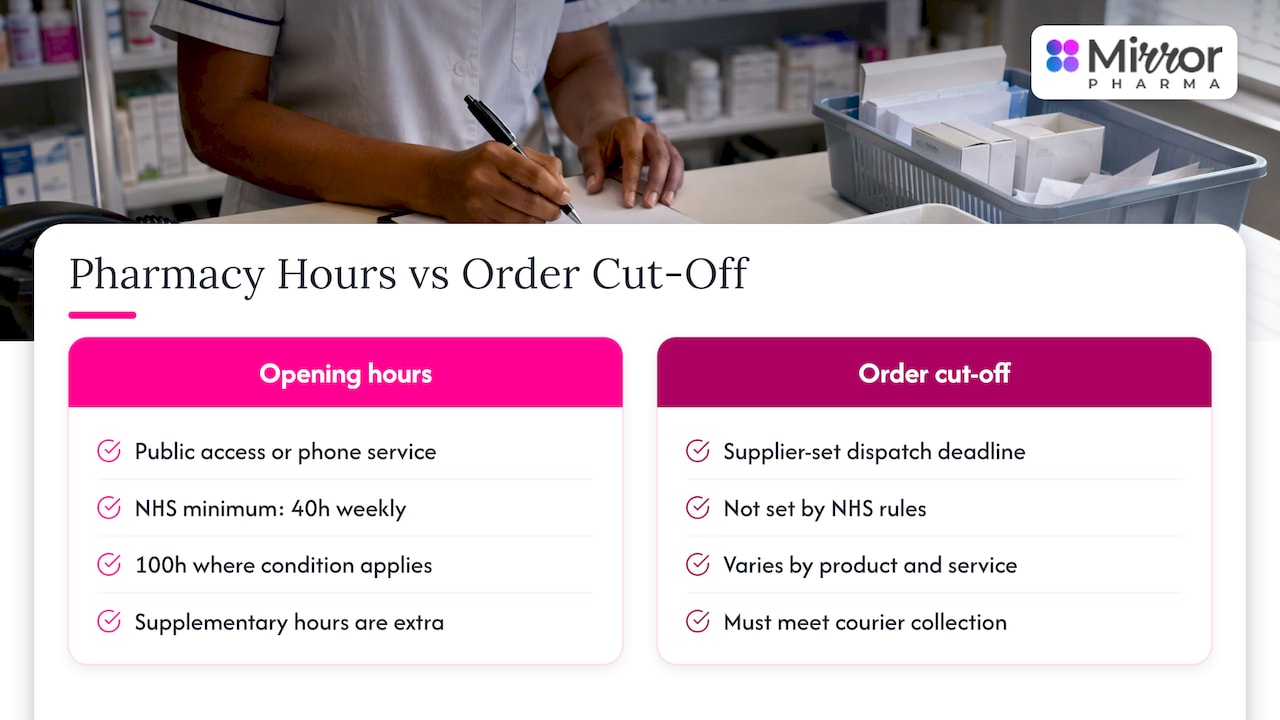
The practical difference matters for B2B ordering. A distance-selling pharmacy supplying clinics may take orders around the clock through a website, yet only dispatch within a fixed window. An order placed at 4.55pm and an order placed at 5.05pm may both be “received” on the same day, but only one leaves that day.
Why “open” does not mean “dispatching”
When search results for this topic talk about closures, rest breaks and reduced hours, they are describing community pharmacy opening arrangements. Pharmacy owners must apply to their integrated care board (ICB) to change core hours, and reductions in supplementary hours need at least five weeks’ notice (Community Pharmacy England). None of that tells you when a courier lifts a parcel. For delivery planning you need the supplier’s own cut-off, which is a separate figure.
What has to happen before a dispatch
For prescription medicines, an order is not a simple pick-and-pack. Before anything is sent for dispensing and labelling, a pharmacist checks that the prescription is legally valid and safe, including the dose and possible interactions (Moorfields Eye Hospital pharmacy). That description comes from a hospital setting, but the principle is the same for any supply of a prescription-only medicine: the clinical and legal checks come first, and the courier comes last.
For a clinic, this gives a more honest way to read a cut-off time. It is the deadline for an order to have completed all of these steps, not merely to have been placed:
- Account verification. The buyer must be a verified practitioner or prescriber, or a clinic acting on one.
- Valid prescription. Where a product is prescription-only, the prescription must be in place and legible to the pharmacy team.
- Clinical check. A pharmacist reviews the prescription.
- Picking and packing. Including any temperature-controlled packaging.
- Courier collection. The fixed time the carrier lifts parcels from the premises.
A delay at any of steps 1 to 3 pushes dispatch to the next working day, whatever time the basket was paid for.
The factors that move your real cut-off
Weekends
Most suppliers dispatch on working days only. An order placed on Friday after the cut-off will usually go on Monday unless the supplier offers a weekend service. Carriers do operate on Saturdays: Royal Mail, for example, offers Special Delivery Guaranteed by 9am or by 1pm on Saturdays, and Next Day service on Saturdays and Sundays (Royal Mail help). But a carrier being able to deliver on Saturday does not mean the supplier is picking orders on Friday evening. Ask which day your parcel is dispatched, not just which day it arrives.
Bank holidays
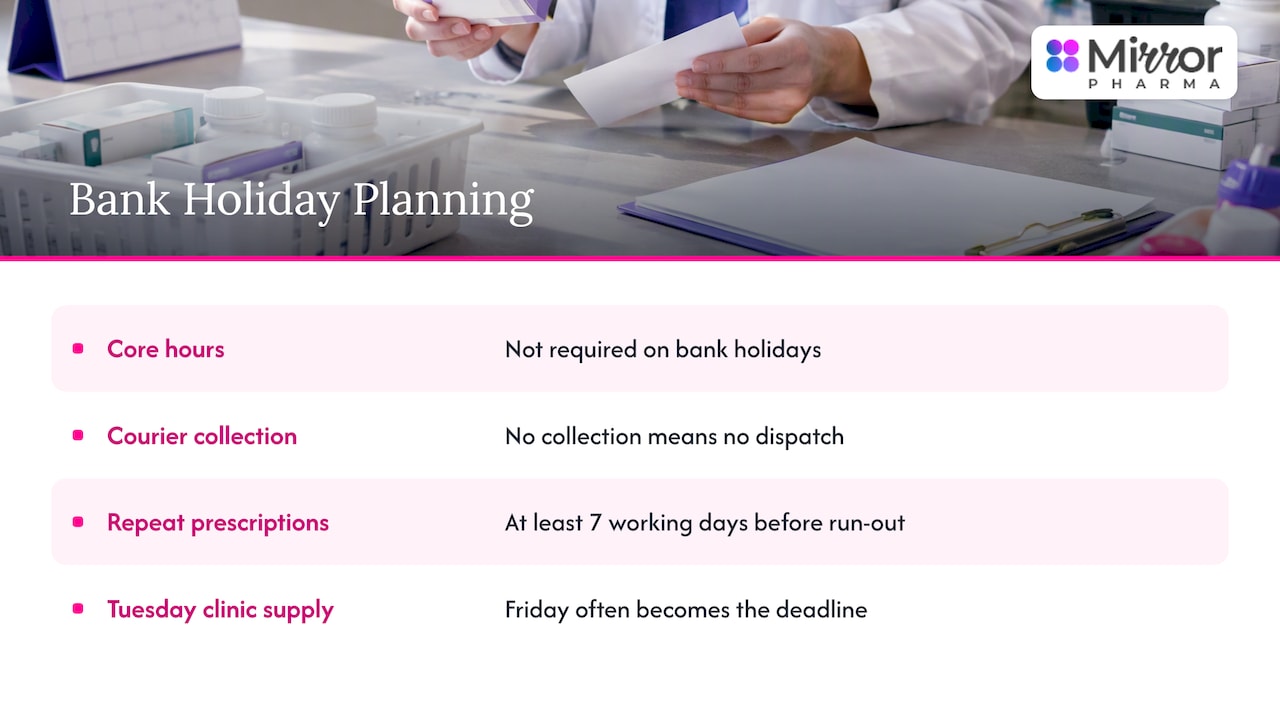
Community pharmacies are not required to provide their core contractual hours on bank holidays, although some may be directed by the NHS to open (Community Pharmacy England). Suppliers that rely on couriers face the same constraint from the other side: if carriers are not collecting, there is no dispatch. A bank holiday Monday effectively removes a working day from your plan, and the Friday before often becomes the real deadline for a clinic day on Tuesday.
NHS guidance for patients makes the same point from the prescribing end. Local health bodies urge people to request repeat prescriptions well ahead of bank holidays, with one ICB suggesting at least seven working days before medicines run out (NHS Essex ICB). Practitioners who write or manage prescriptions for clinic supply should apply the same discipline to their own workflow.
Delivery location and service level
A parcel to a city clinic and a parcel to a remote area can have the same dispatch time but different arrival times. The delivery service matters more than the postcode in most cases: a guaranteed-by-1pm service and a standard service can leave the building together and arrive many hours apart. Choose the service level that matches the clinic’s start time, not the cheapest option, particularly for products you need on a set treatment day.
Product availability and storage conditions
A cut-off applies to stock that is on the shelf. Some medicines need to be stored and shipped at 2 to 8°C unless the manufacturer states otherwise, which requires validated packaging and monitoring (Tucker & Co on GDP cold chain). Cold-chain items are typically packed closer to collection and are not suited to a long weekend in transit, so they are the products where an early order matters most. Always follow the storage instructions on the product’s own documentation.
How the NHS frames notice periods (and what clinics can borrow)
NHS repeat prescription guidance is written for patients, not aesthetic practitioners, and it is not a rule for professional supply. It is still a useful benchmark for how much slack a health system builds in:
| Source | Notice it asks for | What it covers |
|---|---|---|
| NHS | Up to 5 working days before you need the medicine | Requesting an NHS repeat prescription |
| The Exchange Surgery | 2 full working days | Processing a request and sending it electronically to a chosen pharmacy |
| NHS Essex ICB | At least 7 working days | Advice around bank holidays and travel |
Once a prescription is with a pharmacy, patients are told a filled prescription is normally held for 10 to 14 days (Well Pharmacy). The lesson for a clinic is that buffers are normal in healthcare. A pharmacy cut-off is the last minute, not the recommended minute.
A practical ordering routine for licensed practitioners
This is the routine we suggest to qualified aesthetic professionals who want to stop thinking about cut-offs altogether.
1. Fix your paperwork before you need stock
The biggest source of missed dispatches is not a late click, it is an unverified account or a missing prescription. If you are new to ordering, complete prescriber registration first through our prescriber registration page, and learn how supplying works with our guide to the prescription upload process. Once these are in place, an order can move straight to the clinical check.
2. Understand who may prescribe
Regulators have tightened expectations around remote prescribing in aesthetics. Our checklist on remote cosmetic prescribing covers what UK clinicians should have in place. A prescription that does not meet those expectations cannot be fulfilled, whatever the time.
3. Order by a working-day buffer, not the cut-off
Treat the published cut-off as a hard stop and plan to be a working day ahead of it. For a Tuesday clinic list, finalise the order by Friday morning if there is a bank holiday Monday, or Monday morning otherwise.
4. Match the delivery service to the clinic start
If stock must be on site by the first appointment, select a timed service. If a late delivery would force you to rebook clients, the upgrade is cheap compared with the lost session.
5. Watch for tracking updates
For electronic prescriptions, the NHS App can show when a tracking-enabled pharmacy has downloaded an EPS prescription and whether it is being prepared, ready to collect or ready for delivery (NHS England Digital). That tracking is aimed at patients using NHS services, but it shows the stages every prescription passes through, which are the same stages to ask your supplier about.
6. Keep a small buffer stock where storage allows
For consumables such as needles and syringes, a modest reserve removes the cut-off from the equation. For medicines, store strictly to the manufacturer’s instructions and your clinic’s governance policy, and never stockpile beyond what your storage and expiry dates allow.
Planning by product type
Different categories carry different risks of a missed cut-off. This is a planning guide for qualified aesthetic professionals, not a statement of any supplier’s timings.
| Product type | Why it can miss a cut-off | Planning tip |
|---|---|---|
| Prescription-only medicines | Prescription and clinical check must be complete first | Upload paperwork before the day you need dispatch |
| Temperature-sensitive items | Packed and shipped with controlled conditions | Avoid ordering ahead of a weekend or bank holiday |
| Consumables | Usually in stock and simple to pack | Reorder when you reach a set minimum level |
| Unlicensed medicines | Additional prescriber checks apply | Read the MHRA checks before ordering |
If you work with unlicensed products, our summary of the MHRA checks for prescribers explains what to confirm in advance. For botulinum toxin, the 12 week rule guidance sets out the safety and legal steps that must be satisfied before a supply can be made to a clinic.
Common mistakes that cost a delivery day
- Reading opening hours as the cut-off. A phone line staffed until 6pm says nothing about courier collection.
- Paying late on a Friday. Payment confirmation is not dispatch. Complete the order and the prescription together.
- Forgetting the bank holiday. A three-day weekend can mean four days without dispatch if carriers are also off.
- Choosing standard delivery for a fixed treatment day. The saving is rarely worth the risk of rebooking a full list.
- Waiting until stock hits zero. Order when you reach a re-order level.
- Changing the prescriber at the last minute. A different prescriber means a fresh verification step.
Why we extended our cut-off times
Practitioners rarely run out of stock on a convenient day. A cancellation fills a slot, a client rebooks, or a delivery is a day late, and suddenly the order needs to leave tonight.
That is why we extend our order cut-off times and why our team of healthcare professionals handles fulfilment. The goal is simple: a verified practitioner who has their paperwork in place should not lose a clinic day because of a few minutes on the clock.
We also hold the line on verification. Every order for prescription products depends on a verified practitioner or prescriber, and that check protects patients, prescribers and our clinic customers alike. Our advice is to get registered and your prescription process settled well before you need stock, so the extended cut-off is a safety margin and not a habit.
This guidance is for licensed practitioners and qualified aesthetic professionals only.
Rizwan
Ordering from Mirror Pharma
Mirror Pharma is an online pharmacy supplying prescription aesthetic medicines, toxins, weight loss medications, vitamins, infusion therapies, dermal fillers, skin boosters, fat dissolvers, syringes, needles and consumables to verified healthcare professionals and clinics. If you are a licensed practitioner ready to order, start with the category you use most: toxins, dermal fillers or IM/IV vitamins. Our current cut-off times are shown on our site, and we recommend checking them at the point of ordering, as they can be reviewed from time to time. Access to prescription products requires full verification.
FAQ
Is a pharmacy cut-off time the same as its closing time?
No. Closing time is when the premises stops serving people on site, and it is shaped by NHS opening-hours rules for community pharmacies. A cut-off is the supplier’s own deadline for an order to be processed and handed to a courier that day. A pharmacy can take orders after the cut-off, but they will normally go out the next working day.
Do pharmacy cut-off times change on bank holidays?
Usually, yes. Community pharmacies are not required to provide core contractual hours on bank holidays, and couriers often run reduced services. Treat a bank holiday as a missing working day and order earlier. Check the supplier’s published holiday arrangements before the long weekend.
Why was my order placed before the cut-off not dispatched?
The most likely reason is that something was still outstanding, such as a prescription, account verification or a clinical check. A pharmacist must confirm a prescription is legally valid and safe before it goes for dispensing. Complete these elements first and a cut-off becomes straightforward.
How much notice should a clinic allow when ordering?
There is no single legal figure for professional supply. NHS repeat-prescription advice, which asks patients for between 2 and 7 working days depending on the source, shows how much slack healthcare normally allows. For clinic stock, we suggest a clear working day beyond the cut-off, more around bank holidays, and extra for temperature-sensitive items.
Sources
- NHS Resolution: Pharmacy Opening Hours guidance note
- Community Pharmacy England: Opening hours
- Moorfields Eye Hospital: Pharmacy
- Royal Mail: Special Delivery Guaranteed help
- NHS Essex ICB: Order repeat prescriptions before the bank holiday
- Tucker & Co: GDP guidelines for cold chain distribution
- NHS: How to order a repeat prescription
- The Exchange Surgery: Medication review and prescriptions
- Well Pharmacy: Information about NHS prescriptions
- NHS England Digital: National Prescription Tracking Service appendices