

For licensed prescribers and qualified aesthetic professionals, the evidence is consistent: weight comes back after a GLP-1 medicine is stopped, usually within about 18 months, and the amount tracks how much the patient lost. Regain is rarely a patient failing. It is the expected course of a chronic condition when treatment ends. The practical answer is to plan the whole course in advance: dose titration, the 6 month review, a defined exit and at least a year of follow-up. Clinics that do this also need uninterrupted, verified access to the products they prescribe. That is the part we supply at Mirror Pharma, to registered practitioners and prescribers only.
This article is educational and written for healthcare professionals. It is not for patients or members of the public.
TL;DR
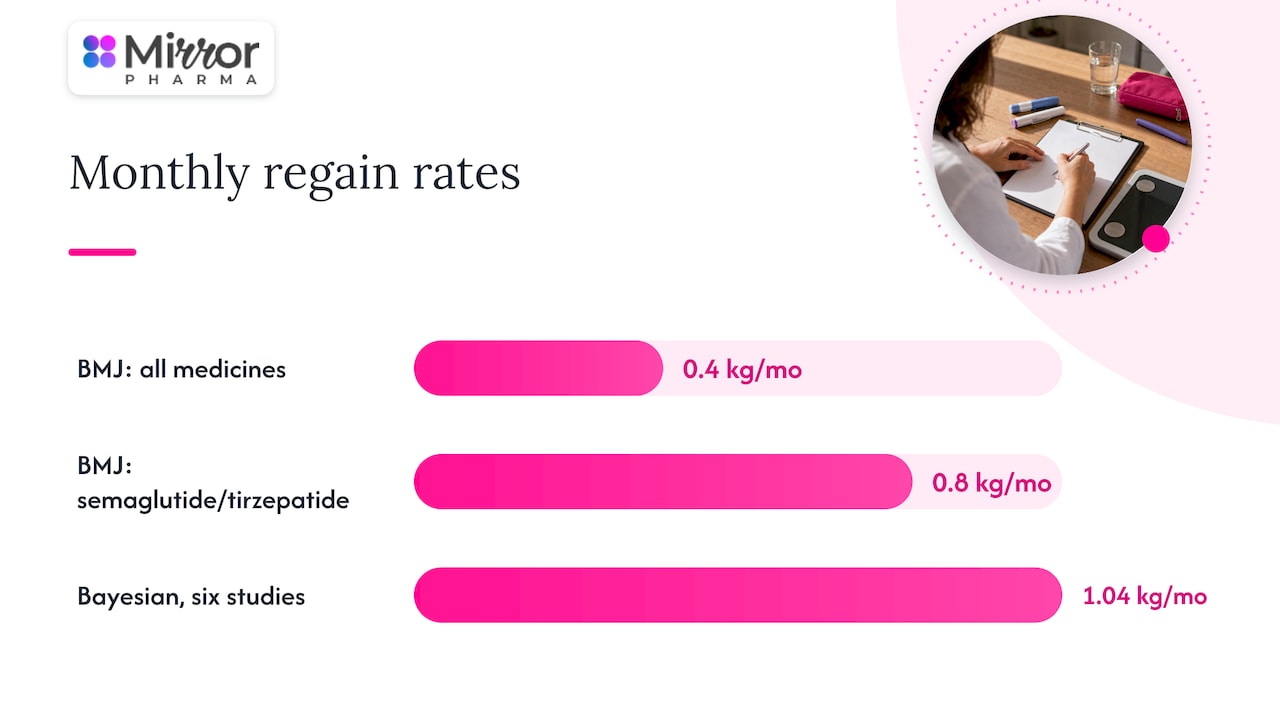
- Across pooled analyses, weight regain after stopping runs from roughly 0.4 kg a month for weight management medicines overall to about 0.8 kg a month for semaglutide and tirzepatide, with return to baseline projected in around 1.5 years.
- Regain scales with initial efficacy. Larger losses tend to be followed by larger regain, so tirzepatide cessation shows the largest pooled figures.
- NICE asks prescribers to review at 6 months on the highest tolerated dose and to weigh continuation if less than 5% of initial weight has been lost.
- Stopping should be a documented, planned decision with monitoring for at least a year, not an unplanned gap.
- For licensed practitioners, reliable supply and a clear prescribing pathway are part of keeping a patient on a planned course.
Table of Contents
- How much weight returns, and how quickly
- Regain by medicine and trial design
- Planning cessation as part of chronic care
- Nonresponse: the 6 month, 5% review
- Switching GLP-1 medicines
- Supporting maintenance after treatment ends
- Supply for the courses you plan
- Our perspective
- FAQ
- Sources
How much weight returns, and how quickly
The largest single piece of evidence for UK practice is the BMJ systematic review and meta-analysis from Oxford. It pooled 37 studies with 9,341 participants and found average regain of 0.4 kg a month after stopping weight management medicines (95% CI 0.3 to 0.5). For the newer incretin mimetics, semaglutide and tirzepatide, the rate was 0.8 kg a month (95% CI 0.6 to 0.9). The authors projected a return to baseline weight at about 1.5 years for those drugs and 1.7 years across all weight management medicines.
That timeline matters for service planning. The Oxford release notes that around half of people stop GLP-1 receptor agonist treatment within 12 months in real-world data. It also notes that NICE’s early cost-effectiveness modelling assumed a return to baseline over two to three years, while this study’s data point to around 18 months.
A Cambridge analysis of randomised data describes the shape of the curve. By 52 weeks, patients had regained 60% of their original weight loss, levelling off at about 75% by 60 weeks. That leaves roughly a quarter of the loss potentially sustained, which for a patient who lost a fifth of their body weight is around 5%. The underlying paper estimated a regain half-life of 23.0 weeks and found trajectories broadly similar across liraglutide, semaglutide and tirzepatide trials.
A Bayesian analysis of six studies gives a faster estimate. It put regain at 1.04 kg a month, with half of the initial loss regained by about 7.5 months and baseline reached by about 15 months. The range across these papers is real, and it reflects different populations, drugs and follow-up lengths. For a clinic, the safe message is the common one: expect meaningful regain within the first year, and plan for it from the first consultation.
Regain by medicine and trial design
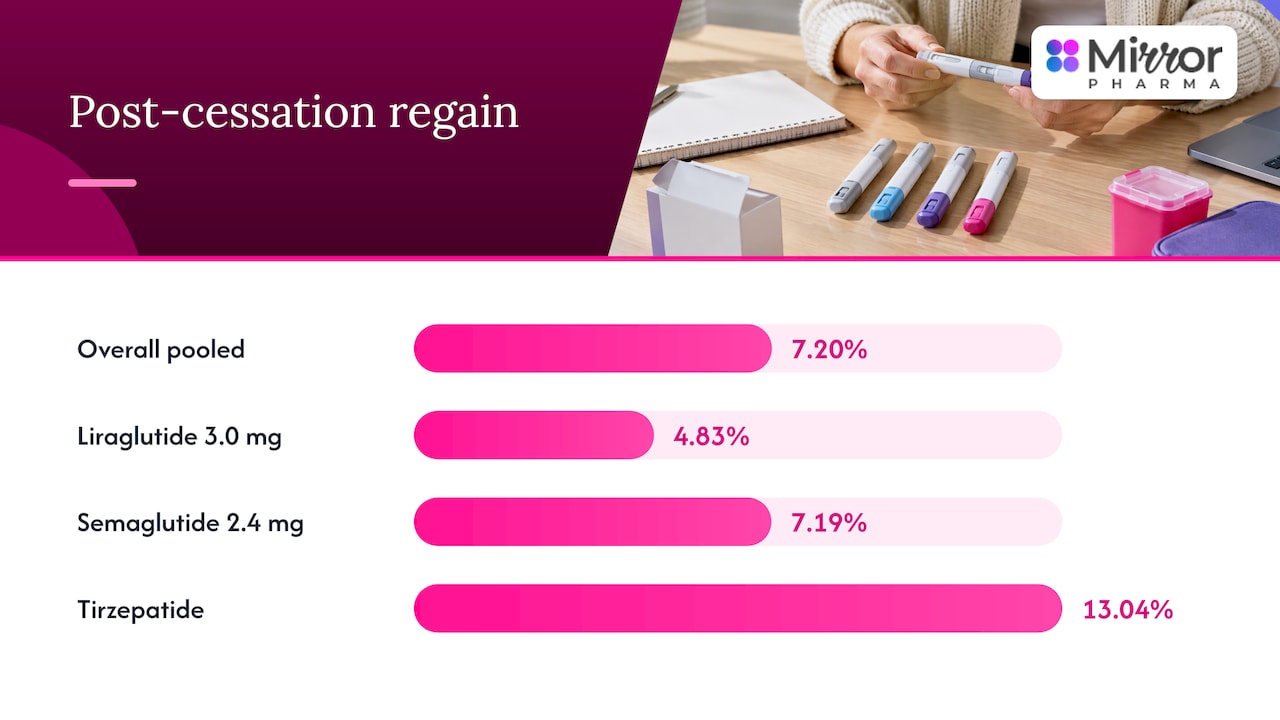
A 2026 meta-analysis of 17 studies reported pooled post-cessation regain of 7.20% of body weight (95% CI 5.93 to 8.48). Its subgroup figures are shown below.
| Medicine | Pooled regain after stopping |
|---|---|
| Liraglutide 3.0 mg | 4.83% |
| Semaglutide 2.4 mg | 7.19% |
| Tirzepatide | 13.04% |
The same analysis found that, in three comparative randomised trials, people who stopped gained 14.26 percentage points more than those who continued. The authors conclude that regain tracks initial efficacy. A medicine that produces a larger loss leaves more to lose back.
The randomised withdrawal trials show the same pattern in plain numbers. A systematic review of 18 reports summarises them: in STEP 4, patients switched to placebo gained 6.9% over 48 weeks, while those who continued semaglutide lost a further 7.9%. In SURMOUNT-4, patients switched from tirzepatide to placebo gained 14.0% over 52 weeks, while those who continued lost a further 5.5%. In the STEP 1 extension, about two thirds of the prior loss returned over a year, yet participants remained 5.6% below their starting weight.
The same review judged the two randomised withdrawal trials at low risk of bias and several non-randomised reports at serious risk. When you quote figures to a colleague or a patient’s multidisciplinary team, lead with the randomised trial results and say which drug and follow-up period they cover.
What the numbers mean for a clinic
Take a patient who loses 15 kg on treatment. Using the Cambridge plateau estimate, you would expect around 11 kg to return over the following year or so, leaving something in the region of 4 kg sustained. Using the faster Bayesian trajectory, the weight could be back within 15 months. Neither is a promise for an individual patient. Both support the same consultation: agree the plan for the end of treatment before the first dose, and record it.
Planning cessation as part of chronic care
The 2026 meta-analysis supports a long-term pharmacotherapy model, analogous to chronic disease management, with post-cessation follow-up as a standard trial outcome. The October 2026 systematic review reaches a similar practical conclusion: magnitude varies by drug, design, follow-up and what treatment follows, so discontinuation should be planned as part of chronic obesity care with explicit monitoring and shared decision-making.
When cessation is necessary, that review recommends that clinicians:
- Document the reason for stopping.
- Agree an individualised follow-up plan with the patient.
- Monitor weight and glycaemia early.
- Reassess blood pressure, waist circumference and lipids according to baseline cardiometabolic risk.
The same planning point applies to the reverse problem: a patient who runs out of medicine for logistical reasons has stopped treatment, with the same biology behind it. Treatment gaps from ordering delays are avoidable, which is why prescribers value predictable supply. We built our service for qualified practitioners ordering weight loss medicines around that need, with extended order cut-off times and verification of practitioner and prescriber access.
Nonresponse: the 6 month, 5% review
Some patients lose less than expected. NICE’s prescribing guide sets a clear checkpoint. For tirzepatide, after 6 months on the highest tolerated dose, calculate the percentage weight reduction. If less than 5% of initial weight has been lost, discuss why with the patient, noting that people with type 2 diabetes may take longer to lose weight. Then decide whether to continue, weighing benefits and risks. For semaglutide, consider stopping at the same point. For liraglutide, stop after 12 weeks on the maintenance dose if at least 5% has not been lost.
Before you call a patient a nonresponder, work through the questions the guide implies:
- Dose: has the patient reached the highest tolerated dose? NICE describes increasing tirzepatide by 2.5 mg every 4 weeks to a maximum of 15 mg weekly, with follow-up every 4 weeks during titration. Our GLP-1 dosing schedule lays out the timelines to 2.4 mg and 15 mg.
- Tolerability: are side effects limiting the dose or leading to missed injections? See our symptom management plan for prescribers.
- Engagement: is the patient attending wraparound care? Local NHS guidance, such as the South Yorkshire ICB tirzepatide guideline, treats missing two or more sessions as a stopping criterion, and also lists any signs or symptoms of pancreatitis.
- Condition: type 2 diabetes can slow weight loss, as NICE notes.
Our guide to the 6 month 5% review for tirzepatide walks through this checkpoint for UK clinicians.
Where there is lack of response or intolerance, NICE suggests considering referral to specialist services for alternative pharmacological management, considering bariatric surgery referral, and encouraging continued diet and physical activity. Those referral routes remain with the specialist and the prescriber.
Switching GLP-1 medicines
Switching is a clinical decision for the prescriber, made against the licensed indication, local formulary and the patient’s eligibility. Two points from UK sources help frame it.
First, eligibility differs by product. NHS formulary guidance summarising NICE TA875 states that semaglutide is recommended for weight management only when used for a maximum of 2 years within a specialist weight management service. The same page summarises NICE TA1026 for tirzepatide: adults with an initial BMI of at least 35 kg/m² and at least one weight-related comorbidity, with lower thresholds, usually reduced by 2.5 kg/m², for people of South Asian, Chinese, other Asian, Middle Eastern, Black African or African-Caribbean backgrounds.
Second, a patient who still has type 2 diabetes after weight loss may continue 2.5 mg to 5 mg of tirzepatide or another GLP-1 receptor agonist in line with local formularies. The South Yorkshire guideline adds that changing to semaglutide may suit some patients, because it is the only GLP-1 receptor agonist with proven cardioprotective benefit.
The Greater Manchester pathway makes a further point: tirzepatide has no defined stopping rule or maximum duration under TA1026, so ongoing prescribing is decided case by case on clinical response and engagement with wraparound care. Stopping rules therefore vary by local ICB, and you should check your own area’s guideline.
For product-level comparisons, see our tirzepatide and semaglutide clinical comparison and our guide to semaglutide prescribing in the UK.
Supporting maintenance after treatment ends
NICE quality statement 7 in QS212 (published 5 August 2025) sets the standard for people who stop medicines for weight management. They should receive advice and support for maintaining change, including:
- feedback and monitoring at regular intervals for at least 1 year;
- well-rehearsed “if-then” action plans;
- changes to the immediate physical environment;
- social support;
- routines that support the new behaviour.
NICE’s accompanying news article says follow-up could include NHS Better Health, work with a dietitian or nutritionist, and local peer groups such as walking groups. The South Yorkshire guideline similarly asks for 12 months of support after discontinuation, with patients weighing themselves at least monthly.
The controlled evidence on specific strategies is limited. In the S-LiTE trial, the group that added supervised exercise to liraglutide kept an extra 5.1 kg of weight loss a year after both interventions ended, compared with liraglutide alone. The October 2026 review also recommends that, when safe, clinicians offer structured progressive activity including resistance training to support maintenance and preserve lean mass, and that nutrition counselling should prioritise adequate protein and micronutrients. Build both into the exit plan rather than raising them once the last dose is given.
Supply for the courses you plan
A planned course only works if the product arrives when the titration schedule needs it. Mirror Pharma is an online pharmacy supplying prescription medicines, weight loss products, vitamins, consumables and aesthetic products to healthcare professionals and aesthetic clinics. We verify practitioner and prescriber access, our orders are fulfilled by a team of healthcare professionals, and our extended order cut-off times are there so that practitioners can meet patient timelines. Licensed prescribers can browse our weight loss range once verified. Products are for use by trained practitioners and prescribers only.
Our perspective
We speak to clinics every day about the same planning problem: the clinical plan is sound, then the supply plan lets it down. The evidence on regain tells us that the end of treatment is as important to schedule as the start.
Our view is that a GLP-1 course should be written down as a whole: titration steps, the 6 month review, the criteria for continuing or stopping, and a year of follow-up. Each step needs a date, and the dates need product behind them. That is why we put effort into a smooth online ordering experience and extended order cut-off times, and why we verify every practitioner and prescriber before they can buy.
The research points toward treating obesity as a long-term condition, and we agree that prescribers deserve a supplier who treats continuity as part of patient care. For licensed practitioners, our team of healthcare professionals handles fulfilment so that you can focus on the consultation and the review.
Rizwan
FAQ
How quickly does weight return after a GLP-1 medicine is stopped?
The Oxford meta-analysis found average regain of 0.8 kg a month for semaglutide and tirzepatide, with a projected return to baseline at around 1.5 years. Other analyses estimate that about 60% of the lost weight returns by one year. Individual patients vary, so plan monitoring from the first month after the last dose.
Does the amount regained differ by medicine?
Pooled figures differ: 4.83% for liraglutide 3.0 mg, 7.19% for semaglutide 2.4 mg and 13.04% for tirzepatide in one 2026 meta-analysis. The authors link this to initial efficacy, since larger losses leave more to regain. One Bayesian analysis found no clear independent drug-specific difference after adjustment, so compare like with like when quoting figures.
What should a prescriber do when a patient loses less than 5% in 6 months?
NICE asks you to calculate the percentage reduction after 6 months on the highest tolerated dose and to discuss the reasons with the patient. Then decide whether to continue, weighing benefits and risks. For semaglutide, consider stopping. Check dose, tolerability, engagement with wraparound care and any type 2 diabetes first.
How long should follow-up last after treatment stops?
NICE QS212 asks for feedback and monitoring at regular intervals for at least 1 year. Plans should include “if-then” action plans, social support and routines that support the new behaviour. Document the reason for stopping and agree the follow-up plan with the patient.
Where can licensed practitioners order GLP-1 products?
Verified practitioners and prescribers can order through our online pharmacy, which supplies prescription weight loss products to healthcare professionals and clinics. Access is subject to verification, and products are for trained practitioners only.
Sources
- Weight regain after cessation of medication for weight management (BMJ meta-analysis, PMC)
- University of Oxford: stopping weight-loss drugs and faster regain
- University of Cambridge: patients regain weight rapidly after stopping weight loss drugs
- Trajectory of weight regain after cessation of GLP-1 receptor agonists (PMC)
- Weight regain trajectories after discontinuation (Bayesian meta-analysis, PMC)
- Post-cessation weight regain after weight management medications (PMC)
- Weight regain after discontinuation of GLP-1 and GIP/GLP-1 therapies (systematic review, PMC)
- NICE: a guide for prescribing medicines to manage overweight and obesity
- South Yorkshire ICB tirzepatide guideline for primary care
- South and West Devon formulary: drugs used in weight management
- Greater Manchester weight management clinical pathway
- NICE QS212 quality statement 7: advice and support after stopping medicines
- NICE: people need support to keep weight off after treatment ends