

Medicine expiry management is a routine, not a one-off check: read the manufacturer’s date and any shorter in-use date, rotate stock so the earliest expiry is used first, check every storage area on a set schedule, record the check, and remove expired stock from usable shelves straight away. This guide is for licensed practitioners, prescribers and clinic managers who hold injectable and other prescription medicines on site. It draws on NHS guidance that clinics can adapt to their own size and risk.
TL;DR
- An expiry date is the manufacturer’s limit. Opening, reconstitution, dispensing or poor storage can bring the usable date forward, so check both dates.
- Rotate stock so the shortest-dated product is used first, and keep stock levels in line with real usage.
- Check every storage point on a fixed schedule, including fridges, trolleys and treatment-room cupboards, and keep a written record.
- Segregate and label expired stock at once, and return or destroy it through your pharmacy or waste route. Controlled drugs have their own rules.
- Ordering closer to need, with reliable delivery, reduces how much short-dated stock you ever hold.
Table of Contents
- What an expiry date actually tells you
- Opening, reconstitution and storage change the clock
- Building a stock-check routine that works
- Rotating stock: first expiry, first out
- Holding the right amount of stock
- Dealing with expired, damaged or improperly stored stock
- Worked example: a small clinic’s monthly check
- Ordering so that less stock goes short-dated
- Our perspective
- FAQ
- Sources
What an expiry date actually tells you
An expiry date is the point after which a medicine may no longer be safe or effective and is unsuitable for administration. NHS Tees, Esk and Wear Valleys’ medication expiry policy explains that the manufacturer sets the original expiry, and an earlier in-use expiry can apply after dispensing, opening, modification or removal from the recommended storage conditions.
That gives every practitioner two dates to think about:
- The printed expiry on the carton, vial, ampoule or syringe label.
- The in-use expiry, which applies once the product has been opened, reconstituted, drawn up, diluted or stored outside its recommended conditions.
The printed date is only the ceiling. The date you actually work to is the earlier of the two.
Where to find the date
Check the outer carton, the primary container (vial, ampoule, pre-filled syringe) and the patient information leaflet or summary of product characteristics for any in-use period. The same policy points staff to the medication, packaging or container for expiry information and any shorter in-use period. Where carton and vial dates differ, work to the earlier one and raise it with your supplier.
If a product has no legible date, treat it as unusable and segregate it. Do not guess from batch codes.
Opening, reconstitution and storage change the clock
For aesthetic practice this is where most avoidable waste and risk sit. Lyophilised products are reconstituted, multi-dose vials are punctured, and refrigerated products leave the fridge for treatment rooms.
NHS guidance for clinical areas notes that opening or reconstitution can change a medicine’s expiry, that liquids and creams may have a shorter life once opened, and that refrigerated medicines need particular attention. The practical rules that follow:
- Read the manufacturer’s instructions for each product. Do not carry an in-use period over from a similar product.
- Write the new date on the container. Humber NHS Foundation Trust’s procedure, approved on 28 May 2026, requires the administering practitioner to note a reduced post-opening expiry on the bottle, and directs staff to the manufacturer’s label for that information. Adding the date opened, and your initials, is a simple habit that makes audits easy.
- Keep reconstituted products to their documented limits. Our guide to shelf life after reconstitution sets out how EMA, WHO and NHS rules apply for UK clinicians.
Cold-chain excursions
When a fridge fails or a product is left out, do not decide by instinct. A Lincolnshire Community Health Services cold-chain policy issued in July 2025 says such decisions are made case by case, using product information, time out of range and the storage environment, and that the medicine-specific information must be established before deciding whether to return a product to refrigeration. In practice: quarantine the affected stock, label it “do not use”, and obtain the manufacturer’s stability statement or take pharmacist advice before anything goes back on the shelf.
Building a stock-check routine that works
Good expiry management is mostly a schedule that someone owns. A workable routine for a clinic looks like this.
Step 1: Map every place medicines are kept
List each location: the clinical fridge, treatment-room cupboards, emergency kit, vitamin and infusion storage, and any bags or trolleys used for home or satellite visits. NHS Cornwall’s expiry-check procedure notes that pharmacy top-up checking does not cover decant stores such as clinic and anaesthetic rooms, drug trolleys and controlled-drug cupboards, so those areas need their own process. A private clinic has no pharmacy top-up service at all, so every location needs a named checker.
Step 2: Set the frequency and the owner
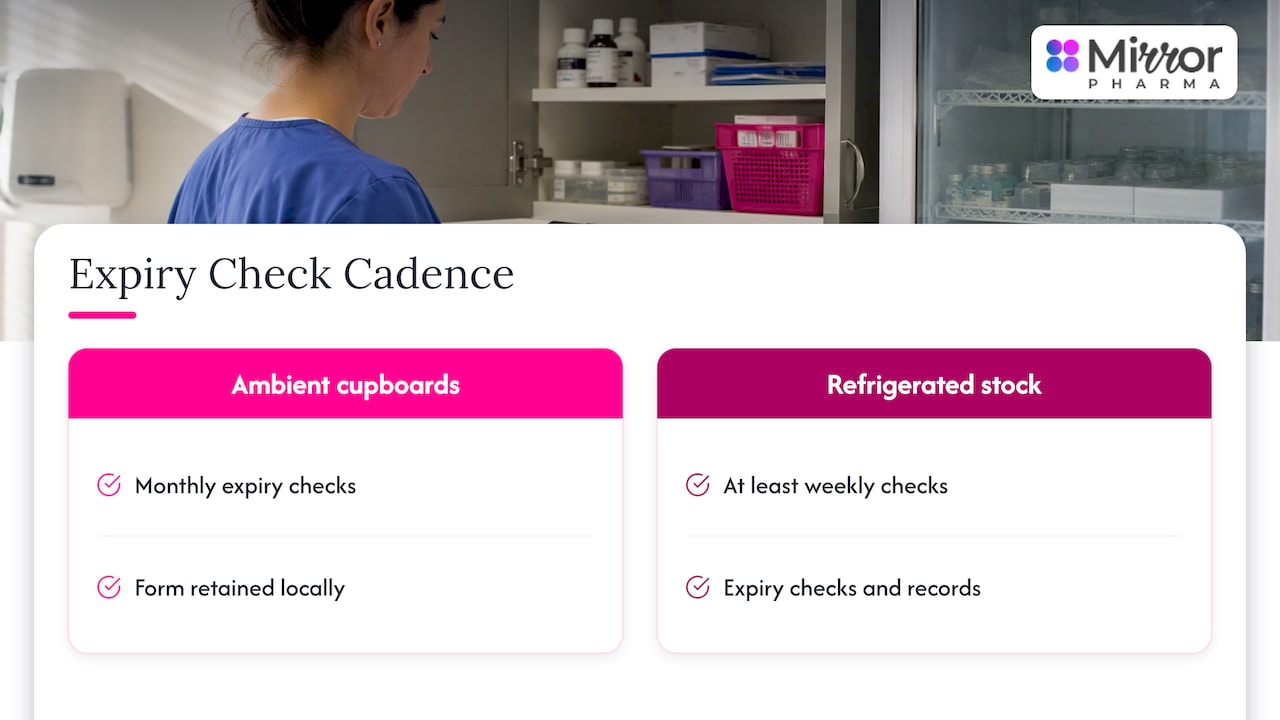
The same Cornwall procedure requires a monthly check in clinical areas not covered by pharmacy top-up, recorded on a form and retained locally. The Lincolnshire cold-chain policy specifies at least weekly checks, including expiry checks and records, for refrigerated stock. Use these as a benchmark: monthly for ambient cupboards, weekly or more often for fridges, adjusted to your volume and your clinical governance lead’s view.
Step 3: Check against a fixed list
For each product on the shelf, confirm:
- printed expiry date and batch number
- any in-use date written on opened containers
- storage conditions met (temperature log up to date for fridges)
- packaging intact, no damage or tampering
- product still on your current formulary or treatment menu
Flag anything expiring within a threshold you choose, for example three months for slow-moving lines, so that it can be used, moved or returned before it lapses.
Step 4: Record and retain
Sign and date the check, note what was removed and why, and keep the record where an inspector or auditor can find it. If your batch and traceability records are already part of your ordering process, our note on documentation with orders covers what UK practitioners should keep.
Step 5: Act on the findings immediately
Expired and doubtful stock moves to a labelled, segregated place on the day you find it. Leaving it “for later” on the shelf is how it ends up drawn up for a patient.
Rotating stock: first expiry, first out
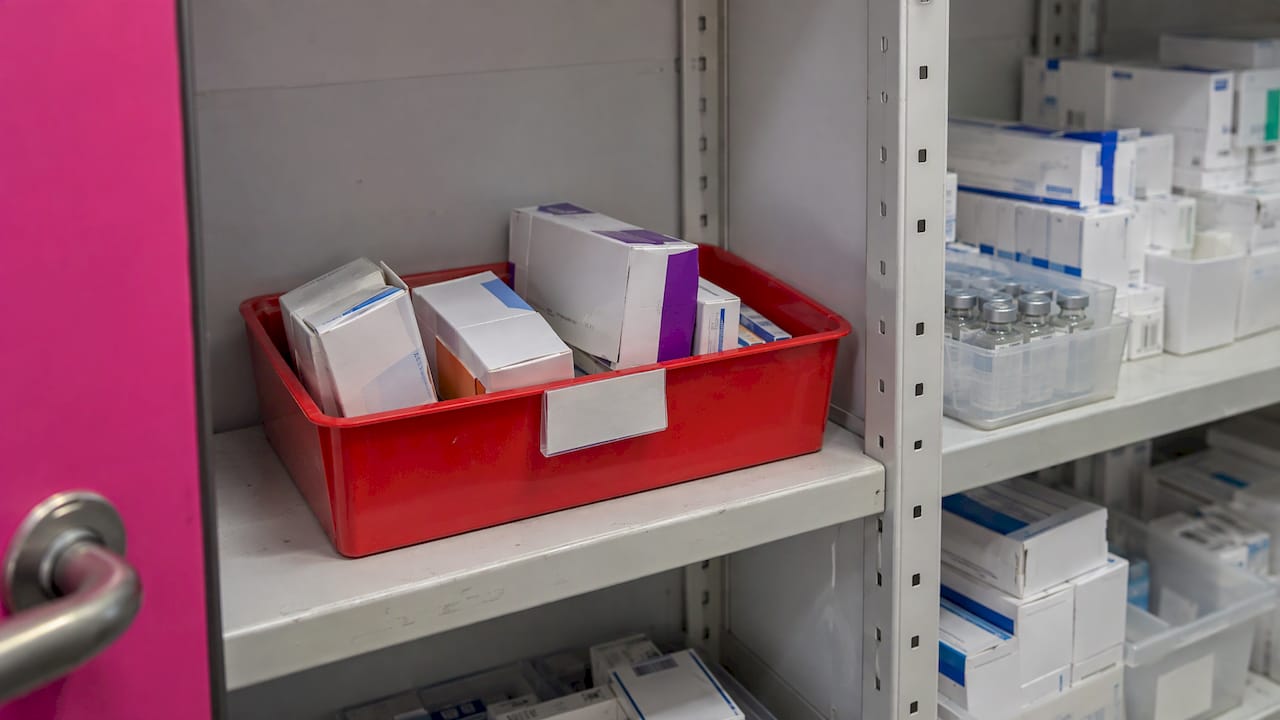
Stock rotation means the product that expires soonest is used first, whatever the delivery order. NHS Specialist Pharmacy Service guidance dated 13 January 2026 says robust stock-control processes and regular rotation are needed across wards, departments and pharmacy so that medicines are available in date.
The same guidance suggests a useful tactic: move low-use stock from critical locations to higher-use areas as expiry nears, and replenish the critical location with longer-dated stock. In a clinic, that might mean moving a short-dated vial from a rarely used room to the room where your most frequent treatment is delivered.
Put new deliveries behind existing stock, not in front. If you want to understand when to rotate by arrival date and when by expiry date, our explainer on FEFO versus FIFO walks through four questions to decide.
Holding the right amount of stock
The cheapest expiry problem to solve is the one you never create. NHS SPS clinical-area guidance from 17 December 2025 says stock levels should support timely access but avoid overstocking, because clutter increases selection errors and waste. It also recommends that a clinical-area lead and a pharmacy lead review and rationalise stock lists regularly, using historical usage and removing unnecessary stock.
For a clinic, translate that into three habits:
- Review usage quarterly. Look at what you actually administered, by product, and cut par levels on slow lines.
- Order to demand, not to discount. A bulk purchase that outlasts your patient demand is a future write-off.
- Keep a lean emergency and contingency list, reviewed by your prescriber or medical lead.
Our clinic inventory management playbook and the guide on how much stock an aesthetic clinic should hold go deeper on turnover, compliance and supplier risk, and injectable stock management covers the specifics of injectable lines.
Dealing with expired, damaged or improperly stored stock
The approach is the same whether a product has passed its date, arrived damaged or been stored out of range: stop it being used, identify it, and route it correctly.
- Remove and segregate. NHS Greater Glasgow and Clyde guidance says obsolete, expired or unwanted medicines must be clearly identified, securely stored and segregated from usable stock.
- Separate waste from returns. NHS SPS recommends distinguishing pharmaceutical waste from returns to pharmacy, assigning staff to remove them promptly, and making sure the right disposal equipment and staff awareness are in place.
- Use a documented return or waste route. The Glasgow and Clyde guidance describes return to pharmacy through locally agreed secure processes with a completed medicines-return form. A private clinic should use its licensed waste carrier or pharmacy arrangement and keep the paperwork.
- Record it. Note product, batch, quantity, reason and date, and who removed it.
Used needles, syringes and other sharps follow a separate route. Our checklist of sharps disposal requirements helps keep a clinic audit ready.
Controlled drugs
Controlled drugs are not handled like other expired stock. NHS Tayside’s procedure requires specified expired ward-stock controlled drugs to be segregated and clearly marked, with witnessed destruction by two registered healthcare professionals, including a pharmacist or pharmacy technician, for the schedules it describes. Most aesthetic clinics will not hold these, but if you do, contact your pharmacy provider before disposing of anything.
Worked example: a small clinic’s monthly check
Consider a clinic with a clinical fridge, two treatment rooms and a storeroom. The practice manager is the named checker, with the lead prescriber signing off.
- Week 1 and each week after: fridge temperature log reviewed, fridge contents checked for dates and opened containers.
- Monthly: all cupboards and the storeroom checked against the list above. Three vials expire within three months; two are moved to the busier room and one is flagged for a return conversation with the supplier.
- Quarterly: the prescriber reviews usage. A slow-moving line is dropped from the standing order, and the par level of a popular line is lowered after a fortnight of cancellations.
Nothing here needs software. A spreadsheet or a signed paper log is enough if it is completed on time and kept.
Ordering so that less stock goes short-dated
When delivery is dependable, you can order nearer the treatment date and hold less. Mirror Pharma supplies prescription aesthetic medicines, toxins, dermal fillers, skin boosters, polynucleotides, IM/IV vitamins, weight loss medications, fat dissolving products and consumables to verified healthcare professionals, and our extended order cut-off times are designed to support timely delivery for practitioners with appointments to meet. Supply is for licensed practitioners and prescribers only, with verification required.
If you are reviewing what you hold in a category, you can see our range of botulinum toxin products for licensed practitioners, dermal fillers and skin boosters, or start from the Mirror Pharma homepage for consumables and the full catalogue. Unlicensed products add their own checks, which our guide to MHRA unlicensed medicines in aesthetics sets out for prescribers.
Our perspective
Expiry waste in a clinic is rarely about carelessness. It is usually a buying problem that shows up as a storage problem: too much of a slow line, ordered at once, with no one assigned to look at it.
We built our service around the practitioner’s day. A smooth online ordering experience, extended order cut-off times for reliable delivery and strict verification of practitioner and prescriber access mean that licensed professionals can order what the next few weeks of appointments need, rather than stockpiling against uncertainty. Orders are fulfilled by a dedicated team of healthcare professionals.
Our advice to qualified aesthetic professionals is simple: write down who checks what, and when. Pair that with ordering that follows your real usage, and the expiry date stops being a surprise.
Rizwan
FAQ
Can a medicine be used after its printed expiry date?
No. For clinical use the printed date is the limit, and an earlier in-use date can apply once a product is opened, reconstituted or stored outside its recommended conditions. Segregate expired stock and follow your return or disposal route. Questions about a specific product go to its manufacturer or a pharmacist.
How often should expiry dates be checked in a clinic?
There is no single rule for every setting. NHS examples use monthly checks for clinical areas without pharmacy top-up and at least weekly checks for cold-chain stock. Licensed practitioners should set a schedule that fits their stock and record every check.
What should I do with a vial after opening or reconstituting it?
Follow the manufacturer’s label for the reduced in-use period, and write the new date on the container. NHS procedure such as Humber’s 2026 medicines procedure requires the practitioner to note the reduced expiry. Never extend it from memory.
How should expired medicines be disposed of?
Segregate and label them, then return them through your pharmacy or licensed waste route with a completed return record. Controlled drugs need separate witnessed destruction. Check NHS SPS guidance on managing medicines in clinical areas for the difference between waste and returns.
Does a fridge failure mean everything must be thrown away?
Not automatically. Quarantine the stock and decide product by product using the manufacturer’s stability information, the time out of range and the storage conditions, as the Lincolnshire cold-chain policy describes. Take pharmacist advice before returning anything to the fridge.
Sources
- Medication Expiry Dates MSS16, Tees, Esk and Wear Valleys NHS Foundation Trust
- Managing expired stock and decommissioned products, NHS SPS
- Managing medicines safely in clinical areas, NHS SPS
- Expiry-check procedure, NHS Cornwall and Isles of Scilly
- Cold-chain policy, Lincolnshire Community Health Services
- Safe and Secure Handling of Medicines Procedures, Humber NHS Foundation Trust
- Safe disposal of medicine, NHS Greater Glasgow and Clyde
- Controlled drug destruction, NHS Tayside