

Injectable stock management is the routine that tells you, at any moment, what you hold, where it is, which batch it belongs to, when it expires and what happened to every unit that left the shelf. For licensed practitioners, it comes down to four habits: record every unit in and out by batch, keep cold-chain products at the right temperature with a daily log, rotate by expiry date, and order against set minimum and maximum levels. Order from a supplier that verifies its buyers and ships on predictable cut-offs, and most shortages and write-offs disappear.
This guide is for qualified aesthetic professionals, prescribers and clinic managers who handle prescription-only injectables such as botulinum toxin, hyaluronic acid filler, skin boosters and IM/IV vitamins. It is educational and written for healthcare professionals only.
TL;DR
- Record purchase, supplier, quantity, batch number, expiry date, use and disposal for every unit, so a recall can be traced to individual treatments.
- Monitor fridge temperature on every working day and have a written plan for what to do after a temperature excursion.
- Rotate stock so the shortest-dated product is used first, and set minimum and maximum levels from your real usage.
- Keep expired, damaged or recalled stock segregated and clearly marked until it is returned or destroyed.
- Buy from a supplier that verifies practitioner and prescriber access and offers predictable order cut-offs, so reorder points stay reliable.
Table of Contents
- Why injectable stock needs its own system
- What to record for every unit
- Receiving and storing stock safely
- Ordering without shortages or waste
- Rotation and expiry control
- Expired, damaged, recalled or incorrectly stored stock
- Know where your stock came from
- Where Mirror Pharma fits
- Common mistakes to avoid
- FAQ
- Sources
Why injectable stock needs its own system
Injectables are expensive per millilitre, perishable, temperature sensitive and traceable to a named patient. A box of toxin or filler sitting in the wrong place is a clinical risk, a financial loss and a regulatory problem at the same time.
The Royal College of Pharmacy’s professional guidance on the safe and secure handling of medicines expects processes that keep medicines within their specified conditions to the point of use or disposal, wherever they are held or transported, and records of destruction where appropriate. The same guidance singles out the preparation and labelling of injectable medicines as particularly high-risk activities.
For clinics registered with the Care Quality Commission in England, medicines management sits inside the Safe domain. A published CQC summary for one aesthetic provider, Jacqui Mac Medispa, shows what good looks like: improved record keeping, medicines stored correctly, and fridge temperatures monitored in line with best practice, assessed under Regulation 12 (Safe care and treatment) and Regulation 17 (Good governance) of the Health and Social Care Act 2008 (Regulated Activities) Regulations 2014.
In practice, an inspector or a recall notice will ask the same questions. What do you hold? Is it in date? Was it stored correctly? Which patients received this batch? If you can answer from a record in minutes, your system works.
What to record for every unit
The national occupational standards for dermal filler procedures list what practitioners must be able to evidence when sourcing, recording and administering product: audit and accountability, disposal, storage, material data sheets, expiry date, batch number and product name. Turning that into a working record gives you two linked logs.
The goods-in log
When a delivery arrives, record:
- the date received and the supplier;
- product name, strength and presentation;
- quantity and pack size;
- batch number and expiry date for each unit;
- condition on arrival, including packaging damage and temperature on receipt for cold-chain items;
- who received it and where it was put away.
The EU’s Good Distribution Practice guidelines set a useful benchmark for transaction records: date, product name, quantity, supplier or consignee, and batch number where required.
The treatment log
For each treatment, record the batch number, expiry date, quantity used, patient, practitioner and date in the patient record. Linking the batch to the patient is the single step that makes a recall manageable. Without it, a recall means searching every file by hand.
The waste and disposal log
Record what was discarded, why (expired, part-used, damaged, recalled), the quantity, the date and who did it. The Royal College of Pharmacy guidance expects waste medicines to be segregated and stored securely pending disposal, and unwanted stock to be returned to a pharmacy or a waste management company with suitable security.
Paper or digital
Either works if it is complete and current. A spreadsheet is enough for a single-room clinic. Multi-site practices usually move to a system that links stock, batch and patient records so a batch search takes seconds. Whatever you choose, test it by picking a batch number at random and tracing it to the patients treated.
Receiving and storing stock safely
The NHS Specialist Pharmacy Service lists several best-practice examples in its guidance on managing medicines safely in clinical areas: agreed maximum stock levels reviewed regularly, defined roles for ordering, barcode scanning to verify products where possible, and protected time for unpacking and putting away deliveries. A clinic does not need an automated cabinet to apply the principle. It needs one named person, a set time to unpack, and a rule that nothing waits on the counter.
A receiving routine that works
- Check the delivery against the order: product, strength, quantity, pack size.
- Inspect packaging for damage and check expiry dates on arrival.
- Move cold-chain products into the fridge immediately.
- Enter batch and expiry details in the goods-in log the same day.
- Shelve new stock behind existing stock of the same product.
NHS Grampian’s injectable medicines policy makes the same checks before administration: product within expiry date, no damage to containers or packaging, and storage as recommended, for example in a refrigerator with monitored temperature. It is a Scottish NHS policy, but the checks transfer directly to a clinic.
Fridge control

The Royal College of Pharmacy guidance says fridge or freezer temperature is monitored on each working day with a calibrated maximum-minimum thermometer or other approved monitoring device. It also says fridges are not overloaded, so air can circulate, and that medicines do not touch the sides or bottom. For the range and how to check it, see our guide to medical fridge temperature.
Two further points from the same guidance matter in a clinic:
- Any decision to use a medicine stored outside the manufacturer’s recommended range must be fully risk assessed.
- A written policy should set out what to do after a temperature excursion.
Write that policy before you need it. It should say who is told, what is quarantined, who decides, and how the decision is recorded. Each product’s own summary of product characteristics sets its storage conditions, so check those for every item rather than assuming one setting suits all.
Reconstituted and opened products
A vial’s printed expiry date is not the end of the story. NHS Grampian’s policy states that ampoules or vials should never be used to prepare more than one injection unless the manufacturer labels them for multi-dose use. A University Hospital of North Midlands medicines policy requires prepared injections to be started immediately by the person who prepared them, with administration completed within 24 hours. For toxin, follow the reconstitution and use window set in the product’s own information, and record the time of reconstitution on the vial label.
Ordering without shortages or waste
The tension is simple. Hold too little and you cancel appointments. Hold too much and stock expires on the shelf. The NHS SPS advises that stock levels should be enough for timely access but that overstocking should be avoided, with stockholding lists reviewed regularly using historical usage data.
Set minimum and maximum levels from your own data
Pull twelve months of treatment records and work out, for each product:
- average weekly use, and the busiest weeks;
- the lead time from order to delivery;
- the shelf life remaining when stock typically arrives.
Your minimum is what you use during the lead time plus a safety margin. Your maximum is what you can use before the shortest realistic shelf life runs out. Review both every quarter, and sooner after a new treatment is launched or a season changes demand. Our clinic inventory management playbook and the guide on how much stock an aesthetic clinic should hold work through turnover, compliance and supplier risk in more detail.
Order only the right thing, by only the right people
The NHS SPS guidance says ordering must ensure the correct medicine in the correct quantity, pack size, strength, formulation and presentation, and that only authorised individuals order, with unauthorised ordering prevented. In a clinic, that means a short list of named people who can place orders and a standing stock list that everyone orders from.
Plan around cut-off times
A reorder point is only reliable if the supplier’s cut-off and delivery pattern are. Greater Glasgow and Clyde’s ordering and stock control guidance asks areas to order suitable quantities on an agreed schedule and to hold enough that they rarely need to order outside it, except in emergencies. Build your schedule around the supplier’s cut-offs. Our guide to pharmacy cut-off times explains how to fit them to your clinic days.
Rotation and expiry control
The rule is first expired, first out. The EU GDP guidelines say stock should be rotated by batch expiry date, and that product beyond expiry should be withdrawn immediately from saleable stock.
The East of England Ambulance Service’s medicines management policy offers two habits worth copying: keep expiry dates under constant review and issue short-dated stock before long-dated, and, where there are no stock issues, remove medication at least four weeks before expiry. It also expects a nominated person to check drugs issued and stock remaining at least weekly.
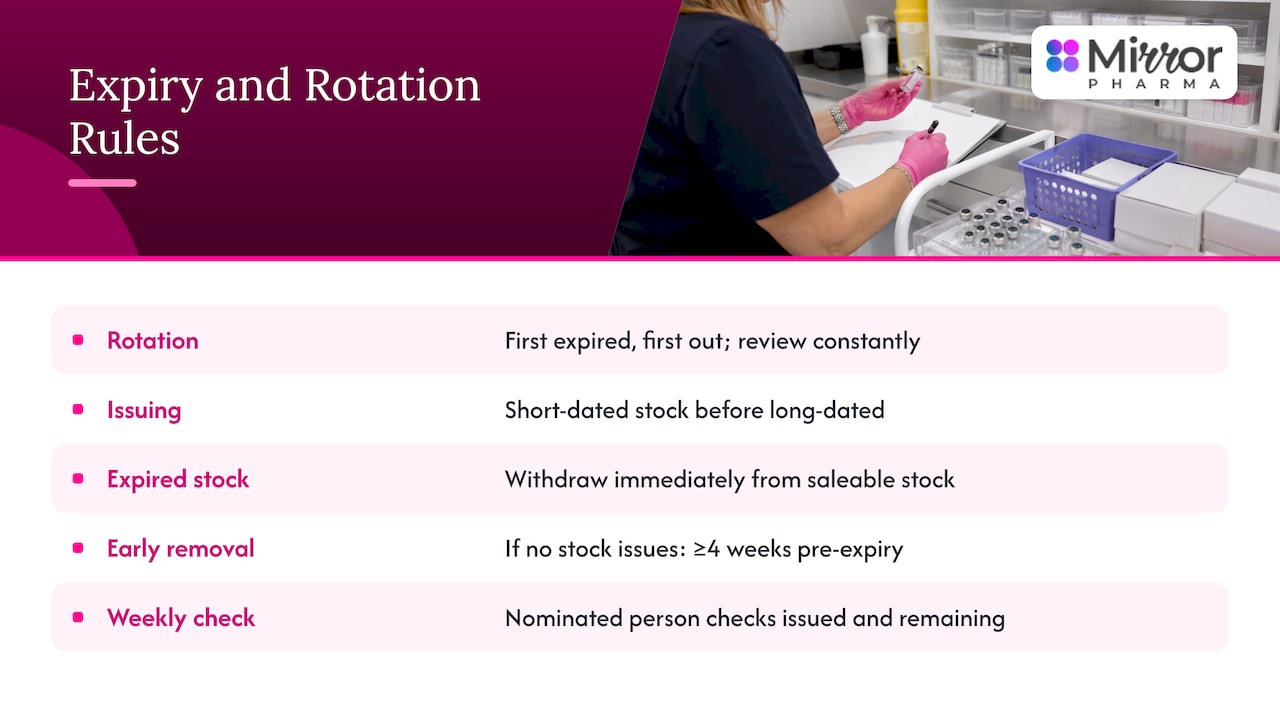
Greater Glasgow and Clyde adds that a named person should ensure a system for regularly checking expiry dates and rotating stock. It gives particular attention to high-cost or rarely used items, and asks that pharmacy is told well before expiry so waste can be minimised. Aesthetic clinics have plenty of these: a filler used for one specific indication, or a product launched for a single treatment.
A weekly check in ten minutes
| Check | What to look for | Action |
|---|---|---|
| Expiry dates | Anything expiring within four weeks | Use first, move to the front, or remove |
| Quantities | Anything at or under the minimum level | Add to the next order |
| Fridge log | Gaps, readings out of range | Investigate and record the response |
| Packaging | Damage, broken seals, unlabelled items | Quarantine |
| Batch records | Entries missing against used stock | Complete the same day |
One expired vial in a fridge tells an inspector something about the whole system, so make this check a fixed slot in the diary rather than a task for quiet days.
Expired, damaged, recalled or incorrectly stored stock
When something fails a check, the first job is to stop it being used by mistake.
- Segregate it. Greater Glasgow and Clyde’s safe disposal guidance says obsolete, expired or unwanted medicines must be kept apart from other medicines and stored securely, clearly identified for return or destruction, until they can be removed.
- Record it. Log product, batch, quantity, reason and date.
- Dispose of it correctly. The same guidance puts part-used vials, syringes with part-used doses and dropped doses in the blue-lidded pharmaceutical waste bin, replaced when three quarters full and at least every three months. Use a licensed waste route in your clinic, and keep the destruction record.
- Trace if it was a recall. Search by batch number, identify the patients treated, and follow the recall notice’s instructions. This is where the treatment log earns its place.
- Review the cause. If product spoiled because of a fridge fault or a missed check, fix the process, not just the stock.
The East of England policy adds that out-of-date drugs, or those exposed to adverse environmental conditions, are returned for safe storage and eventual disposal in line with waste regulations.
Know where your stock came from
Traceability starts with the supplier. A Powys Teaching Health Board stock management standard operating procedure describes accurate records of distribution as a mandatory part of good distribution practice that enables traceability, and says everyone involved shares responsibility for the integrity of the distribution chain. That chain begins with whoever sells to you.
For prescription-only injectables, check the supplier is a registered pharmacy that verifies the practitioners and prescribers it supplies, and keep the paperwork that arrives with each order. Our checklist on what to look for in an aesthetics injectable supplier sets out four compliance checks for UK clinicians, and the prescription upload process shows how prescriptions fit into ordering.
Where Mirror Pharma fits
Stock control is easier when the supply side is predictable. Mirror Pharma is an online pharmacy supplying healthcare professionals, clinics and aesthetic practitioners. Access is subject to strict verification for practitioners and prescribers, and orders are fulfilled by a dedicated team of healthcare professionals. Our order cut-off times are extended, so your reorder points can be set against a delivery pattern you can plan around.
The range covers the products most clinics hold: toxins, dermal fillers, skin boosters, polynucleotides, IM/IV vitamins, weight loss and fat dissolving products, plus needles and consumables. Everything is for licensed practitioners and qualified aesthetic professionals, with full compliance and verification required.
Our view: stock control starts at the supplier
Most stock problems we hear about in this sector begin before the box reaches the clinic: an uncertain delivery day, a rushed top-up order, a short-dated delivery bought in a panic. A tidy fridge cannot fix a supply pattern you cannot predict.
That is why we built our service around what a practitioner needs to plan. Verification of practitioner and prescriber access is strict, because traceability depends on knowing who is buying. Orders are packed by a team of healthcare professionals. Our cut-off times are extended, so a clinician who realises on the day that a product is running low still has a realistic chance of getting an order in.
Our advice to licensed practitioners is to treat ordering as a scheduled routine, not a reaction: set minimum and maximum levels, review them quarterly, record every batch on arrival, and place orders on a rhythm that matches your clinic days. Buy from one verified source for as much of your range as you can, so your records, paperwork and reorder logic stay consistent.
Rizwan
Common mistakes to avoid
- Counting units but not batches. Totals do not help in a recall. Batch and patient linkage does.
- Logging the fridge only when someone remembers. Gaps in a temperature record are what inspectors notice first.
- Ordering on instinct. Without minimum and maximum levels, you either run out or over-buy.
- Mixed storage. Expired, quarantined and in-date stock on the same shelf invites an error.
- No named owner. Stock control that belongs to everyone belongs to nobody. Name one lead and one deputy.
- Letting part-used vials accumulate. Dispose of them under your waste policy and record it.
FAQ
How often should a clinic check injectable stock?
Do a quick expiry and fridge check weekly, and a fuller count against your records at least quarterly alongside your usage review. The NHS policy examples above ask for a nominated person to check stock at least weekly. Increase the frequency if you hold high-value or short-dated items.
What records does an aesthetic clinic need for injectables?
At minimum: purchase and supplier details, quantity, batch number and expiry date for each unit received, the batch used in each treatment linked to the patient and practitioner, storage records and disposal records. The national occupational standards for dermal filler name audit, storage, disposal, expiry date, batch number and product name as core requirements. Check retention periods with your regulator and indemnity provider.
What should I do if the fridge goes out of range?
Quarantine the affected stock, record the readings and times, and follow your written excursion policy. Any decision to use stock stored outside the recommended range must be fully risk assessed, so involve the prescriber and, where needed, the manufacturer’s information. Do not return affected product to saleable stock until that decision is recorded.
How do I decide how much stock to hold?
Use twelve months of treatment data to find average and peak use per product, add your supplier’s lead time and a small safety margin, and cap the maximum by shelf life. Review every quarter. Avoid overstocking, and rely on historical usage rather than guesswork.
Who can order prescription-only injectables for a clinic?
Only authorised people within your organisation should order, and the supplier must verify that the purchaser is a qualified practitioner or prescriber. Keep a short list of named staff who can place orders, and follow the supplier’s prescription and verification process for each order.
Sources
- Professional guidance on the safe and secure handling of medicines, Royal College of Pharmacy
- Jacqui Mac Medispa inspection summary, Care Quality Commission
- National Occupational Standards: dermal filler procedures
- Guidelines on Good Distribution Practice of Medicinal Products, European Commission
- Managing medicines safely in clinical areas, NHS SPS
- Policy on injectable medicines, NHS Grampian
- Storage, prescription, supply and administration of medicines policy, UHNM
- Ordering and stock control guidance, NHS Greater Glasgow and Clyde
- Safe disposal of medicines guidance, NHS Greater Glasgow and Clyde
- Medicines management policy, East of England Ambulance Service
- Vaccination team stock management system SOP, Powys Teaching Health Board