

A Patient Group Direction (PGD) covers a group of patients who are not individually identified before they arrive. A Patient Specific Direction (PSD) is a signed instruction from a prescriber for a named patient, issued after a one-to-one assessment. This guide is for licensed practitioners and qualified aesthetic professionals who need to know which route is lawful for the treatment in front of them, and what to record.
TL;DR
- A PGD works for groups of patients who have not been individually identified in advance. A PSD is written for a named individual after assessment by the prescriber.
- A PGD needs authorisation by an appropriate organisation and sign-off by a doctor or dentist and a pharmacist. A PSD is signed by one prescriber.
- Official guidance tells professionals to look first at prescriptions and PSDs, and to use a PGD only where nothing else suits.
- The most common error the Care Quality Commission (CQC) identifies is treating a PGD template as a PSD, or applying generic instructions to a whole clinic list.
- Keep the instruction, the assessment and the supplier paperwork linked to each patient record.
Table of Contents
- The core difference in plain terms
- How a PGD works
- How a PSD works
- When to use which
- What this means in an aesthetic clinic
- Do the rules differ across the UK?
- Our perspective
- Ordering for your clinic
- FAQ
- Sources
The core difference in plain terms
Both mechanisms let a medicine be supplied or administered by someone who is not the person who prescribed it. The legal logic is very different.
The CQC’s GP mythbuster says that a PGD allows specified health professionals to supply or administer medicines without a prescription or an instruction from a prescriber. A PSD is a written, signed prescriber instruction for a named individual, following a one-to-one assessment.
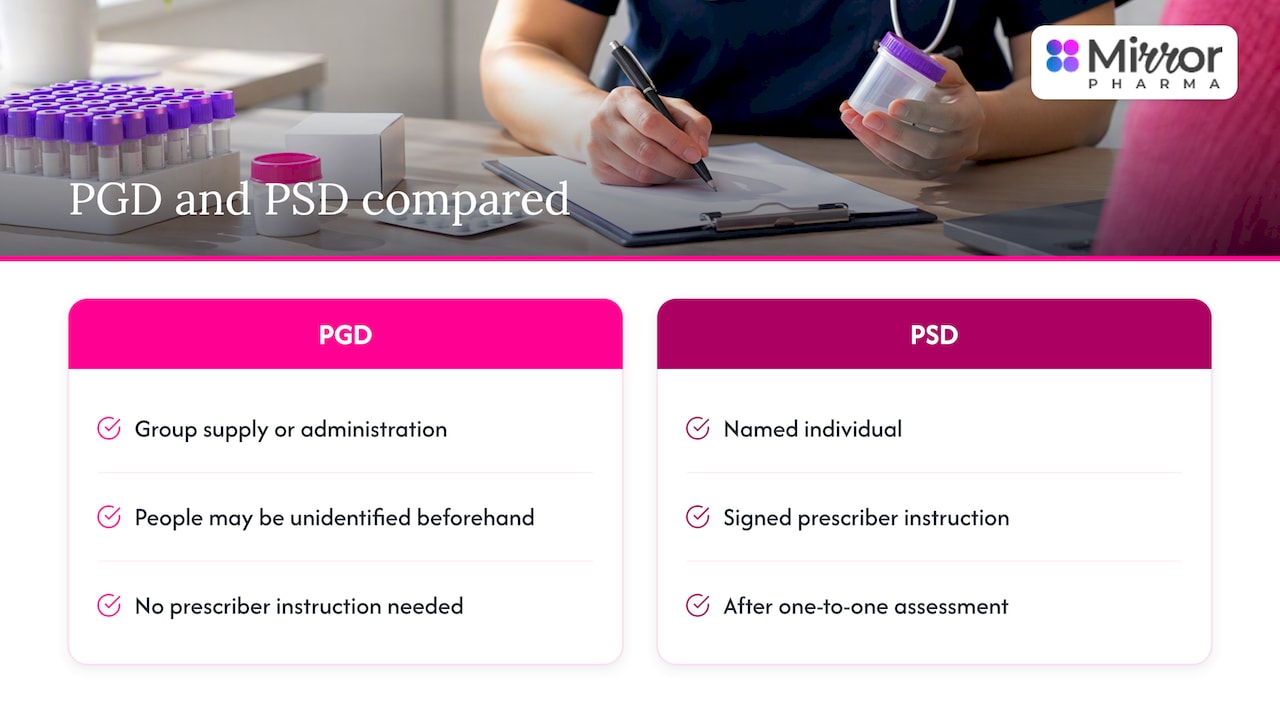
The NHS Specialist Pharmacy Service (SPS) describes a PGD as a written instruction for the sale, supply and/or administration of medicines to groups of individuals who may not be individually identified before presenting for treatment. The registered professionals who can use one are listed in Part 4 of Schedule 16 of the Human Medicines Regulations 2012.
In practice, the question is not which document is more convenient. It is whether a prescriber has assessed this patient, or whether a pre-agreed protocol is covering a group.
Side by side
| Feature | PGD | PSD |
|---|---|---|
| Who it covers | A group of patients, not individually identified beforehand | A named patient, or a list of individually assessed patients |
| Who authors it | Written to a legal template, signed by a doctor or dentist and a pharmacist | A doctor, dentist or other qualified independent or supplementary prescriber |
| Authorisation | An appropriate organisation must authorise it | The prescriber’s own signed instruction |
| Assessment | Staff work strictly within the criteria set out | The prescriber assesses the individual first |
| Flexibility | No deviation allowed | Tailored to the individual’s clinical needs |
| Expiry | Decided case by case, no more than three years after authorisation | Linked to the individual instruction |
The PGD and expiry points come from GOV.UK guidance on who can use PGDs. The PSD points come from SPS guidance on PSDs.
How a PGD works
A PGD is a legal framework, not a clinical judgement call. SPS stresses that clinical judgement cannot be used to supply or administer a medicine outside the strict criteria set in the PGD. If a patient falls outside the criteria, the professional cannot improvise. They need another route, such as a prescription or a PSD.
Who can supply under one
GOV.UK lists qualified healthcare professionals who may supply or administer under a PGD, including nurses, pharmacists and paramedics. The PGD must include specific particulars, be signed by a doctor or dentist and a pharmacist, and be authorised by an appropriate organisation. Its expiry date is decided case by case and should be no more than three years after authorisation.
Who can authorise one
In the NHS in England, NICE guidance on PGDs lists NHS England, clinical commissioning groups, local authorities, NHS trusts or foundation trusts and Public Health England as authorising bodies. SPS notes that Integrated Care Boards were formally recognised as bodies able to authorise PGDs under the Human Medicines Regulations 2012 in July 2022.
There is a practical consequence for independent providers. SPS says that for public-sector commissioned services, a PGD for an independent or private provider must be authorised by the NHS or local-authority commissioner. A PGD is therefore not something a practitioner can simply download and adopt for themselves.
How a PSD works
A PSD can be issued by a doctor, dentist or other qualified independent or supplementary prescriber. SPS explains that it relates to an individual patient, or a list of individually assessed patients, and acts as a signed clinical instruction that effectively functions as a prescription for the named person.
Three features matter for day-to-day governance:
- Individual assessment comes first. A list is acceptable only if the prescriber has individually assessed each patient on it and is satisfied the medicine meets that person’s needs, as the CQC mythbuster sets out.
- Format is flexible, traceability is not. The British Medical Association (BMA) says a PSD can be written or electronic, provided the record can be uniquely linked to the patient and the prescriber and stays under the prescriber’s sole control.
- No fixed legal template. The BMA notes there is no defined protocol for PSDs in legislation, which gives prescribers room to tailor instructions to each assessment.
That flexibility is a strength for licensed practitioners, but it puts the responsibility on the quality of your record. We cover the fields a pharmacist expects to see in our guide to PSD requirements in aesthetic clinics.
When to use which
Official guidance is consistent: a PGD is the exception, not the default.
NICE says PGDs should be used only in limited situations where they offer an advantage for patient care without compromising safety, with clear governance, and that organisations should explore all available options first. SPS repeats this, advising professionals to prioritise care on an individual, patient-specific basis using prescriptions or PSDs, and to use a PGD only when no other suitable legal mechanism or exemption exists.
A practical decision sequence:
- Can the patient be assessed individually before treatment? If yes, a prescription or PSD is the expected route.
- Does a legislative exemption already cover the supply? Some medicines, such as take-home naloxone, have exemptions that allow supply without a prescription, PGD or PSD.
- Is the medicine GSL? SPS advises that PGDs should not be used for GSL medicine supply or administration, where local protocols or standard exemptions usually apply.
- Only then consider a PGD, with an authorised document in place and staff working strictly inside it.
NHS England’s guidance on dental hygienists and dental therapists gives a recent example of the direction of travel. Amendments to the Human Medicines Regulations 2012, effective June 2024, allow suitably trained staff in those roles to supply or administer certain medicines without a PGD or PSD, and providers are expected to transition to PSDs or the exemptions rather than keep using PGDs for those medicines.
What this means in an aesthetic clinic
Aesthetic treatment is, in nearly every case, an elective, individually assessed decision. Each client has a consultation, a history, a treatment plan and consent. That is the shape of a PSD or prescription workflow, not a group protocol.
For licensed practitioners using prescription-only products such as botulinum toxin or prescription weight management medicines, the safest working assumption is that you need an individual prescription or PSD from a prescriber who has assessed the client. A PGD template is not a substitute, and a prescriber cannot sign a blanket instruction for a clinic list they have not assessed.
The CQC lists the errors it sees most often:
- treating PGD templates as if they were PSDs;
- using verbal instructions for PSDs;
- applying generic instructions to clinics without individual patient assessment.
All three are documented in the CQC’s 2024 mythbuster. The mythbuster is written for GP settings in England, but the logic about assessment and written instruction is a useful benchmark for any practitioner.
A record that stands up to inspection
For each treatment under a PSD or prescription, we suggest your file can answer these questions without searching:
- Who is the prescriber, and what is their registration?
- Which named client does the instruction cover?
- When was the individual assessment, and what did it find?
- What product, dose and area were authorised?
- Who administered it, and was that person trained and competent?
- Which supplier delivered the product, and can the batch be traced?
The last point is where many clinics fall down. Our guides on the documents a medicine supplier should provide and on documentation that accompanies orders explain what to expect and keep. If you are working out how a prescription reaches your pharmacy, see our prescription upload process.
Remote prescribing
Many clinics rely on a prescriber who is not on site. That makes the assessment and the record even more important, because the instruction has to be tied to a real, individual consultation. Our remote prescribing checklist for aesthetic clinicians walks through the steps to confirm before you rely on an off-site prescriber.
Unlicensed products
If a product is not licensed in the UK, a further layer of prescriber responsibility applies. We set out the checks in our article on unlicensed medicines in aesthetics.
Do the rules differ across the UK?
The Human Medicines Regulations 2012 apply across the United Kingdom, and the NHS England guidance on the June 2024 amendments is a UK-wide legal change. Authorisation arrangements, however, are organised by nation. The NICE list of authorising bodies and the ICB position above describe England. If you practise in Scotland, Wales or Northern Ireland, check the health board or national body that governs PGD authorisation where you work, and confirm your regulator’s expectations. Several of the sources cited here, including the CQC mythbuster and the BMA paper, are written for England.
Our perspective
We supply prescription aesthetic medicines, toxins, weight loss products, vitamins and infusion therapies to licensed practitioners and clinics, so we see the paperwork side of this question every day.
Our view is simple. In aesthetics, the clean route is an individual prescription or PSD, written after a real assessment by a prescriber, and attached to the client record. That is what our verification process is designed around: we require practitioner and prescriber verification before we supply, and our fulfilment is handled by a dedicated team of healthcare professionals who understand why a missing field matters.
We would rather ask a clinic for one more detail at order stage than leave a practitioner exposed at inspection. A smooth ordering experience should never mean a loose one, and our extended order cut-off times exist so that doing it properly does not cost you a treatment day.
If you are unsure whether your current instruction route is sound, speak to your prescriber and your supplying pharmacy before the next order, not after.
Rizwan
Ordering for your clinic
Our products are for licensed practitioners and qualified aesthetic professionals, and every order is subject to verification. If you are setting up a compliant workflow, you can browse our toxins, dermal fillers and weight loss ranges once your prescriber arrangements are in place. Our guide to choosing a safe online pharmacy and the five-minute GPhC check for suppliers will help you check any supplier, including us.
FAQ
Can NHS England authorise a PGD?
Yes. NICE lists NHS England among the bodies that can authorise PGDs in the NHS in England, alongside clinical commissioning groups, local authorities, NHS trusts and foundation trusts and Public Health England. SPS adds that Integrated Care Boards were recognised as authorising bodies in July 2022. Check the current arrangements with your commissioner.
Who can issue a PSD?
A doctor, dentist or other qualified independent or supplementary prescriber can issue one. It must relate to a named patient, or to a list of patients the prescriber has individually assessed. It can be written or electronic, as long as it is linked to the patient and prescriber and stays under the prescriber’s control.
Can I use a PGD template as a PSD?
No. The CQC identifies treating PGD templates as PSDs as a common error. A PGD is a group protocol authorised by an organisation. A PSD is an individual instruction from a prescriber who has assessed that patient.
When should a PGD be used instead of a prescription?
Only in limited situations where it offers a clear advantage for patient care without compromising safety, and where governance is clear. NICE and SPS both say to consider individual prescriptions and PSDs first, and to check for legislative exemptions before settling on a PGD.
Is a verbal instruction enough for a PSD?
No. The CQC lists verbal instructions for PSDs among the errors it sees. A PSD should be written or electronic, signed, and traceable to the individual patient and the prescriber.
Sources
- GP mythbuster 19: Patient Group Directions and Patient Specific Directions, CQC
- Introduction to PGDs, NHS Specialist Pharmacy Service
- Patient group directions: who can use them, GOV.UK
- Patient Specific Directions (PSD), NHS Specialist Pharmacy Service
- Patient Group Directions and Patient Specific Directions, BMA
- Patient group directions, NICE (guidance PDF)
- Patient group directions, NICE (authorising bodies)
- Supplying take home naloxone without a prescription, GOV.UK
- P and GSL medicines with PGDs, NHS Specialist Pharmacy Service
- Understanding Patient Group Directions and Integrated Care Boards, NHS Specialist Pharmacy Service
- Supply and administration of medicines by dental hygienists and dental therapists, NHS England