

A clinic supplier account is a verified trading account that lets your clinic order from a supplier, usually on credit terms, with your professional status checked before any regulated product is released. For licensed practitioners, it is the gateway to legitimate supply: the supplier confirms who you are, and you confirm the supplier is who they say they are. This guide is for qualified aesthetic professionals, prescribers and clinic managers in the UK. It explains what the account is, what verification to expect, how registration usually runs and what to check before you rely on it.
TL;DR
- A clinic supplier account is a verified, repeat-ordering account. For prescription-only products, the supplier must confirm you are a registered professional or a licensed organisation first.
- Expect to evidence your registration (for example GMC, GDC, NMC or GPhC) or an MHRA licence, plus clinic details and a named prescriber.
- Approval is never automatic. Suppliers can decline or later revalidate an account.
- Before your first order, check the supplier’s own registration and licensing, the documentation that travels with each order, and the practical terms: payment, carriage, cut-off times and support.
- Keep the accounts and logins of each team member separate, and keep records of what you ordered for each batch.
Table of Contents
- What a clinic supplier account actually is
- Who can open a clinic supplier account
- What you will usually need to register
- How registration and approval usually run
- Checks to make before you rely on a supplier
- Terms worth comparing before you commit
- Our view: verification is a feature, not friction
- Open an account for your clinic
- If you cannot sign in or your application is not approved
- FAQ
- Sources
What a clinic supplier account actually is
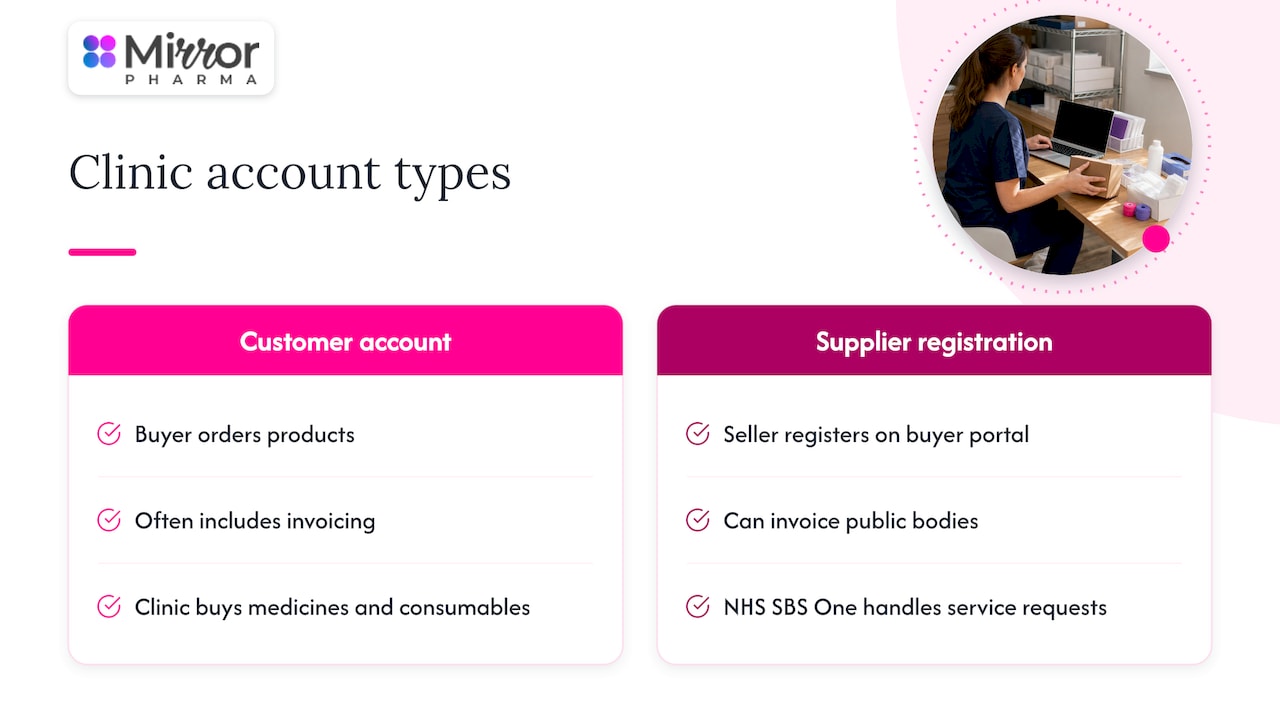
The phrase covers two quite different things, and search results mix them up. The first is a customer account with a supplier: you are the buyer, and you open an account to order products, often with invoicing. The second is a supplier registration: you are the seller, registering on a buyer’s portal, for example to invoice a public body. Pages that rank for this phrase are mostly the second type, such as procurement sign-in pages and onboarding forms for people who sell to large organisations.
If you run an aesthetics clinic, a practice or a wellness service and want to buy medicines and consumables, you need the first type. The NHS gives a useful picture of how this looks in a large system. NHS Supply Chain customer accounts allow eligible organisations to order and transact with it, which is the same basic idea as a private clinic account with a commercial supplier, just with a public-sector rulebook.
The second type exists too, and you may meet it if your clinic delivers NHS-funded work. NHS bodies run portals and invoicing routes for their suppliers. NHS SBS One, for example, is described as a digital customer service centre for day-to-day service requests and real-time progress updates. That is a different job from buying injectables for a private treatment room, so do not assume one login covers both.
Who can open a clinic supplier account
For general consumables, eligibility is mostly a commercial question: is this a real trading business? For prescription-only medicines, it is a regulatory one. A supplier cannot release them simply because a card was accepted at checkout.
NHS Supply Chain shows how strict this can be. It must validate customers seeking medicinal products, and the evidence it accepts may include an MHRA Distributor’s or Manufacturer’s Licence, or a letter showing GMC, GDC or GPhC registration. Private suppliers of prescription aesthetic products work to the same underlying logic, even if their forms differ.
In practice, the people who can usually apply are:
- Registered prescribers such as doctors, dentists, pharmacist prescribers and nurse or pharmacist independent prescribers, buying for patients they are responsible for.
- Clinics and practices with a named prescriber and a registered address, where the account is held by the business.
- Licensed organisations that hold their own MHRA authorisation.
People who cannot, by design, include members of the public and anyone buying for personal use. If you are a non-prescribing practitioner, such as an aesthetic nurse without prescribing qualifications, the route to prescription products runs through a prescriber, not around one. Our guide for clinicians on why remote prescribing in aesthetics is changing sets out what that means for the prescriber relationship.
What you will usually need to register
The exact list is set by each supplier, so treat this as a preparation checklist for qualified aesthetic professionals, not a promise of what every form asks. Having it ready makes approval faster.
- Business details. Legal name, trading name, registered address, company number if applicable, and the delivery address. Medicines should go to a premises where they can be received and stored properly.
- Professional registration. The registration number and body for the prescriber (GMC, GDC, NMC, GPhC or other), which the supplier can check against the public register.
- Evidence of status. Depending on the supplier, this could be a registration letter, a licence, or a clinic’s regulator registration. NHS Supply Chain, for instance, names an MHRA licence or a registration letter as acceptable evidence.
- A named responsible person. Who orders, who signs for deliveries and who is accountable for the account.
- Payment and invoicing details. An accounts email, a purchase order process if you use one, and credit references if you are applying for terms.
- Premises and governance information. If you are opening a new clinic, regulator registration comes first. Our article on opening an aesthetics clinic and the registration delays to plan for covers the sequence.
None of this is a trick question. A supplier that asks for little or nothing about your professional status before selling you a prescription-only product is a supplier to question, not a convenient one.
How registration and approval usually run
Most online accounts follow the same arc, whether the supplier is a pharmacy, a wholesaler or a public-sector portal.
1. Apply with accurate details
Complete the form with details that match your registers exactly: name as registered, registration number, and address. Mismatches are the most common reason a verification stalls.
2. Verify your email and set credentials
Portals typically send a welcome email with a username and a link to set your password. The Atamis supplier portal, for example, asks applicants to complete the form and a CAPTCHA, then sends a welcome email with a username and a password-setup link.
3. Submit evidence and wait for the decision
The supplier checks your registration against the relevant register and your clinic against its own criteria. Approval is a decision, not a formality. NHS Supply Chain states that it may approve or decline an application, and that submitting one does not guarantee an account, credit or products. Expect the same principle with commercial suppliers.
4. Give each team member their own login
If several people order for your clinic, set up individual access. NHS Supply Chain’s portal guidance recommends individual accounts for everyone who needs access, which keeps an audit trail of who ordered what. The guidance dates from 2017, but the principle holds for any clinic that needs to know who placed an order.
5. Place a small first order and check the paperwork
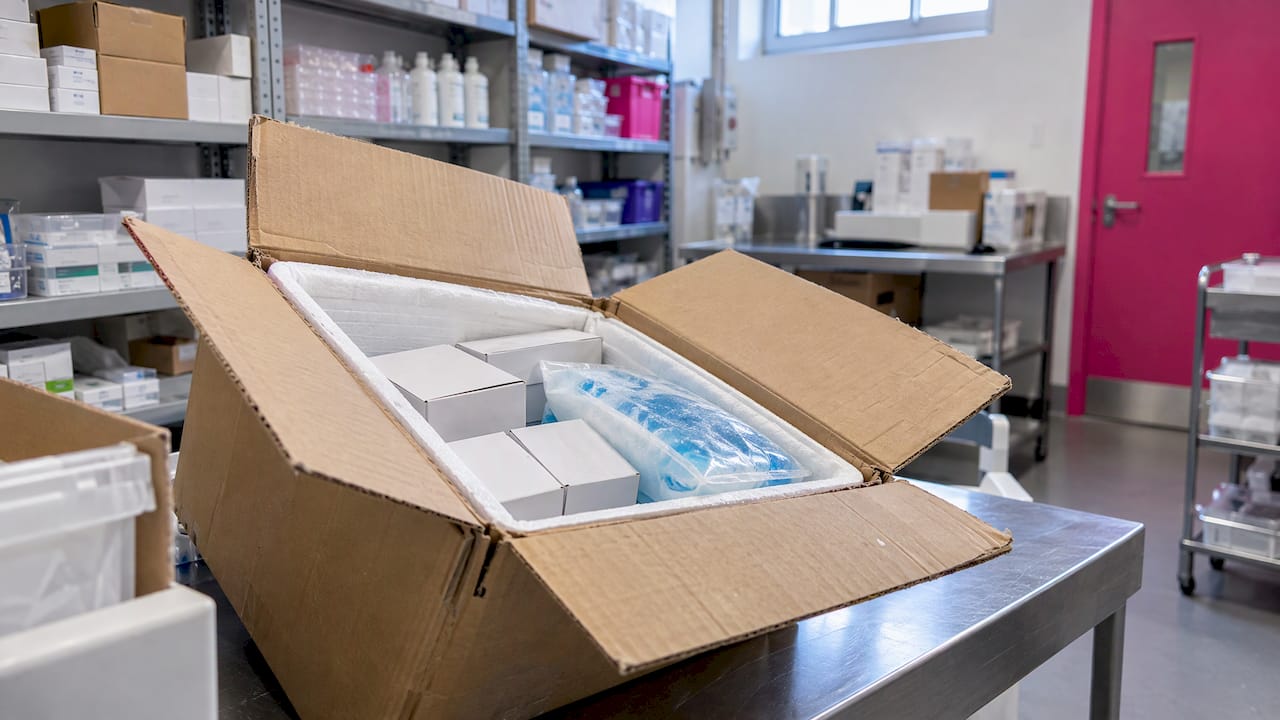
Use the first order to test the whole chain: how it is packed, whether the temperature-sensitive items arrive as they should, and whether the documents match the products.
Checks to make before you rely on a supplier
An account is only as good as the supplier behind it. The Joint Council for Cosmetic Practitioners advises UK practitioners to buy cosmetic medicines and medical devices through legitimate supply routes, including UK registered pharmacies and authorised suppliers. It warns that products obtained outside normal supply chains carry none of the equivalent assurance and may expose the purchaser to enforcement or criminal-prosecution risks. Provenance, in other words, is part of your own professional responsibility.
A practical sequence for qualified aesthetic professionals:
- Check the supplier’s registration. For a pharmacy, look up its entry on the GPhC register. Our five-minute GPhC check for clinic suppliers shows what to look for and which red flags to act on.
- Ask for the paperwork. The documents a legitimate supplier can show are covered in five MHRA-checked documents clinics should get from a medicine supplier.
- Understand wholesaler claims. If you are dealing with a wholesaler rather than a pharmacy, work through the questions to ask before choosing an aesthetic wholesaler.
- Know the broader compliance picture. The four compliance checks for injectables suppliers and the two MHRA checks on unlicensed medicines cover what a prescriber should confirm before choosing a product.
- Understand what travels with each order. Pharmacists check specific fields on a prescription supply, set out in the seven PSD fields pharmacists check in aesthetic clinics, and clinics are expected to keep records, as explained in our piece on five-year documentation with orders.
Also keep in mind that there is no licence for practitioners of injectables yet in the UK. What evidence of competence a supplier or insurer may ask for is covered in our guide on injectables licensing.
Terms worth comparing before you commit
Beyond compliance, the day-to-day terms decide whether an account is pleasant to use. Compare these across suppliers, and ask in writing where the website is silent.
| Term | What to find out |
|---|---|
| Payment terms | Pay at checkout, or invoice terms? How long from the invoice date? |
| Carriage | Is there a delivery charge, and is there a minimum order threshold? |
| Order cut-off | How late can you order for dispatch, and is delivery next-day? |
| Cold-chain handling | How are temperature-sensitive items packed and what happens if they arrive compromised? |
| Verification | How does the supplier check practitioner and prescriber status, and how often? |
| Support | Who answers queries, and are they healthcare professionals? |
| Records | Can you download order history and invoices for your clinical records? |
For a sense of what published terms can look like, NHS Supply Chain customer accounts have payment terms of 30 days from the invoice date, and orders below £120 incur a £7.50 carriage charge. Those are NHS figures, not a benchmark for private suppliers, but they show the level of detail you should expect any supplier to be able to give you.
If you also invoice an NHS body, mind the administrative detail. NHS invoicing guidance notes that invoices may be rejected for a missing or incorrect PO number or for containing patient-identifiable data. For NHS England and Wales suppliers, the 2025 operational requirements also say that, to comply with the Scan4Safety programme, all NHS suppliers must trade electronically via PEPPOL through an accredited provider. This is separate from buying products for a private clinic.
Our view: verification is a feature, not friction
Clinics sometimes ask us why we ask for registration details before we release prescription products. The honest answer is that it protects everyone in the chain: the patient, the prescriber and the clinic.
We built Mirror Pharma for healthcare professionals and aesthetic practitioners. Access is limited to verified practitioners and prescribers, and orders are fulfilled by a dedicated team of healthcare professionals. We also extend our order cut-off times, because a clinic with a full diary cannot always order early.
Our advice is simple: pick a supplier whose checks you can describe in a sentence, and whose documentation you could show an inspector. A smooth ordering experience matters, but only after the compliance is right.
Rizwan
Open an account for your clinic
If you are a licensed practitioner or clinic ready to order, Mirror Pharma supplies toxins, dermal fillers, skin boosters, polynucleotides, IM/IV vitamins, weight loss products, fat dissolving products, and needles and consumables, all for qualified professionals only. Start at mirrorpharma.co.uk and complete the verification step at registration.
If you cannot sign in or your application is not approved
Most access problems are small ones. Work through them in order:
- Check you are on the right portal. Buyer and supplier portals often look alike but use different credentials.
- Check the username. The welcome email contains it, and it is often not the same as your email address.
- Reset the password through the link on the sign-in page.
- Joining an existing company account? Ask an existing contact to approve your request. The Atamis guidance says that if nobody can, contact support from your work email and include written director approval if you are not a director.
- If you were declined, ask what evidence was missing. Common gaps are a registration number that does not match the register, an address without a named prescriber, or a missing licence document.
An approved account can also be revisited. NHS Supply Chain may periodically revalidate evidence for medicinal products, and failing the requirements may mean access to those products is removed. Keep your registration details current and tell your supplier when your prescriber or premises change.
FAQ
What is a clinic supplier account?
It is an account that lets a verified clinic or practitioner order products repeatedly from a supplier, often with invoicing and order history. For prescription-only medicines, the supplier checks professional registration or licensing first. It is intended for licensed practitioners and clinics, not members of the public.
Do I need a prescriber to open one?
For prescription-only products, yes, there has to be a registered prescriber responsible for the supply. Non-prescribing practitioners can usually open an account for consumables, but prescription items depend on a prescriber relationship. Check the supplier’s requirements before applying.
How long does approval take?
It varies by supplier and by how complete your evidence is. Accurate details that match the professional registers are the single biggest factor. Ask the supplier for its typical turnaround rather than relying on a guess.
Is a supplier account the same as registering as a supplier on a portal?
No. A clinic supplier account is for buying. Supplier registration on a portal, such as those used by public bodies, is for selling to that organisation. Most results for this phrase relate to the second, so check which one you need before you start.
What should I do if a supplier does not ask for any verification?
Treat it as a warning sign for prescription-only products. JCCP guidance points practitioners to legitimate supply routes such as UK registered pharmacies and authorised suppliers. Run the GPhC and MHRA checks above before ordering.
Sources
- Create New or Modify Existing Customer Account, NHS Supply Chain
- Invoicing, NHS Thames Valley
- Registering with a Supplier Portal, Atamis
- Supplier Portal Guidance Notes, NHS Supply Chain
- Aesthetics Product supply video, JCCP
- Operational Requirements of Suppliers, NHS Supply Chain