
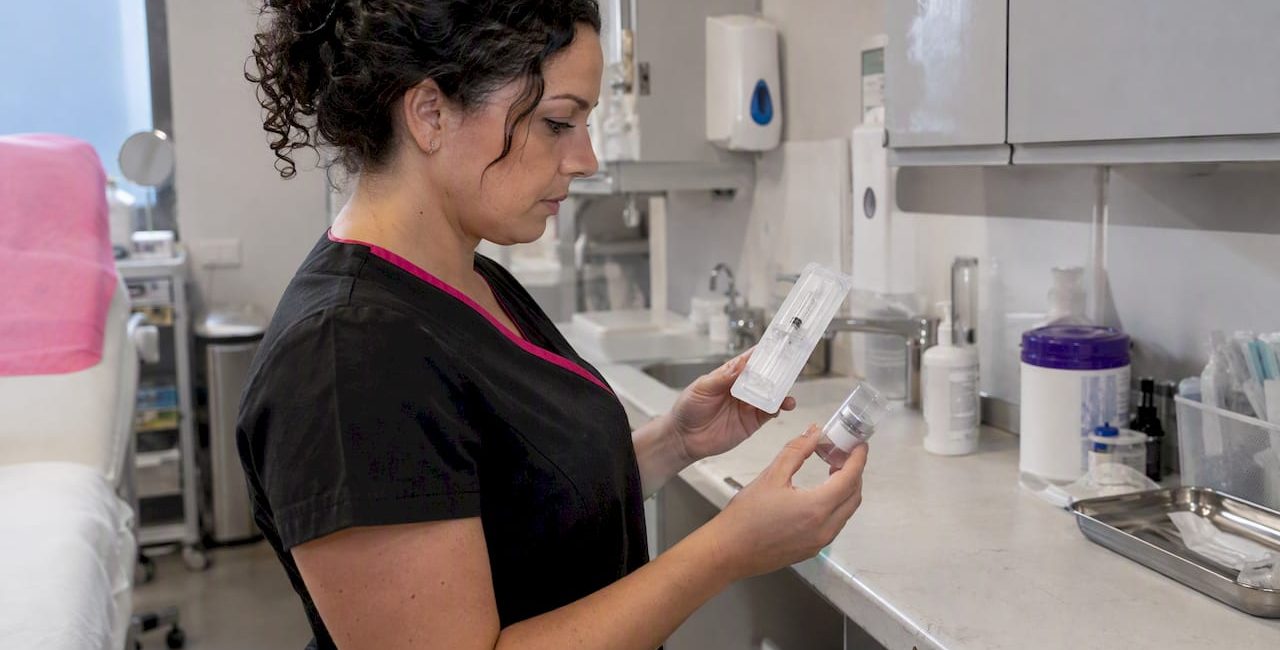
For licensed practitioners in the UK, the comparison is short: polynucleotides are an injectable regenerative option with a published clinical evidence base, while injectable exosomes have no UK marketing authorisation and cannot lawfully be used for aesthetic injection. This guide sets out how the two differ in mechanism, evidence, regulation and product selection, so qualified aesthetic professionals can make decisions they can defend in front of a patient, an insurer or a regulator. It is written for prescribers and trained practitioners, not for members of the public.
TL;DR
- Polynucleotides are injected fractions of DNA used for skin quality. A 2024 systematic review of nine studies and 219 patients reported consistent improvement in skin rejuvenation measures, with mild, transient side effects.
- Exosomes are extracellular vesicles that carry signalling cargo. A 2026 meta-analysis of human trials shows promise but also heterogeneity and no long-term follow-up.
- In the UK, the MHRA treats injected exosomes as medicinal products with no marketing authorisation, and human-derived exosomes are banned for cosmetic use.
- Neither is a stand-alone fix. Both are usually combined with a procedure, and both demand rigorous documentation and supplier checks.
Table of Contents
- What each one actually is
- The UK legal position
- Comparing the evidence
- Vetting products: what to ask for
- How they are used in practice
- Our perspective
- Where to source polynucleotides
- FAQ
- Sources
What each one actually is
Polynucleotides
Polynucleotides (PN) are chains of nucleotides, usually purified from fish or other biological DNA sources, formulated as an injectable gel. Practitioners use them for biorevitalisation: improving hydration, elasticity and the general quality of thin, crepey or photodamaged skin. They are not volumising products. If your patient wants lift or projection, that is a job for a hyaluronic acid filler, not a polynucleotide. Our skin booster vs filler guide covers where each category sits.
The working rationale is tissue repair. PN has a history in wound healing, and the aesthetic literature frames it as supporting fibroblast activity and the skin’s own repair signalling. A key practical point is that the formulation profile is comparatively consistent, which matters when you need to compare one product with another.
Exosomes
Exosomes are microscopic extracellular vesicles, roughly 30 to 150 nm, released by cells. Think of them as envelopes carrying proteins, lipids and genetic material to neighbouring cells. In aesthetics the commercial interest centres on exosomes derived from stem cells, on the theory that their cargo can calm inflammation and prompt collagen production, as Save Face explains in its UK safety briefing.
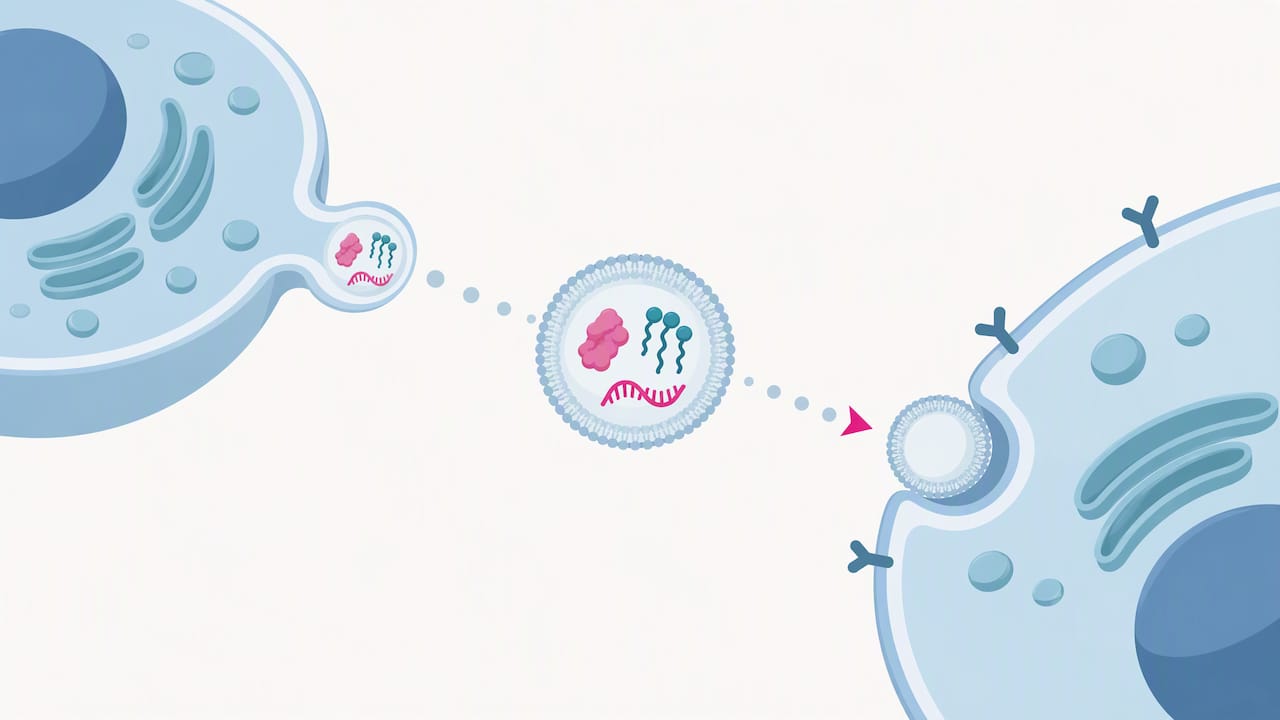
That theory is attractive, but it describes a mechanism, not a standardised product. Exosomes can come from humans, animals or plants, isolated by different methods from different source cells. That variability is the root of most of the problems below.
A note on terminology, since readers often ask: liposomes are not exosomes. Liposomes are synthetic phospholipid vesicles built mainly as drug carriers, while exosomes are biological vesicles with native signalling content. A comparison in Advanced Healthcare Materials sets out the differences in composition and behaviour. Treat the two as different tools with different purity profiles, and do not accept the words interchangeably on a product sheet.
The UK legal position
This is where the comparison stops being close.
- Human-derived exosomes are banned for cosmetic use in the UK. Any product marketed as human-derived stem cell exosomes should be treated as unlawful.
- Injected exosomes, of any origin, are classed by the MHRA as medicinal products. Per Save Face, injectable exosome therapies hold no UK marketing authorisation, so injecting them for aesthetic purposes is not permitted.
- Topical exosome-type products that are non-human in origin and properly formulated may be used, applied after a channel-creating procedure. This is the narrow lawful lane the same source describes.
- Polynucleotides are treated differently. Save Face notes they are legally distinct from exosome therapies and available to trained professionals within the established regulatory framework.
The press has been reporting on the gap between the rules and the market. The Guardian reported in March 2025 that banned products harvested from human cells were being used in UK beauty clinics, with experts warning of serious health risks. If you are a prescriber, the regulatory exposure sits with you, not with the supplier’s marketing copy.
Rules change, so check the current MHRA position and your professional indemnity terms before adopting any new biologic. If you are unsure whether a specific product is lawful for your intended use, ask the supplier for written regulatory documentation and, where needed, your insurer or professional body.
Comparing the evidence
| Factor | Polynucleotides | Exosomes |
|---|---|---|
| Typical route | Intradermal injection | Topical, after microneedling or laser (lawful UK use) |
| UK status | Available to trained professionals within the regulatory framework | Injectable: no marketing authorisation. Human-derived: banned for cosmetic use |
| Human evidence | Systematic review of 9 studies, 219 patients | Meta-analysis of human trials, but heterogeneous |
| Reported outcomes | Improved elasticity, hydration and wrinkle measures | Average facial wrinkle reduction of 20.2% and hair density gain of 23.6% across trials |
| Standardisation | Comparatively consistent formulation | Source cells and isolation methods differ by manufacturer |
| Long-term data | Limited, but more established | Lacking |
What the polynucleotide data says
The 2024 systematic review in the journal literature found statistically significant improvements in skin rejuvenation metrics, well-tolerated treatment with mild, transient side effects and moderate to high patient satisfaction. Read that carefully. It supports polynucleotides as a reasonable option for skin quality, not as a guaranteed or permanent result. Study designs, products and protocols vary, and individual response varies with them.
What the exosome data says
The 2026 systematic review and meta-analysis pooled human trials and reported an average facial wrinkle reduction of 20.2% (95% CI 15.3% to 25.2%) and hair density improvement of 23.6% (95% CI 18.1% to 29.0%). The same review flags significant heterogeneity, little long-term follow-up and regulatory challenges around production standards. Those are the limits on how far you can lean on the headline figures.
In a wider 2026 review of regenerative approaches to ageing skin, platelet-rich plasma is described as the most translationally mature option, secretome as an intermediate one, and exosomes as the most mechanistically advanced but earliest in clinical readiness, because standardisation and high-quality human trials are missing. For a detailed look at the autologous comparison, see our polynucleotides vs PRP guide.
Why standardisation matters so much
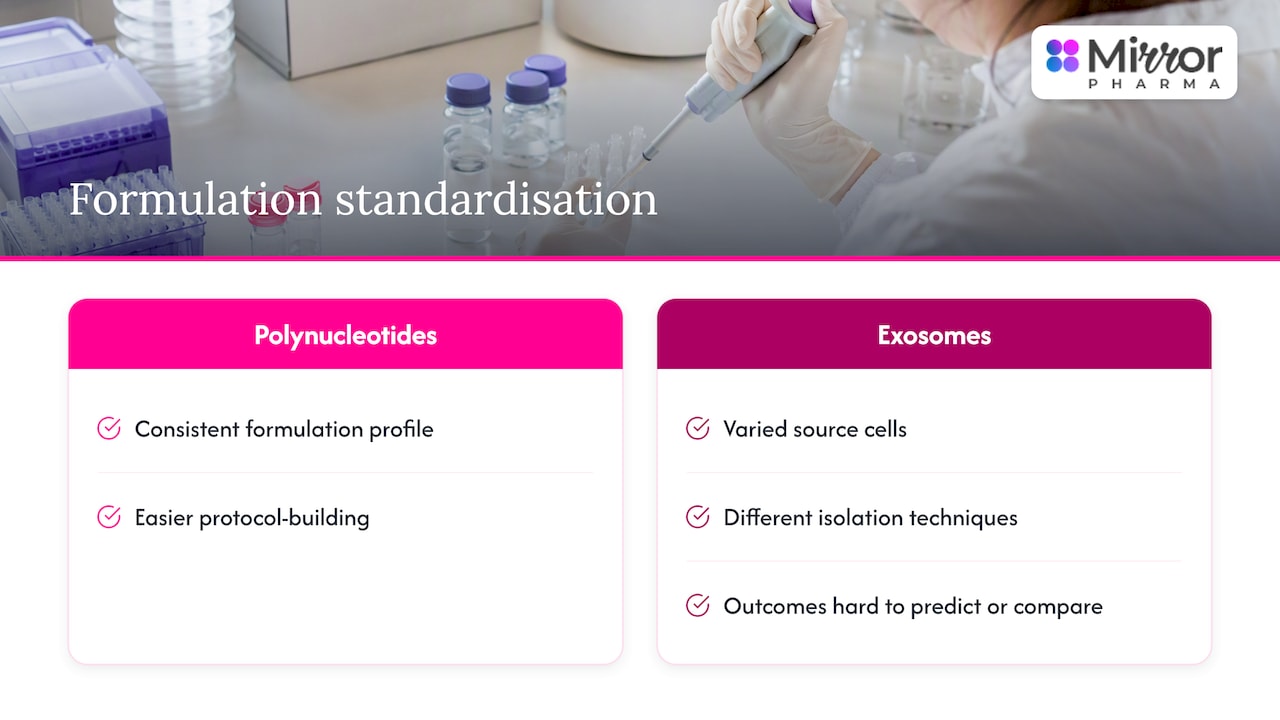
Experts have pointed out that the main barrier to wider exosome adoption is the lack of standard production and application protocols. Different manufacturers use different source cells and isolation techniques, which makes it hard to predict or compare outcomes from one product to the next. Polynucleotides have a clearer and more consistent formulation profile, which is part of why they are easier to build a protocol around.
Vetting products: what to ask for
“Exosome” is often used as a marketing category rather than a defined one. Reporting by indy100 cites independent testing suggesting that as many as 95% of products labelled as exosomes do not meet the functional biological criteria, and may be broken or contaminated material. Treat that figure as a reported claim, not a settled measurement, but let it shape your due diligence.
Whichever product class you are considering, ask the supplier for:
- The full manufacturer and brand details in writing, not a “regenerative blend” or “growth factor mix” description.
- The source material and, for any vesicle product, the isolation method.
- Written regulatory status for the UK and the intended route of administration.
- Batch traceability you can record in the patient notes.
- Storage, shelf-life and handling instructions.
A review on regenerative aesthetics makes the same point from the clinical side: variability in source, extraction and delivery calls for extreme diligence in product selection and documentation.
How they are used in practice
Expert commentary consistently finds that results for both approaches are best when the product is integrated into a procedure, such as microneedling or laser, rather than used as a stand-alone biologic. In the UK that point has a legal edge for exosomes: the only lawful lane is topical use following a channel-creating procedure with a non-human-derived product, and injection is off the table.
Polynucleotides are placed by trained injectors, typically as a short course of sessions. Our UK guidance on polynucleotides covers a two to three session approach, regulation and sourcing in more detail. For the wider category context, our regenerative aesthetics overview explains how true regeneration differs from biostimulation.
Practical points for consultation:
- Record the indication, the product, batch number and consent discussion for every treatment.
- Discuss realistic outcomes. No regenerative treatment is guaranteed, permanent or free of risk.
- Screen for contraindications and follow your own training and your indemnity insurer’s requirements.
- If a patient arrives asking for “injectable exosomes”, explain why that is not permitted in the UK and what the lawful alternatives are.
Our perspective
We supply regulated products to licensed practitioners, and we see the same question from clinics again and again: “What can I lawfully offer that has evidence behind it?” On this comparison our view is plain. Polynucleotides are the more defensible choice today, because the formulation is more consistent, the human data is more established, and the legal route for trained professionals is clear.
Exosomes are an interesting research field, and we would not dismiss it. But a field that is interesting is not the same as a product you can safely buy and inject. Until there are standard production methods, long-term data and a lawful authorisation pathway, we advise practitioners to be sceptical of any supplier who blurs the line between “exosome” as a cosmetic marketing label and a verified biological product.
Our approach to supply follows from that: strict verification that buyers are practitioners or prescribers, and fulfilment by a team of healthcare professionals who understand why documentation matters. We would rather lose a sale to a clinic that is not yet verified than become part of a compliance problem for the clinic or for ourselves.
— Rizwan
Where to source polynucleotides
If you are a licensed practitioner or prescriber and want to add or review a polynucleotide protocol, you can browse our polynucleotides range. Access is for verified professionals only. Where your protocol pairs PN with other skin quality work, our skin booster category and needles and consumables are available through the same ordering process, with extended order cut-off times to support your clinic schedule.
FAQ
Is it legal to inject exosomes in the UK?
No, not for aesthetic purposes. The MHRA treats injected exosomes as medicinal products, and injectable exosome therapies have no UK marketing authorisation. Human-derived exosomes are banned for cosmetic use altogether. Practitioners should check the current position with the regulator before considering any such product.
Can polynucleotides and exosomes be used together?
The lawful UK use of exosome-type products is topical only, after a channel-creating procedure and with non-human-derived material. Combining that with an injected polynucleotide course is a clinical decision for the prescriber, and the published evidence on combinations is limited. Document your rationale, the products and the consent discussion.
How long do exosome results last?
There is no reliable answer yet. The 2026 meta-analysis of human trials notes a lack of long-term follow-up, and results vary by product and protocol. Practitioners should avoid promising duration or permanence to patients.
Is PRP better than exosomes?
On clinical maturity, expert commentary places PRP ahead, describing it as the most validated of the regenerative options and exosomes as the earliest in readiness. PRP is autologous and so avoids the sourcing questions that surround exosome products. Choice still depends on indication, patient and your training.
What is the difference between liposomes and exosomes?
Liposomes are synthetic phospholipid vesicles designed to carry and protect a drug payload. Exosomes are biological vesicles secreted by cells, carrying their own proteins, lipids and nucleic acids. Their mechanism and purity profiles differ, so they should not be treated as interchangeable.
Sources
- Exosome Therapy in the UK: A Patient Safety Warning, Save Face
- The Effectiveness of Polynucleotides in Esthetic Medicine: A Systematic Review, PubMed
- Clinical Advances in Exosome-Based Therapies for Aesthetic Medicine, PubMed
- Regenerative aging skin review, Our Dermatology Online
- Exosome standardisation commentary, PubMed
- Regenerative aesthetics product selection review, PubMed
- Exosome facial treatment report, indy100
- Liposomes and Extracellular Vesicles as Drug Delivery Systems, Advanced Healthcare Materials
- Beauty clinics in UK offering banned treatments derived from human cells, The Guardian