

Mixing vitamins in an IV admixture is only justified when it is clinically necessary, backed by compatibility and stability data, and carried out under aseptic conditions. Vitamin C and trace elements usually need separate lines because they oxidise fast once combined. Pharmacy compounding on the day of use is preferred; when bedside mixing cannot be avoided, follow a written SOP, label clearly, apply a validated beyond-use date, and use the correct inline filter.
TL;DR:
- Mixing vitamins in IV admixtures is only safe when backed by compatibility data, stability studies, and performed under strict aseptic conditions.
- Vitamin C should always be administered separately from iron and copper to prevent rapid oxidative degradation due to catalytic metals.
- Stability of vitamin admixtures depends highly on formulation specifics, with ascorbic acid degrading within hours if not properly protected from oxygen, light, and metals.
- Use licensed, ready-to-use products first, then pharmacy-compounded solutions, and only resort to bedside mixing with documented clinical justification and strict procedures.
- Routine elective IV multivitamin infusions lack strong evidence and should be used selectively, with a preference for single vitamins or licensed multi-component products.
Table of Contents
- Which vitamins and micronutrients can be safely combined
- Why chemical stability limits how vitamins are combined
- A stepwise protocol for preparing IV vitamin admixtures
- Monitoring patients and managing reactions during infusion
- Who should avoid mixed vitamin infusions
- Tools that support safe IV vitamin practice
- Where the evidence still falls short
- How Mirror Pharma supports practitioners preparing IV vitamin admixtures
- Sources
- FAQ
Which vitamins and micronutrients can be safely combined
The first split that matters is solubility. Water-soluble vitamins, the B group and vitamin C, behave differently in solution to fat-soluble vitamins A, D, E and K, which need a lipid carrier or specific formulation to stay in suspension. Combining the two families without a manufacturer-validated product increases the chance of precipitation or an unstable emulsion that is invisible until it fails.
Some combinations carry a known, elevated risk and should be treated as a default no unless a specific product states otherwise.
- Vitamin C mixed with iron or copper accelerates oxidative degradation, since these trace elements catalyse ascorbic acid breakdown and can shorten stability from days to hours.
- Adding iron to lipid emulsions risks destabilising the emulsion itself, not just the vitamin content.
- Multivitamin additions to parenteral nutrition bags increase the risk of calcium phosphate precipitation when calcium and phosphate sources are already present.
- Trace elements added to an all-in-one admixture should be treated as a compatibility question every time, not a one-off decision.
The practical rule is simple: check the manufacturer’s data sheet, a compatibility reference such as a hospital pharmacy database, and your pharmacy team before combining anything that is not already licensed as a single product. Where documented stability does exist, for instance in certain multivitamin preparations formulated specifically for parenteral nutrition, mixing may be acceptable within the manufacturer’s stated conditions. Outside that documentation, separate administration is the safer default, even when it means two infusions instead of one.
Why chemical stability limits how vitamins are combined
Ascorbic acid is the least stable component in most vitamin admixtures, and understanding why explains most of the mixing restrictions above. Vitamin C degrades through oxidation, a reaction that speeds up in the presence of oxygen, light and catalytic metals such as iron and copper. Laboratory data on ascorbic acid stability show degradation can occur within hours under unfavourable conditions, though specific formulations, such as 1.5 g in 50 ml, have remained stable for several days under controlled storage.

Stability figures are formulation specific. A degradation window reported for one concentration and diluent does not transfer to a different strength, diluent or container, so a stability claim always needs to match the exact product in front of you.
Diluent volume and choice affect how fast degradation proceeds. Larger dilution volumes generally slow catalytic reactions by reducing the concentration of reactive species, but this is not a substitute for validated stability data. Where no data exist for your specific admixture, the conservative approach is to treat the mixture as immediate-use only, prepared just before administration, refrigerated and protected from light only where a stability study supports that step. Inline filtration and single-patient labelling reduce the separate risk of particulate matter, which is a physical hazard rather than a chemical one and needs its own mitigation regardless of how stable the solution looks.
A stepwise protocol for preparing IV vitamin admixtures
Preparation should follow a clear decision order, starting with the least improvised option available.
- Check whether a licensed, ready-to-use product covers the clinical need. If it does, use it rather than compounding.
- If no licensed product exists, refer preparation to pharmacy compounding under controlled aseptic conditions.
- Reserve near-patient mixing for cases where pharmacy compounding is genuinely not achievable in time, and only with documented clinical justification and a written SOP.
- Prepare in an appropriate aseptic environment, ideally a laminar flow hood or closed-system device, with trained staff and a second checker for calculations and additions.
- Follow a fixed mixing order: aqueous base fluid first, then vitamins, then any electrolytes, adding each component slowly and never injecting concentrated additives directly into undiluted lipid emulsions.
- Use the minimum diluent volume stated in the reference or product literature, never a rougher estimate.
- Apply the correct inline filter for the solution type: 1.2 micron filters for parenteral nutrition and 0.2 micron for aqueous, lipid-free solutions, as recommended in UK drug safety guidance.
- Label the finished preparation with contents, concentration, preparer’s initials, time of preparation and a validated beyond-use date, plus storage instructions if the mix is not for immediate use.
Pro tip: Treat every bedside admixture as immediate-use unless a named stability study covers your exact concentration and diluent; when in doubt, prepare later and infuse sooner.
MHRA guidance for specials manufacturers sets out this same hierarchy: licensed products first, pharmacy compounding second, and near-patient mixing only under strict aseptic standards with clear justification recorded in the notes.
Monitoring patients and managing reactions during infusion
Vitamin admixtures carry the same infusion risks as any IV therapy, plus specific ones tied to concentration and rate. Watch for acute hypersensitivity reactions, flushing, and shifts in electrolytes or fluid balance during and after the bolus or infusion.
- Record baseline observations before starting, including vital signs and, where relevant, renal function.
- Monitor continuously during a bolus and at intervals through a longer infusion, since reactions can develop mid-infusion rather than only at the start.
- Keep patients under observation for a defined period after infusion ends, per local policy, rather than discharging immediately.
- If a reaction occurs, stop the infusion, assess the patient, and treat anaphylaxis according to trust protocol without delay.
- Retain the line and any remaining fluid if particulate contamination is suspected, and escalate to pharmacy for investigation.
- Report the adverse event through the local incident system and feed findings back into SOP updates.
Who should avoid mixed vitamin infusions
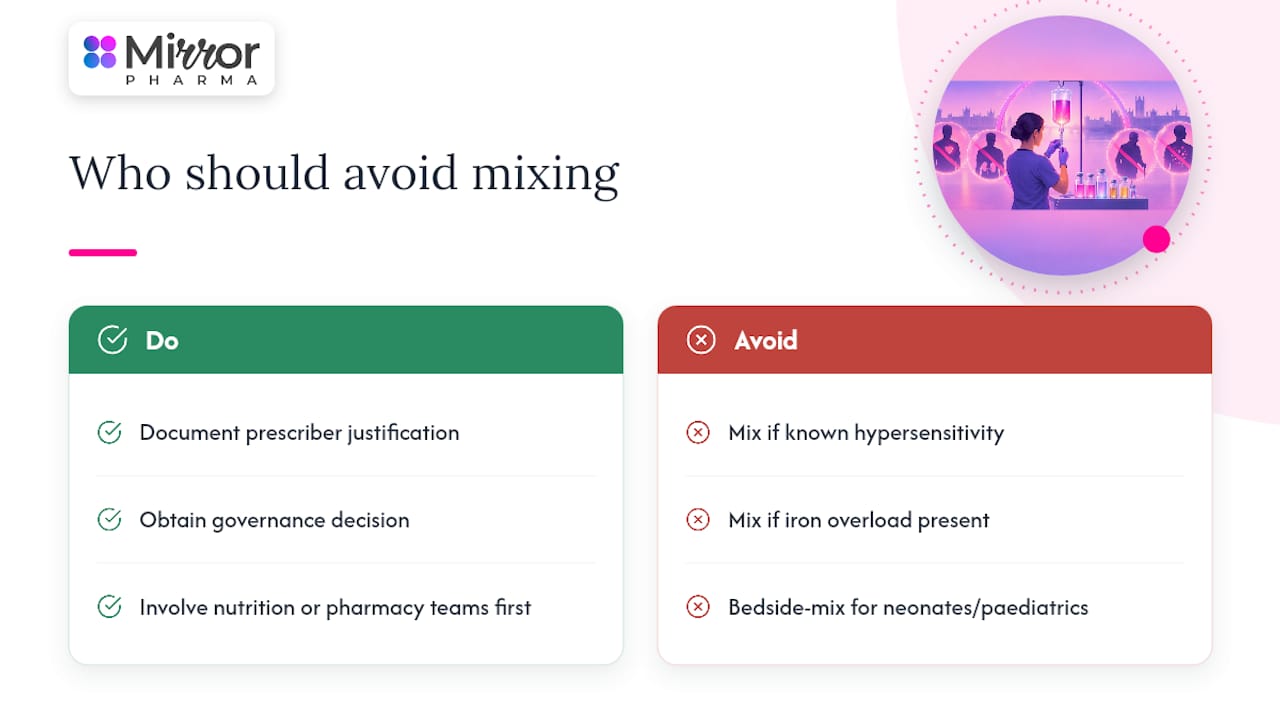
Certain patients need a more cautious approach or a different route altogether. Known hypersensitivity to any component is an absolute contraindication, and iron overload states rule out any admixture containing iron. Severe renal impairment warrants particular caution around electrolyte content, since vitamin admixtures often carry potassium, phosphate or magnesium alongside the vitamins themselves.
Paediatric and neonatal patients should generally receive standard, pharmacy-compounded parenteral nutrition rather than bedside-mixed vitamin additions, given the narrower margin for error at lower body weights. Where a non-standard mix is genuinely required, the prescriber’s clinical justification and the governance decision should be documented in the patient record, and specialist nutrition or pharmacy teams should be involved before proceeding rather than after.
Tools that support safe IV vitamin practice
Preparing vitamin admixtures safely depends as much on process as on chemistry. Mirror Pharma’s IV vitamin therapy safety toolkit provides SOP templates and checklists that licensed practitioners can adapt to their own setting, covering aseptic preparation, labelling and beyond-use dating.
Practitioner-only products commonly used alongside this protocol include Glutathione 600mg/4ml powder and solvent for infusion, Biotine IM 0.5% ampoules, and Pabrinex I/M ampoules for thiamine and B-complex replacement. These are supplied for licensed practitioners only, and any compounding decision should still go through pharmacy verification before use.
Where the evidence still falls short
Elective vitamin cocktails are marketed with more confidence than the evidence supports. A systematic review of IV multivitamin therapy found limited high-quality evidence outside established parenteral nutrition indications, and recommended selective, indication-based use with pharmacy involvement rather than routine mixing for wellness purposes.
My own position is straightforward: default to the conservative option, use single-vitamin or licensed multi-component products wherever they exist, and reserve improvised mixes for cases where the clinical need is clear and the stability data back you up. Align with local policy, and report anything that goes wrong so the next practitioner benefits from what you learned.
— Rizwan
How Mirror Pharma supports practitioners preparing IV vitamin admixtures
Getting the right product, in the right strength, without a scramble at the point of care, is most of what keeps IV vitamin practice safe. Practitioner-only IM and IV vitamin products, consumables and the safety toolkit referenced above are supplied to support preparation following a documented process rather than improvisation on the day.
- Browse the IM/IV Vitamins category for practitioner-only products and consumables.
- Use the IV vitamin therapy protocols page for SOP templates before your next order.
- Practitioner verification at checkout is required for all prescription and near-patient products.
This service is for licensed practitioners and qualified aesthetic professionals only. Verified professional accounts may benefit from extended order cut-off times aimed at reliable next-stock delivery.
Sources
- Stability of ascorbic acid in solution (pubmed listing)
- Compatibility and stability of additives in parenteral nutrition admixtures
- Intravenous multivitamin therapy use in hospital or outpatient settings: a review of clinical effectiveness and guidelines
- MHRA guidance for specials manufacturers (qa version 3)
- Gov
FAQ
Are IV drips with vitamins good for you?
There is limited high-quality evidence supporting elective IV vitamin infusions outside recognised clinical indications such as documented deficiency or established parenteral nutrition use. Benefit depends on the individual’s clinical picture, and any infusion carries the general risks of IV administration, including infusion reactions and, rarely, particulate or embolic complications.
Which vitamins should you not mix together?
Vitamin C should not be mixed with iron or copper, since these trace elements catalyse oxidative degradation of ascorbic acid. Iron should also be kept separate from lipid emulsions, and any multivitamin addition to parenteral nutrition needs product-specific compatibility data before it is combined with calcium or phosphate sources.
What happens if B12 is given IV?
Vitamin B12 given intravenously enters the circulation directly rather than relying on gut absorption, which is the usual route for oral replacement. It is typically given for confirmed deficiency rather than as a routine wellness measure. Patients should be monitored for infusion reactions during administration.
What is in a Myers cocktail IV?
A Myers cocktail is a mixed IV formulation historically combining B vitamins, vitamin C and sometimes minerals in a single infusion, though exact recipes vary between practitioners and there is no single standardised formula. Evidence for its use is limited, and the systematic review of IV multivitamin therapy notes scarce direct evidence for elective multivitamin cocktails of this kind.