
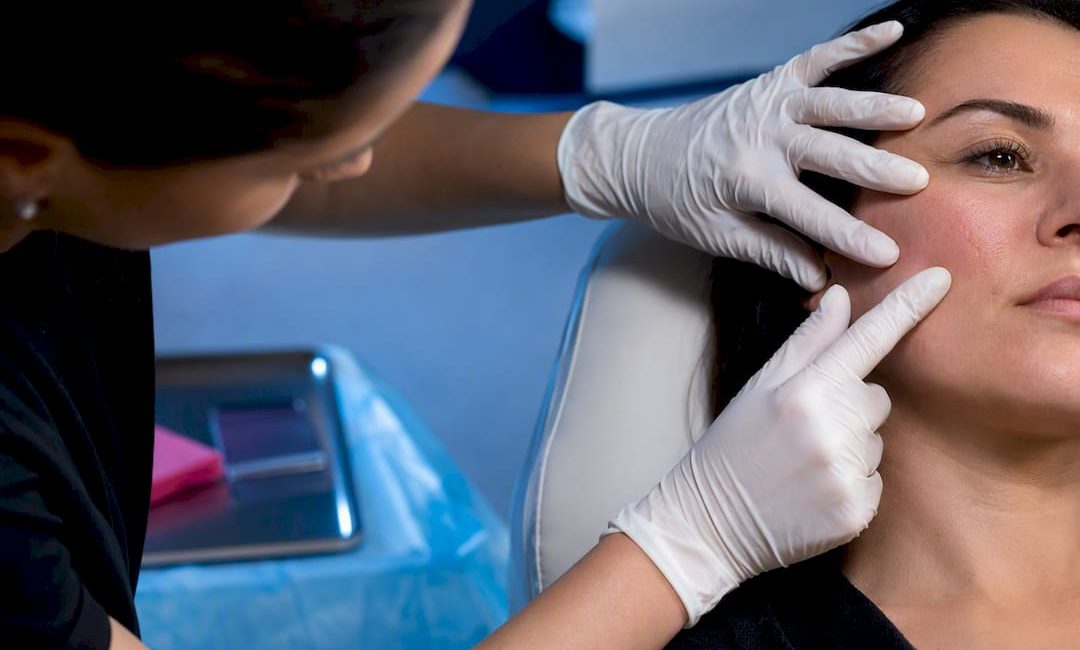
For licensed practitioners, hyaluronidase dosing must be individualised: elective dissolution commonly uses 100 to 300 units per treated area, delayed nodules respond to lower, targeted doses, and suspected vascular occlusion demands high-dose, repeated infiltration running into the hundreds or low thousands of units until reperfusion is confirmed. There is no single fixed dose. The starting point always depends on filler type, treated area, and how the tissue responds within the first hour.
TL;DR:
- Doses for hyaluronidase vary widely depending on the indication, filler type, and tissue response, with emergency vascular treatments requiring up to thousands of units.
- Reconstituting hyaluronidase properly with saline and injecting in multiple small deposits enhances effectiveness and reduces risks, especially in delicate areas.
- High-dose, broad infiltration across the affected vascular territory is critical during occlusion management, and practitioners often treat until reperfusion signs are evident rather than reaching a fixed unit limit.
- Waiting 48 hours for elective dissolution and immediate reassessment during vascular emergencies ensures optimal timing and effectiveness of treatment.
- Stocking sufficient, properly stored hyaluronidase and having emergency protocols readily accessible are essential for safe, effective practice.
Table of Contents
- What is the correct hyaluronidase dose for common indications?
- Dosing by indication: practical detail and rationale
- How should hyaluronidase be diluted and injected for best effect?
- When should you reassess and re-dose hyaluronidase?
- Allergy testing and emergency readiness
- Storing and stocking hyaluronidase safely
- Practical protocol summary and clinic checklist
- Pharmacokinetics and metabolism of hyaluronidase relevant to dosing
- Adjusting dosing for elderly patients, pregnancy, and comorbidities
- Contraindications and precautions specific to dosing
- How other injectables affect hyaluronidase dosing decisions
- The gap between guideline ranges and the treatment room
- How Mirror Pharma supports practitioners with hyaluronidase supply
- Sources
- FAQ
What is the correct hyaluronidase dose for common indications?
Hyaluronidase dosing recommendations vary more than most practitioners expect, largely because the enzyme’s target, cross-linked hyaluronic acid, degrades at different rates depending on how densely the filler was manufactured. A monophasic, highly cross-linked volumiser resists dissolution far more than a lightly cross-linked skin booster, so the same dose that clears one product barely touches another.
The table below draws on the dosing tables published in the Guideline for the Safe Use of Hyaluronidase in Aesthetic Medicine, practitioner survey data from The Use of Hyaluronidase in Aesthetic Practice, and the review of modern cross-linked filler behaviour in Fundamental considerations for the use of hyaluronidase. Treat every figure as a starting point for titration, not a prescription.
| Indication | Typical unit range | Concentration/dilution example | Caveat |
|---|---|---|---|
| Elective dissolution / overfilling | 100 to 300 units per area | 150 to 200 IU/mL, diluted with saline for even spread | Highly cross-linked fillers may need repeat sessions rather than one large dose |
| Delayed inflammatory nodule | 10 to 20 units per injection point | Lower concentration, small aliquots directly into the nodule | Consider adjuncts (steroid, antibiotics) if infection or granuloma is suspected |
| Periorbital / infraorbital area | 100 to 150 units total in small deposits | Diluted to a low concentration to limit spread to surrounding structures | Periorbital skin is thin; over-treatment risks visible volume loss and hollowing |
| Nasal / perioral region | 20 to 50 units per point | Moderate concentration, small volume per injection | Vascular density here raises occlusion risk; work slowly and monitor closely |
| Vascular occlusion (limb of face, non-ocular) | 450 to 1,500 units total, given as repeated pulses | 500 to 750 IU/mL, infiltrated broadly across the affected vascular territory | Re-dose hourly until capillary refill and skin colour normalise; many practitioners report no fixed ceiling |
| Ocular / retrobulbar involvement | 150 to 200 IU into 2 to 4 mL diluent, where retrobulbar injection is used | Prepared as an emergency dilution, used only alongside urgent ophthalmology input | Carries genuine procedural risk; this is not a routine intervention |
These ranges overlap deliberately. The practitioner survey data found concentrations for vascular events spanning 150 to 1,500 IU/mL depending on the clinician and the case, with no consistent upper limit reported once treatment for occlusion had begun. That spread is not sloppy science. It reflects a genuine absence of randomised trial data forcing every guideline into pragmatic, consensus-based territory rather than a fixed formula.
Dosing by indication: practical detail and rationale
Elective dissolution: start low, escalate on response
For unwanted volume, asymmetry, or a filler placed too superficially, most protocols begin at the lower end of the range and wait. A typical approach:
- Inject 100 to 150 units into the treated area, distributed across several small deposits rather than one bolus.
- Massage firmly to spread the enzyme through the tissue and increase contact with filler particles.
- Wait 48 hours before assessing the result, since hyaluronidase activity in tissue is thought to persist for only a few hours after injection, and the visible dissolution effect takes time to develop.
- If dissolution is incomplete, repeat with a similar or slightly higher dose rather than doubling immediately.
The review in Fundamental considerations for the use of hyaluronidase makes a point worth repeating here: the old heuristic of 5 to 15 units dissolving 0.1 mL of a 20 mg/mL hyaluronic acid filler was calibrated on older, less cross-linked products. Modern monophasic volumisers often need 200 to 750 units per mL to achieve the same clinical effect, and undertreating a dense filler with an outdated dose simply wastes product and the patient’s time.
Delayed nodules: lower doses, more patience
Nodules appearing weeks or months after treatment behave differently to acute overfilling. Lower concentrations, delivered directly into the palpable lump across several sessions spaced days to weeks apart, tend to outperform a single aggressive dose. Where inflammation is suspected alongside filler presence, adjuncts such as a short course of antibiotics or an intralesional steroid are commonly used alongside hyaluronidase rather than instead of it, though the enzyme remains the tool that actually clears the material.
Vascular occlusion: the protocol that cannot wait
Suspected vascular compromise, whether from direct arterial injection or external compression of a vessel, is the one scenario where hesitation costs tissue. The modified high-dose protocol recommends broad infiltration across the entire affected vascular territory, not just the visible blanched area, because occluded vessels can feed a wider zone than the skin change suggests.
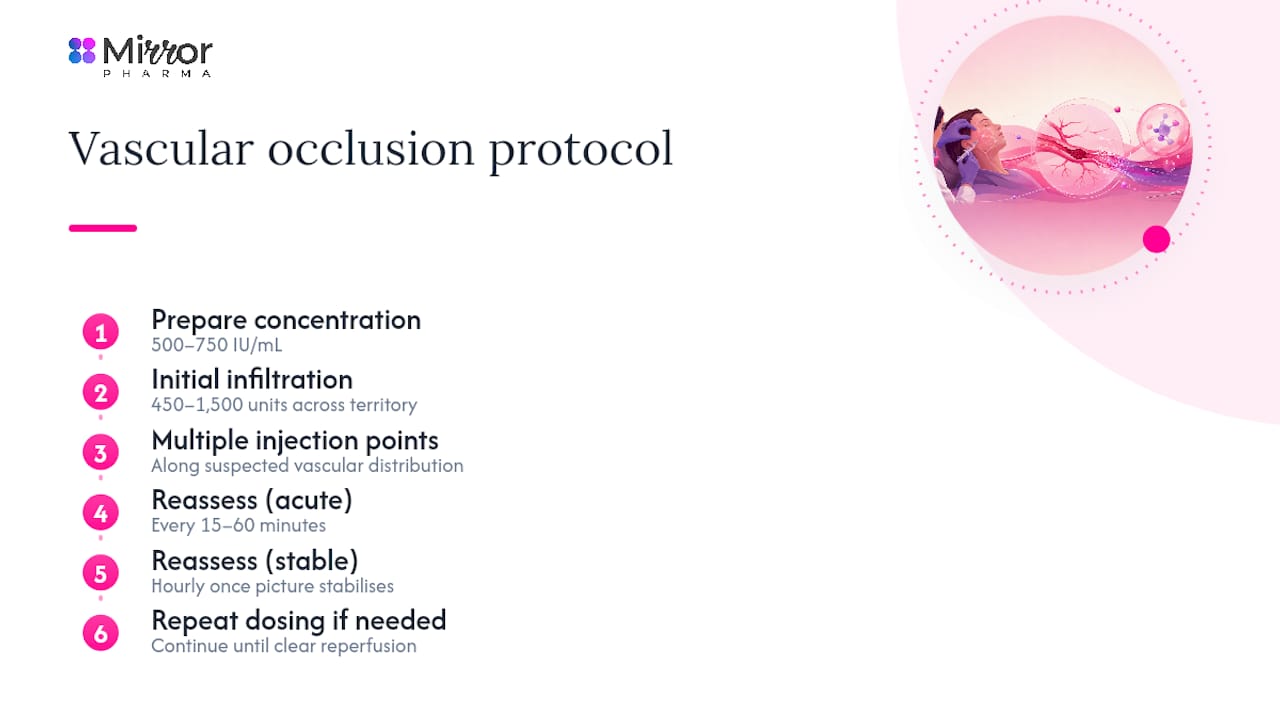
Practical distribution looks like this: prepare a concentration of 500 to 750 IU/mL, and infiltrate 450 to 1,500 units across the compromised area in the first pass, using multiple injection points along the suspected vascular distribution. Reassess capillary refill, skin colour, and pain at intervals as short as 15 to 60 minutes in the acute phase, then hourly once the picture stabilises. If reperfusion signs are not clearly improving, repeat the dose. Several practitioners in the survey data reported continuing this cycle without a formal ceiling until clinical reperfusion was evident. Under-dosing an occlusion risks tissue necrosis, while the enzyme itself has a wide safety margin at these doses.
When the eye is involved
Vision-threatening complications from retrograde arterial flow into the ophthalmic circulation are rare but catastrophic. Retrobulbar injection of 150 to 200 IU in 2 to 4 mL of diluent has been described in the literature, but this is a specialist procedure carrying real risk of its own, and current guidance treats it as an adjunct to, never a substitute for, immediate ophthalmology referral. If you are not trained in retrobulbar injection, do not attempt it under pressure. Send the patient on and document the timeline precisely.
How should hyaluronidase be diluted and injected for best effect?
Reconstitution technique matters almost as much as the dose itself, because poorly mixed enzyme leaves pockets of concentrated product sitting next to areas that receive none.
- Reconstitute the vial using 1 mL of preservative-free saline first, swirling gently rather than shaking, to fully dissolve the powder before adding further diluent.
- Dilute into your intended total volume, commonly 1 to 10 mL depending on whether you need a concentrated dose for occlusion or a larger, lower-concentration volume for fine titration across a wide area.
- Choose concentration by purpose: higher IU/mL (500 to 750) for vascular emergencies where speed and coverage matter, lower concentrations for delicate periocular work where over-dissolution is the greater risk.
- Deliver via multiple small deposits rather than one bolus, following a linear or fanning pattern that tracks the suspected filler location or vascular territory.
- Massage the treated area firmly after each injection to disperse the enzyme and increase its contact surface with the filler material.
Needle versus cannula is a genuine choice, not a formality. A fine needle gives more precise placement for nodules and small volumes, while a blunt cannula reduces the risk of further vascular trauma when working through already-compromised tissue, particularly useful in occlusion cases where you are infiltrating broadly through a single entry point.
Pro Tip: Draw up slightly more diluted solution than you think you need for a vascular occlusion case. Running out mid-protocol because you under-prepared the syringe wastes precious minutes you do not have.
When should you reassess and re-dose hyaluronidase?
Timing separates a good outcome from a poor one, and the correct interval depends entirely on what you are treating.
- For elective dissolution, wait a full 48 hours before judging the result. Photographing the area at baseline and again at follow-up gives an objective record beyond memory or patient perception.
- For suspected vascular occlusion, check capillary refill and skin colour every 15 to 60 minutes in the first hour, then move to hourly reassessment cycles once you have re-dosed at least once.
- Markers of genuine improvement include faster capillary refill, return of normal skin colour, and reduction in the characteristic mottled or dusky appearance, alongside a drop in the patient’s reported pain.
- Continue treatment cycles until reperfusion is clinically evident rather than stopping at an arbitrary unit count. This mirrors the pattern reported across practitioner surveys, where clinicians treated to effect rather than to a fixed maximum.
- Document every dose, time, and observation. In an occlusion case, this record becomes both a clinical tool and a medicolegal necessity.
Aftercare for elective cases is straightforward: review at 48 hours, then again at one to two weeks if a second treatment cycle is needed. Vascular occlusion cases need a follow-up review within 24 to 48 hours even after apparent resolution, since delayed tissue changes can still emerge.
Allergy testing and emergency readiness
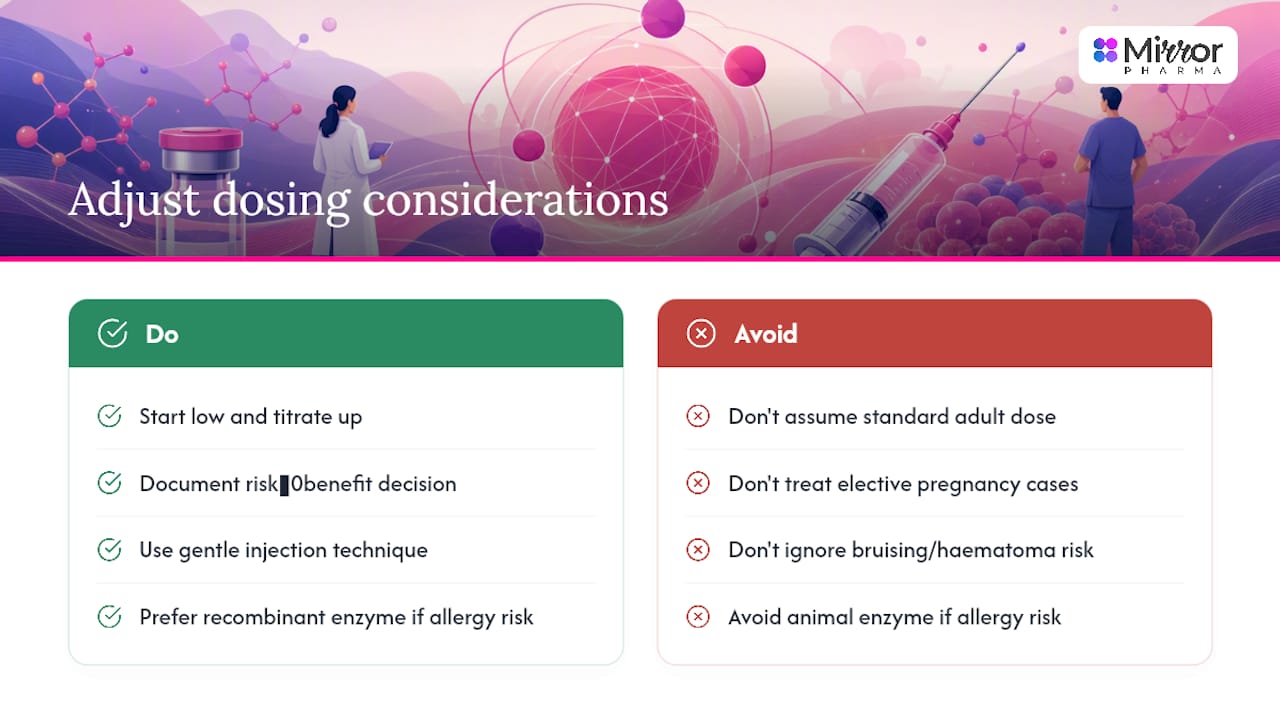
Intradermal test dosing has weak supporting evidence and a real practical problem: it can delay treatment in an emergency where minutes matter, so guidance consistently advises against waiting for a test result before treating suspected occlusion. Animal-derived hyaluronidase carries a higher allergy risk than recombinant formulations, and a history of bee or wasp sting anaphylaxis warrants extra caution given shared allergenic proteins.
- Keep adrenaline, oxygen, and basic resuscitation equipment on site and check stock regularly.
- Know your clinic’s anaphylaxis pathway before you need it, not while you are running it.
- Document hyaluronidase use for filler reversal as an off-label application, with clear clinical reasoning recorded at the time.
Storing and stocking hyaluronidase safely
Unreconstituted hyaluronidase vials generally require refrigerated storage per the manufacturer’s prescribing information, and most practitioners use reconstituted product promptly rather than storing it for later sessions, given limited stability data once diluted. A sensible clinic policy sets a defined emergency stock buffer, enough units on site to run a full high-dose protocol without waiting on a delivery, and logs batch numbers and expiry dates alongside every use. Treat reconstituted vials as single-use given the sparse evidence on post-reconstitution sterility, and dispose of sharps and vials through your clinical waste route as normal.
Practical protocol summary and clinic checklist
Protocol A: Elective dissolution
- Confirm filler history and treated area.
- Inject 100 to 150 units in small deposits, massage thoroughly.
- Review at 48 hours; repeat if dissolution is incomplete.
Protocol B: Suspected vascular occlusion
- Stop injecting immediately and infiltrate broadly across the vascular territory.
- Use 500 to 750 IU/mL, delivering 450 to 1,500 units in the first pass.
- Reassess every 15 to 60 minutes; re-dose until reperfusion signs are clear.
- Escalate to emergency services or ophthalmology if vision or systemic symptoms appear.
Clinic checklist: adequate hyaluronidase stock, saline for reconstitution, appropriately sized syringes and cannulas, an anaphylaxis kit, a photographic record system, and a documentation template covering dose, time, and clinical observation at each reassessment point.
Pro Tip: Print your occlusion protocol and keep it physically in the treatment room. Recalling exact dosing intervals from memory during a genuine vascular event is harder than it sounds.
Pharmacokinetics and metabolism of hyaluronidase relevant to dosing
Hyaluronidase works locally, breaking the glycosidic bonds within hyaluronic acid chains at the injection site rather than circulating to exert a systemic effect. Its action in tissue is understood to be time-limited, with meaningful enzymatic activity persisting for only a few hours after injection according to monograph-level detail in StatPearls. This short window explains why a single injection sometimes fails to fully dissolve a dense filler deposit: the enzyme simply stops working before it has degraded every cross-linked molecule it contacts.
This is also why repeated, moderate dosing often outperforms one enormous bolus, a point reinforced in the PRS GO review, which favours multiple injections over a short period for highly cross-linked monophasic fillers. Once its local activity window closes, remaining hyaluronic acid fragments are cleared through normal tissue turnover and lymphatic drainage rather than through further enzymatic action. Systemic absorption after aesthetic dosing is considered minimal at the volumes typically used, which is part of why the enzyme has such a wide practical safety margin even at the high-dose end used for occlusion.
Adjusting dosing for elderly patients, pregnancy, and comorbidities
Age itself does not require a different hyaluronidase dose, but the skin and vascular changes that come with it can. Thinner, more fragile dermis in elderly patients means the same volume of enzyme may spread further and dissolve more surrounding tissue than intended, so many practitioners start at the lower end of the relevant range and titrate up rather than defaulting to a standard adult dose.
Pregnancy presents a different problem entirely: there is essentially no controlled safety data for hyaluronidase use in pregnant patients, and elective aesthetic dissolution should generally be deferred until after pregnancy unless a genuine emergency, such as vascular occlusion, makes the risk of inaction clearly greater than the risk of treatment. That judgement sits with the treating clinician and should be documented accordingly.
Patients with bleeding disorders or on anticoagulant therapy need no dose adjustment for the enzyme itself, but the injection technique warrants extra care given the increased bruising and haematoma risk. A history of atopic conditions or previous reaction to insect venom raises allergy risk given the animal-derived origin of some hyaluronidase preparations, which shifts the conversation towards recombinant options and closer monitoring rather than a different unit dose.
Contraindications and precautions specific to dosing
The main absolute contraindication is a known hypersensitivity to hyaluronidase or to bee/wasp venom proteins, given the cross-reactivity risk with animal-derived preparations. Active infection at the injection site is a relative contraindication for elective dissolution, since injecting through infected tissue risks spreading it, though this calculation changes entirely in a vascular emergency where treating through minor local concerns becomes secondary to preserving tissue viability.
Practitioners should also be cautious with dosing near mucous membranes and in areas of dense vascular anatomy, such as the glabella and nose, where even a correctly calculated dose delivered too forcefully or too fast can theoretically compress surrounding vessels. Precision matters as much as the unit count in these zones. There is no established maximum lifetime dose for hyaluronidase, but repeated high-dose use across many sessions in the same patient warrants a broader conversation about why dissolution keeps being needed, whether filler choice, technique, or patient expectation is the underlying issue.
How other injectables affect hyaluronidase dosing decisions
Hyaluronidase only targets hyaluronic acid, so it has no direct effect on non-HA fillers such as calcium hydroxylapatite or poly-L-lactic acid, and mistaking one for the other wastes a dose and delays proper management. When a patient has multiple filler types layered in the same area, a common scenario in noses and cheeks treated over several years by different practitioners, working out what you are actually dissolving matters as much as the dose you choose.
Botulinum toxin injected in the same region does not interact pharmacologically with hyaluronidase, so there is no need to adjust timing between the two when both are clinically indicated. Anticoagulants and antiplatelet medications do not change the hyaluronidase dose itself but do raise bruising risk during the injection process, worth flagging to the patient beforehand. Where a patient has recently received a skin booster or biostimulatory product alongside structural filler, remember that lower cross-linked products dissolve far faster and at lower doses than dense volumisers, so treating both with the same aggressive protocol risks over-correcting the softer product while under-treating the denser one.
The gap between guideline ranges and the treatment room
Dosing ranges exist because no two cases are identical, not because the literature is vague for the sake of it. A 200 unit dose that comfortably clears an overfilled cheek in one patient might barely touch a densely cross-linked product injected six months earlier in another. Treating the guideline figures as a formula to be applied uniformly is the single most common misreading of this evidence.
Consider two schematic scenarios side by side: a patient requesting reduction of an overfilled tear trough, where the sensible choice is a low dose, delivered slowly, with 48 hours to judge the result before touching the area again. Contrast that with a patient presenting with sudden blanching and pain along the nasolabial fold minutes after filler injection, where the correct response is immediate, broad, repeated high-dose infiltration with no waiting period at all. Same enzyme, same practitioner, entirely different dosing logic. The protocols above are a living template, not a fixed script, and every experienced injector adapts them slightly as their own case volume grows.
— Rizwan
How Mirror Pharma supports practitioners with hyaluronidase supply
Running an evidence-based dosing protocol only works if the right product is actually in the fridge when you need it. Mirror Pharma supplies hyaluronidase preparations, including Hyaluronidase 1500iu and SEVENTY HYAL, alongside the saline diluent and consumables needed for reconstitution, directly to verified practitioners. Every order goes through practitioner verification before dispatch, and extended order cut-off times mean stock reordered late in the day still tends to arrive in time to keep your emergency buffer intact, rather than leaving a gap in your occlusion protocol while you wait on a delivery.
Alongside hyaluronidase, the same dermal fillers category gives you access to the products you may eventually need to dissolve or replace, all through the same licensed-prescriber channel. This content is for licensed practitioners and qualified aesthetic professionals only; all prescription-only products require valid verification before purchase.
This article is general information, not a substitute for advice from a qualified doctor. Consult a qualified healthcare professional about your own circumstances before acting on anything here.
Sources
- Guideline for the Safe Use of Hyaluronidase in Aesthetic Medicine, Including Modified High-dose Protocol
- VITRASE prescribing information / DailyMed
- Hyaluronidase – StatPearls
FAQ
What is hyaluronidase 1500 IU used for?
A 1500 IU vial is typically reconstituted and diluted down to a working concentration for the specific task, whether elective filler dissolution or emergency vascular occlusion management, rather than used undiluted. The full vial gives practitioners enough enzyme to prepare multiple treatment doses or one large emergency infiltration from a single vial, following the dosing tables discussed above.
How many days does hyaluronidase take to work?
Visible dissolution from elective treatment is usually assessed at 48 hours, though the enzyme’s own activity in tissue is thought to last only a few hours after injection. In a vascular occlusion, the goal is much faster: clinical signs of reperfusion should be checked within 15 to 60 minutes of each dose, not days later.
What is the emergency high-dose hyaluronidase protocol?
The emergency protocol for suspected vascular occlusion involves broad infiltration of 450 to 1,500 units across the affected vascular territory, using a concentration of 500 to 750 IU/mL, repeated hourly (or sooner) until capillary refill and skin colour improve. Many practitioners report continuing this cycle without a fixed upper limit, guided entirely by clinical reperfusion signs rather than a preset unit ceiling, as reported in practitioner survey data.
Does hyaluronidase dosing differ between filler brands?
Yes. Highly cross-linked, monophasic fillers generally require higher concentrations, often 200 to 750 units per mL, compared with the 5 to 15 units per 0.1 mL heuristic once used for older, less dense products, according to the review on cross-linked filler behaviour. Practitioners sourcing fillers from Mirror Pharma’s dermal fillers range can check product-specific cross-linking detail to inform their dissolution planning in advance.
Is intradermal allergy testing necessary before hyaluronidase injection?
Formal test dosing has limited supporting evidence and should never delay treatment of a genuine vascular emergency. Practitioners should instead take a focused allergy history, particularly around bee or wasp sting reactions, and keep full anaphylaxis equipment on hand for every session where hyaluronidase is used.