
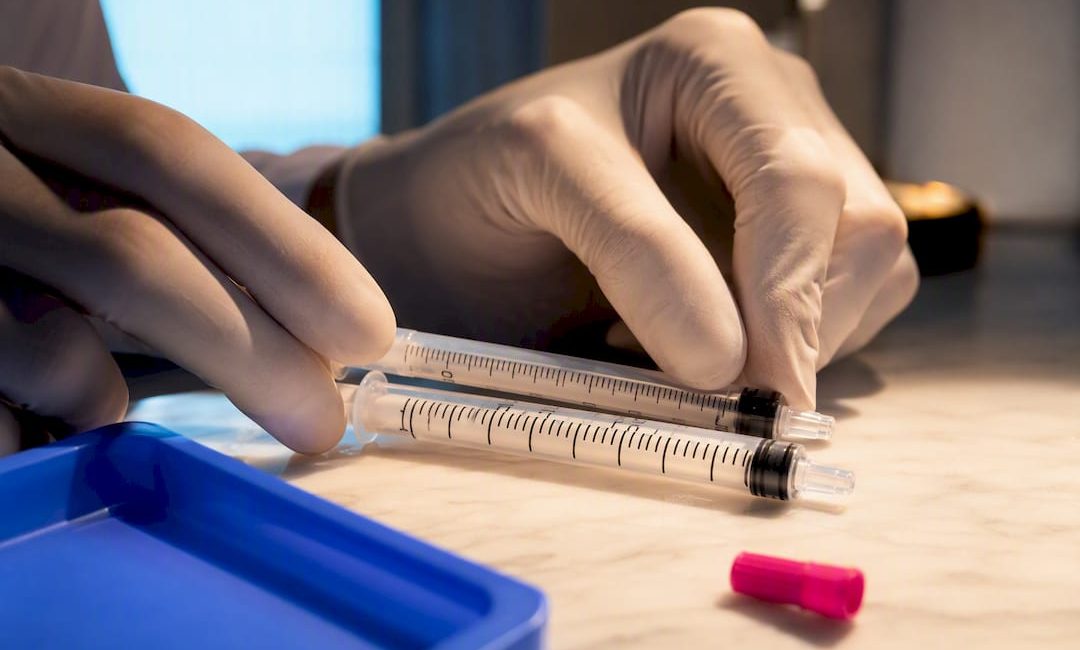
Use insulin-calibrated syringes for insulin dosing; use tuberculin syringes for intradermal skin tests and other precise small-volume injections. Never substitute one for the other. Insulin syringes are marked in insulin units, while tuberculin syringes are marked in millilitres, and confusing the two scales has caused documented tenfold dosing errors. For licensed practitioners and healthcare learners, confirming medication, concentration and route before drawing up a dose is the single most important safety check in this comparison.
TL;DR:
- Using the wrong syringe type can lead to tenfold insulin overdose errors, especially if a tuberculin syringe labeled in millilitres is mistaken for an insulin syringe marked in units.
- Insulin syringes are calibrated in units based on 100 units per millilitre, while tuberculin syringes use fine millilitre graduations for intradermal injections, never in units.
- Needle gauge and length vary to optimize comfort and placement accuracy, with insulin syringes favoring shorter, finer needles and tuberculin syringes requiring longer needles for proper intradermal delivery.
- Proper storage, clear labeling, and independent double-checks are essential to prevent mix-ups caused by similar packaging and shared storage conditions.
- Always verify medication, concentration, route, volume, and syringe markings carefully before drawing up doses, especially when switching between syringe types or tasks.
Table of Contents
- Insulin vs tuberculin syringe: what each one is built for
- Reading the markings: units versus millilitres
- Needle gauge and length: why the choice matters clinically
- A five-step checklist for choosing the right syringe
- Why syringe mix-ups keep happening, and how to stop them
- Why this keeps tripping up experienced staff, not just trainees
- Ordering insulin and tuberculin syringes without the guesswork
- Sources
- FAQ
Insulin vs tuberculin syringe: what each one is built for
The two syringes exist for different clinical jobs, and the design reflects that. An insulin syringe is built around one task: measuring insulin units accurately for subcutaneous delivery, whether the person drawing it up is a trained nurse or a patient self-injecting at home. Most insulin in current use is U100, so these syringes assume 100 units per millilitre as their baseline.
A tuberculin syringe does something different. It is designed for very small, exact volumes, typically between 0.01 mL and 0.1 mL, delivered intradermally rather than subcutaneously. That makes it the standard tool for Mantoux (PPD) tuberculin skin tests and certain allergy testing protocols, where precision at a tiny scale matters more than speed.
There is a grey area worth knowing. Some prescribers or product instructions specify an insulin syringe for small-volume subcutaneous injections that are not insulin at all, simply because the fine graduations suit the dose. That instruction always has to come from the prescriber or pharmacist, never assumed by the person administering it.
- Insulin syringes: subcutaneous route, unit-based dosing, U100 concentration by default.
- Tuberculin syringes: intradermal route, millilitre-based dosing, volumes as low as 0.01 mL.
- Non-insulin small-volume drugs: insulin syringe only when explicitly instructed.
Reading the markings: units versus millilitres
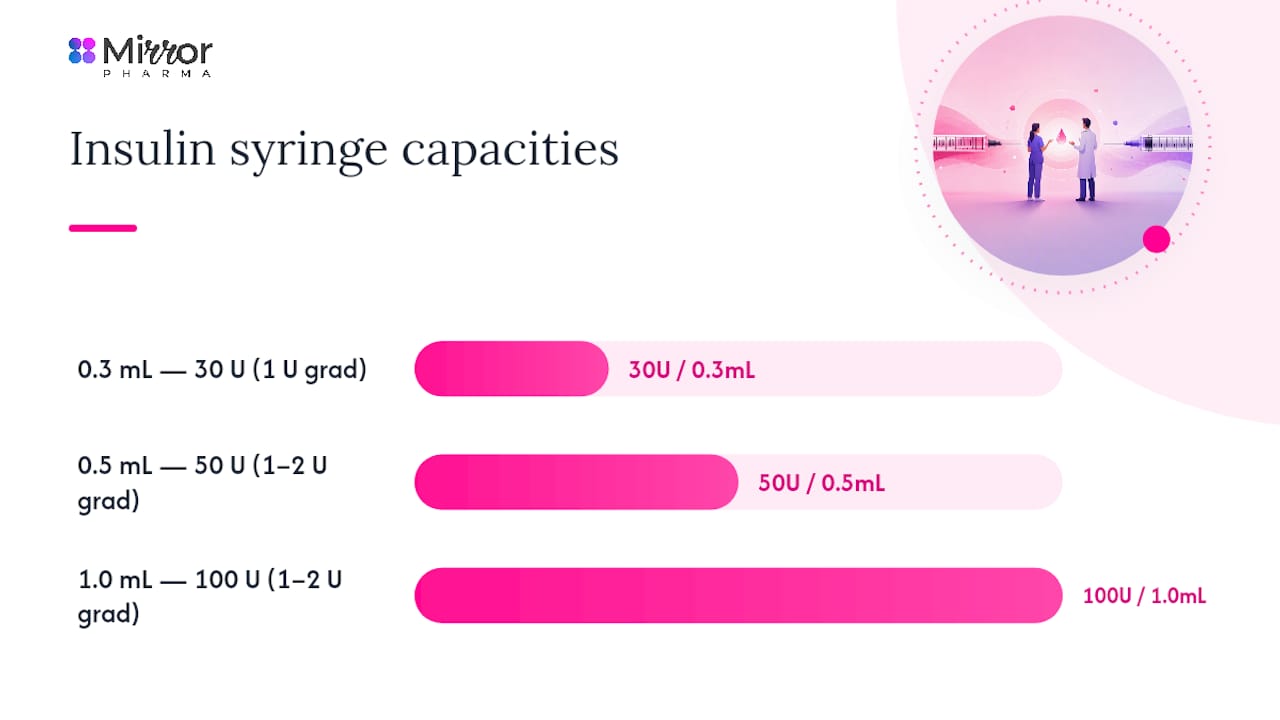
Get the maths wrong here and the consequences are immediate. A U100 insulin syringe works on the principle that 100 units equals 1 millilitre, and the barrel is printed accordingly. The common sizes are the 0.3 mL syringe (marked to 30 units), the 0.5 mL syringe (marked to 50 units), and the 1.0 mL syringe (marked to 100 units), each with graduations running in single or two-unit increments depending on capacity.
A tuberculin syringe carries no unit scale at all. It reads purely in millilitres, usually with markings at 0.01 mL intervals near the tip and 0.1 mL intervals further up the barrel, built for the sub-0.1 mL precision that intradermal testing demands.
Pro Tip: If a syringe barrel shows “units” anywhere on its printed scale, it is an insulin syringe. If it shows only mL figures with no unit label, treat it as a tuberculin or standard syringe and never draw insulin into it.
The confusion is not hypothetical. Patient safety systems have logged repeated cases of a tenfold insulin overdose caused by using a tuberculin syringe instead of an insulin syringe, because a dose intended as 10 units on a unit scale becomes 10 units read as 0.1 mL on a millilitre scale, roughly ten times too much insulin by volume.
- 100 units = 1 mL on a standard U100 insulin syringe.
- 0.3 mL, 0.5 mL and 1.0 mL are the three common insulin syringe sizes.
- Tuberculin syringes graduate in 0.01 mL and 0.1 mL steps, never in units.
Needle gauge and length: why the choice matters clinically
Needle specification is not an afterthought bolted onto the syringe body, it changes how the injection feels and how accurately the dose lands. Insulin syringes typically pair with needles in the 28 to 32 gauge range, with lengths of 4 to 6 mm now standard for most adults receiving subcutaneous injections, since shorter, finer needles improve comfort without sacrificing dosing accuracy for the majority of patients.
Tuberculin syringes generally use a slightly thicker needle, in the 25 to 27 gauge range, and a longer needle than insulin work calls for. That is deliberate. Intradermal placement for a Mantoux test needs the needle bevel positioned correctly just under the epidermis, a shallower and more technique-dependent placement than a straightforward subcutaneous jab.
There is also the question of dead space. Insulin syringes almost always come with a fixed, non-detachable needle, and that design reduces the residual volume left in the hub after injection compared with a detachable luer-lock needle. For a drug dosed in single-digit units, that saved dead space is the difference between an accurate dose and a silently short one.
- Insulin: 28 to 32 gauge, 4 to 6 mm length, fixed needle for minimal dead space.
- Tuberculin: 25 to 27 gauge, longer needle for correct intradermal bevel placement.
- Detachable-needle syringes retain more residual volume, which matters more as the dose shrinks.
Pro Tip: Consider a shorter, finer needle first for routine subcutaneous insulin in adults with typical body habitus, and reserve longer needles for cases where the prescriber or clinical assessment specifically calls for deeper placement.
Detailed length and gauge recommendations by brand and product line are set out in Mirror Pharma’s pen needle sizing guide, useful when standardising stock across a clinic.
A five-step checklist for choosing the right syringe
Rather than relying on memory alone, run every unfamiliar order through the same sequence.
- Confirm the medication and its concentration. U100 insulin behaves nothing like a diluted skin-test antigen, and assuming the concentration rather than checking it is where most errors start.
- Confirm the route. Subcutaneous, intradermal and intramuscular each demand a different needle angle and, often, a different syringe family entirely.
- Confirm the required volume. A dose under 0.1 mL almost always calls for tuberculin-grade graduations; a dose in insulin units calls for a unit-marked barrel.
- Check the syringe markings match the prescription’s units. Never draw a unit-based dose against a millilitre-only scale, and never assume a conversion in your head is safe without an independent check.
- Match needle gauge and length to the route, and account for dead space if using a detachable-needle luer-lock syringe rather than a fixed-needle design.
Clinics running mixed regimens, insulin for some patients, skin testing for others, often end up stocking several syringe sizes side by side. That is manageable with clear labelling and separated storage, but it does mean ordering has to account for genuinely different products, not just different pack sizes of the same item. A luer-lock, detachable-needle syringe has its place when a clinic needs to switch needles between draw-up and injection, but if a unit-to-volume conversion is ever unavoidable, it should be checked independently by a second qualified person before the dose is given.
Why syringe mix-ups keep happening, and how to stop them
The overdose reports are not isolated incidents. PA-PSRS advisories describe a recurring pattern: similar packaging, similar-looking barrels, and syringes stored in the same drawer or bin, so a clinician reaches for the wrong one under time pressure. Colour coding that looks distinct on a product page can look identical under clinic lighting at speed.
The fixes are not complicated, but they have to be deliberate.
- Store insulin and tuberculin syringes in physically separate locations, never in the same bin or drawer.
- Choose suppliers whose packaging and printed scales are clearly differentiated, not just technically compliant.
- Use pharmacy-prepared, pre-labelled kits for insulin draws wherever the workflow allows it.
- Build in an independent double-check for any insulin dose drawn from a vial rather than a pre-filled pen.
- Train new staff explicitly on the difference in graduation systems, not just on “which syringe is which”.
Simple procurement and storage changes, separate bins, clearer supplier labelling, independent double-checks, address the same root causes that keep appearing in syringe confusion advisories: packaging similarity and shared storage under time pressure.
For a quick visual reference during ordering or training, Mirror Pharma’s needle gauge chart sets out gauge and length by clinical use, and always cross-check against the specific manufacturer’s instructions before administering anything unfamiliar.
Why this keeps tripping up experienced staff, not just trainees
Most syringe mix-ups I have seen discussed in patient safety literature involve staff who knew the theory perfectly well. The failure is rarely knowledge, it is workflow: a rushed shift, a poorly labelled drawer, a batch of stock that looks close enough to the usual supplier’s packaging not to trigger a second look. That is a procurement and storage problem dressed up as a training problem.
Clinics that get this right treat supplier selection as a safety decision, not just a cost one, and they lean on a fixed reference, such as a needle gauge chart, rather than trusting memory during a busy clinic session. Build to double-check into the workflow itself, not into good intentions.
— Rizwan
Ordering insulin and tuberculin syringes without the guesswork
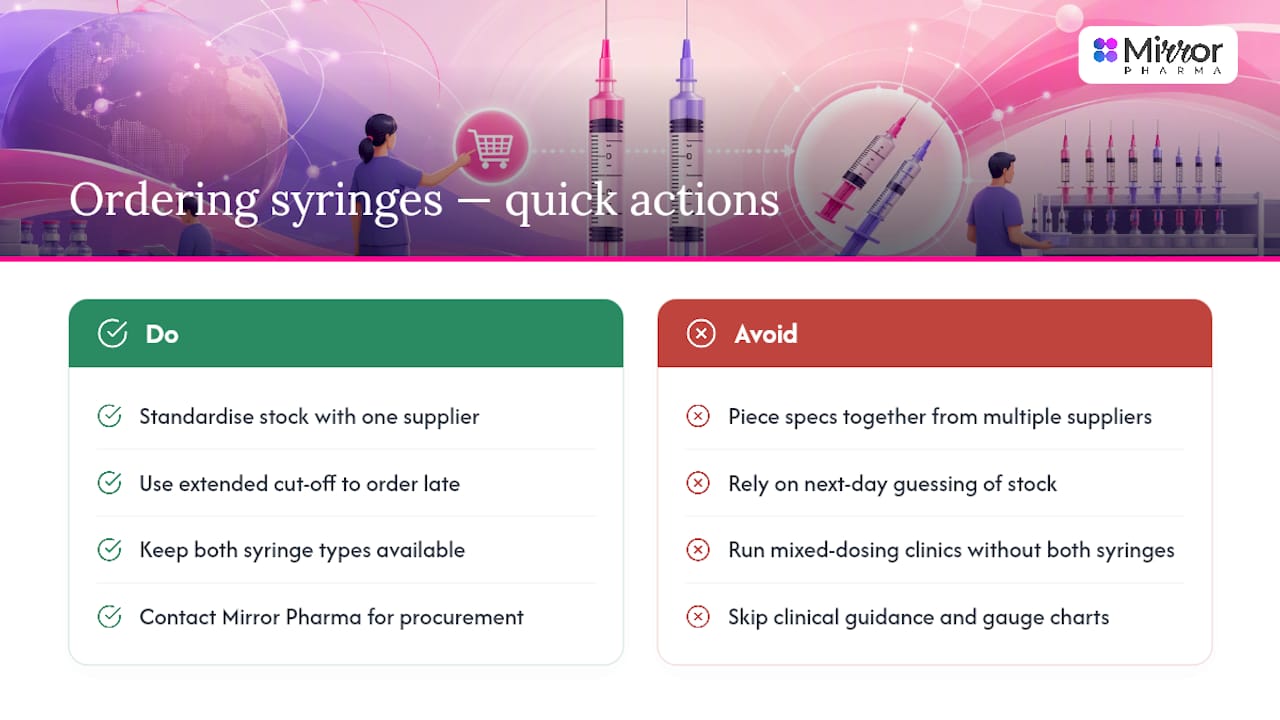
Getting the right syringe on the shelf before the mix-up happens is the whole point of this comparison. Mirror Pharma supplies syringes, needles and consumables for licensed practitioners, alongside clinical reference material such as the needle gauge chart and guidance comparing IV and IM injection routes, so clinics can standardise their stock against a single trusted source rather than piecing together specifications from multiple suppliers.
Extended order cut-off times mean practitioners placing orders later in the day still see stock arrive in time for the next clinic list, which matters when a mixed-dosing clinic needs both insulin-calibrated and tuberculin syringes on hand simultaneously. Browse current syringe and needle supplies or get in touch with the Mirror Pharma team directly for procurement queries on stocking a clinic that runs both insulin therapy and skin testing.
This article is general information, not a substitute for advice from a qualified doctor. Consult a qualified healthcare professional about your own circumstances before acting on anything here.
Sources
- Administration of insulin and insulin delivery methods — NCBI Bookshelf
- Overdoses caused by confusion between insulin and tuberculin syringes — PA‑PSRS advisory
- The difference between insulin syringes and standard syringes — Charles Medical (UK)
- Insulin syringe sizes — Healthline
FAQ
Can I use an insulin syringe for a tuberculin test?
No. An insulin syringe is graduated in units, not the fine millilitre increments a tuberculin test needs, and using one risks an inaccurate, non-standard dose for the skin test.
Why are they called tuberculin syringes?
The name comes from their original and still primary use: administering tuberculin (PPD) for the Mantoux skin test, which requires exact intradermal volumes as small as 0.01 mL.
What are the two types of insulin syringes?
Insulin syringes are generally distinguished by capacity and unit markings, most commonly 0.3 mL (30 units), 0.5 mL (50 units) and 1.0 mL (100 units), all calibrated for U100 insulin at 100 units per millilitre.
What is a tuberculin syringe used for?
It is used for intradermal skin tests, such as the Mantoux tuberculin test and some allergy testing, and occasionally for other precise small-volume injections where a millilitre scale is more appropriate than a unit scale.
Is it ever safe to convert between unit and millilitre scales?
Only with independent verification by a second qualified professional. Manual conversion between insulin units and millilitres is a documented cause of tenfold dosing errors, so relying on mental maths alone is not an acceptable safety margin.