
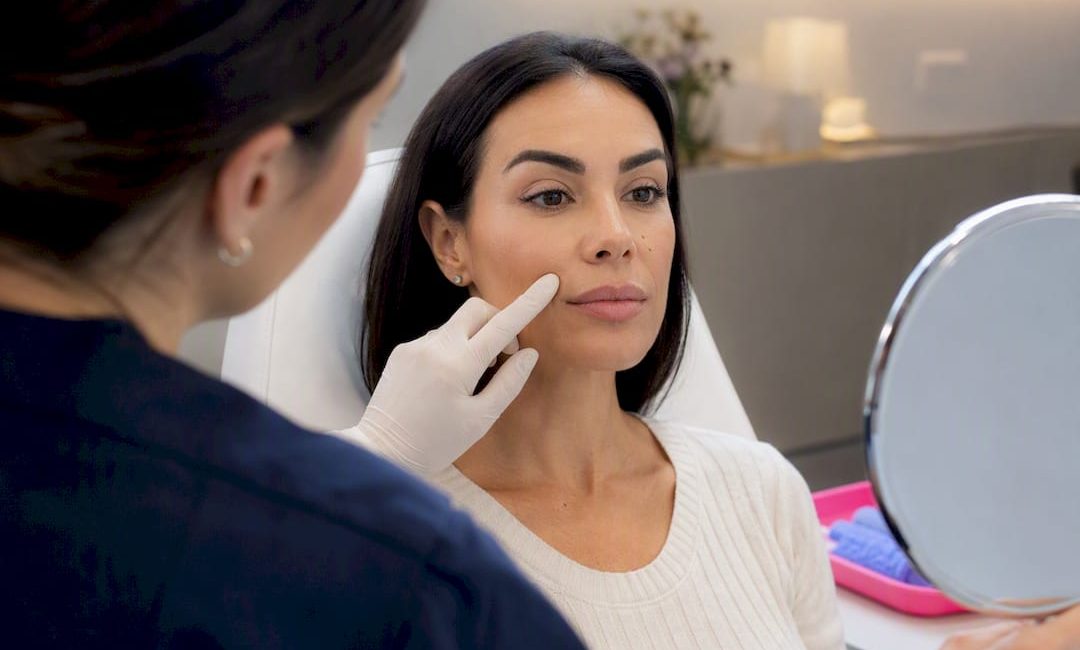
Neither hyaluronic acid filler family beats the other outright. What decides the outcome is the specific product within that family, the facial zone being treated and the skill of the practitioner selecting it. Both families are hyaluronic acid gels and both are reversible with hyaluronidase, so the sensible next step for anyone weighing this up is a consultation with a qualified aesthetic practitioner, not a brand allegiance.
TL;DR:
- Product-specific formulation and plasticity, not brand, determine outcomes; a gel’s cohesivity, firmness, and water attraction are key for different facial zones.
- Hyaluronic acid fillers are reversible with hyaluronidase, but treatment safety relies on practitioner skill, proper zone matching, and emergency preparedness.
- Deeper structural areas like cheeks and jawline require firmer G′ gels placed near bone, whereas lips need softer, more flexible formulas for natural movement.
- Results and longevity depend on injection depth, product type, and patient metabolism, with structural fillers lasting up to 24 months and lip fillers typically under 12 months.
- Consistent access to the right formulation from trusted suppliers is more important for quality outcomes than choosing between Juvederm or Restylane brands.
Table of Contents
- Juvederm vs Restylane: what “family” actually means
- How cross-linking technology changes the way these gels behave
- Which product properties matter for each facial zone?
- How long do results actually last?
- What are the safety risks and who should avoid treatment?
- How do practitioners decide between products?
- Cost comparison and what actually drives the price
- Do patients report better results with one family over the other?
- What formulations exist within each range, and what are they for?
- Planning touch-ups and repeat treatments
- A publisher’s perspective on choosing between filler families
- Where licensed practitioners can source these formulations reliably
- Sources
- FAQ
Juvederm vs Restylane: what “family” actually means
Talking about hyaluronic acid filler brands as if they were single products is where most comparisons go wrong. Each brand is really an umbrella covering a dozen or more distinct formulations, each engineered for a different depth, movement pattern and volume of tissue. A firmer, particulate gel designed for cheekbone projection behaves nothing like a softer product from the same range designed for lips. Comparing “the brand” tells you almost nothing useful; comparing the specific product against the treatment zone tells you everything.
Both families sit in the hyaluronic acid category, which matters clinically for one big reason: hyaluronic acid gels can be broken down with the enzyme hyaluronidase if the result is unsatisfactory or if a vascular complication occurs. That reversibility is a meaningful safety advantage over older, permanent filler materials, though it should never be read as a guarantee of a risk-free or fully predictable outcome.
For licensed practitioners and qualified aesthetic professionals, a few practical points frame every consultation:
- All hyaluronic acid dermal fillers referenced here are prescription-only medical devices requiring a trained, registered injector.
- Treatment sessions typically run 15 to 45 minutes depending on the zone and number of syringes used.
- Immediate swelling and mild bruising are common and usually settle within a few days to two weeks.
- Reversibility with hyaluronidase is a shared safety feature across the hyaluronic acid category, not a brand-specific benefit.
How cross-linking technology changes the way these gels behave
The clinical differences between filler families trace back to how the hyaluronic acid molecules are cross-linked during manufacturing. One approach uses platforms such as VYCROSS and Hylacross, which tend to produce smoother, more cohesive gels with lower water uptake once injected. The other relies on NASHA and XpresHAn-style platforms, producing gels that range from firmer and more particulate to noticeably flexible, depending on the specific product in the range.
These manufacturing choices show up clinically in three measurable properties practitioners actually discuss at the point of selection:
- Cohesivity describes how well the gel particles hold together as a single mass rather than spreading through tissue. Higher cohesivity tends to suit precise, structural placement.
- G′ (elastic modulus) is a measure of gel firmness. Higher G′ gels resist deformation and are chosen for lift and projection over bone; lower G′ gels sit softly in mobile tissue such as lips.
- Hydrophilicity refers to how much water the gel attracts after injection. More hydrophilic gels can swell further over the days following treatment, which matters enormously in delicate areas like the tear trough.
NCBI/PubMed literature on filler rheology makes clear that these physical properties, not brand identity, are what predict clinical outcome. A firmer, high G′ gel will lift and project. A softer, low G′ gel will integrate and move naturally. A highly hydrophilic gel will draw in water after placement, sometimes producing delayed puffiness that alarms patients unfamiliar with the phenomenon.
Pro Tip: Ask your supplier or product literature for the G′ value and hydrophilicity profile of a specific syringe, not just the family name. Two products from the same brand can behave completely differently once injected.
The practical upshot: gel behaviour, not the logo on the box, should drive product selection. A practitioner picking purely by brand loyalty is skipping the step that actually determines whether the patient gets natural movement or unwanted stiffness.
Which product properties matter for each facial zone?
Anatomy dictates the ideal filler characteristics far more reliably than brand preference. Here is how practitioners typically map product properties onto specific zones.
- Cheeks and jawline need higher G′ gels capable of resisting the pull of facial muscles and gravity. Placement is usually supraperiosteal or deep subcutaneous, close to bone, where a firm, cohesive gel gives structural lift without migrating.
- Lips call for low-to-mid G′, more pliable gels that move with speech and expression rather than sitting rigidly. Overly firm gels in this zone tend to feel lumpy under the fingers and look unnatural when the mouth moves.
- Tear trough is the most technically demanding zone on the face. It needs minimal hydrophilicity and low bulk, because this thin-skinned area shows even small amounts of water uptake as visible puffiness days after treatment.
- Nasolabial folds and marionette lines generally respond well to mid-G′ products with enough flexibility to soften a static fold while still tolerating the constant movement around the mouth.
- Temples and hands often benefit from higher-volume, supportive gels placed deep, since both areas involve replacing lost structural volume over a broader area rather than fine contouring.
Some Restylane XpresHAn-range formulations were specifically engineered to flex with facial animation, which is one reason some practitioners favour them where preserving natural expression is the priority, particularly around the lower face and lips.
A useful rule practitioners apply at the chair: firmer, particulate gels go on bone for structural lift; smoother, higher-cohesivity gels go into superficial, mobile tissue where integration and pliability matter more than projection. That single distinction resolves most of the “which product” debate before brand ever enters the conversation.
Patient-facing comparisons, including Healthline’s review of the two filler families, consistently note that swelling profile and onset speed differ more by individual product than by brand overall, reinforcing why zone-specific product selection outperforms a blanket family choice.
How long do results actually last?
Longevity varies far more by product type and injection depth than by which family supplied the gel. Deeper volumising products placed against bone tend to last longest, sometimes reported up to around 18 to 24 months in favourable cases, while lip and fine-line products metabolise faster, commonly lasting under 12 months.
Several factors shift where an individual patient lands within those ranges:
- Metabolic rate varies between patients and speeds up or slows down how quickly the body clears hyaluronic acid.
- Dose and volume injected at the initial session affects how long there is material left to break down.
- Placement depth matters because deeper, structural placements generally persist longer than superficial ones.
- Muscle activity in the treated zone, particularly around the mouth, accelerates gel turnover compared with the relatively static cheek or jawline.
Dissolution with hyaluronidase also differs by gel type. Clinic-level observation suggests some of the more cohesive, higher G′ gels require more enzyme in practice to dissolve completely compared with softer, more hydrophilic products, which is a relevant consideration for practitioners planning correction or emergency management.
What are the safety risks and who should avoid treatment?
Common reactions are similar across both hyaluronic acid families and generally resolve without intervention: bruising, localised swelling, tenderness and small palpable lumps in the days following treatment. These typically settle within one to two weeks.
Rarer but more serious complications include infection at the injection site, delayed inflammatory nodules, and vascular occlusion, where filler is inadvertently injected into or compresses a blood vessel. Vascular occlusion is uncommon but requires immediate recognition and treatment, which is precisely why hyaluronidase must be on hand at every injection appointment.
Medscape’s clinical reference on hyaluronic acid fillers sets out the standard contraindications practitioners must screen for before any treatment:
- Known hypersensitivity to hyaluronic acid or to lidocaine where the formulation includes it.
- Active infection or inflammatory skin condition at the proposed injection site.
- Pregnancy or breastfeeding, where treatment is generally deferred as a precaution.
- Bleeding disorders or current use of blood-thinning medication, which raises bruising and haematoma risk.
- A history of keloid or hypertrophic scarring, which warrants caution and a frank discussion of risk.
Pro Tip: Never treat without hyaluronidase and an emergency protocol immediately accessible. Vascular occlusion can progress within hours, and delayed recognition is the single biggest driver of poor outcomes in filler complications.
The American Society of Plastic Surgeons’ procedural overview reinforces that outcome safety rests on practitioner training and patient screening at least as much as on which product is chosen.
How do practitioners decide between products?
A competent consultation follows a fairly consistent assessment flow, regardless of which brand ends up on the tray. The practitioner examines facial anatomy and skin quality, watches how the area moves during expression, discusses the patient’s desired degree of projection versus subtlety, and sets realistic expectations about maintenance and retreatment intervals.
Patients can steer this conversation productively by asking a few direct questions:
- Which specific product, not just which brand, are you planning to use, and why for this zone?
- What is the expected swelling timeline, and when should I expect to see the final result?
- How will you manage it if I’m unhappy with the result or a complication occurs?
- How many syringes do you anticipate needing, and how does that affect the plan?
A practitioner should postpone treatment or refer to a specialist colleague when a patient presents with unclear anatomy, active skin infection, unrealistic expectations that can’t be met safely, or signs of body dysmorphic concern that go beyond routine cosmetic interest.
Cost comparison and what actually drives the price
Product pricing for prescription-only medicines cannot be discussed publicly here, and rightly so. That said, the factors that drive overall treatment cost are worth understanding regardless of which family a practitioner selects. Total cost depends primarily on the number of syringes required, the complexity and skill level demanded by the zone being treated, and the practitioner’s own experience and clinic overheads, far more than on any inherent price gap between hyaluronic acid families.
Deep structural work such as cheek or jawline contouring typically requires more product volume than a single-zone lip or nasolabial fold treatment, which is usually the biggest driver of the final bill patients see. Clinics operating in higher-cost regions or with more senior injectors also tend to price sessions higher, independent of which manufacturer supplied the syringe.
For practitioners themselves, the commercial consideration is less about brand markup and more about consistent, timely supply. A clinic that can’t source a specific formulation reliably ends up substituting on the fly, which undermines the zone-specific planning outlined earlier in this piece. Working with a supplier that maintains stable stock across multiple ranges and formulations matters more to long-term outcomes than chasing marginal price differences between comparable products.
Do patients report better results with one family over the other?
Large-scale, brand-level satisfaction comparisons are surprisingly thin on the ground, and for good reason: satisfaction tracks far more closely with correct product-to-zone matching and injector skill than with brand. Clinical literature comparing hyaluronic acid filler outcomes consistently points to rheological properties and placement technique as the dominant variables in patient-reported results, not the manufacturer.
Where patient feedback does show a consistent pattern, it tends to relate to onset and swelling rather than final aesthetic result. Some formulations settle visibly faster than others in the first week, and patients who aren’t warned about this timeline in advance are more likely to report early dissatisfaction that resolves on its own within days. Practitioner communication about what to expect in the first 48 to 72 hours does more for reported satisfaction than the underlying chemistry.
Restylane reviews and Juvederm-focused feedback both show the same split: patients treated in the correct zone with an appropriately matched product report high satisfaction, while patients treated with a mismatched product, regardless of brand, report firmness, lumpiness or unnatural movement. That pattern alone should tell a prospective patient more than any brand-level statistic could.
What formulations exist within each range, and what are they for?
Both major hyaluronic acid families offer several distinct formulations rather than a single one-size-fits-all product, and knowing the difference matters when discussing options with a practitioner.
Within the Juvederm range, formulations vary by cross-linking density and water content, spanning fine-line products intended for superficial lines through to firmer, high-lift options intended for cheek and jaw projection. A commonly stocked example used across UK clinics is Juvederm Ultra 2 with Lidocaine, typically reserved for finer lines and lighter volumising work.
The Restylane range spans a similarly broad spread. Softer, hydrating formulations such as Restylane Vital Light with Lidocaine suit fine superficial lines and general skin hydration work, while lip-specific products like Restylane Kysse with Lidocaine are engineered for the flexibility lips demand. At the firmer end, Restylane Volyme with Lidocaine is built for deeper volumising work in cheeks and jawline, and the standard Restylane with Lidocaine formulation covers a range of general contouring indications.
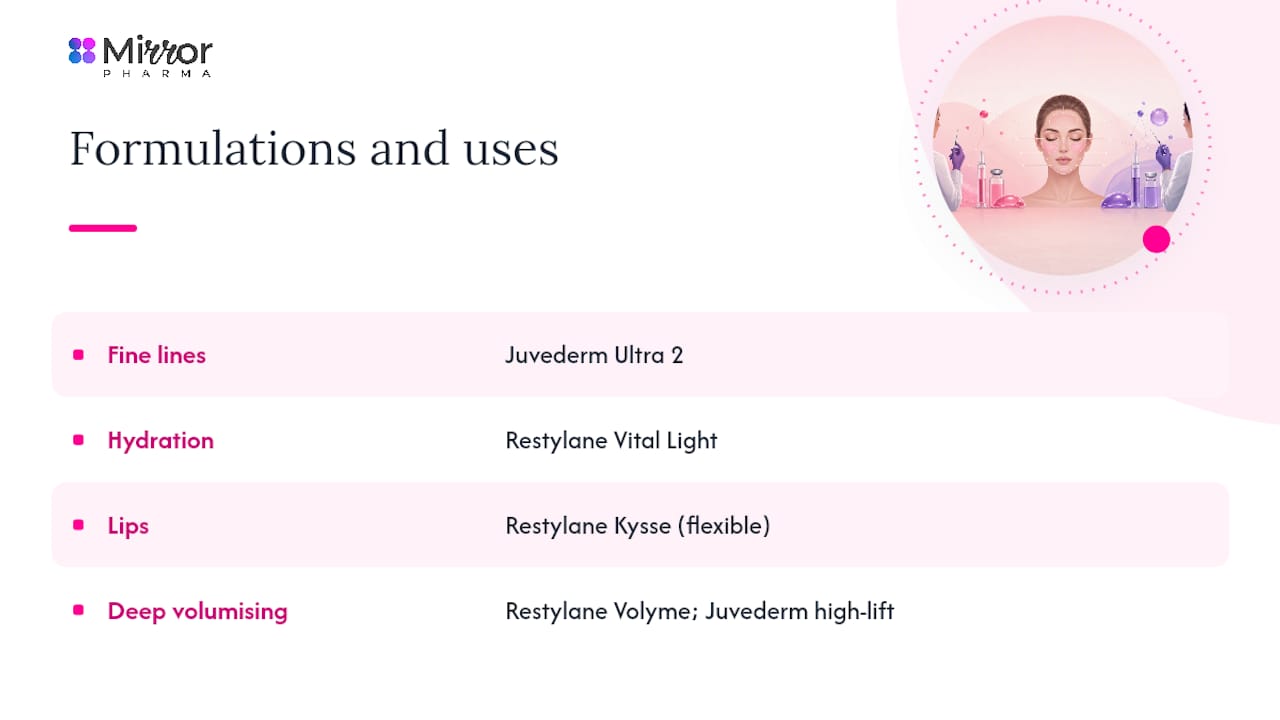
The lesson repeats itself: the formulation within the range, matched correctly to the zone, decides the outcome far more than which brand supplied it.
Planning touch-ups and repeat treatments
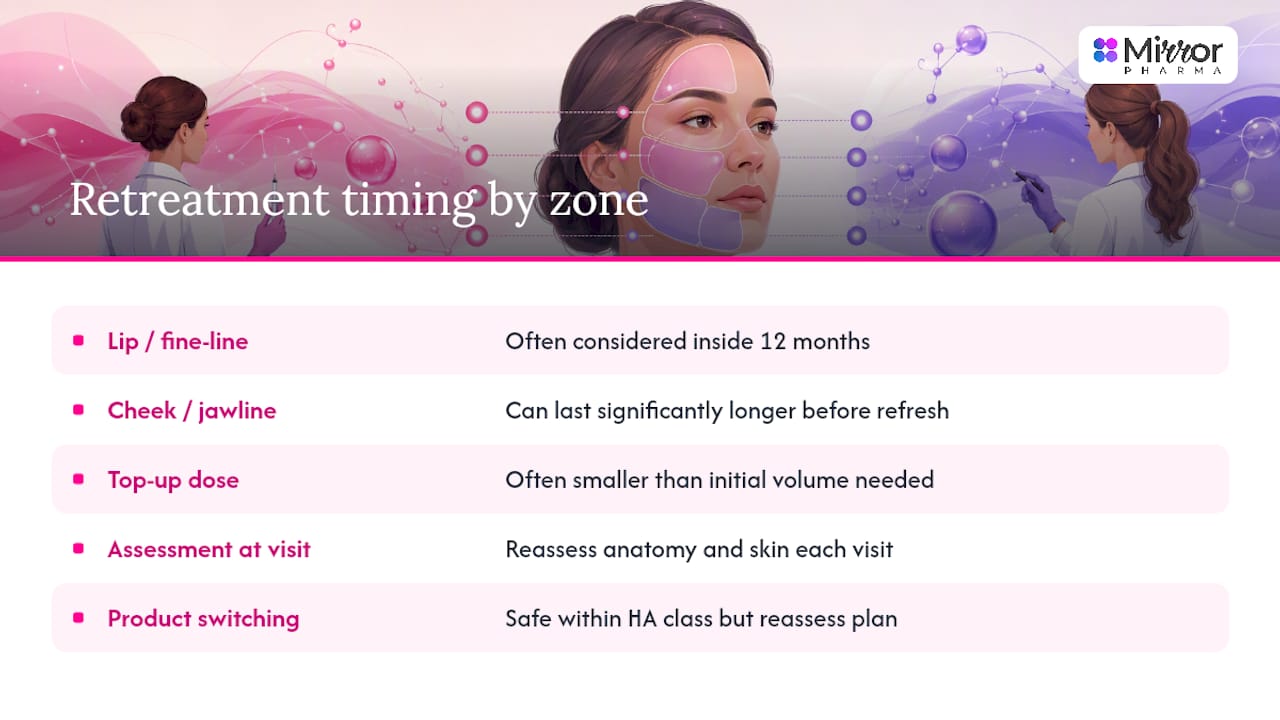
Retreatment planning should start at the very first consultation, not months later when the initial result has faded. Because lip and fine-line products metabolise faster than deep volumisers, patients treated in those zones should expect a shorter interval before a touch-up is worth considering, often inside the 12-month mark, while structural cheek or jawline work can often go significantly longer before needing refreshment.
Repeat sessions are rarely a simple repeat of the first treatment. Tissue response to hyaluronic acid can change slightly with each session as some residual product typically remains at the injection site, meaning a smaller top-up dose sometimes achieves what the initial treatment needed more volume to reach. Practitioners should reassess anatomy and skin quality at every repeat visit rather than assuming the original plan still applies unchanged.
Patients considering a different product family at their next session, having tried one initially, should be told plainly that switching is generally safe within the hyaluronic acid category, but the practitioner needs to reassess from scratch rather than simply substituting one syringe for another under the same plan. Consistency of supply matters here too. A clinic that can reliably source the same or comparable formulation session after session gives patients a more predictable retreatment experience than one that substitutes products based on whatever happens to be in stock that week.
A publisher’s perspective on choosing between filler families
The debate over which brand is “better” misses what actually protects patients: rigorous practitioner training, correct product-to-zone matching, and dependable access to genuine product for the clinicians doing the work. There are suppliers that serve as the final link in the chain, providing licensed practitioners and training academies with verified, traceable stock so the clinical decision-making described throughout this piece can actually happen on time. Every product referenced here remains prescription-only, restricted to trained, registered professionals, and subject to the same GDC professional standards that govern scope of practice across the UK.
— Rizwan
Where licensed practitioners can source these formulations reliably
Everything covered above, from G′ values to zone-specific product matching, only translates into good patient outcomes if a clinic can actually get the right syringe on the day it’s needed. This role is critical for UK practitioners: ensuring verified hyaluronic acid filler stock across multiple ranges, extended order cut-off times built specifically around clinic scheduling pressure, and a straightforward online ordering process that doesn’t leave injectors substituting products at the last minute.
Whether a clinic is stocking firmer volumisers for cheek work or softer, pliable formulations for lips, having dependable access to the specific product a treatment plan calls for matters more than any brand preference discussed earlier in this piece. Qualified aesthetic professionals and training academies can review current stock and place verified orders directly through the Mirror Pharma product range, with compliance checks built into the account verification process before any prescription-only item ships.
This article is general information, not a substitute for advice from a qualified doctor. Consult a qualified healthcare professional about your own circumstances before acting on anything here.
Sources
- Restylane, Juvederm (hyaluronic acid, non-animal stabilized) dosing, indications, interactions, adverse effects, and more
- NCBI / PubMed review on dermal filler rheology and outcomes
- ASPS dermal fillers procedure overview
- Juvederm vs. Restylane: Comparing the Dermal Fillers (Healthline)
FAQ
What are the downsides of Restylane?
Reported downsides mirror those of hyaluronic acid fillers generally: temporary bruising, swelling and palpable lumps, with rarer risks including infection or vascular complications if injected incorrectly. Specific formulations with higher hydrophilicity can also show more noticeable early swelling in delicate areas such as the tear trough.
What is the best type of dermal filler?
There is no single best type; the right choice depends on matching a product’s firmness, cohesivity and water uptake to the specific facial zone and the patient’s anatomy. A firmer, high G′ gel suits structural lift on bone, while a softer, low G′ gel suits mobile tissue like the lips.
Is Juvederm dermal filler worth it for patients?
Value depends entirely on correct product selection and practitioner skill rather than the brand itself, since satisfaction correlates most strongly with zone-appropriate matching. Patients treated with a mismatched product, regardless of brand, are more likely to report unnatural results.
What is better than Restylane?
No single hyaluronic acid filler family is universally better than another; outcomes depend on the specific formulation, the facial zone and the injector’s technique. Practitioners typically select whichever product’s rheology, cohesivity and hydrophilicity best suit the treatment area rather than defaulting to one brand across every zone.